Emitwise’s Series A deck is a departure from traditional slide design, utilizing a layout that mirrors a Notion document or a structured web page. Across only 6 slides, the company establishes a high-level mission to accelerate the transition to a net-zero carbon world. While the version made public is heavily redacted—removing specific ARR targets, customer counts, and financial figures—it successfully communicates a product-led strategy focused on automating Scope 1, 2, and 3 emissions tracking. The deck relies on a 'Current State' snapshot from May 2020 to demonstrate resilience during COV…
Key takeaways
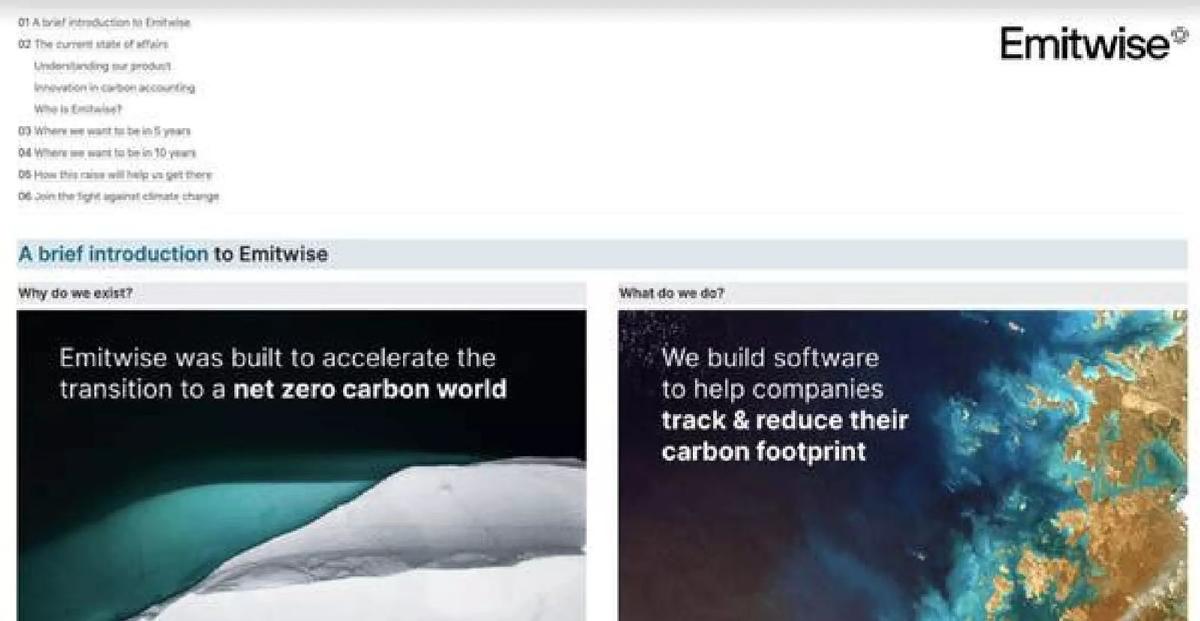
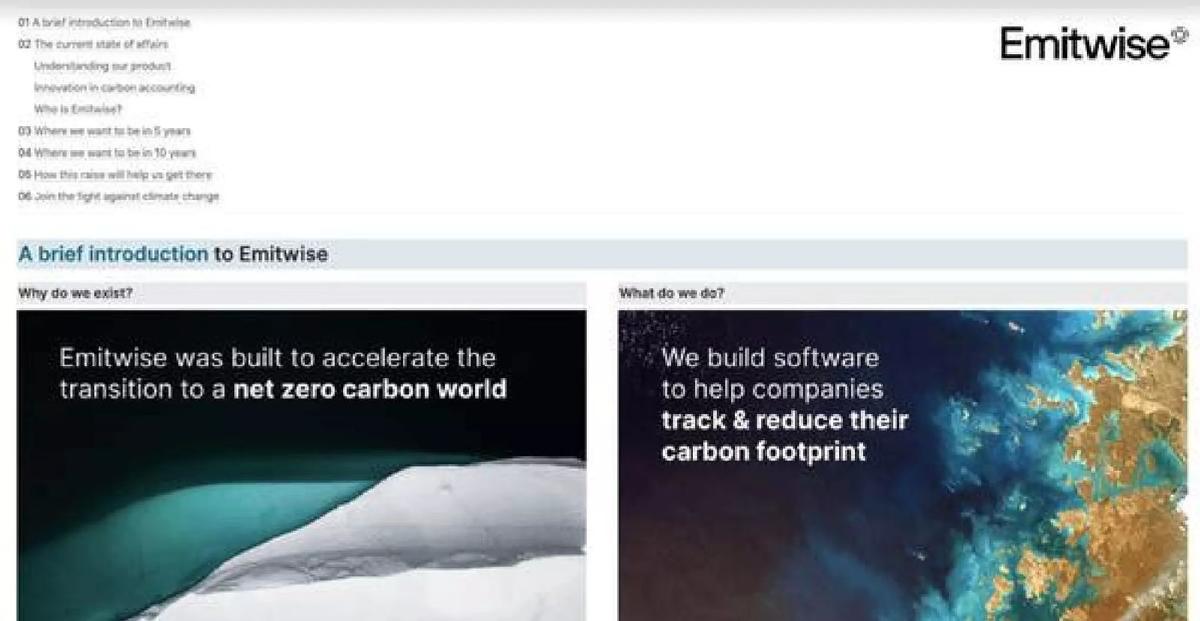
- The deck uses a non-traditional document-style layout rather than standard presentation slides (Slide 1).
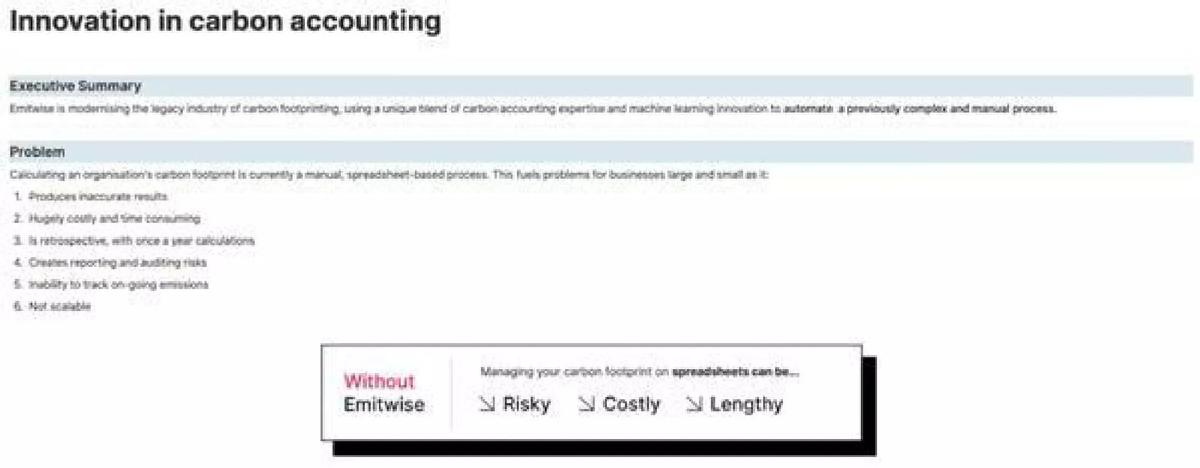
- Emitwise positions itself as an automation layer for the 'legacy industry' of manual, spreadsheet-based carbon footprinting (Slide 6).
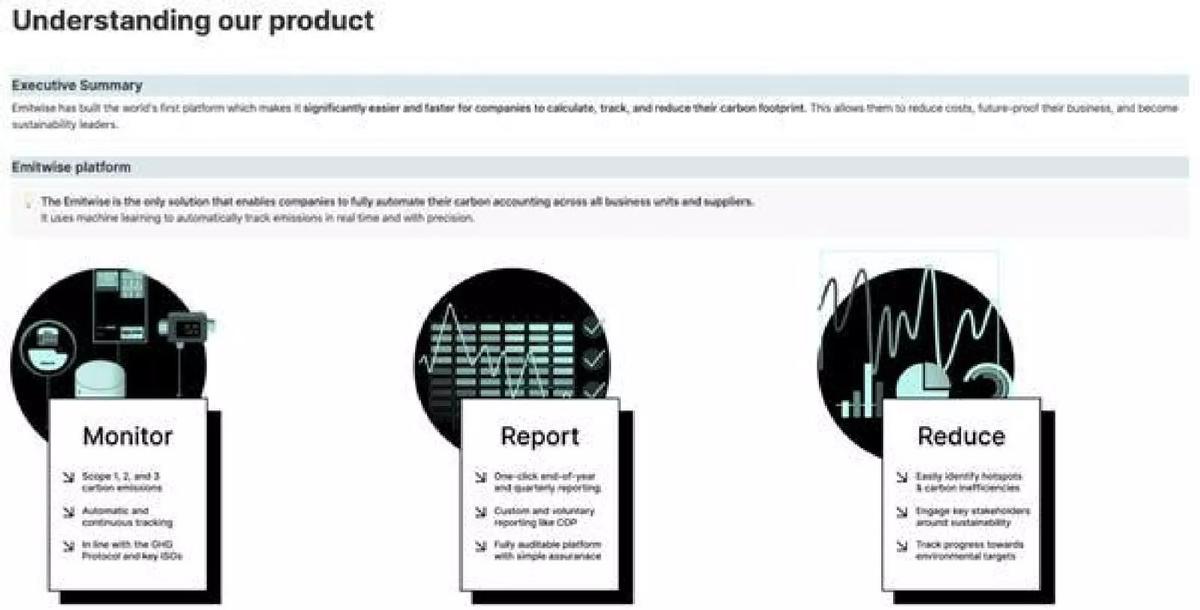
- The platform covers the full lifecycle of carbon management: Monitor, Report, and Reduce (Slide 5).
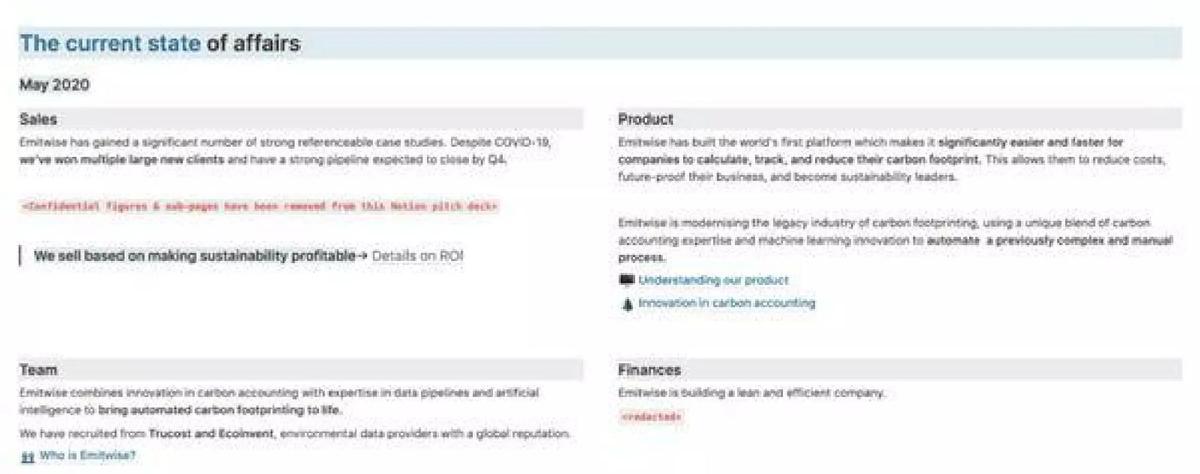
- A 'Current State' slide from May 2020 highlights that the company won multiple large clients despite the COVID-19 pandemic (Slide 2).
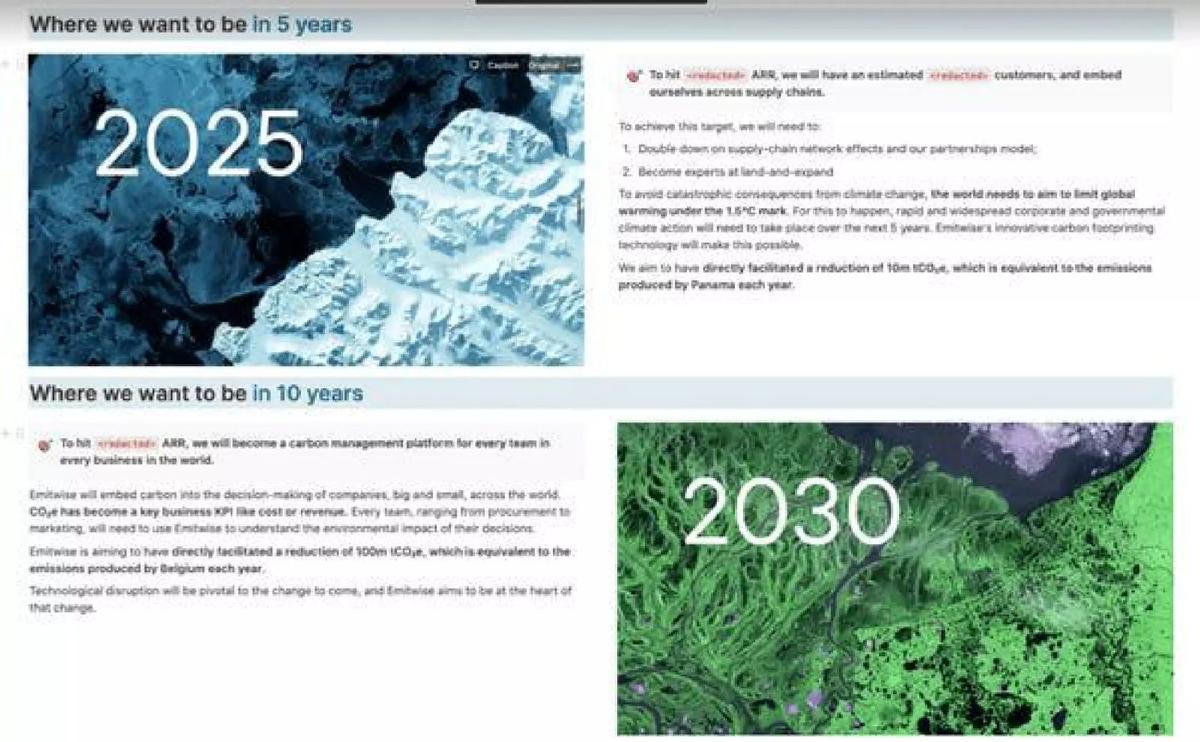
- The company sets a 5-year goal to facilitate a reduction of 10m tCO2e, equivalent to the annual emissions of Panama (Slide 3).
- The 10-year vision scales this impact to 100m tCO2e, equivalent to the annual emissions of Belgium (Slide 4).
- The product is designed to handle Scope 1, 2, and 3 emissions in line with the GHG Protocol and ISO standards (Slide 5).
- The deck mentions recruiting from established environmental data providers Trucost and Ecoinvent to bolster credibility (Slide 2).
The Anatomy of a Mission-Driven Climate Tech Pitch
The Emitwise deck is an interesting artifact from the 2019-2020 era of climate tech fundraising. Rather than a standard 15-20 slide deck, this 6-slide summary presents a high-level narrative. It is structured more like a briefing document than a visual presentation, which suggests it may have been used as a 'leave-behind' or a pre-read for investors. The company, which raised $16.5 million in Series A funding, focuses heavily on the transition from manual processes to automated AI systems.
Slide 1: Introduction and Mission
The opening slide serves as a table of contents and a mission statement. It establishes two fundamental questions: 'Why do we exist?' and 'What do we do?'. The answers are direct: to accelerate the transition to a net-zero carbon world by building software that helps companies track and reduce their carbon footprint. The visual style is minimalist, using high-quality environmental imagery to anchor the 'Why' in the physical reality of climate change.
Slide 2: The Current State of Affairs (May 2020)
This slide provides a snapshot of the company's health during a specific moment in time. It is divided into four quadrants: Sales, Product, Team, and Finances. Sales: The company claims to have won 'multiple large new clients' despite the COVID-19 pandemic and points to a strong pipeline for Q4. Product: It describes the platform as the 'world's first' to automate carbon footprinting. Team: Instead of individual bios, it highlights the pedigree of the staff, noting recruits from Trucost and Ecoinvent . Finances: This section is almost entirely redacted, though it notes the company is 'lean and efficient.' This slide is critical because it addresses the 'Why Now?' and 'Why You?' questions simultaneously.
Slide 3: The 5-Year Vision (2025)
Slide 3 looks forward to 2025. While the ARR and customer count figures are redacted, the strategic goals are clear. Emitwise plans to 'double down on supply-chain network effects' and 'become experts at land-and-expand.' The environmental impact goal is quantified: a reduction of 10m tCO2e , which the slide helpfully contextualizes as being equivalent to the annual emissions of Panama. This use of a geographic equivalent helps investors visualize the scale of the impact beyond just a number on a page.
Slide 4: The 10-Year Vision (2030)
The 10-year outlook shifts from a specific product to a global infrastructure play. The goal is to become a 'carbon management platform for every team in every business in the world.' The impact target increases tenfold to 100m tCO2e , equivalent to the annual emissions of Belgium. The slide argues that carbon (CO2e) will become a 'key business KPI like cost or revenue,' suggesting that Emitwise intends to be the ERP or accounting system for the carbon era.
Slide 5: Understanding the Product
This slide provides the most technical detail in the deck. It breaks the Emitwise platform into three functional areas: Monitor , Report , and Reduce .
Monitor: Focuses on Scope 1, 2, and 3 emissions with automatic and continuous tracking in line with the GHG Protocol. · Report: Offers one-click quarterly and end-of-year reporting, including custom reports for the CDP. · Reduce: Uses data to identify 'hotspots' and inefficiencies, allowing companies to engage stakeholders and track progress against targets.
The slide emphasizes that this is the 'only solution' that fully automates accounting across all business units and suppliers using machine learning.
Slide 6: Innovation in Carbon Accounting
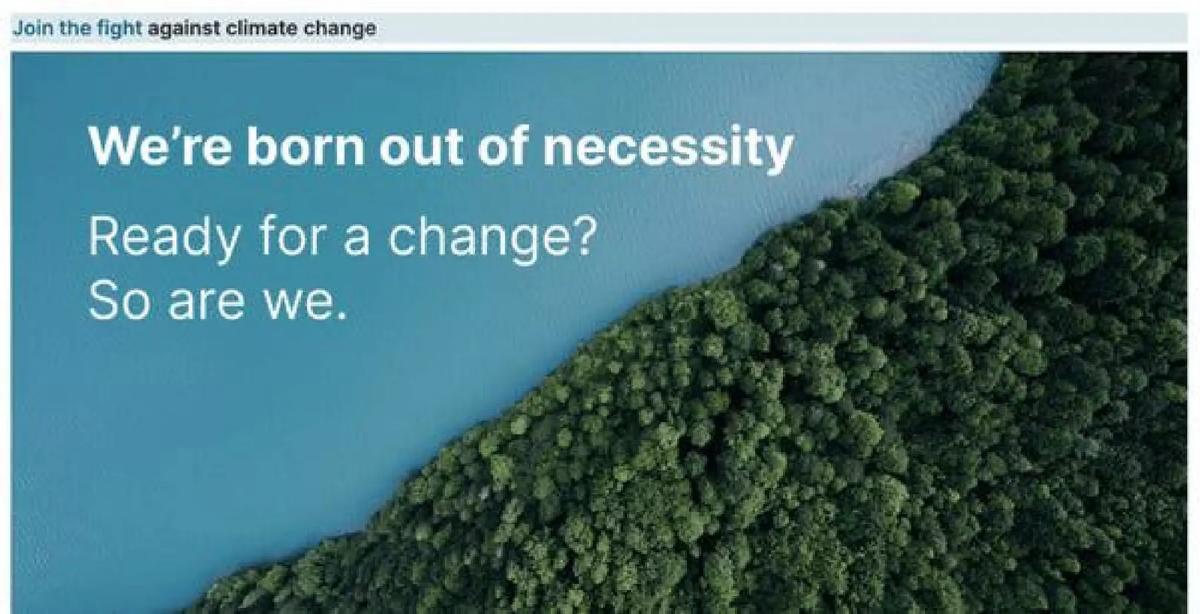
The final slide serves as the 'Problem' slide, though it appears at the end of the deck. It lists six specific pain points of the current 'legacy' industry: inaccuracy, high cost/time, retrospective nature, reporting risks, inability to track ongoing emissions, and lack of scalability. It positions the current manual spreadsheet-based process as 'Risky, Costly, and Lengthy.' The slide concludes with a call to 'Join the fight against climate change,' framing the investment as a necessity born out of the climate emergency.
What Works in the Emitwise Deck
Clear Value Proposition: The deck does an excellent job of contrasting the 'old way' (manual spreadsheets) with the 'new way' (automated AI). By labeling carbon accounting as a 'legacy industry,' Emitwise positions itself as a modern disruptor. Impact Benchmarking: Comparing CO2e reductions to the total emissions of countries like Panama and Belgium is a highly effective way to communicate scale to investors who may not be carbon experts. Resilience Narrative: Mentioning that they won large clients 'Despite COVID-19' on Slide 2 is a powerful signal of product-market fit and sales execution during a period of global economic uncertainty.
What is Missing
The Team: While the deck mentions recruiting from Trucost and Ecoinvent, it lacks a dedicated team slide with names, faces, and specific founder backgrounds. For a Series A, investors typically want to see the leadership's specific track record. The Competitive Landscape: The deck claims to be the 'world's first' and the 'only solution,' but it provides no market map or comparison against other carbon accounting startups or established ESG reporting software. Unit Economics and Financials: Because this version is redacted, there is no information on CAC, LTV, churn, or revenue growth rates. The Ask: There is no slide detailing how much capital is being raised (though we know from external data it was $16.5M) or how those funds will be deployed across hiring, R&D, or sales expansion.
What a Founder Should Copy
The 'Document' Style: If you are sending a deck ahead of a meeting, consider a layout that is easy to read on a screen. Emitwise’s use of clear headings and bulleted lists makes the information highly digestible. The Three-Pillar Product Framework: Breaking a complex software product into three simple stages (Monitor, Report, Reduce) is a classic and effective way to explain a workflow to non-technical users. Quantifiable Mission: Don't just say you want to 'save the planet.' Set specific, time-bound impact targets (e.g., 10m tCO2e by 2025) and provide context so the numbers have meaning.
Frequently asked questions
- What is the core problem Emitwise is solving?
- According to Slide 6, carbon accounting is currently a manual, spreadsheet-based process that is inaccurate, costly, and retrospective. Emitwise aims to replace this 'legacy' method with an automated, machine-learning-driven platform that provides real-time tracking and scalability, reducing the risks associated with annual reporting.
- How does Emitwise define its product functionality?
- On Slide 5, the product is broken down into three pillars: Monitor, Report, and Reduce. It tracks Scope 1, 2, and 3 emissions automatically, provides one-click and custom reporting (such as for the CDP), and helps companies identify 'hotspots' and carbon inefficiencies to drive actual emissions cuts.
- What are the company's long-term growth targets?
- The deck outlines two major milestones. By 2025 (Slide 3), the company aims to have reduced 10 million tonnes of CO2e. By 2030 (Slide 4), it intends to become a 'carbon management platform for every team in every business in the world,' targeting a reduction of 100 million tonnes of CO2e.
- What information is missing from this pitch deck?
- This version of the deck is heavily redacted. It lacks specific ARR figures, customer numbers, and financial details (Slides 2, 3, and 4). Additionally, there is no dedicated team slide with bios, no competitive landscape analysis, and no specific 'ask' detailing how the $16.5M would be allocated.
- How does Emitwise differentiate its team?
- While it lacks a traditional bio slide, Slide 2 notes that the team combines expertise in carbon accounting, data pipelines, and artificial intelligence. They specifically highlight that they have recruited talent from reputable environmental data providers like Trucost and Ecoinvent.