Emma’s pitch deck is a masterclass in product-led storytelling, prioritizing user experience and engagement metrics to validate its position in the crowded personal finance space. With 100,000 users and a 4.7-star iOS rating, the deck focuses on the 'financial friend' persona rather than just a utility tool. While the provided slides redact specific revenue and growth figures, the narrative clearly transitions from a simple budgeting app to a comprehensive financial hub, including crypto, investments, and bill switching. The roadmap outlines an aggressive global expansion strategy across the…
Key takeaways
- Emma positions itself as 'The abacus for the modern world,' focusing on a global market with initial footprints in the UK, US, and Canada (Slide 1).
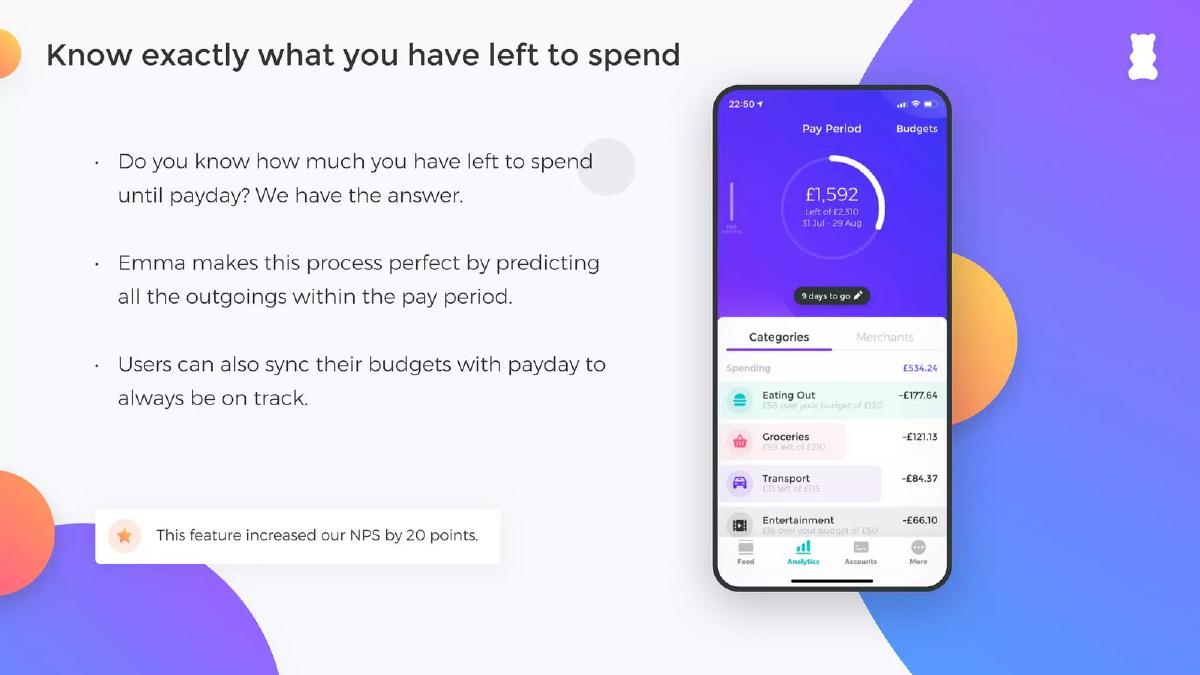
- The product emphasizes 'predicting all outgoings within the pay period,' a feature the company claims increased their NPS by 20 points (Slide 3).
- User acquisition is heavily driven by social sharing of 'smart insights,' turning spending data into shareable social content (Slide 4).
- Social proof is a core pillar of the deck, citing 1.5k iOS reviews with a 4.7/5 rating and an 'App of the Day' award from Apple (Slide 5).
- The company has successfully launched a subscription model, showing consistent growth in 'Active Subscribers' for the Emma Pro plan through August 2019 (Slide 7).
- Current traction stands at 100k users, achieved primarily through organic channels like word of mouth, referrals, and SEO (Slide 8).
- The team claims technical superiority in the banking API space, having integrated with TrueLayer, Saltedge, FinAPI, and Plaid (Slide 9).
- The roadmap outlines a transition into high-margin financial services, including bill switching, remortgaging, and credit scoring (Slide 10).
Emma Pitch Deck Teardown: The Product-First Fintech Play
Emma enters the personal finance management (PFM) market not as a spreadsheet tool, but as a consumer brand. In a space dominated by legacy banks and utilitarian budgeting apps, Emma’s deck focuses heavily on the 'how it feels' aspect of money management. By prioritizing design, social proof, and engagement metrics, the company attempts to prove that it has solved the retention problem that plagues most PFM apps.
Slide 1: The Vision
The title slide introduces Emma with the tagline 'The abacus for the modern world.' The background features a dotted world map with flags for Canada, the US, and the UK, immediately signaling that this is not a localized UK-only play. The branding is clean, utilizing a purple bear mascot that softens the often-intimidating nature of financial data. It sets a tone of accessibility and global ambition.
Slide 2: The Solution
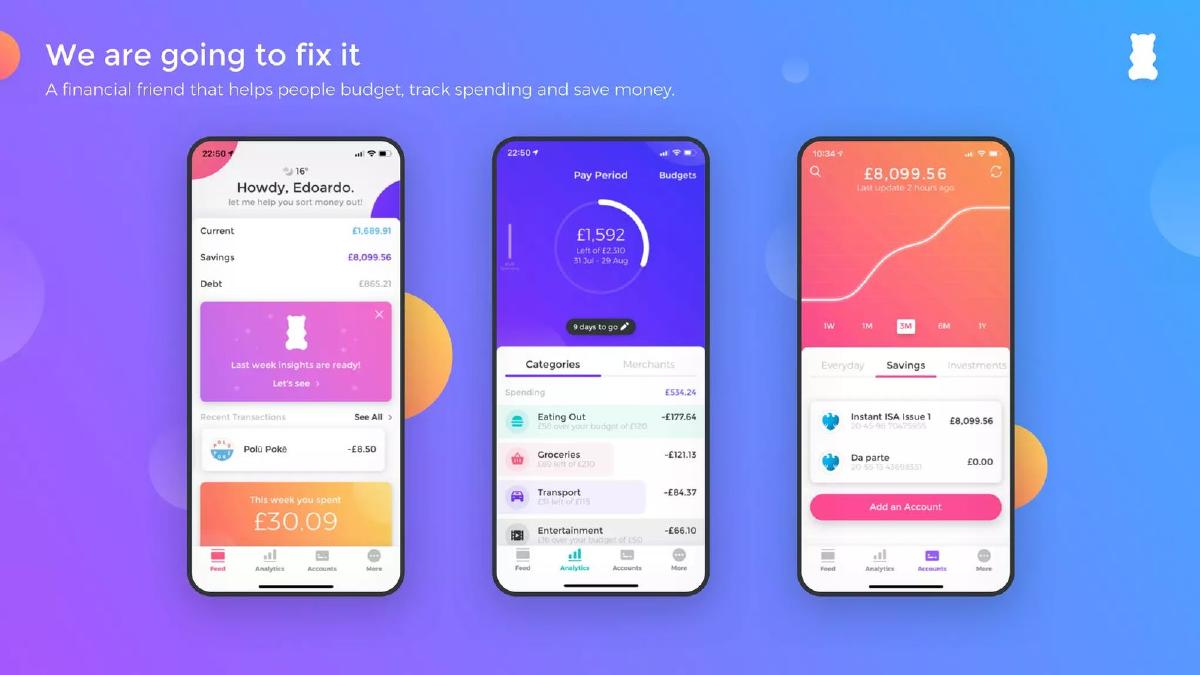
Titled 'We are going to fix it,' this slide defines Emma as a 'financial friend.' The use of the word 'friend' is a deliberate positioning choice against 'banks' or 'tools.' The slide showcases three high-fidelity mobile mockups: a dashboard showing current, savings, and debt balances; a 'Pay Period' budget tracker; and a consolidated view of savings and investments. The UI is bright, colorful, and clearly designed for a younger, mobile-native demographic.
Slide 3: Predictive Budgeting
Slide 3 focuses on a specific pain point: knowing how much is left to spend until payday. Emma claims to solve this by 'predicting all the outgoings within the pay period.' A significant data point here is the claim that this specific feature increased their Net Promoter Score (NPS) by 20 points. This is a strong way to demonstrate that the product features are directly tied to user satisfaction.
Slide 4: Engagement and Virality
This slide addresses one of the hardest problems in PFM: keeping users coming back. Emma uses 'Smart insights' that are described as 'fun and engaging.' The example shown is a gamified insight comparing a user's spending at a specific merchant (Wasabi) to the rest of the user base. Crucially, the deck notes that these insights serve as an acquisition channel because users share screenshots of them on social media. This turns private financial data into a social currency, a rare feat in fintech.
Slide 5: Social Proof
Slide 5 is dedicated entirely to user sentiment. It features four 5-star reviews and highlights their 4.7/5 rating on iOS (1.5k reviews) and 4.5/5 on Android (753 reviews). The inclusion of the 'App of the Day' badge from Apple adds significant third-party validation. For a seed-stage company, this volume of positive feedback is a powerful indicator of product-market fit.
Slide 6 & 7: Growth and Subscriptions
Slide 6 shows a bar chart titled 'We never stopped growing.' While the axes are redacted in this version of the deck, the visual trend is a steady month-over-month increase in what appears to be total users or sessions. Slide 7 focuses on the 'Pro plan,' showing a line graph of 'Active Subscribers' from January '19 to August '19. The curve shows an accelerating upward trend, which is the primary evidence that users are willing to pay for the service.
Slide 8: Acquisition Strategy
Emma lists its current and future acquisition channels. Currently, they rely on 'Word of mouth,' 'In-App referrals,' 'SEO,' and 'Press' to reach 100k users. The 'Tomorrow' column introduces more aggressive tactics: payments to increase virality, a web dashboard for better SEO, and paid acquisition on Facebook and Apple. This shows a transition from purely organic growth to a scalable, multi-channel marketing engine.
Slide 9: Execution and Technical Moat
This slide summarizes the achievements of the last 12 months. Key highlights include tripling their NPS, launching in the US and Canada in less than a month, and bringing crypto alongside traditional products. The team also makes a bold claim about their technical expertise, stating they have worked with every major banking API provider (TrueLayer, Saltedge, FinAPI, Plaid). This is intended to de-risk the technical execution for investors.
Slide 10: The Roadmap
The final slide in this set provides a 'clear roadmap' spanning from Q4 '19 to Q1 '21. It shows a strategic evolution from a budgeting app to a financial marketplace. Near-term goals include 'Bills Switching' and 'Remortgaging' (high-commission lead gen), while long-term goals include 'Emma for Biz' and expansion into Australia, New Zealand, South Africa, and South America. It paints a picture of a company aiming to be the central interface for a user's entire financial life.
What Works in This Deck
Product-Centricity: The deck does an excellent job of showing, not just telling. The high-quality mockups and specific feature-to-NPS correlations prove that the team understands their users. They aren't just building a database; they are building an experience.
Social Proof: In a crowded market, the 100k user milestone and high App Store ratings are the most convincing arguments for the company's viability. It proves they can cut through the noise and retain users better than the competition.
Strategic Monetization: The roadmap shows a clear path from a free utility to a high-margin financial services hub. By mentioning bill switching and remortgaging, they signal to investors that they understand how to turn a large user base into a profitable business.
What is Missing
Unit Economics: While the deck shows that the Pro plan is growing, it omits details on Customer Acquisition Cost (CAC) and Lifetime Value (LTV). For a consumer app, these metrics are vital to understanding if the business can scale profitably.
Competitive Landscape: The deck does not mention competitors like Mint, Yolt, or Revolut. Investors will inevitably ask how Emma differentiates itself from these giants, and a slide addressing this directly would have been beneficial.
Team Slide: The provided slides do not include a team overview. In a seed round, the founders' backgrounds are often as important as the product itself, especially when making claims about 'delivering faster than a team of 50 engineers.'
What a Founder Should Copy
The 'Social Sharing' Angle: Emma’s insight that financial data can be shareable social content is brilliant. Founders should look for ways to make their product’s output 'viral' by design, even in industries that are traditionally private.
Linking Features to Metrics: Instead of just saying 'we have a budgeting feature,' Emma says 'this feature increased our NPS by 20 points.' This level of specificity connects product development directly to business value.
Clean, Consistent Branding: The use of color, the bear mascot, and the consistent UI across all slides makes the company feel professional and 'big' even at the seed stage. It builds trust, which is the most important currency in fintech.
Frequently asked questions
- What is Emma's primary value proposition?
- Emma describes itself as a 'financial friend' designed to help users budget, track spending, and save money. Unlike traditional banking apps that simply list transactions, Emma uses predictive analytics to tell users exactly how much they have left to spend until their next payday, aiming to correct spending behaviors through engaging, shareable insights.
- How does Emma acquire new users without high marketing spend?
- According to slide 8, Emma relies on organic acquisition channels including word of mouth, in-app referrals, and SEO. A unique driver mentioned on slide 4 is the 'social sharing' of spending insights; users take screenshots of their personalized financial data and share them on social media, acting as a viral loop for the brand.
- What are the company's current revenue streams?
- As of the deck's publication, Emma has two active revenue streams: Emma Pro (a subscription service) and Emma Rewards. The roadmap on slide 10 suggests future monetization through high-intent financial lead generation, such as bill switching and remortgaging, as well as the introduction of 'Emma Gold' and business-focused accounts.
- What is Emma's technical advantage in the fintech space?
- Slide 9 asserts that 'no one knows more than us in the banking API space.' The company has integrated with major open banking providers including TrueLayer, Saltedge, FinAPI, and Plaid. They also highlight their development speed, claiming to deliver faster than a team of 50 engineers, which suggests a highly efficient, lean technical core.
- What geographic markets is Emma targeting?
- The deck shows an active presence in the UK, US, and Canada. The roadmap on slide 10 indicates a rapid global expansion plan, with launches scheduled for Australia, New Zealand, and South Africa in Q3 2020, followed by a South American launch in Q1 2021.