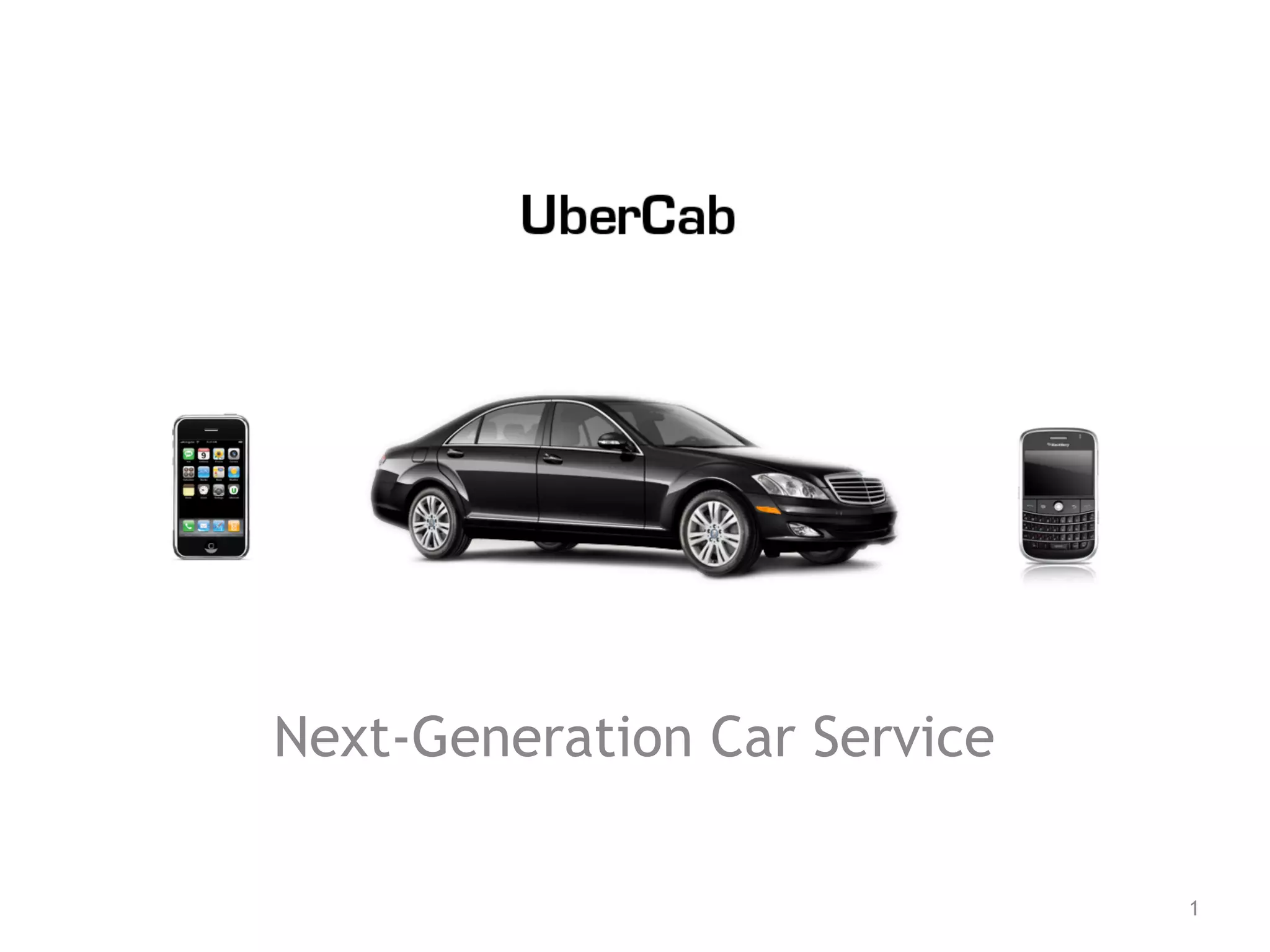
Uber’s original 2008 deck, then branded as UberCab, presents a vision for a 'Next-Generation Car Service' targeting professionals in American cities. The deck emphasizes luxury, efficiency, and a 'cashless billing system' to solve the frustrations of traditional taxi services in San Francisco and New York. While it lacks a team slide or detailed financial projections in this 9-slide subset, it clearly outlines a plan to use technology—specifically iPhone and Blackberry apps—to automate dispatch and optimize fleet response times. The strategy was initially built around high-end vehicles like t…
Key takeaways
- The original concept was positioned as the 'NetJets of car services,' focusing on luxury and professional chauffeurs (Slide 4).
- UberCab aimed to solve the convenience gap of NYC cabs combined with the experience of a professional chauffeur (Slide 4).
- Operating principles included a pre-paid, cashless billing system and being 'profitable by design' (Slide 7).
- Initial target vehicles were high-end luxury cars like the Mercedes S550 and Lexus GS450h, significantly outperforming the 14-16 mpg of existing fleets (Slide 13).
- Demand forecasting was a core technical pillar, with cars 'hovering' in statistically optimized positions to minimize pickup time (Slide 16).
- The expansion strategy focused on SF and NYC first, noting these cities plus five others covered 50% of the entire US market (Slide 19).
- Future optimizations included dynamic pricing, where 'get here now' would cost more than a scheduled booking (Slide 22).
- Progress as of late 2008 included a California LLC, a provisional patent, and 15 recruited clients (Slide 25).
UberCab: The 2008 Luxury Vision
The original UberCab deck is a fascinating artifact of the pre-gig-economy era. In 2008, the vision wasn't to replace car ownership or create a global logistics network; it was to fix the broken black car industry. The deck is minimalist, text-heavy, and focuses heavily on the operational inefficiencies of the status quo. It presents a solution that is as much about luxury and status as it is about software.
Slide 1: Title Slide
The title slide features the name 'UberCab' and the tagline 'Next-Generation Car Service.' Visually, it places a high-end Mercedes sedan between an iPhone and a Blackberry. This immediately signals the target demographic: professional workers who were early adopters of smartphone technology. The choice of the Mercedes S-Class reinforces the luxury positioning that would define the company's first few years.
Slide 4: UberCab Concept
This slide defines the core value proposition. It describes the service as 'fast & efficient on-demand car service' for 'Professionals in American cities.' The most telling bullet point is the comparison: 'Convenience of a cab in NYC + experience of a professional chauffeur.' By calling itself the 'NetJets of car services,' UberCab was positioning itself as a premium, fractional-utility model for the wealthy, not a budget alternative to the bus.
Slide 7: Operating Principles
Here, the founders outline the 'how' of the business. The principles include 'Luxury service on-demand' and a 'Modern and fuel-efficient fleet.' Crucially, they introduce the 'pre-paid, cashless billing system,' which would become one of Uber's most disruptive features. The slide also mentions being 'Profitable by design,' suggesting a focus on high margins per ride rather than the high-volume, low-margin strategy that came later.
Slide 10: Use-Cases
The use cases listed are highly specific to the lifestyle of a 2008 tech professional. They include 'Trips to/from restaurants, bars & shows,' 'Airport pickup/dropoff,' and 'Working while commuting (wifi in cars).' The mention of a '3 person rideshare to a South-Bay campus' is an early, albeit limited, nod to what would eventually become UberPool. Other cases like 'Dropping off Kids at School' and 'Elderly transport' show they were already thinking about broader demographic needs.
Slide 13: UberCab Fleet
This slide focuses on the hardware. For the SF Beta, they planned to use the Mercedes S550. They also highlight a planned shift to the S400 BlueHybrid in 2010 to achieve 30mpg. The competitive comparison is clear: existing fleets get 14-16 mpg, while UberCab's 'Standard' fleet (Lexus GS450h or E320) would get 23mpg. This was a pitch for operational efficiency through better asset selection.
Slide 16: Demand Forecasting
This is the most 'tech' slide in the deck. It features a heat map of a city (presumably San Francisco) and explains that cars will 'hover in statistically optimized positions.' The goal was to minimize pickup times by accounting for the 'hour of week & weather/traffic conditions.' This statistical approach to dispatch was the seed of the algorithmic routing that now powers the entire industry.
Slide 19: Target Cities
UberCab's expansion strategy was data-driven. They identified that focusing on just a handful of major cities—SF, NYC, LA, Chicago, Houston, PA, and Dallas—would cover 50% of the entire US market. They included a table citing 'Philip M. Parker, INSEAD, copyright 2008' showing the US Taxi and Limousine Service market at $4.3 billion. This slide proved the market was large enough to support a massive company even without total geographic coverage.
Slide 22: Future Optimizations
This slide hints at the future of the platform. It mentions 'Cheaper cars by buying used' and 'Less expensive hybrid vehicles (prius),' showing they knew the luxury-only model might have a ceiling. Most importantly, it introduces the concept of surge or tiered pricing: '“get here now” costs more than “tomorrow at 5pm”.' This is the early conceptualization of dynamic pricing based on urgency and demand.
Slide 25: Progress to Date
The final slide in this set lists the company's traction. As of late 2008, they had the domain, an SMS code, a California LLC, and an iPhone dev license application (dated Nov 28, 08). They had recruited 5 advisors and 15 clients. The 'NEXT' steps were modest: 'buy 3 cars, develop app, Feb 1st demo.' The funding ask was for 'a few million' to set up a small office and hire a General Manager in San Francisco.
What Works in This Deck
The deck is exceptionally clear about the problem it is solving: the friction of the traditional taxi experience. By focusing on a specific user (the professional) and a specific solution (luxury on-demand), it avoids the trap of trying to be everything to everyone at once. The inclusion of the INSEAD market data (Slide 19) provides a solid foundation for the 'why now' and 'how big' questions investors always ask. Furthermore, the emphasis on 'cashless billing' and 'automated dispatch' identified the two biggest pain points in the industry at the time.
What is Missing
This 9-slide subset is missing several critical components of a modern pitch deck. There is no Team Slide , which is usually the most important factor for seed-stage investors. There are no Unit Economics beyond a mention of fuel efficiency; we don't see projected take rates, driver payouts, or customer acquisition costs. The Competitive Landscape is also omitted here, though it may have been in the other 16 slides of the full 25-slide deck. Finally, the Ask is vague ('a few million'), lacking a specific valuation or a detailed breakdown of how that capital would be deployed beyond 'buying 3 cars.'
Founder Takeaways
Founders should note how UberCab used analogies to explain their business model. Calling themselves the 'NetJets of car services' (Slide 4) instantly communicated a complex business model (fractional luxury utility) in five words. Another takeaway is the focus on efficiency . Uber didn't just say they would be better; they showed how (better MPG, optimized hovering, automated dispatch). If you are building a service business, don't just pitch the 'what'; pitch the 'how' of your operational superiority. Lastly, the Future Optimizations slide (Slide 22) is a great way to show investors that you have a vision beyond your initial niche, without losing focus on the immediate launch plan.
Frequently asked questions
- What was Uber's original target market?
- Uber, then UberCab, targeted 'Professionals in American cities' (Slide 4). The deck specifically mentions San Francisco and New York City as the primary starting points. The use cases focused on high-value scenarios like trips to restaurants, airport pickups, and working while commuting, rather than the general daily transport market it occupies today.
- How did Uber plan to differentiate itself from traditional taxis?
- The differentiation was built on two pillars: luxury and technology. Slide 7 highlights a 'luxury service on-demand' with a 'pre-paid, cashless billing system.' Slide 4 emphasizes 'automated dispatch' to reduce wait times, contrasting the experience with the unreliable nature of hailing a cab in NYC or SF.
- What were the technical innovations proposed in the 2008 deck?
- The deck highlights 'Demand Forecasting' (Slide 16) as a key innovation, where cars would 'hover' in optimized positions based on the hour of the week, weather, and traffic. It also mentions using the 'latest consumer web & device technology' to automate dispatch, specifically targeting iPhone and Blackberry users (Slide 1).
- What were Uber's early unit economics goals?
- While specific dollar amounts aren't provided, Slide 13 focuses on fuel efficiency as a cost-saver. UberCab planned to use vehicles getting 23-30 mpg, compared to the 14-16 mpg of existing cab and towncar fleets. Slide 7 also explicitly states the business was intended to be 'profitable by design.'
- What was the initial roadmap for expansion?
- The plan was to start in SF and NYC, then expand to LA, Chicago, Houston, PA, and Dallas. The founders noted that these cities represented 50% of the total US taxi and limousine market, which was valued at $4.3 billion in 2009 according to their research (Slide 19).