The UFC and WWE merger deck, dated April 2023, serves as the definitive blueprint for the formation of TKO Group Holdings. Valued at $21.4 billion, the transaction combines two of the most resilient and high-margin sports entertainment properties under the Endeavor umbrella. The presentation focuses heavily on the 'Endeavor Flywheel'—a proven operational model that previously scaled UFC's profitability—and projects $50-100 million in net operating synergies. By positioning the new entity as a 'pure-play' live sports giant, the deck successfully argues for a valuation premium based on year-rou…
Key takeaways
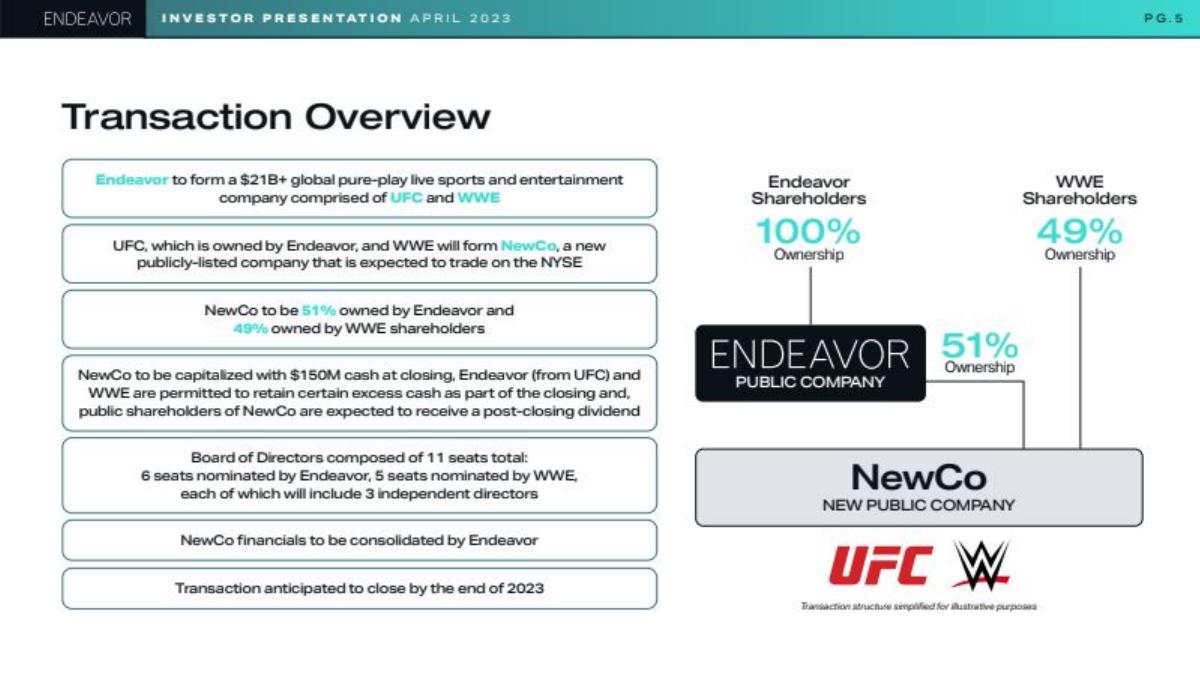
- The merger creates a $21B+ global pure-play live sports and entertainment company (Slide 5).
- Endeavor retains 51% ownership of the new public company, while WWE shareholders hold 49% (Slide 5).
- The deal targets $50-100 million in realizable net operating synergies (Slide 27).
- UFC and WWE combined for $2.4B in FY2022 revenue with a 42% Adjusted EBITDA margin (Slide 25).
- Over 70% of the combined entity's revenue is contracted, providing high financial visibility (Slide 25).
- The 'Endeavor Flywheel' is cited as the primary driver for site fees, premium hospitality, and technical improvements (Slide 23).
- The combined fan base exceeds 700M for UFC and 1.2B for WWE globally (Slide 27).
- The new entity claims a unique market position by lacking team owners and providing year-round content (Slide 19).
The $21.4 Billion Consolidation of Combat and Scripted Sports
The merger of UFC and WWE into TKO Group Holdings is not just a corporate reorganization; it is a strategic play to create a dominant force in the global media rights market. This investor presentation, released in April 2023, outlines how Endeavor plans to apply its management 'flywheel' to WWE, just as it did with UFC. The deck is a masterclass in institutional storytelling, focusing on high-margin IP, contracted revenue, and the elimination of operational redundancies.
Slides 1-3: The Legal and Structural Foundation
The deck opens with a stark, minimalist title slide (Slide 1) featuring the Endeavor, UFC, and WWE logos. This immediately establishes the brand hierarchy. Slide 3 is a dense legal disclaimer regarding non-GAAP financial information and market data. For a deal of this magnitude ($21.4B), these disclaimers are standard but critical, as they signal that the following projections rely heavily on management estimates and 'pro forma' combined financials rather than historical audited results for the single entity.
Slide 5: Transaction Overview and Ownership
Slide 5 is the most important slide for understanding the deal mechanics. It explicitly states the formation of a $21B+ global pure-play live sports and entertainment company . The ownership split is clearly visualized: Endeavor holds 51% and WWE shareholders hold 49%. Key details include a $150M cash capitalization at closing and a board of directors composed of 11 seats (6 for Endeavor, 5 for WWE). This slide serves to reassure shareholders of both companies that the governance is balanced but firmly under Endeavor's operational control.
Slide 7: The UFC Precedent
Endeavor uses Slide 7 to sell the 'why now' through a historical lens. Titled Path to Substantial Value Creation Tracks UFC Precedent , it uses a waterfall chart (though illustrative and without specific Y-axis figures) to show how Adjusted EBITDA grows through net operating synergies, domestic/international rights, and the 'Endeavor Flywheel.' The message is clear: 'We have done this before with UFC, and we will do it again with WWE.'
Slides 9-11: The Endeavor Flywheel in Motion
Slide 9 showcases the Global Portfolio of Premium Owned Assets . It categorizes IP into 'Owned' (UFC, WWE, PBR, Euroleague), 'Represented' (Wimbledon, NFL, Olympics), and 'Capabilities' (WME, IMG, OpenBet). This illustrates the massive scale of the parent company, powered by 11,000+ employees in 30+ countries. Slide 11 breaks down the 'Flywheel' into four segments: Owned Sport Properties, Events/Experiences, Representation, and Sports Data/Tech. It notes that UFC had 21 consecutive sell-outs in 2022, proving the demand for the 'Owned IP' segment of the business.
Slide 13: Endeavor's Standalone Financial Strength
Before diving deeper into the merger, Slide 13 presents Endeavor’s FY2022 financials: $5.3B in Revenue and $1.2B in Adj. EBITDA . It highlights a significant deleveraging event, moving from 4.8x net leverage in 2021 to 3.8x in 2022. This slide is intended to prove that the acquirer is financially disciplined and capable of absorbing a massive merger without overextending its balance sheet.
Slides 15-17: The NewCo Opportunity
Slide 15 acts as a transition, re-introducing the UFC and WWE logos. Slide 17 provides a side-by-side revenue comparison for FY2022. UFC generated $1.1B while WWE generated $1.3B . Interestingly, the revenue mixes are nearly identical, with Media accounting for 71% of UFC and 75% of WWE. This high correlation in business models justifies the merger; both companies are essentially content factories that sell rights to the highest bidder.
Slide 19: The Competitive Moat
Slide 19 is a classic 'check-mark' competitive matrix. It compares NewCo against the NBA, NFL, and F1. The 'differentiated attributes' claimed by NewCo include Control of All Rights and Lack of Teams / Team Owners . This is a subtle but powerful jab at traditional leagues where the central office must negotiate with individual team owners. In UFC and WWE, the company owns the athletes/talent and the league, allowing for much faster decision-making and 100% capture of commercial value.
Slides 21-23: Future Growth and Synergies
Slide 21 lists four avenues for growth: maximizing media rights, enhancing sponsorships, accelerating brand/talent placement, and developing new content. Slide 23 gets specific about the Endeavor Flywheel . It cites a 3x increase in UFC VIP guests and ~$70M in run-rate operating synergies achieved two years post-UFC acquisition. By providing these concrete numbers from the past, Endeavor makes its future projections for WWE feel like a mathematical certainty rather than a guess.
Slides 25-27: The Combined Financial Profile
Slide 25 presents the 'Key Financials' for the combined entity. The numbers are impressive: $2.4B Revenue , 10% Revenue CAGR (2019-2022), and a 42% Adj. EBITDA Margin . Perhaps most importantly for investors, it claims 70%+ Contracted Revenue . Slide 27 summarizes the investment opportunity, framing it as 'Category-Defining Brands Better Together' with a global fan base of 1.9 billion people (700M UFC + 1.2B WWE).
Slides 29-33: The Appendix and Debt Detail
The final section (Slides 29, 31, 33) focuses on the technical debt structure. Slide 31 shows the combined net leverage of 2.5x, which is significantly lower than Endeavor’s standalone leverage. This suggests the merger is actually a 'de-leveraging' event for the parent company, as WWE carries very little debt ($21.3M) compared to UFC ($2.75B). This is a sophisticated financial engineering move that improves the overall credit profile of the group.
What Works in This Deck
The 'Flywheel' Proof: Instead of just saying they will improve WWE, they show exactly how they improved UFC (Slide 23). This historical evidence is the strongest part of the pitch. · Revenue Visibility: Highlighting that 70% of revenue is already contracted (Slide 25) removes the 'hit-driven' risk typically associated with entertainment companies. · Clear Ownership Structure: The diagram on Slide 5 eliminates any confusion about how the two entities will interact and who holds the voting power. · Market Positioning: By comparing themselves to F1 and the NFL (Slide 19), they move the conversation away from 'wrestling' and 'fighting' and toward 'global sports media rights.'
What Is Missing
Talent Risk: There is no mention of the aging talent pool in WWE or the injury risks in UFC. The deck treats the brands as immortal IP, ignoring the human element required to produce the content. · Integration Costs: While the deck touts $50-100M in synergies, it omits the one-time costs associated with merging two massive, distinct corporate cultures. · Regulatory Hurdles: For a $21B merger, there is no slide addressing potential antitrust or regulatory challenges, which are common in media consolidations. · Detailed Tech Roadmap: Slide 23 mentions a 'New Tech Stack' for UFC Fight Pass, but there is little detail on how the digital platforms of both companies will be integrated or if a unified streaming service is planned.
Founder Lessons: Copy This Strategy
Use Precedent to Sell Future Gains: If you are raising a Series B or C, don't just project growth. Show a specific initiative from your Series A that worked and explain how you will apply that exact 'playbook' to a larger market. · Focus on Contracted Revenue: Investors love predictability. If you have recurring revenue or long-term contracts, make that a headline metric. It drastically lowers the perceived risk. · Define Your Own Category: NewCo didn't call itself a 'wrestling and MMA company.' They called themselves a 'pure-play live sports and entertainment company.' By changing the label, they changed the peer group and the valuation multiples. · Visual Simplicity in Complexity: The ownership structure on Slide 5 is a complex legal arrangement, but the slide uses simple boxes and lines to make it understandable in five seconds. Always simplify your cap table or deal structure for the deck.
Frequently asked questions
- What is the primary business model of the new entity?
- The business model is built on B2C entertainment and B2B media rights. As shown on Slide 17, media represents 71% of UFC's revenue and 75% of WWE's. The strategy involves consolidating these rights to negotiate larger deals with broadcasters and streaming platforms, supplemented by live events, sponsorships, and consumer products.
- How does the ownership structure work post-merger?
- According to Slide 5, Endeavor forms a new publicly listed company (NewCo, later TKO). Endeavor shareholders own 100% of Endeavor, which in turn owns 51% of NewCo. WWE shareholders own the remaining 49% of NewCo. The board consists of 11 seats: 6 nominated by Endeavor and 5 by WWE.
- What are the specific 'synergies' mentioned in the deck?
- Slide 23 and 27 highlight $50-100M in net operating synergies. These include operational improvements through Endeavor’s global infrastructure, increased site fees/grants by leveraging Endeavor’s event operations, and a 3x increase in premium hospitality guests, mirroring the success Endeavor had after acquiring UFC.
- How does the company compare itself to other major sports leagues?
- Slide 19 features a competitive matrix comparing NewCo to the NBA, MLB, NHL, NFL, Premier League, and F1. NewCo claims superiority in 'Control of All Rights,' 'Lack of Team Owners,' and 'Year-Round Content,' attributes that the traditional 'Big Four' leagues lack due to their seasonal nature and fragmented ownership.
- What is the financial health of the combined companies?
- Slide 25 reports a combined FY2022 Adjusted EBITDA of $1.0B and a 61% Free Cash Flow conversion rate. The balance sheet is described as 'healthy' with a 2.5x net leverage ratio. The deck emphasizes that 70%+ of revenue is contracted, reducing the risk profile for institutional investors.