The Uber acquisition of Postmates represents a classic consolidation move in the high-burn food delivery sector. Valued at $2.65 billion in an all-stock transaction, the deal was designed to bolster Uber Eats' domestic footprint, particularly in the US Southwest. The 13-slide deck focuses heavily on the 'Strategic Rationale,' emphasizing that the combined entity would achieve $200 million in run-rate synergies within a year. By absorbing Postmates' 10 million active customers and 115,000 partner restaurants, Uber aimed to accelerate its path to profitability. The presentation serves as a mast…
Key takeaways
- The transaction was valued at approximately $2.65 billion on a fully diluted basis, paid entirely in Uber stock (Slide 6).
- Postmates brought a strong regional lead in the Southwest, specifically in Los Angeles, Las Vegas, and San Diego (Slide 7).
- Uber projected $200 million+ in run-rate synergies to be achieved one year after the deal's close (Slide 6).
- Postmates' subscription program, Postmates Unlimited, accounted for over 30% of its orders at the time of acquisition (Slide 7).
- The deck highlights Postmates' 'hero' brands like Sugarfish and Tocaya Organica as high-quality, exclusive differentiators (Slide 7).
- Postmates demonstrated high courier efficiency with nearly 3 trips per hour in strategic markets (Slide 7).
- The combined entity aimed to leverage Postmates' 'Delivery-as-a-service' for non-partnered merchants to expand beyond food (Slide 11).
- Uber Eats reported 111 million monthly active platform consumers compared to Postmates' 10 million at the time of the deal (Slide 11).
The Consolidation of On-Demand Delivery
In mid-2020, the food delivery landscape was defined by intense competition and a desperate race toward profitability. Uber’s acquisition of Postmates for $2.65 billion was a definitive move to reduce the number of major players in the US market. This 13-slide presentation, titled Uber Acquisition of Postmates , was the document used to communicate the deal's value to the public and shareholders. It focuses less on the 'why' of Postmates as a standalone business and more on the 'how' the two entities create a more efficient machine together.
Slides 1-3: Legal and Administrative Foundation
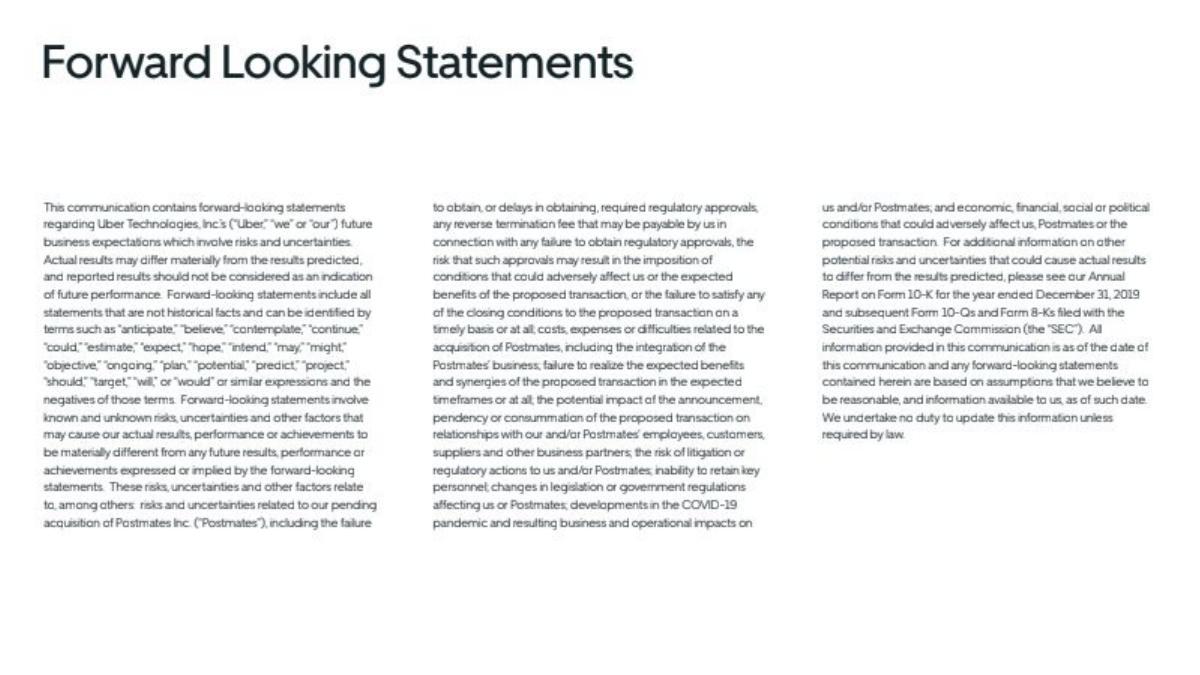
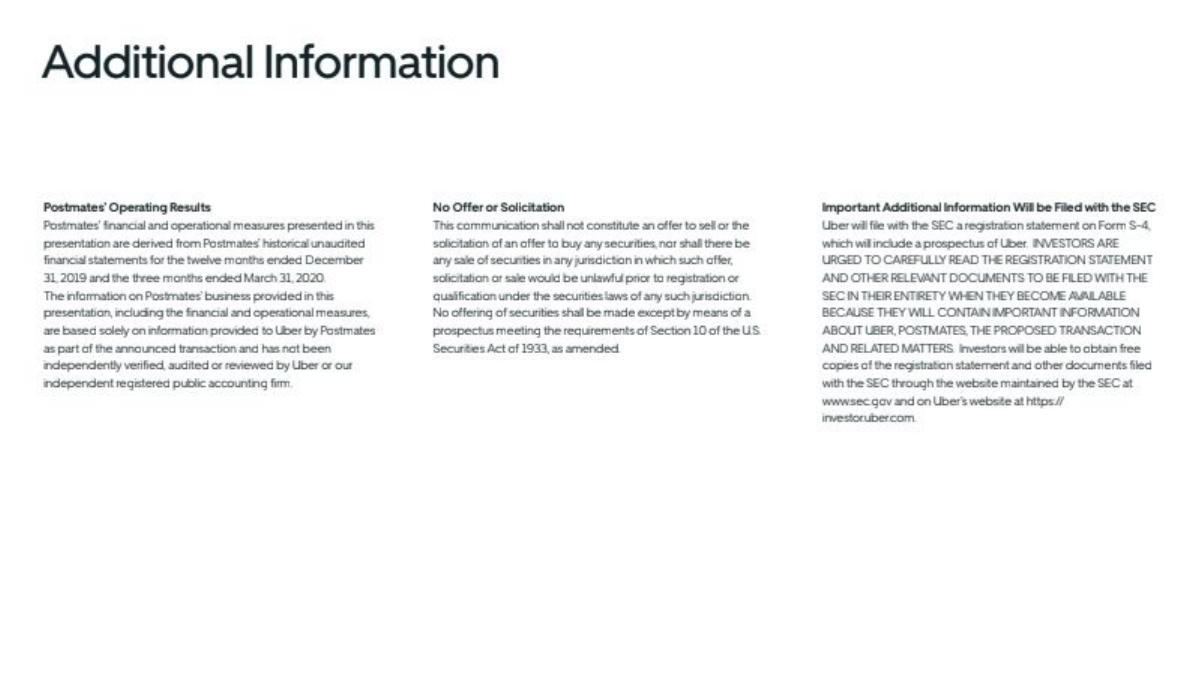
The deck opens with a standard title slide (Slide 1) dated July 6, 2020. This is immediately followed by two dense slides of Forward Looking Statements (Slide 2) and Additional Information (Slide 3). For a public company like Uber, these are mandatory. They protect the company against litigation regarding future projections—specifically the $200 million in synergies mentioned later—and clarify that the presentation does not constitute an offer to sell securities. Slide 3 specifically notes that Postmates' financial results were unaudited at the time of the presentation.
Slides 4-5: The Roadmap
Slide 4 provides a simple table of contents, dividing the deck into two sections: 01 Transaction Overview and 02 Strategic Rationale . Slide 5 serves as a section break for the Transaction Overview. This clean, minimalist structure is typical of corporate M&A decks, where clarity for analysts is prioritized over narrative flair.
Slide 6: The Deal Terms
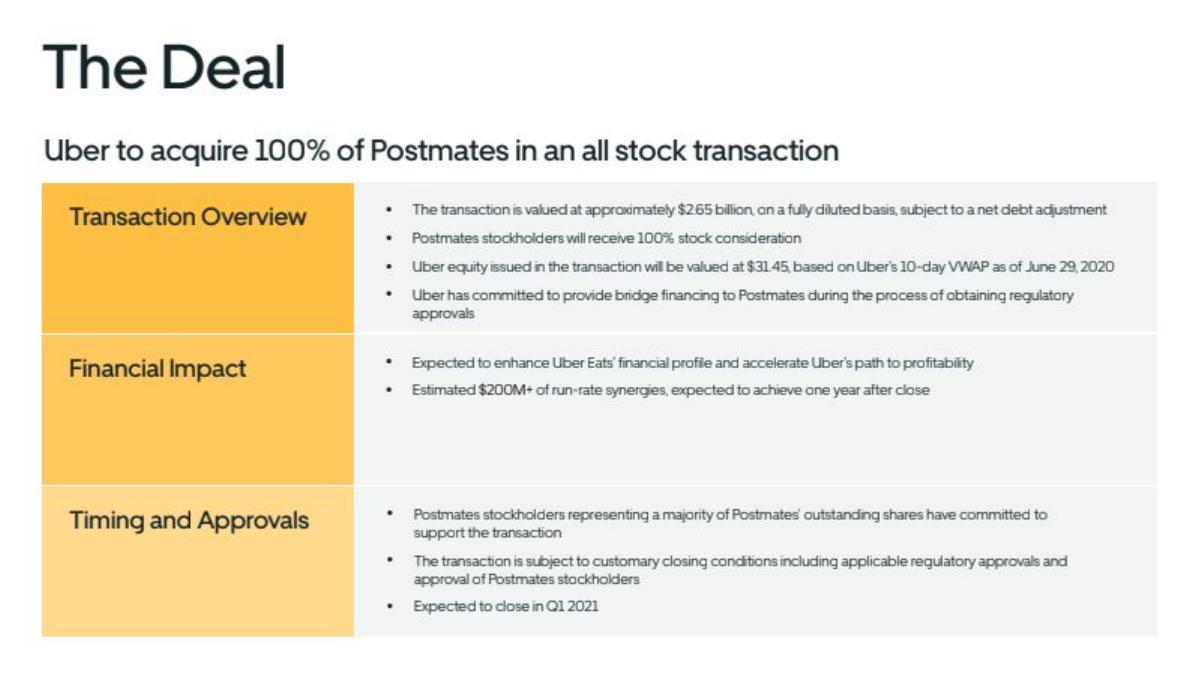
This is the most critical slide for financial analysts. It outlines that Uber is acquiring 100% of Postmates in an all-stock transaction . Key figures include:
Valuation: Approximately $2.65 billion on a fully diluted basis. · Stock Price: Uber equity issued was valued at $31.45, based on a 10-day VWAP (Volume Weighted Average Price) as of June 29, 2020. · Synergies: Estimated $200M+ of run-rate synergies expected one year after close. · Bridge Financing: Uber committed to providing bridge financing to Postmates during the regulatory approval process. · Timeline: Expected to close in Q1 2021.
The mention of bridge financing is a subtle nod to the fact that Postmates, like many in the sector, required consistent capital to maintain operations during the transition.
Slide 7: Postmates Overview
Slide 7 shifts to the target company's performance. It highlights Postmates' Q1 2020 metrics: $643M in Gross Bookings and $107M in Revenue . The slide emphasizes three core strengths: Southwest regional leadership (LA, Las Vegas, San Diego), a beloved brand with 10M+ active customers, and innovative technology . A standout metric here is that 'Postmates Unlimited' (their subscription program) accounted for 30%+ of orders, a key indicator of customer retention and lifetime value.
Slides 8-10: Strategic Rationale and Market Context
After a section break (Slide 8), Slide 9 lists the three pillars of the acquisition's logic: a large/dynamic industry, complementary assets, and benefits to the marketplace. Slide 10 provides the macro view, showing a chart of Online Delivery Penetration from 2018 to a projected 2025. It argues that online food delivery represents only a fraction of the total opportunity, with penetration expected to rise from 9% in 2020 to 13% by 2025. It also lists a 'dynamic environment' of competitors, including not just other delivery apps (DoorDash, Grubhub) but also POS models like Toast and Square, justifying the need for scale to compete.
Slide 11: Uber Eats + Postmates Comparison
This slide is a side-by-side comparison of the two brands. It highlights the massive scale difference: Uber Eats had 400K partnered restaurants and 111M Monthly Active Platform Consumers , while Postmates had 115K merchants and 10M active customers . The 'Strategic Fit' column on the right summarizes the value: combining global scale with local category strengths. It specifically mentions that Postmates brings 'batching and chaining' technology and 'Delivery-as-a-service' expertise, which Uber intended to use to accelerate its non-food delivery efforts.
Slides 12-13: Synergies and Stakeholder Value
Slide 12 doubles down on the $200M+ cost synergies , stating that the increase in scale allows for the elimination of redundant expenditures. This is the 'path to profitability' slide that investors were looking for. Finally, Slide 13 concludes by framing the deal as a win for all stakeholders: Consumers get more choice and lower prices; Restaurants see increased demand; and Delivery People get more work opportunities. It’s a classic marketplace 'flywheel' argument, suggesting that the combined scale makes the entire ecosystem more efficient.
What Works in This Deck
The deck is exceptionally disciplined. It doesn't waste time on the history of the companies; it focuses entirely on the future state of the combined entity. The use of specific regional data (Slide 7) is a strong move—it proves that Uber wasn't just buying 'more delivery,' but was buying 'dominance in specific, high-value geographies' like Los Angeles. The clear articulation of the $200 million synergy target (Slide 6 and 12) provides a concrete metric for the market to hold Uber accountable to, which generally builds investor confidence during an acquisition.
What Is Missing
As an M&A deck for a public company, it is intentionally light on certain details. There is no mention of the failed Grubhub merger that preceded this deal, nor is there a detailed breakdown of unit economics (CAC/LTV) for Postmates. While it mentions 'path to profitability,' it does not provide a specific date for when the combined delivery segment would reach EBITDA breakeven. Additionally, the deck glosses over the regulatory risks ; while it mentions 'customary closing conditions,' it doesn't address the antitrust concerns that were prevalent in the delivery industry at the time.
What Other Founders Can Copy
Founders looking to be acquired should study Slide 11. The Side-by-Side Comparison is a perfect way to show a potential acquirer exactly where your company fits into their puzzle. Don't just list your stats; list them in the context of the acquirer's stats to show complementarity. If you have a regional stronghold or a specific technological 'edge' (like Postmates' batching tech), highlight it as a 'Strategic Fit' rather than just a feature. Finally, the emphasis on subscription revenue (Slide 7) is a powerful signal of business health that every marketplace founder should track and present prominently.
Frequently asked questions
- What was the primary financial justification for the acquisition?
- The primary justification was the realization of $200 million in run-rate synergies within the first year. Uber argued that by eliminating redundant expenditures and improving operating efficiency across the combined marketplace, the acquisition would significantly accelerate Uber’s overall path to profitability, which was a major concern for investors in 2020.
- How did Postmates' geographic footprint complement Uber Eats?
- Postmates held a leadership position in the US Southwest, a region where Uber sought deeper penetration. Specifically, Postmates brought dominant market shares in Los Angeles, Las Vegas, Orange County, San Diego, and Phoenix. This allowed Uber to consolidate the market in high-volume urban centers rather than fighting for incremental gains.
- What unique technology did Postmates bring to the table?
- Beyond standard delivery, the deck highlights Postmates' 'batching and chaining' capabilities and its operational expertise in 'Delivery-as-a-service.' This allowed merchants to add delivery capabilities to their own websites and apps, a feature Uber viewed as an 'early player' advantage in the broader logistics and grocery space.
- Why was the deal structured as an all-stock transaction?
- The deck notes that Postmates stockholders received 100% stock consideration, valued at $31.45 per share based on a 10-day VWAP. This structure allowed Uber to preserve cash during the economic uncertainty of 2020 while aligning the incentives of Postmates’ backers with Uber’s long-term stock performance and the success of the integration.
- What role did Postmates' brand play in the acquisition?
- Uber identified Postmates as a 'beloved brand,' particularly among Millennials. While Uber Eats was a global powerhouse, Postmates had cultivated a 'hero' brand status with local favorites and a high-quality restaurant selection that Uber believed would strengthen its consumer-facing appeal and customer loyalty.