Uguru, an on-demand tutoring marketplace, raised $100,000 in 2013 using a 17-slide deck that is almost entirely devoid of bullet points. Instead of complex financial models, the deck relies on high-impact numbers: 20% penetration of UC Berkeley within one month and $10,000 in initial revenue. The presentation follows a 'problem-solution-traction' arc using large-scale imagery and single-metric slides. While it lacks traditional sections like a detailed budget breakdown or a formal 'Ask' slide with a specific dollar amount, it successfully communicates a 'blitzscaling' potential by showing how…
Key takeaways
- The deck highlights a rapid 1-month launch period to demonstrate immediate market demand (Slide 2).
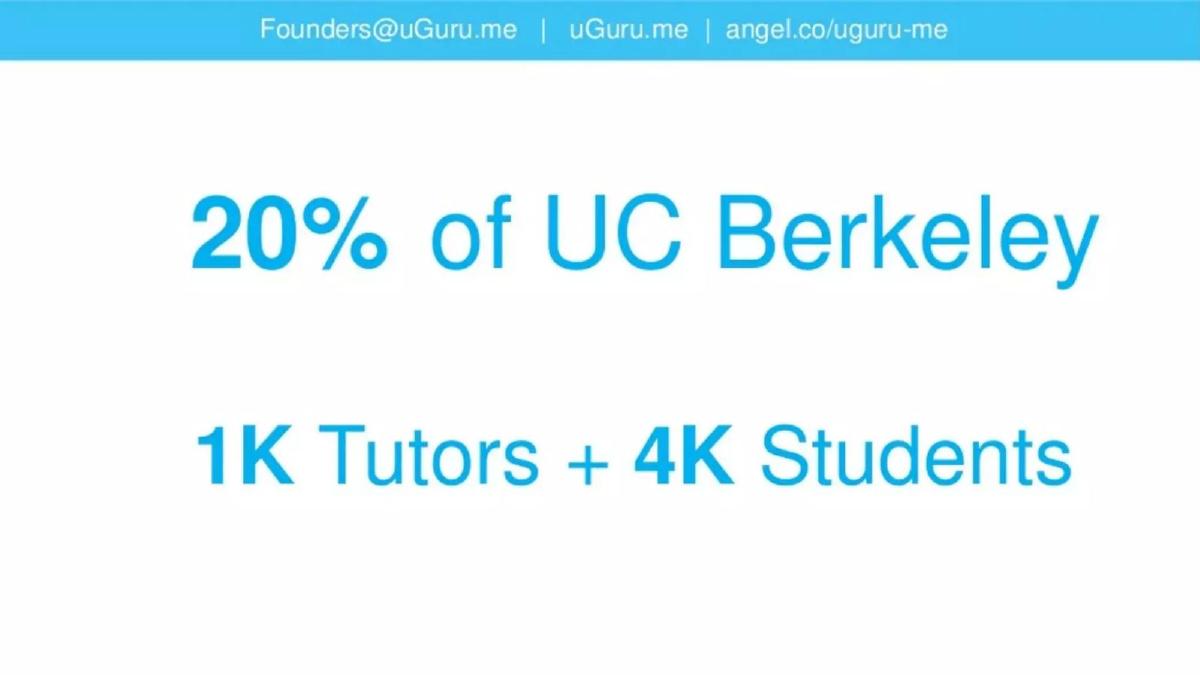
- Uguru achieved 20% market penetration at UC Berkeley with 1,000 tutors and 4,000 students (Slide 3).
- The company generated $10,000 in revenue within its first four weeks of operation (Slide 4).
- The value proposition centers on reducing tutoring costs from $60 to $15 (Slide 10).
- The platform claims to reduce the time to find a tutor from 1 week to 3 minutes (Slide 11).
- Expansion plans were set for UCLA in September 2014 to prove the model's repeatability (Slide 14).
- The founders cite a $10 billion immediate market and a $50 billion total addressable market (Slides 15-16).
- The team slide emphasizes technical and business experience at Google, Yahoo, and Berkeley (Slide 17).
The Anatomy of a High-Signal Seed Deck
The Uguru pitch deck is an artifact from the 2013 era of 'Uber-for-X' startups. It utilizes a minimalist design language that was popularized by early 500 Startups and Y Combinator demo day presentations. With only 17 slides and almost no body text, the deck is designed to be spoken over rather than read in isolation. It relies on the strength of its 'North Star' metrics to do the heavy lifting.
Slides 1-4: The Traction Hook
Slide 1 introduces the brand with the tagline 'On-Demand Tutoring Marketplace.' The branding is friendly, featuring a 'Guru' mascot that suggests wisdom and accessibility. Slide 2 simply reads '1 Month,' setting the stage for a narrative of rapid execution. This is a classic storytelling technique: establishing a very short timeframe to make the subsequent numbers more impressive.
Slide 3 delivers the 'wow' factor. It claims a 20% penetration of the UC Berkeley student body, consisting of 1,000 tutors and 4,000 students. For a seed-stage investor, seeing 5,000 active users at a single prestigious institution within 30 days is a massive signal of product-market fit. Slide 4 reinforces this with a revenue graph showing a climb to '$10K Revenue' by Week 4. The upward curve is steep, suggesting that the marketplace is not just active, but liquid and generating cash immediately.
Slides 5-8: Problem and Market Context
Slide 5 uses a full-bleed image of a stressed student, a visceral representation of the problem. Slide 6 displays the logos of incumbents: WyzAnt, Kaplan, Tutor.com, and InstaEDU. By showing these established players, Uguru acknowledges the competition but positions itself as the modern, more efficient alternative. Slide 7 shows a photo of two students studying together, emphasizing the peer-to-peer nature of the platform. This contrasts with the 'professional' (and often expensive) nature of the competitors shown on the previous slide.
Slides 9-13: The Solution and Value Prop
Slide 9 identifies the core differentiator: 'Course Specific.' This is the 'secret sauce.' While other platforms offer 'Calculus tutoring,' Uguru offers tutoring for 'Math 1A at Berkeley.' Slide 10 highlights the economic disruption, showing a crossed-out '$60' replaced by '$15.' This 75% reduction in price is a powerful incentive for the student demographic. Slide 11 addresses the friction of time, claiming a reduction from '1 week' to '3 mins' to find help. Slide 12 and Slide 13 focus on quality and retention, citing '4.9 Stars' and the word 'Addicted' over a heart icon. These slides aim to prove that the low price and high speed do not come at the expense of user satisfaction.
Slides 14-17: Expansion, TAM, and Team
Slide 14 shows a map of California with the 'Cal' (Berkeley) and 'UCLA' logos, noting 'September 2014' as the expansion date. This demonstrates a clear, logical next step for growth. Slide 15 and Slide 16 define the market opportunity: a '$10 Billion' immediate tutoring market and a '$50 Billion' broader market including test prep (SAT, GRE, MCAT), professional skills (Excel, Photoshop), and career services (Resume Polishing). This transition from a niche campus tool to a broad skill-sharing platform is essential for justifying a venture-scale valuation.
Slide 17 introduces the founders, Michael Koh and Samir Makhani. The slide is heavy on pedigree, featuring logos for Google, Yahoo, Berkeley, and Hadoop. This 'Who' slide is positioned at the end to leave investors with the impression that the traction shown earlier was achieved by a team with the technical and business chops to scale it. The final slide (unmarked but functioning as a summary) reiterates the $10K revenue and 100% week-over-week growth, ending with a call to action: 'Come talk to us!'
What Works
Extreme Focus on Traction: By leading with the 20% Berkeley penetration and $10K revenue, the deck answers the most important question first: 'Does anyone want this?' · Clear Differentiation: The 'Course Specific' slide (Slide 9) explains exactly why a student would choose Uguru over a generic tutoring site. · Visual Simplicity: The lack of text makes the deck highly memorable. An investor will walk away remembering '3 minutes,' '$15,' and 'Berkeley.' · Founder Pedigree: The team slide (Slide 17) effectively uses recognizable logos to de-risk the investment.
What is Missing
The Ask: There is no slide stating how much money the company is looking to raise or what the specific milestones for the next round will be. · Unit Economics: While the $15 price point is mentioned, the deck does not explain the margin, the cost of customer acquisition (CAC), or the lifetime value (LTV). · Product Screenshots: For a tech platform, there is a surprising lack of actual UI/UX shots. The deck relies on icons and stock photos rather than showing the app in action. · Burn Rate and Runway: There is no mention of the current financial health of the company beyond top-line revenue.
What a Founder Should Copy
The 'Micro-Market' Strategy: If you have dominated a single niche (like one university or one city), make that the centerpiece of your deck. It proves your model works in a vacuum before you ask for money to expand. · The 'Before and After' Value Prop: Slides 10 and 11 are excellent examples of showing a 10x improvement in both price and time. Use this 'crossed-out' format to make your impact undeniable. · Minimalist Design: If you are presenting in person, reduce your text. Use one big number or one big idea per slide to keep the audience's attention on your words.
Frequently asked questions
- How much did Uguru raise with this deck?
- According to catalogue data from pitchdeckhunt.com, Uguru raised $100,000 in a Seed round in 2013. The deck itself does not state the amount raised or the valuation sought, which is a common omission in early-stage 'teaser' or demo day decks.
- What was Uguru's primary competitive advantage?
- The deck emphasizes 'Course Specific' tutoring (Slide 9). Unlike general platforms, Uguru connects students with 'Gurus' who have taken the exact same courses at the same university, ensuring the help is highly relevant to specific exams and professors.
- What metrics did the founders use to prove traction?
- They focused on three core metrics: user volume (5,000 total users), speed of service (3-minute matching), and revenue ($10,000 in month one). They also highlighted a 4.9-star rating to indicate high service quality (Slide 12).
- Is there a business model or fee structure explained in the slides?
- The deck shows a price drop from $60 to $15 (Slide 10), but it does not explicitly state the take-rate or commission Uguru charges. It focuses on the end-user price rather than the internal unit economics.
- Who were the founders of Uguru?
- The founders are Michael Koh (Biz Co-Founder) and Samir Makhani (Tech Co-Founder). Their backgrounds include experience at Google, Yahoo, and Renren, as well as education at UC Berkeley (Slide 17).