uGift is a Kiev-based startup addressing the lack of flexible gifting options in Ukraine. The deck outlines a multi-channel approach, selling universal gift cards through a proprietary website, partner APIs, and physical retail stands. With a team led by the former CEO of Groupon Ukraine, the company emphasizes its operational expertise and existing network of over 70 partners. The business model boasts a 35% revenue margin per customer, targeting a $4 gross profit on a $25 transaction. Seeking a modest $80,000, the founders aim to reach break-even by February 2013 and achieve $20,000 in mont…
Key takeaways
- The company identifies a specific regulatory and market gap: major payment system gift cards are unavailable in Russia/Ukraine due to legislation (Slide 2).
- uGift employs a hybrid distribution strategy including web, API, and physical retail stands near cash registers in over 30 partner locations (Slide 3, 7).
- The startup has already secured over 70 partners in Kiev, ranging from restaurants and salons to karting and snowboarding lessons (Slide 4).
- Unit economics are clearly defined: a typical $25 voucher yields $9 in revenue (35% margin) and $4 in gross profit after a $5 customer acquisition cost (Slide 9).
- The team is highly experienced in the local market, featuring the former CEO and Head of Strategic Projects from Groupon Ukraine (Slide 11).
- Current traction is modest but growing, with 5-10 certificates sold per week and a forecast of $1,000 in gross sales for August (Slide 10).
- The funding ask is $80,000, with $40,000 already committed, to be used for marketing and regional expansion into five cities (Slide 12).
- The deck lacks a formal market size (TAM/SAM/SOM) slide, relying instead on the 'land grab' potential of the retail space (Slide 8).
Executive Summary
uGift is a localized gifting platform targeting the Ukrainian market. The pitch deck outlines a transition from a fragmented, merchant-specific gift card landscape to a universal, multi-channel solution. By leveraging a team with significant experience in the daily deals space (Groupon), the company seeks to capture both the digital and physical retail gifting markets in Kiev and beyond.
Slide 1: Title Slide
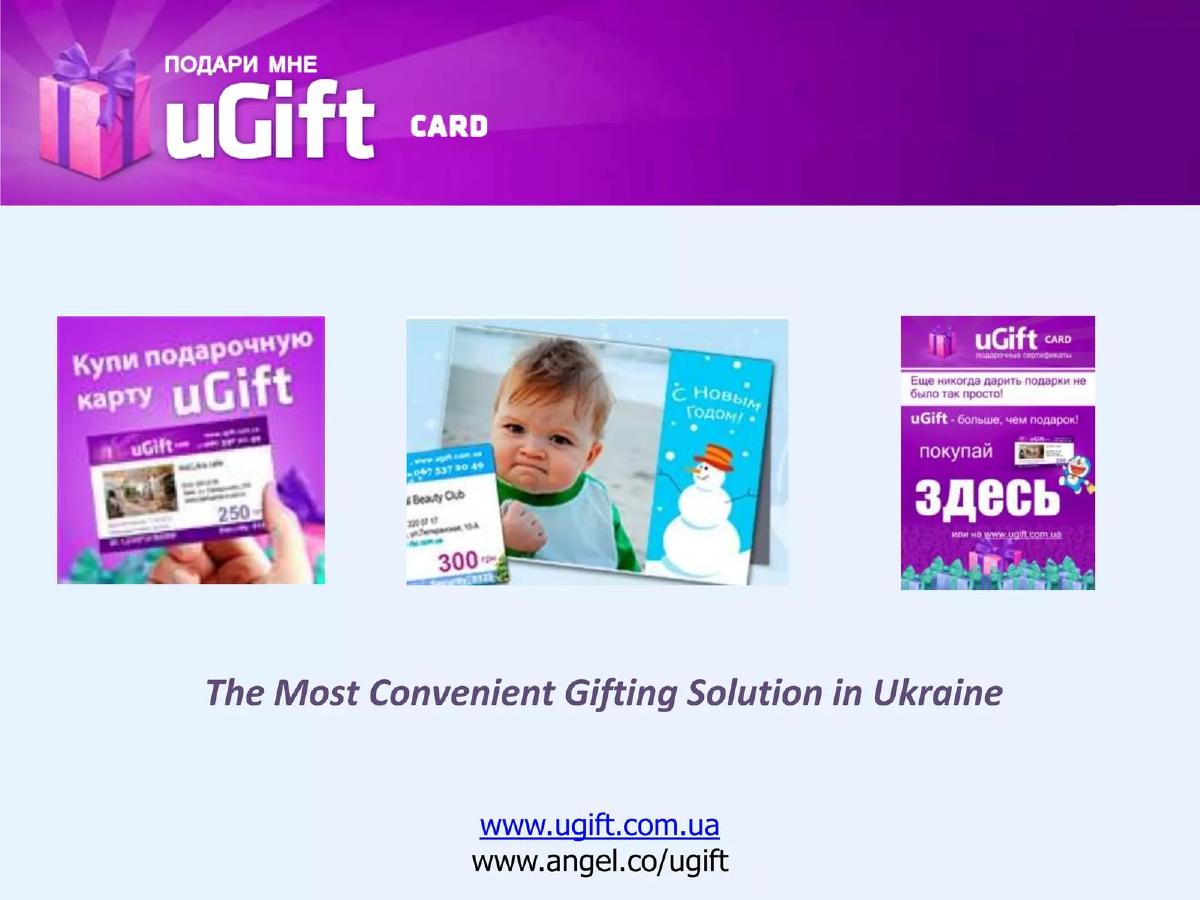
The deck opens with the brand name 'uGift CARD' and the Russian tagline 'ПОДАРИ МНЕ' (Give me). It positions the company as 'The Most Convenient Gifting Solution in Ukraine.' The slide includes links to their website and AngelList profile, establishing an immediate call to action for investors.
Slide 2: The Problem
The problem is defined as 'Poor gifting solutions in Ukraine.' The slide categorizes existing failures into four groups: 1) Gift cards by payment systems (Amex/Visa) are unavailable due to legislation; 2) Online cards by retailers lack visual appeal and promotion; 3) In-store cards require merchants to manage design and software; 4) Online specialists lack personalization and partner promotion. This slide effectively highlights a gap in the market for a third-party aggregator.
Slide 3: The Solution - Purchase Flexibility
uGift proposes 'Maximum flexibility where you buy.' The solution is three-pronged: a proprietary website, an API for partner websites, and physical cards available at partner shops. The slide includes a 'Coming Soon' badge for the API integration, indicating that the technology stack is still in development or early rollout.
Slide 4: The Solution - Use Flexibility
This slide emphasizes the breadth of the network, claiming over 70 partners signed in Kiev. Visual logos and categories include photo sessions, bowling, salons, restaurants (Gorilla), retail stores (Adidas, Comfy, Brocard), sports clubs, karting, and even snowboarding. The inclusion of a Groupon logo under 'E-stores' suggests a strategic alignment or partnership with the CEO's former employer.
Slide 5: The Solution - Delivery Flexibility
uGift offers four delivery methods: physical card delivery by courier, email, SMS, and posting to a Facebook Wall. This multi-channel delivery approach is designed to cater to both traditional gift-givers and the younger, digitally native demographic.
Slide 6: Product Workflow
A six-step process diagram explains the user journey: 1) Seeing an ad or retail stand; 2) Selecting a merchant and amount; 3) Personalizing the card; 4) Paying via Visa, MasterCard, or terminal; 5) Receiver getting the gift; 6) Merchant authenticating the security code. This slide clarifies that uGift handles the transaction and security, while the merchant only needs to verify a code.
Slide 7: Customer Acquisition
The 'How we get customers' slide lists four channels: SEO (claiming top 1-2 pages for key terms), weekly birthday reminders via a Facebook app, physical A4 stands in 30+ partner locations, and social media (150 Likes on FB, 300+ on vKontakte). The reliance on physical stands near cash registers is a notable 'offline' growth hack.
Slide 8: Competitive Landscape
The main competition is identified as online specialists (Bodo.com.ua, Originaloff.com.ua) and in-store certificates (Smile). uGift claims advantages in having no service fees, better UI/UX, and a unique retail presence. The slide concludes with a bold claim: 'Right now there is no competition in retail... it is a land grab!!'
Slide 9: Business Model and Unit Economics
This is the most detailed slide in the deck. It breaks down a $25 transaction: $21 goes to the merchant, $9 is revenue (35% margin), and after a $5 CAC, the gross profit is $4. The slide also notes that while the standard margin is 40%, it drops to 30% for merchants who host physical uGift stands. Current conversion is stated at 0.5% with a target of 2%.
Slide 10: Validation and Traction
Traction is early-stage: 5-10 certificates sold per week, with $1,000 in gross sales forecasted for August. The slide notes that 40 of the 70 signed partners have agreed to the 30% commission structure. It also mentions that four retailers are already signed to sell certificates in their stores.
Slide 11: The Team
The team is the deck's strongest asset. CEO Ken Leaver is the former CEO of Groupon Ukraine and a BCG alum. COO Andrey Jivolovich also comes from Groupon UA. The board and mentors include Hrish Lotlikar (Eastlabs) and founders of other Ukrainian startups like Best.ua and YouScan. This signals deep local execution capability.
Slide 12: The Ask
uGift is seeking $80,000, with $40,000 already secured as a soft commitment. The funds are earmarked for marketing ($20k), partner network expansion ($30k), and regional expansion ($30k). The milestones are clear: break-even by February 2013 and $20,000 in monthly sales by year-end.
What Works Well
Local Context: The deck does an excellent job of explaining why international giants like American Express or Visa haven't captured this market, citing specific regional legislation. · Unit Economics: Slide 9 provides a clear, transparent look at how the company makes money on a per-transaction basis, including the impact of customer acquisition costs. · Team Credibility: Highlighting the Groupon Ukraine connection is a powerful signal that the founders understand how to build merchant networks and scale a transaction-based business in this specific geography. · Distribution Strategy: The hybrid approach of using physical retail stands to drive 'free' customer acquisition (Slide 7) is a smart way to offset high digital CPC costs.
What Is Missing
Market Size (TAM): There is no slide quantifying the total addressable market for gift cards in Ukraine. While they mention a 'land grab,' investors usually want to see the dollar value of the opportunity. · Technology Detail: While they mention an API, there is little detail on the robustness of their backend or how they prevent fraud beyond a 'security code.' · Historical Data: The traction slide (Slide 10) only provides a forecast for one month (August) and a weekly sales range. More historical month-over-month growth data would be more convincing. · Exit Strategy: There is no mention of potential acquirers, though the Groupon connection hints at a possible path.
Founder Takeaways
Focus on the 'Why Now': uGift successfully argues that a regulatory gap has created a temporary window of opportunity. Founders in emerging markets should always highlight these local nuances. · Be Specific with the Ask: Breaking down the $80,000 into specific buckets (Marketing vs. Expansion) makes the request feel grounded and planned rather than arbitrary. · Leverage 'Offline' Growth: In a world of rising digital CAC, uGift’s strategy of placing physical stands in partner stores is a great reminder that sometimes the best way to get online customers is to meet them in the real world. · Define the Unit: Even at a seed stage, showing that you understand your margins and acquisition costs (as seen on Slide 9) builds significant investor confidence.
Frequently asked questions
- What is the primary problem uGift is solving?
- According to slide 2, the problem is 'Poor gifting solutions in Ukraine.' This includes the absence of major international gift cards due to local legislation, lack of personalization in existing retail cards, and the fact that most current solutions are only sold within a single merchant's store, limiting their appeal as flexible gifts.
- How does uGift differentiate itself from local competitors like Bodo?
- Slide 8 notes that competitors like Bodo.com.ua focus on 'fun activities' like skydiving and primarily sell online. uGift differentiates by offering no service fees, a wider range of partners (including restaurants and beauty), and the ability to buy physical cards in retail outlets or via partner websites using an API.
- What are the specific unit economics for a uGift transaction?
- Slide 9 breaks down a typical $25 (200uah) voucher. The merchant receives $21 (65%), leaving uGift with $9 in revenue (35% margin). After a $5 customer acquisition cost (CAC), the company nets $4 in gross profit, representing 16% of the total card value.
- Who are the key members of the leadership team?
- The team (Slide 11) is led by CEO Ken Leaver, who was previously the CEO of Groupon Ukraine and a strategy consultant at BCG. He is joined by COO Andrey Jivolovich (formerly of Groupon UA) and CTO Mark Magura. The board includes Hrish Lotlikar and Dmitry Havrylenko.
- What are the company's immediate financial goals?
- As stated on slide 12, uGift aims to reach break-even by February 2013. They also target achieving $20,000 in monthly sales by the end of the year. The $80,000 investment is intended to cover marketing and expansion into five additional regional cities.