Clari’s 2021 Series E pitch deck, which secured $150M, is a highly polished narrative focused on category dominance. Rather than getting bogged down in granular feature lists, the deck prioritizes massive scale and social proof. With over $1T in pipeline managed and $600B in revenue forecasted through the platform (Slide 2), Clari positions itself as the essential 'Revenue Operations' authority. The deck effectively uses a 'before and after' narrative, contrasting the 'Traditional IT Approach' of disjointed data lakes (Slide 14) with Clari’s purpose-built platform (Slide 15). While it lacks a…
Key takeaways
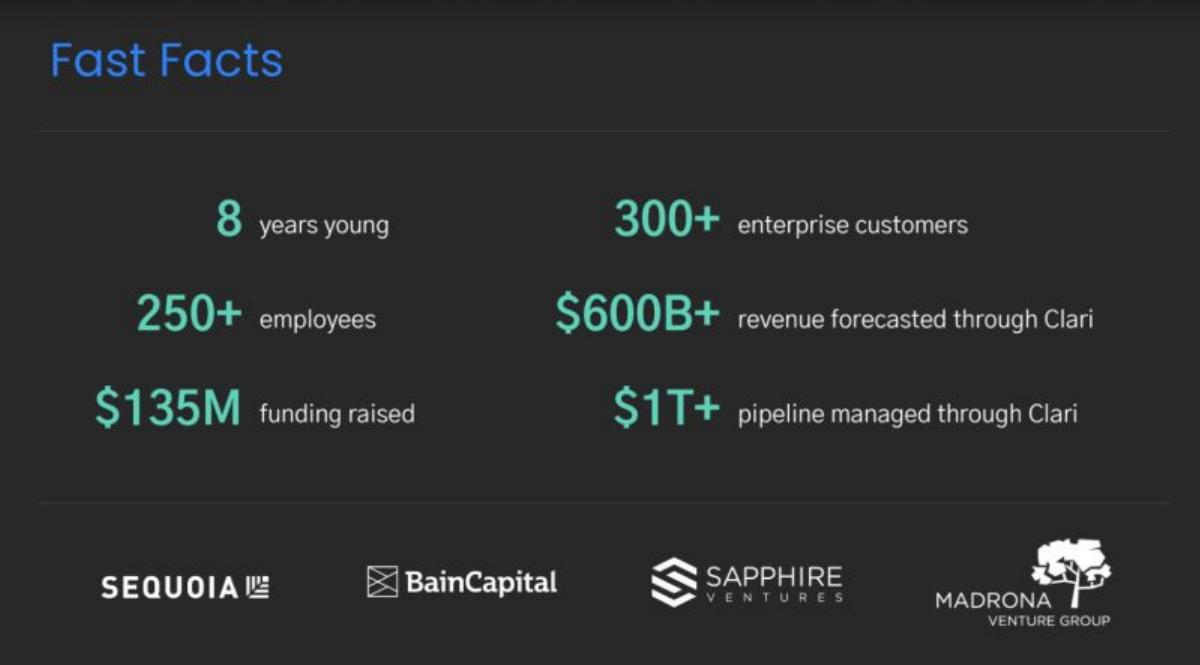
- Clari highlights $135M in previous funding and $1T+ in pipeline managed as core credibility markers on Slide 2.
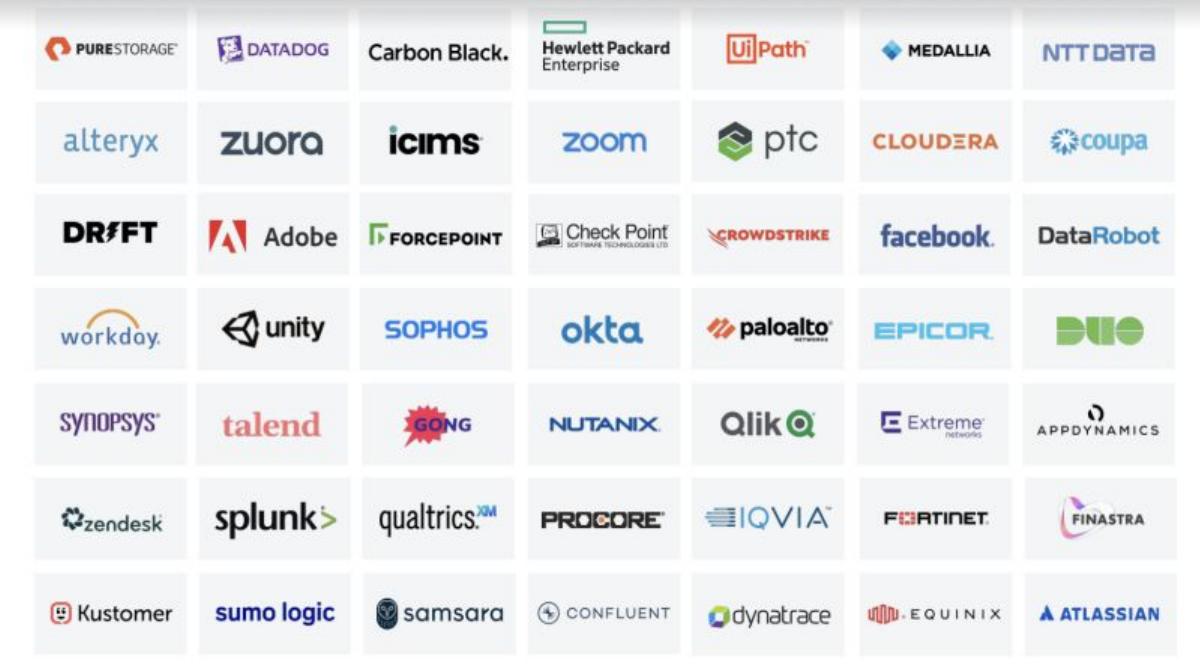
- The deck leverages a massive logo wall featuring companies like Adobe, Zoom, and Atlassian to demonstrate enterprise market fit on Slide 4.
- Executive testimonials from the CEOs of Okta and ThoughtSpot provide high-level social proof on Slide 5.
- The platform evolution is shown through a three-step build (Slides 7-9), moving from Sales to Marketing and finally Customer Success.
- Clari defines the problem as a 'Do-it-Yourself' limitation involving inconsistent data and stale insights on Slide 13.
- The 'Revenue Data Iceberg' visual on Slide 17 argues that CRM data is only a small fraction of the total revenue signal.
- The deck positions Revenue Operations as a 'Sea Change' occurring from 2020 onwards, contrasting it with GTM Ops from 2005-2019 on Slide 18.
- Clari claims 'Time to value in days, not months' as a key competitive advantage on Slide 19.
The Series E Narrative: Selling Authority Over Features
Clari’s Series E deck is a masterclass in enterprise positioning. By the time a company reaches this stage, the goal of a pitch deck is not to prove that the technology works, but to prove that the company is the inevitable winner in a massive category. Clari achieves this by focusing on three pillars: scale, social proof, and a proprietary data model. The deck is visually sparse, using high-contrast dark backgrounds and bold typography to convey a sense of 'Boardroom' readiness.
Slides 1-3: The Foundation of Scale
The deck opens with a bold statement: "A New Way to Revenue" (Slide 1). This immediately signals that Clari is not just a tool, but a new methodology. Slide 2, titled "Fast Facts," is the most important slide for a late-stage investor. It lists "8 years young," "250+ employees," and "$135M funding raised." More impressively, it claims "$600B+ revenue forecasted through Clari" and "$1T+ pipeline managed through Clari." These numbers are designed to show that Clari is already infrastructure-level software for the global economy. The inclusion of logos for Sequoia, Bain Capital, Sapphire Ventures, and Madrona at the bottom of Slide 2 reinforces that Clari is backed by top-tier institutional capital.
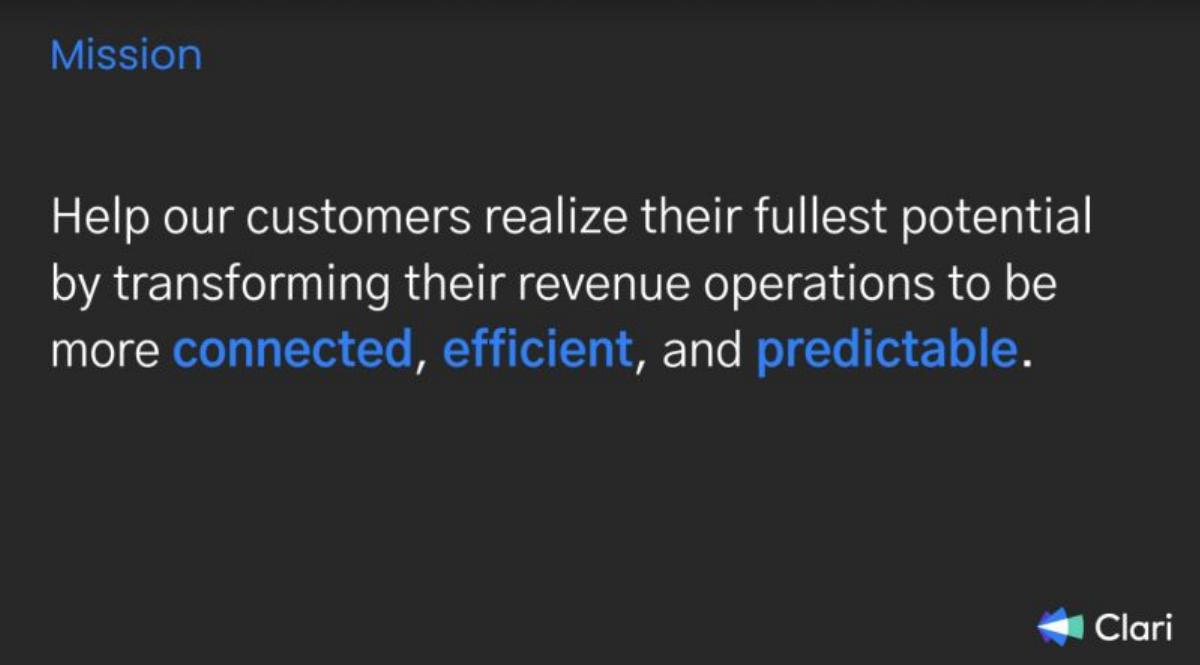
Slide 3 defines the mission: "Help our customers realize their fullest potential by transforming their revenue operations to be more connected, efficient, and predictable." This sets the stage for the 'RevOps' category they are building.
Slides 4-5: Unimpeachable Social Proof
Slide 4 is a dense logo wall. It includes massive enterprise names like Adobe, Zoom, Workday, Splunk, Atlassian, and Lenovo. For a Series E investor, this slide represents the 'de-risking' of the investment. If these market leaders rely on Clari, the product-market fit is no longer a question. Slide 5 follows up with two high-impact quotes from Todd McKinnon (CEO @ Okta) and Sudheesh Nair (CEO @ ThoughtSpot). Using CEO-level testimonials reinforces that Clari is a strategic priority for the C-suite, not just a tactical tool for sales managers.
Slides 6-9: The Platform Evolution
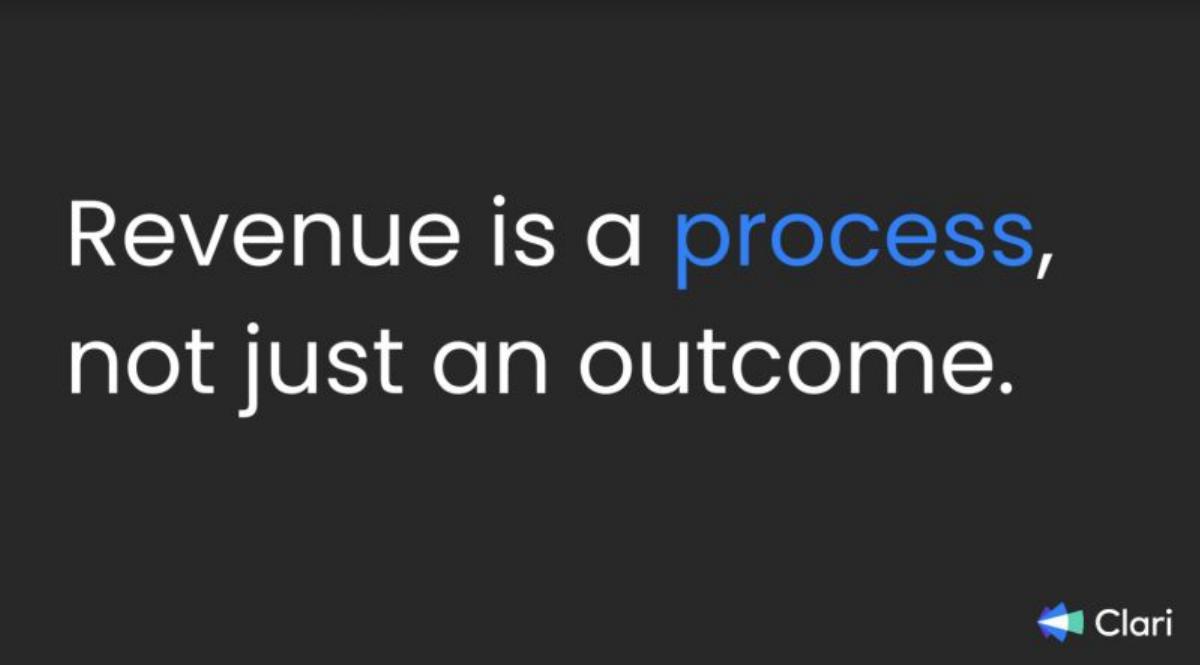
Slide 6 introduces the core thesis: "Revenue is a process, not just an outcome." This is a subtle but powerful shift in how executives think about their income statements. Slides 7, 8, and 9 use a build animation to show the "Clari Platform (Evolution)." It starts with Sales (Slide 7), adds Marketing (Slide 8), and concludes with CS (Customer Success) on Slide 9. All three are built on the "Clari Time-Series Data Hub & AI Engine," which pulls from CRM, Email, Calendar, Marketing, Phone/IM, and Partners. This visualizes the company's product roadmap and its ability to capture the entire customer lifecycle.
Slides 10-12: Defining the RevOps Category
Slides 10 and 11 focus on "Becoming the Rev Ops Authority." Clari defines the role of Revenue Operations as "Operationalize Growth, from the boardroom to the front line." Slide 12 provides a linear workflow for this operationalization: Align on SGIs, Identify Indicators, Execution Insights, Cadence & Communication, and Enablement & Scale. By providing this framework, Clari positions itself as a consultant and partner, not just a software vendor.
Slides 13-15: The 'Before and After' Comparison
Slide 13 attacks the "Limitations of the Do-it-Yourself Approach." It lists pain points like "Lengthy custom development," "Inconsistent data," and "Stale insights." Slide 14 visualizes the "Traditional IT Approach," which shows a disjointed flow into a general-purpose data lake. Slide 15 contrasts this with "Clari’s Modern, Purpose-Built Approach." This is a classic sales tactic: make the current way of doing things look broken and expensive, then present your solution as the only logical path forward.
Slides 16-17: The Revenue Data Iceberg
Slide 16 and 17 introduce the "Revenue Data Iceberg." Slide 16 shows CRM as the tip of the iceberg. Slide 17 reveals the massive amount of data below the surface: Emails, Meetings, Files, People, Conversations, Marketing data, Product usage data, and more. The text notes that this data was "Previously impossible to tie together into a single, coherent view without great effort and expense." This is Clari's 'secret sauce'—the ability to capture the 'real work' that happens outside of the CRM.
Slides 18-19: The Sea Change and Value Prop
Slide 18 frames the current moment as a "Sea Change." It contrasts "GTM Ops (2005-2019)" —characterized by disparate systems and manual integration—with "Revenue Ops (2020 and beyond)," which offers a single source of truth and AI-driven insights. Slide 19 summarizes the value proposition: "No custom development projects," "Time to value in days, not months," and a "New data model & data store – purpose built."
What Clari Does Exceptionally Well
Category Leadership: The deck doesn't just sell software; it sells the concept of 'Revenue Operations.' By defining the category, Clari makes itself the default choice for anyone looking to implement that category. · Quantified Scale: Using figures like $1T in pipeline managed (Slide 2) makes the company's impact feel undeniable. · Executive Framing: The deck is clearly designed for a C-suite audience. It talks about 'Boardrooms,' 'Strategic Growth Initiatives,' and 'Operationalizing Growth.'
What is Missing from the Deck
Team Slide: There is no mention of the founders or the executive leadership team. While social proof is high, a Series E deck usually includes a slide highlighting the 'bench strength' of the management team. · Financials and Unit Economics: There are no slides showing ARR growth, Net Revenue Retention (NRR), or Customer Acquisition Cost (CAC). These are standard for a Series E raise and were likely moved to a separate financial appendix or data room. · The Ask: The deck concludes with a simple "Thank you" (Slide 20) without stating how much capital is being raised or how it will be used.
Founder Takeaways: Copy the Authority, Not the Omissions
Founders should emulate Clari's use of social proof and category definitions . If you can convince an investor that your company represents a 'Sea Change' in how an industry operates, you move from being a commodity to being a strategic necessity. However, early-stage founders (Seed through Series B) should not copy the omission of the team and financial slides. Clari can afford to skip these because of their massive public profile and existing investor base; smaller startups cannot.
The use of the 'Iceberg' analogy (Slide 17) is a brilliant way to visualize a complex technical advantage (data integration) in a way that a non-technical executive can immediately understand. If your product solves a 'hidden' problem, find a similar visual metaphor to make the invisible visible.
Frequently asked questions
- Why does the deck omit a team slide?
- At the Series E stage, Clari is an established enterprise with over 250 employees and $135M in prior funding (Slide 2). The 'team' is no longer just the founders; it is the entire organization's track record. Investors at this level are often already familiar with the leadership, or the company's scale and customer list (Slide 4) serve as sufficient evidence of management capability.
- How does Clari differentiate itself from a standard CRM?
- Clari uses the 'Iceberg' analogy on Slides 16 and 17. It argues that CRM data is just the visible tip, while the 'real work' happens in emails, meetings, and transcripts below the surface. By integrating these disparate signals into a 'Time-Series Data Hub' (Slide 9), Clari claims to provide a more accurate revenue forecast than a CRM alone.
- What is the significance of the 'Evolution' slides?
- Slides 7 through 9 show the platform's expansion from a Sales tool to a full-funnel Revenue Operations platform. This demonstrates a successful 'land and expand' strategy, showing investors that Clari has increased its Total Addressable Market (TAM) by moving into Marketing and Customer Success workflows.
- What is the core problem Clari claims to solve?
- The deck identifies the problem as the 'Traditional IT Approach' (Slide 14), which relies on general-purpose data lakes. Clari argues this leads to 'lengthy custom development' and 'stale insights' (Slide 13). Their solution is a 'purpose-built' platform that operationalizes growth from the boardroom to the front line.
- Is there an 'Ask' or valuation mentioned in the deck?
- No. Late-stage decks like this one often omit a specific 'Ask' slide because the terms are usually negotiated through detailed data rooms and formal term sheets prior to or following the high-level presentation. The deck is designed to sell the vision and authority, not the specific mechanics of the $150M raise.