The ClaimCompass pitch deck is a rare example of extreme minimalism that successfully raised $1.8M. Spanning only 10 slides, the deck avoids the traditional 'problem/solution' fluff in favor of immediate, hard-hitting metrics. It opens with a clear value proposition—securing $650 for passengers—and quickly pivots to a business model based on a 25% commission of an $8B annual market. The deck's strength lies in its transparency regarding growth, showing a jump from 85 claims in July to 1,700 in February. While it lacks detailed financial projections or a technical deep dive into its 'automated…
Key takeaways
- The deck leads with a specific dollar value ($650) on Slide 1 to immediately quantify the customer benefit.
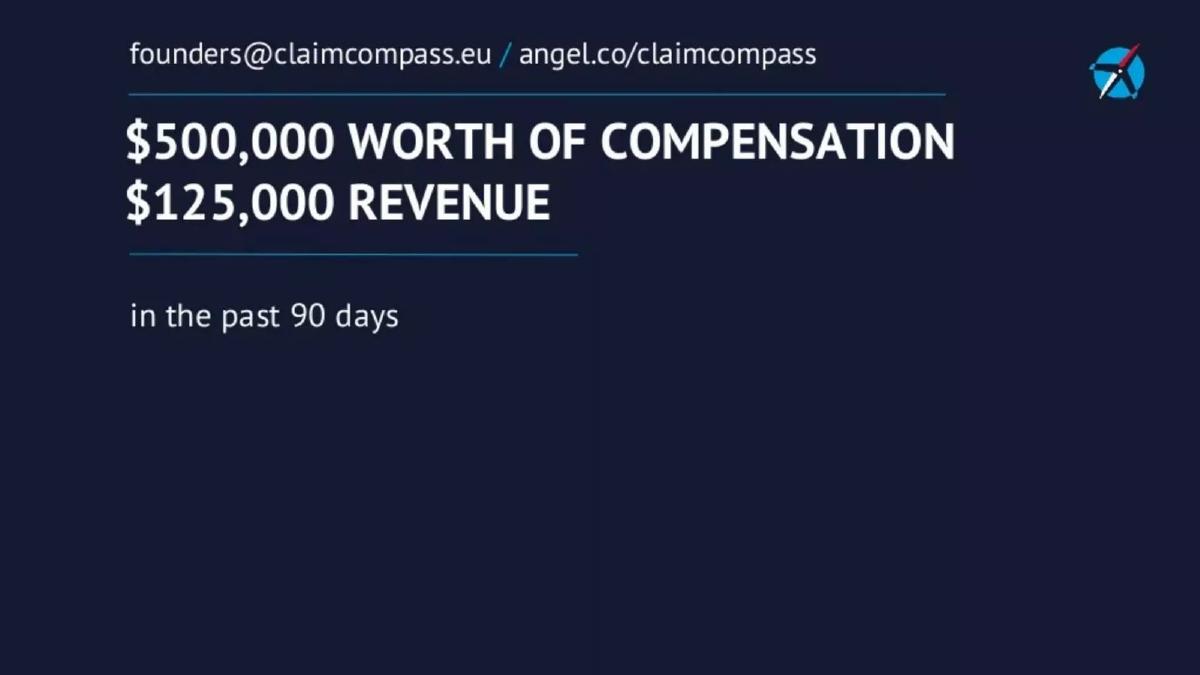
- Traction is front-loaded, showing $125,000 in revenue generated within the 90 days prior to the pitch on Slide 2.
- The total addressable market is simplified to a single, digestible figure: $8B left behind by passengers each year (Slide 3).
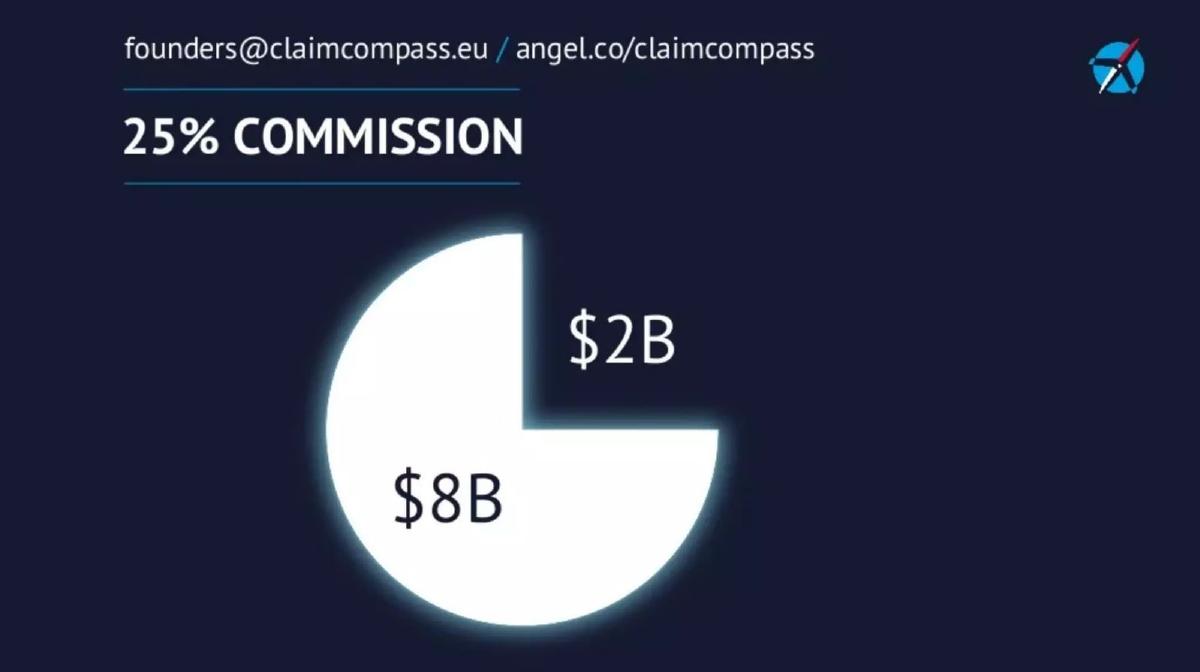
- The business model is explicitly stated as a 25% commission, implying a $2B serviceable addressable market (Slide 6).
- Growth is the centerpiece of the deck, visualized by a claim count increasing from 85 to 1,700 over an eight-month period (Slide 7).
- Strategic defensibility is hinted at through a 'Partner API' with an agency handling 7K bookings per day (Slide 8).
- The team slide (Slide 9) is minimalist, listing only names and titles (CEO, CTO, CMO) without prior experience or logos.
- The deck omits a formal 'Ask' slide, instead using a 'Free Money' hook and restating key traction metrics on Slide 10.
The Power of Minimalism in Legal-Tech Fundraising
The ClaimCompass pitch deck is a masterclass in brevity. In an industry often bogged down by regulatory complexity and legal jargon, this 10-slide deck cuts through the noise by focusing on two things: the consumer's wallet and the company's growth chart. By the time an investor reaches the third slide, they already know the product, the revenue generated to date, and the size of the problem. This teardown examines how ClaimCompass used high-signal data to secure a $1.8M seed round.
Slides 1-2: The Hook and the Proof
Slide 1: Title and Value Proposition The deck opens with a bold, aggressive statement: "WE MAKE AIRLINES PAY YOU $650 FOR SCREWING UP YOUR FLIGHT." This is not a vague mission statement about 'improving travel experiences.' It is a direct financial promise. By including the specific figure of $650, ClaimCompass grounds the business in a tangible reality. The contact information is immediately available, signaling a level of transparency and accessibility.
Slide 2: Recent Traction Most decks wait until slide 7 or 8 to show traction. ClaimCompass puts it on slide 2. They state they have secured "$500,000 WORTH OF COMPENSATION" and "$125,000 REVENUE" in the past 90 days. This is a critical move. It proves the business model works, the unit economics are clear (25% of the compensation), and the team can execute. For a seed-stage investor, seeing six-figure revenue in a 90-day window significantly de-risks the investment.
Slides 3-5: The Market and the Product
Slide 3: Market Size The deck identifies an "$8B LEFT BEHIND EACH YEAR" market. The phrasing "Airlines screw up all the time" is informal but resonates with the universal frustration of travelers. It frames the market not just as a financial opportunity, but as a systemic failure that ClaimCompass is positioned to exploit.
Slide 4: The Emotional Connection Slide 4 is purely visual, featuring a single poop emoji. While unconventional, it serves as a psychological break and reinforces the 'problem'—that airline service is often poor. In a fast-paced pitch environment, this slide ensures the audience is paying attention before the technical solution is presented.
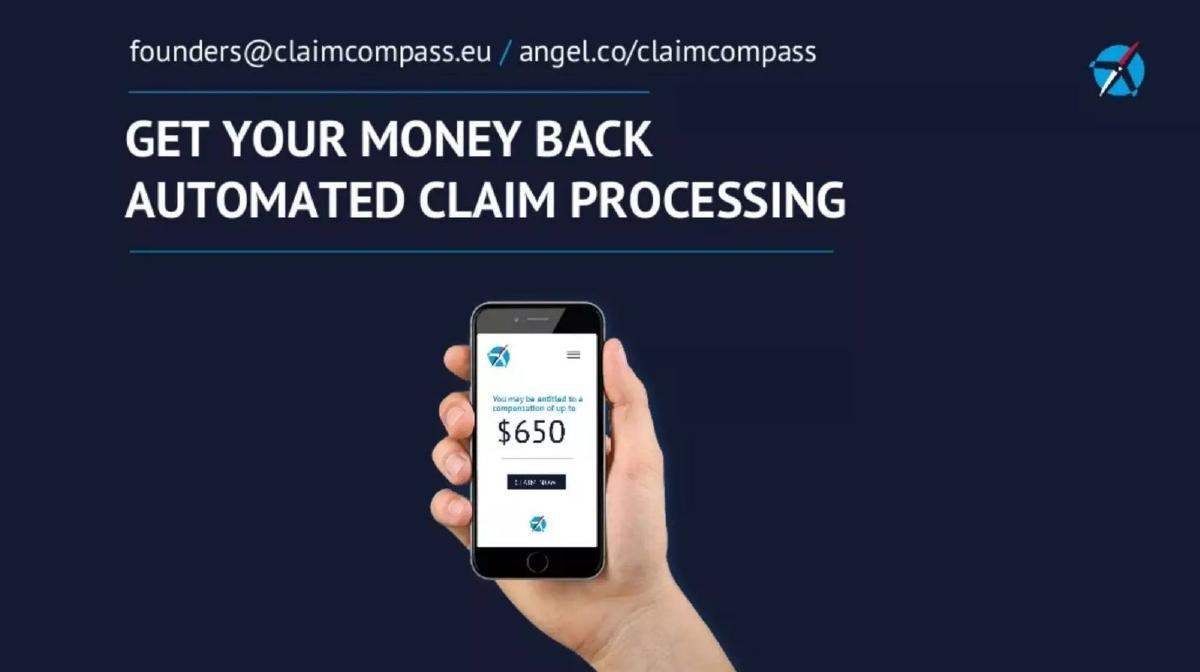
Slide 5: The Solution The solution is presented as "AUTOMATED CLAIM PROCESSING." The slide features a mobile mockup showing a user interface with a "Claim Now" button and the $650 figure. This tells the investor that the product is a technology platform, not a manual law firm. The word "Automated" is the most important word on this slide, as it implies scalability and high margins.
Slides 6-8: Business Model and Growth Engine
Slide 6: The Revenue Model ClaimCompass uses a simple pie chart to explain their 25% commission. They take the $8B market mentioned earlier and show their $2B slice of that pie. It is a clean, effective way to communicate the Serviceable Addressable Market (SAM). There are no complex tiers or subscription models; it is a pure performance-based business.
Slide 7: Growth Velocity This is arguably the most important slide in the deck. It shows a line graph of the "NUMBER OF CLAIMS" from July to February. The numbers move from 85 to 1,700. The headline "75% MoM GROWTH" is the primary signal. Investors at the seed stage are looking for 'up and to the right' charts, and this slide provides a textbook example of early-stage momentum.
Slide 8: Acquisition Strategy To sustain that 75% growth, the company highlights its "PARTNER API." They mention a partnership with a large Online Travel Agency (OTA) that handles 7K bookings per day. This addresses the 'how' of their growth. Instead of relying solely on expensive B2C marketing, they are building a B2B2C engine that plugs directly into the source of the claims (the bookings).
Slides 9-10: The Team and the Closing
Slide 9: The Team The team slide is surprisingly sparse. It lists Tatyana Mitkova (CEO), Velizar Shulev (CTO), and Alexander Sumin (CMO). There are no logos of former employers (Google, McKinsey, etc.) or universities. While this worked for ClaimCompass, it is generally a risk. However, given the revenue and growth numbers shown in previous slides, the founders likely felt their results spoke louder than their resumes.
Slide 10: The Final Ask The final slide is titled "ASK US ABOUT FREE MONEY." This is a clever play on words—referring both to the compensation they get for customers and the investment they are seeking. They restate their two strongest metrics: 75% MoM growth and $500,000 claimed since October 2016. (Note: The catalogue facts state the year was 2015, but Slide 10 explicitly mentions 2016, suggesting the deck was updated during the fundraising process).
What Works in This Deck
Extreme Clarity: There is no ambiguity. You know exactly what they do, how they make money, and how fast they are growing within 60 seconds of viewing the deck. The use of large fonts and minimal text makes it ideal for a mobile-first or quick-skim review by a VC.
Traction-First Approach: By putting revenue and claim volume at the beginning and end of the deck, ClaimCompass forces the investor to focus on the business's success rather than the potential legal hurdles of airline regulations.
The 25% Math: The business model is so simple it requires no explanation. This allows the pitch to focus on the 'how' (the API and automation) rather than the 'what.'
What Is Missing
Competitive Landscape: There are several other players in the flight compensation space (e.g., AirHelp). The deck makes no mention of them. An investor would certainly ask how ClaimCompass differentiates itself from these incumbents, especially regarding their "Automated" claim processing claims.
Regulatory Risk: Airline compensation is governed by specific laws like EU 261. The deck doesn't address the legal stability of these regulations or what happens if airlines successfully lobby to change them.
Detailed Financials: While revenue is mentioned, there is no information on Burn Rate, Customer Acquisition Cost (CAC), or Lifetime Value (LTV). For a $1.8M raise, investors usually expect to see how that capital will be deployed over the next 18-24 months.
What a Founder Should Copy
The 'Big Number' Hook: Start your deck with the most impressive number you have. For ClaimCompass, it was $650 per user. For your startup, it might be a percentage of time saved or a specific ROI. Don't hide your best asset on slide 12.
The Growth Chart Style: Slide 7 is a perfect example of how to visualize traction. It uses clear labels, a simple line, and a headline that summarizes the data (75% MoM). It doesn't overcomplicate the visual with multiple axes or unnecessary legends.
The API/Partnership Slide: If you have a 'unfair advantage' in distribution, dedicate a slide to it. ClaimCompass's mention of the 7K bookings/day OTA partnership explains how they will scale without burning all their cash on Facebook ads.
Final Thoughts
The ClaimCompass deck is proof that you don't need 25 slides of market research and 'visionary' prose to raise a significant seed round. If the underlying business has real traction and a clear path to revenue, a minimalist deck can actually be more effective by removing any distractions from the core data. It is a confident deck that relies on the strength of its numbers rather than the polish of its design.
Frequently asked questions
- How much did ClaimCompass raise with this deck?
- According to the catalogue facts, ClaimCompass raised $1,800,000 in a Seed round in 2015. The deck itself focuses on traction and growth metrics rather than the specific dollar amount being sought from investors, which is a common tactic for high-growth startups to maintain leverage during negotiations.
- What is the core business model of ClaimCompass?
- As shown on Slide 6, the business model is a success-based commission. They charge a 25% commission on the compensation recovered for the passenger. With a total market of $8B in unclaimed flight compensation, the deck calculates their potential revenue opportunity at $2B annually.
- Is there a competitive analysis in the deck?
- No. The deck completely omits a competitor slide. It focuses entirely on the internal growth of ClaimCompass and the massive size of the untapped market. This suggests the founders believed the primary challenge was market awareness and execution rather than direct competition with other legal-tech firms.
- What traction did the company have at the time of the pitch?
- The company demonstrated significant momentum. Slide 7 shows they grew from 85 claims in July to 1,700 claims in February, representing 75% month-over-month growth. Additionally, Slide 2 notes they generated $125,000 in revenue and $500,000 in total compensation for users in the 90 days leading up to the deck's creation.
- Who are the founders of ClaimCompass?
- The team consists of three co-founders: Tatyana Mitkova (CEO), Velizar Shulev (CTO), and Alexander Sumin (CMO). While Slide 9 provides their photos and roles, it does not list their professional backgrounds, education, or previous successes, which is an unusual omission for a $1.8M seed round.