CleanHub’s 12-slide seed deck focuses on solving the 'non-recyclable' plastic problem by creating a financial incentive for waste collection where none previously existed. By introducing plastic credits, they bridge the gap between brands wanting to offset their footprint and waste managers in Asia and Africa who lack the infrastructure to handle low-value materials. The deck leans heavily on the technical verification of their process, highlighting an ISO-certified track-and-trace system powered by AI and computer vision. While the deck excels at explaining the mechanics of the marketplace a…
Key takeaways
- The founders leverage significant experience from high-growth ventures like Delivery Hero, Avrios, and Treatwell to establish operational credibility (Slide 2).
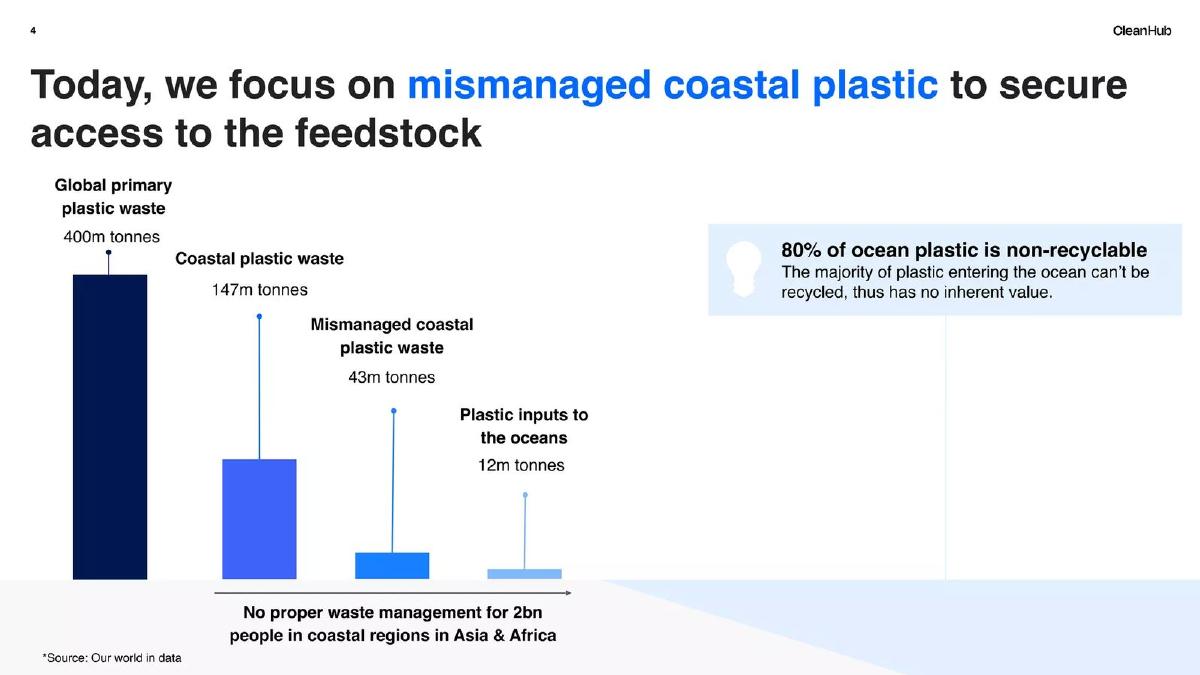
- CleanHub identifies a massive supply gap, noting that 80% of ocean plastic is non-recyclable and currently has no inherent value (Slide 4).
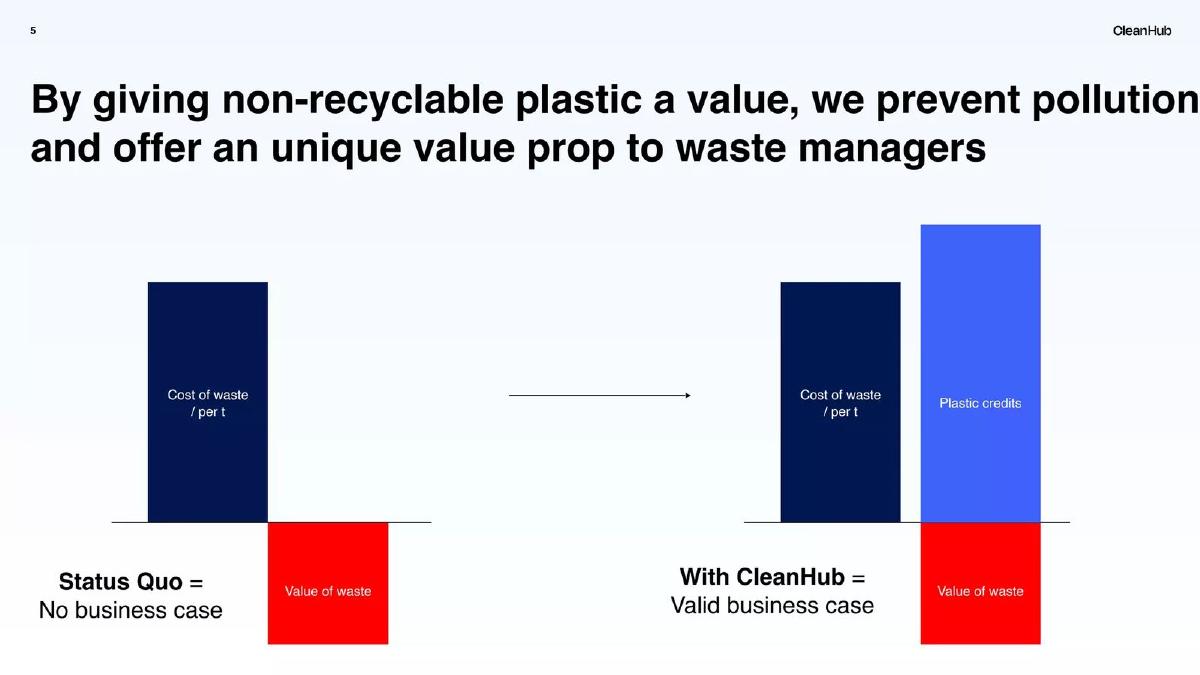
- The business model relies on 'Plastic Credits' to turn a negative-value waste management case into a profitable one for local managers (Slide 5).
- A three-pronged marketplace approach connects brands (cash flow), track-and-trace technology (data flow), and waste companies (content flow) (Slide 7).
- The technology stack uses computer vision to estimate waste volume and density with 98.5% precision, reducing human review to under 10% (Slide 10).
- The market strategy targets a €24bn launch market of SMBs in DACH, UK, and US before expanding to a €170bn raw material trade (Slide 12).
- The deck is missing a financial slide, a competition slide, and a specific funding request or use-of-funds breakdown.
- CleanHub positions itself as the 'digital infrastructure' for waste management, emphasizing ISO/IEC 14064-3 conformity audited by TÜV Süd (Slide 9).
CleanHub Slide-by-Slide Teardown
Slide 1: Title Slide
The deck opens with a minimalist title slide featuring the CleanHub logo and a high-resolution image of ocean water. It establishes the brand identity immediately but lacks a sub-headline or mission statement that explains what the company does. While clean, it relies entirely on the subsequent slides to provide context.
Slide 2: The Founder Team
CleanHub leads with its team, which is a strong tactical choice for a seed-stage company. The slide highlights three founders: Joel (Product & Waste Management), Louis (GTM & Ops), and Florin (CTO). The pedigree is impressive, citing experience at Avrios , Lehman Brothers , Delivery Hero , Treatwell , and Mila . Notably, Joel is listed as a 'Certified waste management officer,' providing the necessary domain expertise to balance the tech-heavy backgrounds of the other founders. The inclusion of logos at the bottom reinforces their professional history in high-growth environments.
Slide 3: The Vision and Market Opportunity
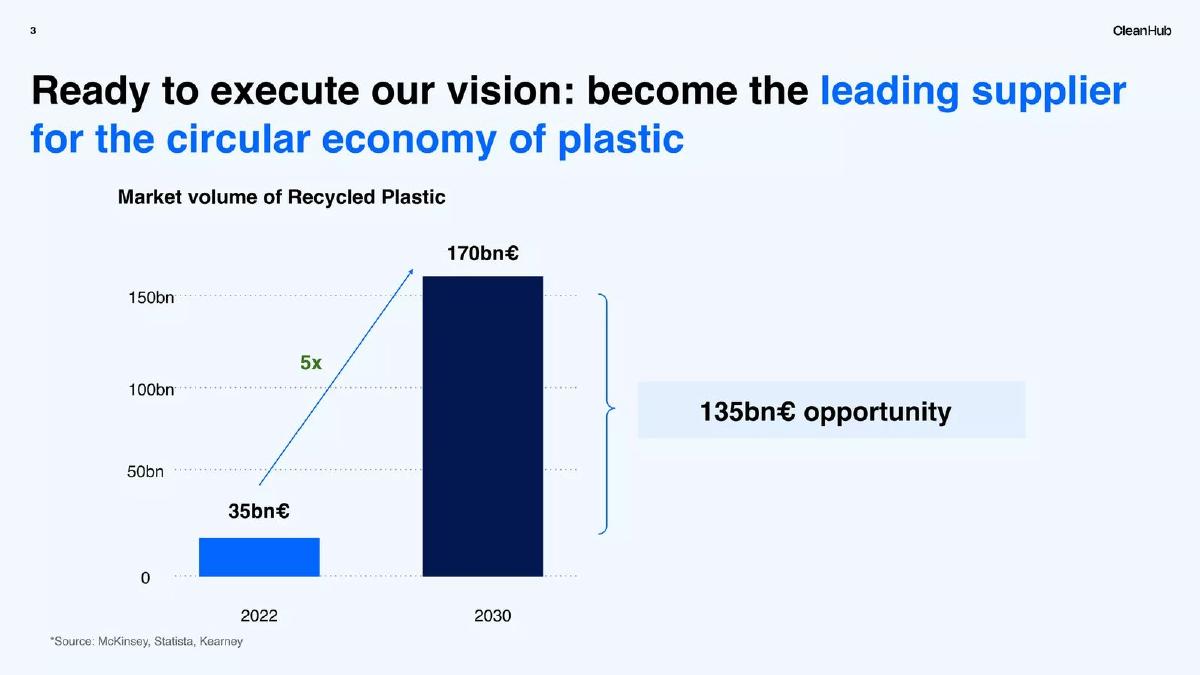
This slide sets the stage for a massive market play. It claims a vision to become the 'leading supplier for the circular economy of plastic.' Using data from McKinsey, Statista, and Kearney, it shows the market volume of recycled plastic growing from 35bn€ in 2022 to 170bn€ in 2030 . This 5x growth represents a 135bn€ opportunity . By framing the problem as a supply chain opportunity rather than just a charity project, they appeal to venture scale logic.
Slide 4: The Problem - Mismanaged Coastal Plastic
CleanHub narrows its focus to 'mismanaged coastal plastic.' The slide uses a funnel graphic to show that of the 400m tonnes of global primary plastic waste, 12m tonnes end up in the ocean. A critical 'lightbulb' insight is provided: 80% of ocean plastic is non-recyclable and therefore has no inherent value. This explains why the current market fails to solve the problem: there is no profit in picking up most of the trash. The slide also notes that 2bn people in Asia and Africa lack proper waste management.
Slide 5: The Solution - Giving Waste Value
This is the 'aha' moment of the deck. It compares the 'Status Quo' (where the cost of waste exceeds its value, resulting in no business case) with the 'CleanHub' model. By adding Plastic Credits to the equation, the total value of the waste now exceeds the cost of collection. This creates a 'valid business case' for waste managers to operate in regions they previously ignored.
Slide 6: The Marketplace Transition
A simple transition slide stating that CleanHub allows brands to act on their plastic footprint via its marketplace . It serves as a bridge between the 'why' (market failure) and the 'how' (the platform).
Slide 7: Marketplace Mechanics
This slide illustrates the three-way flow of the platform. Brands provide cash flow for plastic recovery and receive data and content. CleanHub acts as the central hub, providing the marketplace, track-and-trace data, and a content hub. Local waste companies collect and sort the plastic, uploading proof of work to receive payment. This clearly defines the value proposition for each stakeholder: brands get impact/marketing assets, and waste managers get steady income.
Slide 8: Digital Infrastructure
A bold statement slide: 'We build the digital infrastructure for waste management - secure, compliant and scalable.' This positions CleanHub as a software-first company rather than a logistics company, which is vital for achieving SaaS-like valuations in a physical industry.
Slide 9: ISO Certified Track-&-Trace
CleanHub details its five-step process: Collect, Register, Sort, Clear, and Certify . The slide emphasizes that every step is documented via a proprietary app. A key trust signal is the TÜV Süd logo, confirming conformity assessment according to ISO/IEC 14064-3 . This addresses the 'greenwashing' concern by showing an unbroken audit trail from the collection point to the final destination (e.g., a cement plant).
Slide 10: AI Verification
This slide focuses on the technical defensibility of the platform. It explains how computer vision models and instance segmentation are used to estimate the volume and density of waste bags. The metrics are specific: 60k evidence uploads , 98.5% precision , and less than 10% human review needed . This demonstrates scalability; the system can handle massive growth without a linear increase in manual auditing costs.
Slide 11: Value for Waste Managers
CleanHub reiterates the benefits for the supply side: additional income, higher collection efficiency leading to increased profitability, and access to technology to improve operations. This slide is likely intended to show investors that CleanHub has a sustainable way to acquire and retain the 'supply' side of their marketplace.
Slide 12: Market Expansion and TAM
The final slide breaks down the Total Addressable Market (TAM). It identifies a €24bn launch market (Plastic Credits for SMBs in DACH, UK, & US), a €51bn TAM for enterprise plastic credits, and the ultimate €170bn opportunity in raw material trade. The footnotes provide the math: 1.7m brands x $15,000 for the launch market. This gives investors a clear roadmap from a niche entry point to a global commodity play.
What CleanHub Does Well
Clear Economic Logic: The deck does an excellent job of explaining why the current waste management system is broken (non-recyclable plastic has no value) and how their financial product (credits) fixes the incentive structure. · Technical Credibility: By highlighting ISO certifications and specific AI precision metrics (98.5%), they move beyond 'impact' fluff and into 'infrastructure' reality. · Pedigreed Team: The founder slide is exceptionally strong, showing a mix of logistics, marketplace, and waste management experience.
What is Missing from the CleanHub Deck
Traction Data: While they mention 60k evidence uploads, they don't disclose how many brands are paying, what the current revenue is, or the total tonnage of plastic removed to date. · Competitive Landscape: There is no mention of other plastic credit providers (like RePurpose Global or PCX) or how CleanHub's technology differs from competitors. · The Ask: The deck ends abruptly. There is no slide detailing how much they are raising (though the source listing says $7M), what the valuation is, or how the funds will be allocated (hiring, geographic expansion, R&D). · Unit Economics: There is no breakdown of the take-rate or the margin CleanHub earns on each plastic credit sold.
Founder Takeaways
Quantify the 'Un-quantifiable': If you are in the impact space, follow CleanHub’s lead by using technical metrics (precision rates, ISO standards) to prove your impact is real and scalable. · Focus on the 'Business Case': Don't just pitch a problem; pitch why the problem exists due to market failure, and show how your product creates a new economic equilibrium. · Use a 'Land and Expand' TAM: CleanHub’s Slide 12 is a masterclass in showing a realistic starting point (€24bn) while still pointing toward a massive long-term vision (€170bn).
Frequently asked questions
- What is the core problem CleanHub is solving?
- CleanHub targets the 80% of ocean plastic that is non-recyclable. Because this plastic has no inherent market value, it is often mismanaged or dumped. CleanHub creates a 'business case' for collecting this waste by introducing plastic credits, which provide the necessary funding for waste managers to collect, sort, and process materials that would otherwise be economically unviable to handle.
- How does CleanHub verify that the plastic was actually collected?
- They use an ISO-certified track-and-trace technology. Waste managers use a proprietary app to document every step from collection to arrival at a processing plant (like a cement plant). This data is then verified by AI computer vision models that estimate volume and density to detect anomalies, achieving a stated 98.5% precision rate in evidence verification.
- Who are the primary customers for CleanHub?
- The deck identifies two sides of the marketplace. On the demand side, they target brands (specifically SMBs in the DACH region, UK, and US) looking to act on their plastic footprint. On the supply side, they partner with local waste management companies in coastal regions of Asia and Africa where proper waste management is currently lacking for 2 billion people.
- What is the long-term market vision for the company?
- While they are starting with plastic credits for SMBs (a €24bn market), the ultimate goal is to become the leading supplier for the circular economy of plastic. They aim to facilitate the raw material trade for recycled plastic, which they estimate will be a €170bn market by 2030 as they build denser networks of collection hubs.
- What critical information is missing from this pitch deck?
- The deck is highly focused on vision and mechanics but lacks 'hard' traction data. There are no mentions of current monthly recurring revenue (MRR), the number of active brand partners, or the total volume of plastic collected to date. Additionally, there is no slide detailing the competitive landscape or the specific terms of the $7M funding round.