RealFriend’s 14-slide deck from February 2020 is a masterclass in prioritizing user sentiment and engagement metrics over traditional financial projections. The company, which raised $4.4M in Seed funding, positions its AI assistant, 'Luke,' not as a tool, but as a 'friend' for home seekers. By showcasing an NPS of 65 in Tel Aviv and 40 in New York, the founders demonstrated product-market fit in a notoriously difficult sector. The business model is a straightforward 25% referral fee from agents, targeting a $10 billion referral market. While the deck lacks a detailed roadmap, competitor matr…
Key takeaways
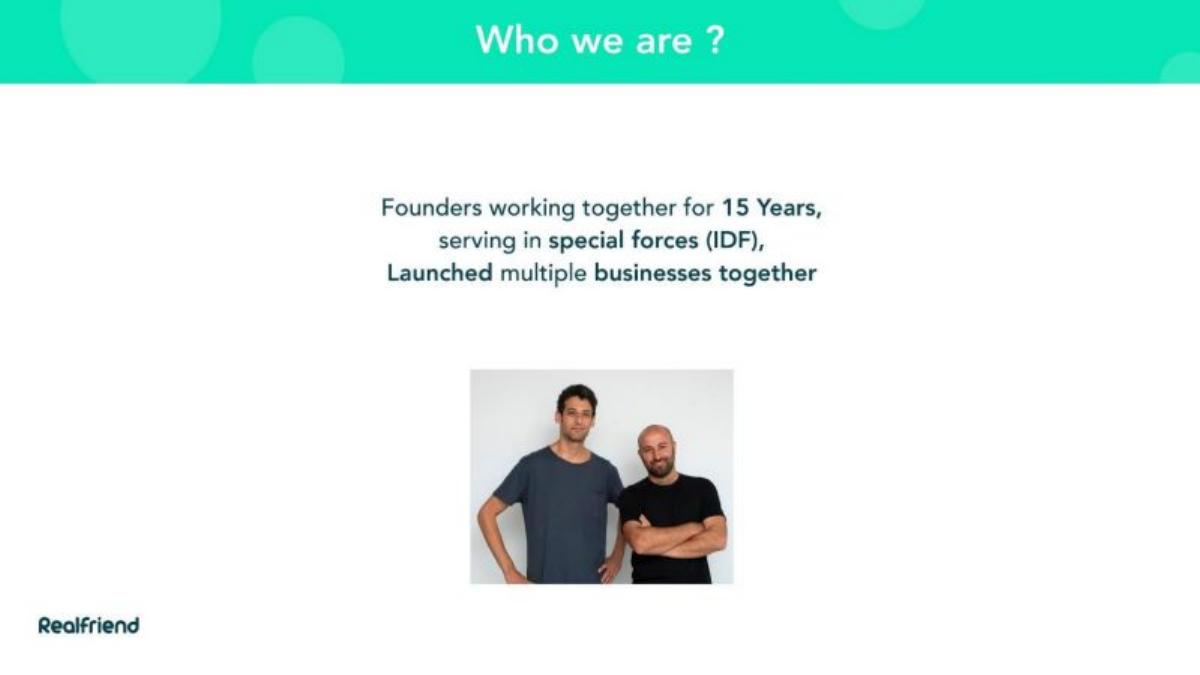
- The founders emphasize a 15-year working relationship and shared background in the IDF special forces on slide 2.
- RealFriend positions itself as a 'Hybrid AI RealEstate assistant' that operates via 24/7 chat on slide 5.
- The company claims to be the market leader in the Tel Aviv rental market, having interacted with 53.8K users in a city with 50K annual rentals (slide 8).
- Engagement in the New York beta grew at 25% month-over-month as of February 2020 (slide 9).
- The deck highlights a Net Promoter Score (NPS) of 65 in Tel Aviv, comparing it to aspiration brands like Tesla and Airbnb (slide 11).
- The business model relies on a 25% referral fee from agents, targeting a $100B commission pool (slide 12).
- The 'Why Now' slide notes that 60 billion messages are exchanged daily and millennials make up 40% of US home buyers (slide 7).
- The deck completely omits a financial 'Ask' slide, a detailed use of funds, or a competitive landscape analysis.
RealFriend: The Conversational AI Approach to PropTech
RealFriend’s February 2020 pitch deck is a focused narrative on user experience and market traction. At a time when many PropTech companies were building complex web portals, RealFriend bet on a 'Hybrid AI' chat interface. This teardown examines how they used high-engagement metrics and founder pedigree to secure a $4.4M Seed round.
Slides 1-2: The Team and the Bond
The deck opens with a simple title slide (Slide 1) introducing 'Luke' and 'Dooron,' the two founders based in NYC and Tel Aviv respectively. The subtitle, 'Your AI assistant for all things real estate,' immediately establishes the product category. Slide 2 is the primary team slide, and it is notably light on specific past company names or titles. Instead, it focuses on the strength of the partnership: 15 years of working together, service in the IDF special forces, and a history of launching multiple businesses. This is a classic 'bet on the jockey' move, signaling to investors that the team is battle-tested and cohesive.
Slides 3-6: Vision and Product Experience
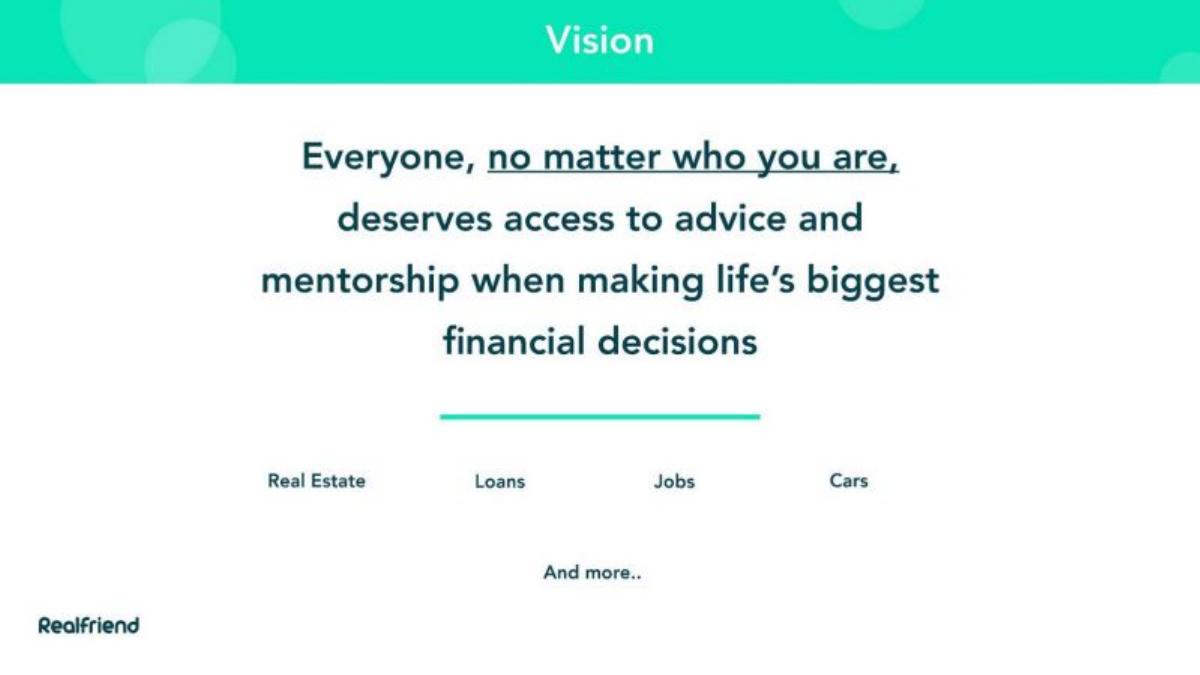
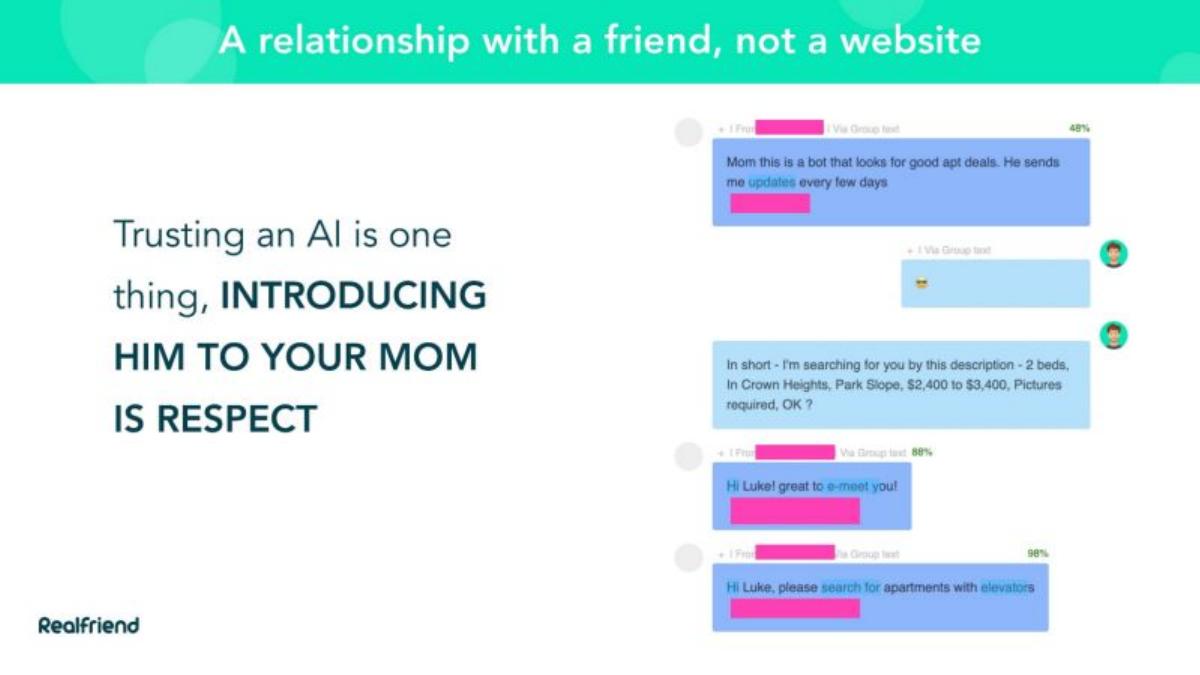
Slide 3 expands the vision beyond real estate, suggesting that the AI assistant model could eventually apply to loans, jobs, and cars. This is a common tactic to show a massive Total Addressable Market (TAM) beyond the initial niche. Slide 4 introduces the emotional hook: 'A relationship with a friend, not a website.' It uses a screenshot of a group text where a user introduces the bot to their mother, framing the AI as a trusted entity rather than just a tool. Slide 5 and 6 provide a deep dive into the product interface. The screenshots show 'Luke' (the AI) handling complex queries, scheduling showings, and providing data-driven insights (e.g., 'it's 11.5% lower than the average 1 bed apt in the area'). The product is described as 'Hybrid AI,' implying there may be human-in-the-loop elements to ensure accuracy.
Slide 7: The 'Why Now'
RealFriend justifies its existence through four key points on Slide 7 . They highlight that chat is the preferred medium for millennials, citing 60 billion messages exchanged daily. Most importantly, they note that millennials make up 40% of US home buyers. This slide successfully connects a demographic shift with a specific communication preference, creating a sense of urgency for a chat-based real estate solution.
Slides 8-11: Traction and Sentiment Metrics
The meat of the deck lies in its traction slides. Slide 8 focuses on Tel Aviv, where the company launched in 2018. They claim to be the market leader in rentals, having spoken with 53.8K 'friends' in a city where only 50K apartments are rented annually. This implies near-total market penetration. Slide 9 covers the New York beta, launched in March 2019. Key metrics include 2,500 monthly active users and 25% month-over-month growth in engagement. Slide 10 uses qualitative data, showing screenshots of users sending 'LUV U' messages and cat GIFs to the bot, reinforcing the 'friend' branding. Slide 11 is perhaps the most important slide in the deck. It plots RealFriend's NPS (65 in Tel Aviv, 40 in New York) against competitors and aspirational brands. They place Zillow at an NPS of -8 and 'AI assistants' like Alexa in the 30-40 range, positioning RealFriend as a superior user experience.
Slides 12-13: Business Model and Problem Statement
Slide 12 outlines a simple, scalable revenue model: a 25% referral fee from agents. They visualize this against a $100 billion commission market, identifying a $10 billion slice for referral fees. This clarity is helpful for investors who might worry about how a 'free' assistant makes money. Curiously, the 'Problem & Opportunity' slide ( Slide 13 ) appears near the end of the deck rather than the beginning. It reiterates that home searching is a 'headache' and offers the solution of having someone do it for free.
What Works in the RealFriend Deck
Focus on NPS: By highlighting an NPS of 65, the founders proved that users don't just use the tool—they like it. In a crowded PropTech market, high sentiment is a strong differentiator. · Founder History: The '15 years together' and 'Special Forces' callouts on Slide 2 provide a level of de-risking regarding team dynamics that is rare in Seed rounds. · Demographic Alignment: Slide 7 does a great job of explaining why a chat interface is the correct 'form factor' for the modern home buyer. · Traction vs. Market Size: Slide 8 provides a very specific comparison (53.8K users vs. 50K rentals) that makes their market dominance in Tel Aviv feel tangible.
What is Missing from the RealFriend Deck
The Ask: There is no slide detailing how much money is being raised, the valuation, or the specific milestones the funding will achieve. · Competitive Landscape: While they mention Zillow on the NPS slide, there is no comprehensive matrix comparing RealFriend to other AI-driven search tools or traditional brokerages. · Unit Economics: While they mention the 25% referral fee, they do not disclose the Customer Acquisition Cost (CAC) or the Lifetime Value (LTV) of a user, which are critical for a Seed-stage referral business. · Technology Deep-Dive: For a company calling itself 'Hybrid AI,' there is very little information on the proprietary nature of their tech or how they handle data ingestion from real estate listings.
Founder Lessons
Lead with the 'Who': If you have a long, successful history with your co-founder, make that a central pillar of your pitch. Investors at the Seed stage are buying the team as much as the idea. · Use Qualitative Proof: Don't just show charts. Screenshots of users actually enjoying your product (like the 'LUV U' texts on Slide 10) can humanize your data and make a lasting impression. · Benchmark Your NPS: If your Net Promoter Score is high, don't just state the number. Compare it to the industry standard and the 'gold standard' brands to give it context, as seen on Slide 11. · Keep the Business Model Simple: RealFriend didn't overcomplicate their revenue. A single, clear percentage (25% referral fee) is much easier to sell than a multi-tiered subscription model in an early-stage deck.
Frequently asked questions
- How much did RealFriend raise with this deck?
- According to the catalogue facts, RealFriend raised $4.4M in a Seed round in 2020. Interestingly, the deck itself does not include a slide specifying the amount being raised or the valuation sought, which is common in decks designed for initial interest rather than final closing.
- What is the core business model of RealFriend?
- As stated on slide 12, the business model is a referral-based system. RealFriend collects a 25% referral fee from real estate agents who work with the platform. They estimate the total addressable market for these fees at $10 billion, derived from a larger $100 billion pool of real estate commissions.
- How does the company measure product success?
- RealFriend relies heavily on Net Promoter Score (NPS) and engagement growth. Slide 11 shows an NPS of 65 in Tel Aviv and 40 in New York. They also cite a 'Product-Market Fit' metric on slide 9, stating that 60% of users would be 'very disappointed' if they could no longer use the service.
- Who are the founders and what is their background?
- The founders are Luke (based in NYC) and Dooron (based in Tel Aviv). Slide 2 highlights that they have worked together for 15 years, served in the Israel Defense Forces (IDF) special forces, and have launched multiple businesses together previously.
- What market problem does RealFriend aim to solve?
- Slide 13 defines the problem as the 'headache and frustrating task' of finding a home to rent or buy in 2020. Their solution is a free AI assistant that performs the search on behalf of the user, leveraging the fact that millennials prefer chat-based communication (slide 7).