The reDock pitch deck is a masterclass in brevity and authority. In just 9 slides, the company establishes a massive $25B problem and immediately validates its solution through the founder’s unique technical pedigree—specifically, writing AI for the Assassin’s Creed franchise. This 'unfair advantage' is paired with high-impact social proof, featuring logos from global consulting giants like PwC, KPMG, and BDO. While the deck lacks traditional deep dives into unit economics or a detailed competitive landscape, it compensates with a clear value proposition: automating the grueling RFP process.…
Key takeaways
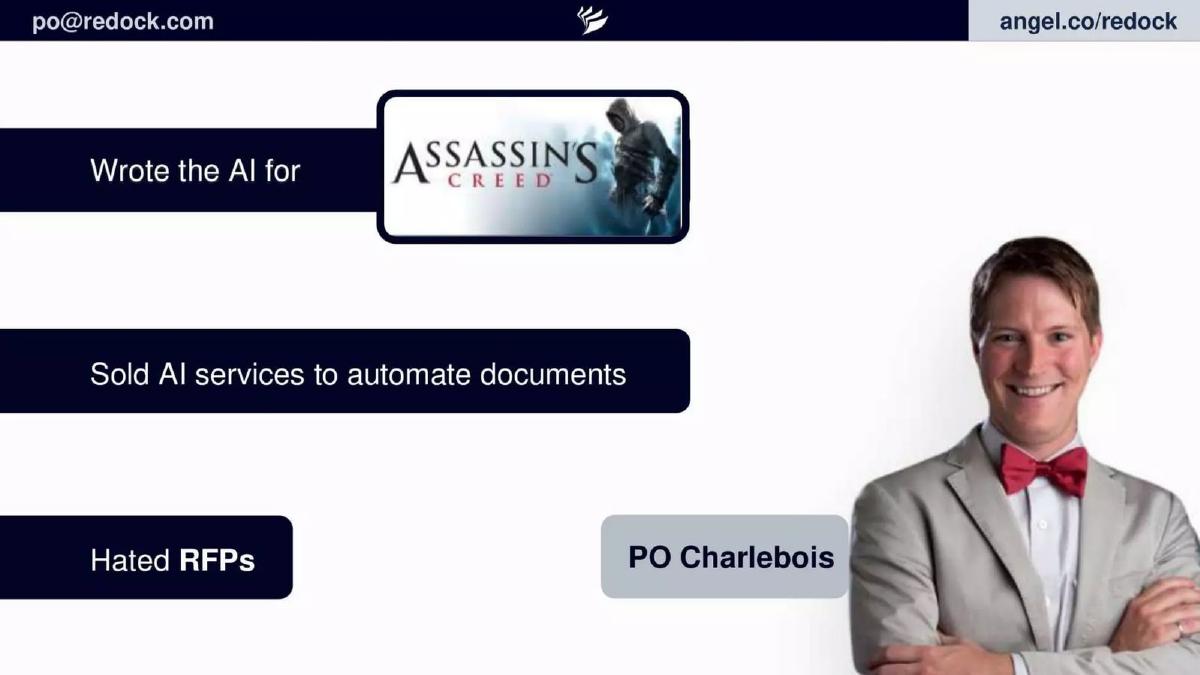
- The deck leads with founder pedigree, highlighting that PO Charlebois wrote the AI for Assassin's Creed on slide 2.
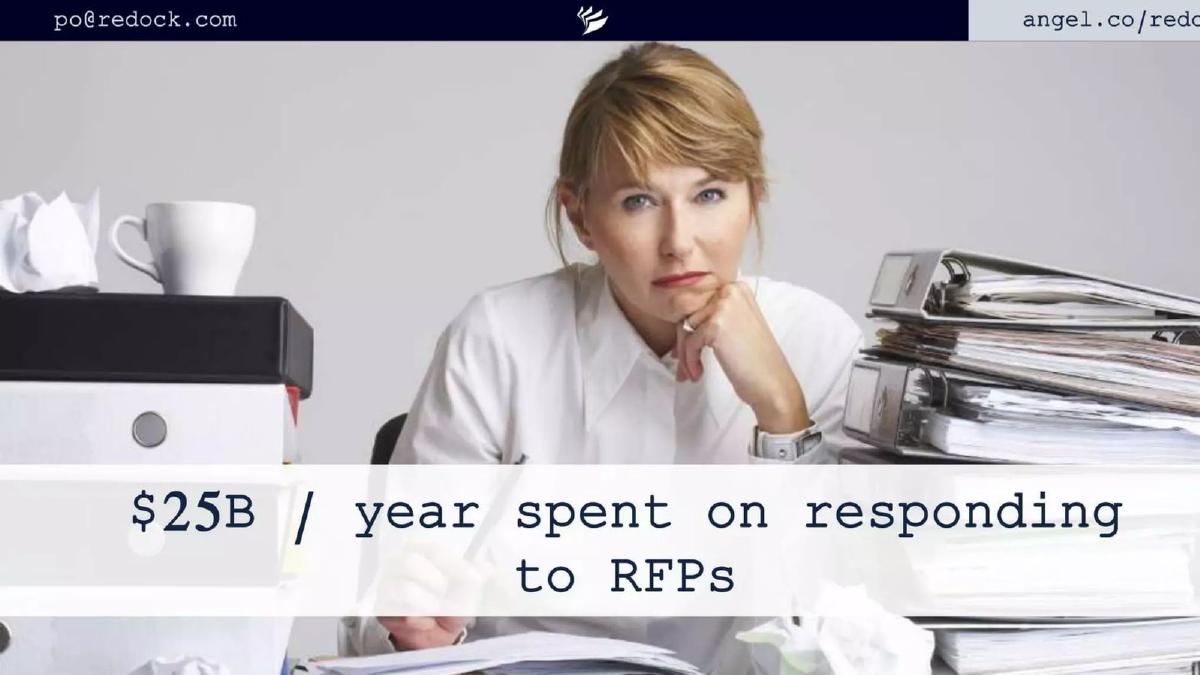
- Market size is defined simply as a $25B per year spend on responding to RFPs on slide 3.
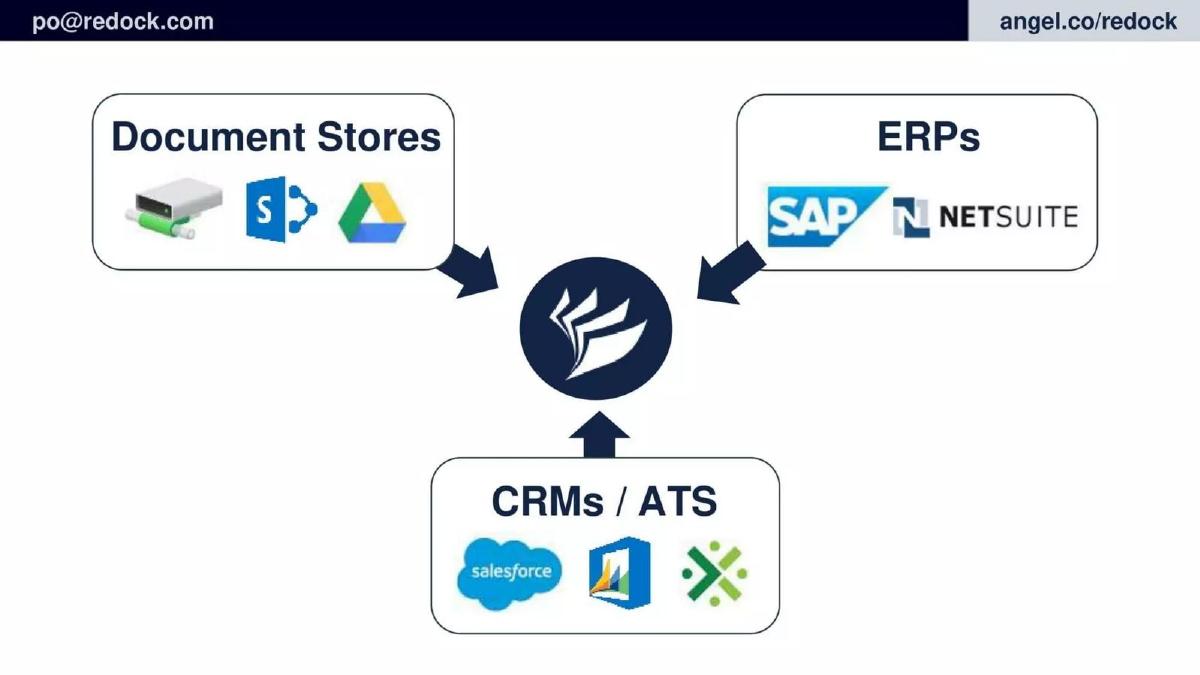
- The product architecture emphasizes integration with existing enterprise stacks including SAP, NetSuite, and Salesforce on slide 4.
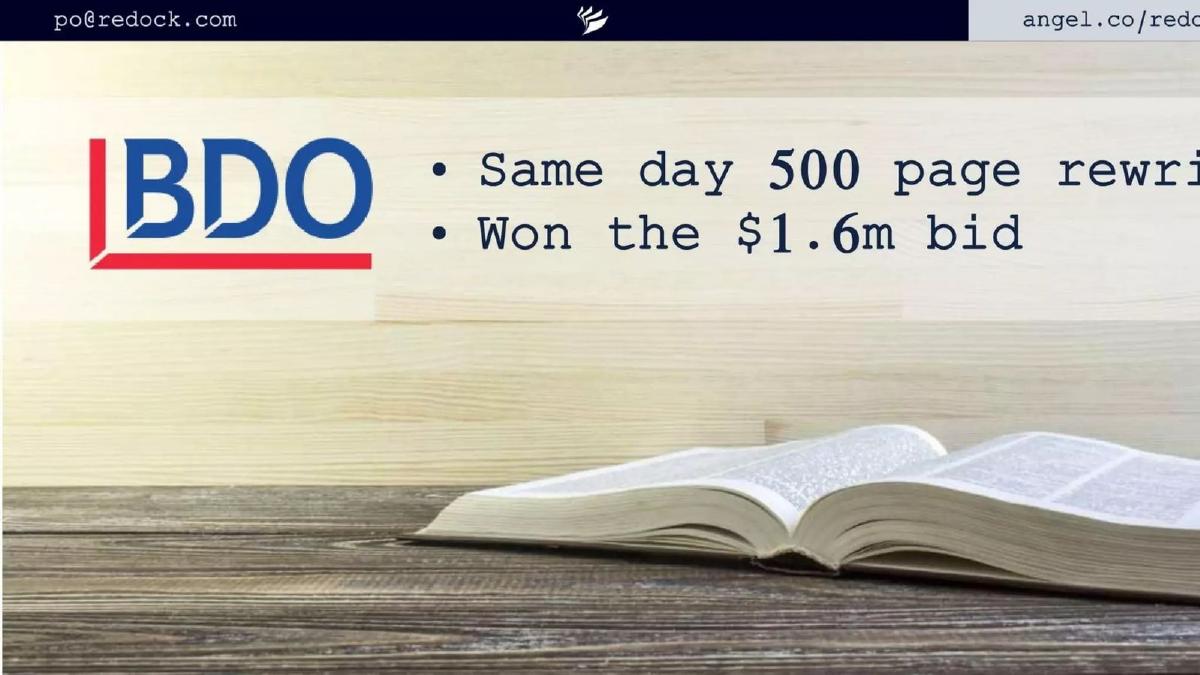
- A specific case study for BDO claims a 'Same day 500 page rewrite' that won a $1.6M bid on slide 6.
- Social proof is a core pillar, displaying six major enterprise logos including PwC, KPMG, and Adecco on slide 7.
- The company reported $300k in ARR and a $3m pipeline as of its November 2016 launch period on slide 8.
- The deck omits a formal 'Ask' slide, leaving the specific funding requirements to the catalogue facts which state $1,000,000 was raised.
- Visuals are prioritized over text, with several slides containing fewer than 10 words to maintain focus on the narrative.
The Power of the 'Unfair Advantage'
The reDock pitch deck from 2016 is a lean, 9-slide presentation that successfully secured $1,000,000 in Seed funding. In an era where AI pitches are often cluttered with jargon, reDock took a different path: they focused on the person behind the code and the massive organizations already paying for it. This teardown examines how a minimalist approach can work when the traction and pedigree are undeniable.
Slide 1: The Hook
The cover slide is functional and minimalist. It features the reDock logo and the tagline: "AI that Builds Winning Proposals." Notably, the slide includes direct contact information (po@redock.com) and a link to their AngelList profile in the header. This immediately signals that the deck is a tool for outreach and investor interest. The background imagery of layered, translucent panes suggests document processing and depth without being overly literal.
Slide 2: The Founder and the Pedigree
This is arguably the most important slide in the deck. Instead of a traditional team slide with four headshots and bulleted resumes, reDock focuses on a single individual: PO Charlebois . The slide lists three key facts: "Wrote the AI for Assassin's Creed," "Sold AI services to automate documents," and "Hated RFPs." By linking high-end gaming AI—one of the most complex fields in software engineering—to the mundane world of RFPs, the deck establishes an 'unfair advantage.' It suggests that if this founder can build the logic for a global gaming franchise, he can certainly handle document automation.
Slide 3: The $25 Billion Problem
Slide 3 uses a stock photo of a frustrated office worker buried in paperwork to illustrate the pain point. The text is stark: "$25B / year spent on responding to RFPs." This slide establishes the Total Addressable Market (TAM) not through a complex bottom-up calculation, but by highlighting the sheer volume of administrative waste in the current system. It frames the problem as a financial drain on enterprises, setting the stage for a high-ROI solution.
Slide 4: The Integration Ecosystem
To sell to the enterprise, you must prove you can play with their existing toys. Slide 4 shows the reDock logo at the center of an ecosystem. It pulls data from three main sources: Document Stores (SharePoint, Google Drive), ERPs (SAP, NetSuite), and CRMs / ATS (Salesforce, Microsoft Dynamics, Bullhorn). This slide addresses a major technical hurdle: data silos. It promises that reDock isn't just another place to type, but a layer that sits on top of the company's entire knowledge base.
Slide 5: The Workflow
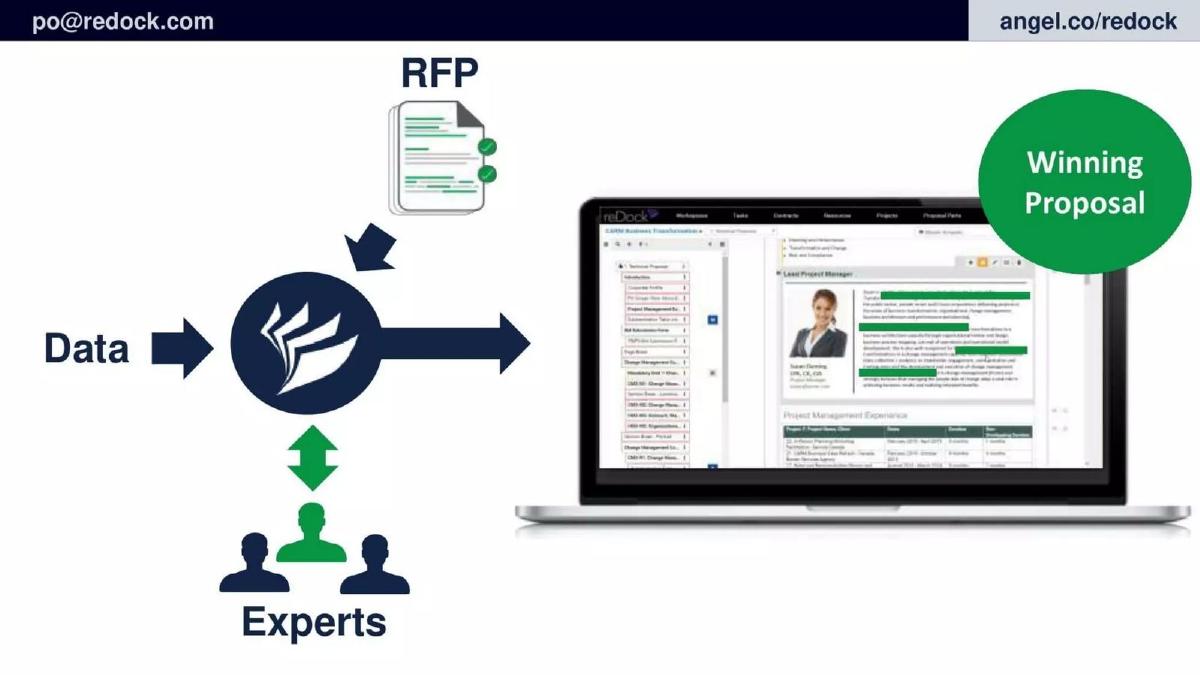
This slide visualizes the product in action. It shows Data , RFPs , and Experts all feeding into the reDock engine. The output is a screenshot of the software interface, which looks clean and professional, leading to a green circle labeled "Winning Proposal." This simplifies a complex process into a clear input-output machine, emphasizing that the software augments human experts rather than replacing them entirely.
Slide 6: The BDO Case Study
Traction is best proven through specific results. Slide 6 features the BDO logo and two powerful bullet points: "Same day 500 page rewrite" and "Won the $1.6m bid." This is the ultimate 'so what' for an investor. It proves the software can handle massive scale (500 pages), extreme speed (same day), and deliver a tangible financial outcome (a $1.6M win). This single slide does more work than five slides of feature descriptions.
Slide 7: Social Proof and Logos
Slide 7 is a classic 'logo wall' set against a backdrop of a bustling city. It features PwC, BDO, Cofomo, KPMG, Adecco, and Welch LLP. For a Seed stage company in 2016, this is an extraordinary list of customers. It demonstrates that reDock has already bypassed the 'innovator' stage and moved into the 'early adopter' phase with some of the most conservative and rigorous buyers in the professional services world.
Slide 8: The Traction Graph
The penultimate slide provides the hard numbers. It shows a timeline starting in Nov 2016 when they "Launched." The central bubble shows "$300k ARR," and the final bubble shows a "$3m Pipeline." This indicates that the company is not just a project but a growing business with a 10x pipeline-to-revenue ratio, which is a healthy indicator for a Seed round investment.
Slide 9: The Vision
The final slide returns to the branding of the first, with the closing tagline: "The Time to Think. The Data to Win." It reinforces the value proposition that reDock frees up human intelligence by handling the data-heavy lifting of proposal writing.
What Works
Extreme Focus on Pedigree: By highlighting the Assassin's Creed AI connection, the deck solves the 'why you' question immediately. It makes the technical challenge of RFP automation seem trivial by comparison. · High-Value Case Studies: The BDO slide is a perfect example of how to present a case study. It focuses on the most impressive metrics (500 pages, $1.6M win) rather than the process. · Enterprise Readiness: The integration slide (Slide 4) speaks directly to the concerns of a CTO or Head of Sales at a large firm, showing that the tool fits into their existing workflow. · Brevity: With only 9 slides and very little text, the deck is designed to be read in under two minutes, making it highly shareable among busy partners at VC firms.
What is Missing
The Team: While the founder's pedigree is excellent, the deck does not mention a CTO, a sales lead, or any other team members. Investors usually want to see a balanced team, even at the Seed stage. · The Ask: There is no slide detailing how much money they are raising or what they plan to do with it. While the catalogue facts state they raised $1M, the deck itself leaves this to the conversation. · Competition: The deck completely ignores the competitive landscape. In 2016, there were already several RFP automation tools on the market. Failing to acknowledge them can sometimes be seen as a lack of market awareness. · Business Model: There is no mention of pricing. Is it per seat? Per proposal? A flat enterprise fee? While the ARR is stated, the mechanics of how they get there are absent.
What a Founder Should Copy
The 'Unfair Advantage' Slide: If you have a unique background that makes you the perfect person to solve a specific problem, make that your second slide. Don't bury it in a team slide at the end. · The Outcome-Oriented Case Study: Use the BDO format. Logo + Speed Metric + Financial Result. It is the most persuasive way to show product-market fit. · Minimalist Design: Notice how few words are on each slide. This forces the presenter to tell a story and prevents the audience from squinting at small text instead of listening. · Pipeline Transparency: Showing a pipeline that is significantly larger than your current ARR (in this case, 10x) is a great way to show future potential and justify a higher valuation.
Frequently asked questions
- How does reDock prove its AI actually works?
- Instead of technical whitepapers, reDock uses 'pedigree by association.' Slide 2 highlights that the founder wrote the AI for the blockbuster game Assassin's Creed. This suggests a level of technical sophistication far beyond standard template software. They follow this up with a concrete result on slide 6: a 500-page document rewrite completed in a single day for BDO, which resulted in a $1.6M win.
- What is the primary market reDock is targeting?
- The deck targets the professional services and enterprise sector. Slide 7 features logos for PwC, KPMG, BDO, and Welch LLP—all major accounting and consulting firms. These organizations live and die by Request for Proposals (RFPs), making them the ideal high-contract-value customers for a tool that claims to make the process ten times faster.
- Is there a clear explanation of the technology?
- The deck remains high-level regarding the 'how.' Slide 4 shows that the system pulls from Document Stores, ERPs, and CRMs. Slide 5 illustrates a workflow where data and experts feed into the reDock engine to produce a 'Winning Proposal.' It focuses on the inputs and outputs rather than the specific machine learning models used.
- What traction did reDock have at the time of this deck?
- According to slide 8, the company had reached $300,000 in Annual Recurring Revenue (ARR) by November 2016. Furthermore, they claimed a sales pipeline of $3 million, indicating significant market interest and a repeatable sales motion among the enterprise clients listed earlier in the deck.
- What are the biggest missing elements in this deck?
- The deck is missing several standard venture components: a competitor slide, a detailed team slide (only the founder is shown), a business model/pricing slide, and a specific 'Ask' slide detailing how the $1M would be spent. It relies almost entirely on the strength of its current traction and the founder's background.