Reducto’s 13-slide deck is a masterclass in technical differentiation through visual evidence. By focusing on the specific failure modes of current LLMs—namely their inability to parse complex document structures like tables in PDFs—Reducto positions itself as the essential infrastructure layer for enterprise AI. The deck avoids abstract promises, instead showing side-by-side comparisons of ChatGPT and Claude failing to extract data that Reducto handles accurately. With a reported $8.4M Seed round in 2024, the company leveraged rapid traction metrics, showing a steep growth curve from zero to…
Key takeaways
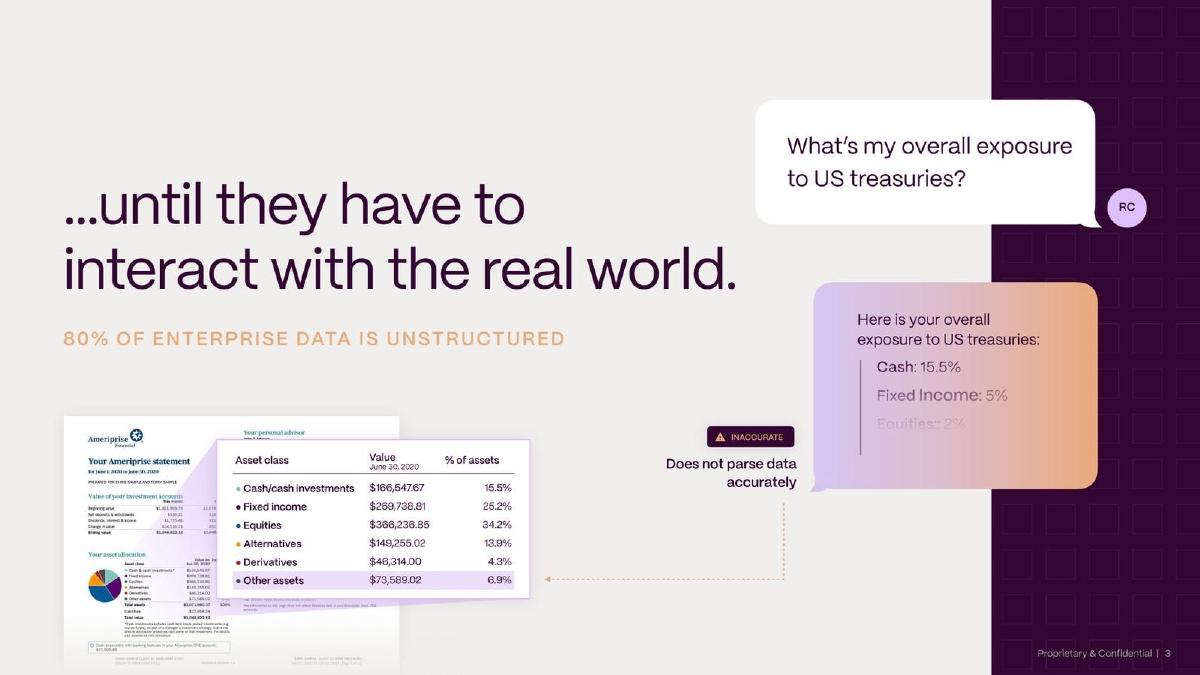
- Reducto identifies that 80% of enterprise data is unstructured, creating a massive bottleneck for LLM adoption (Slide 3).
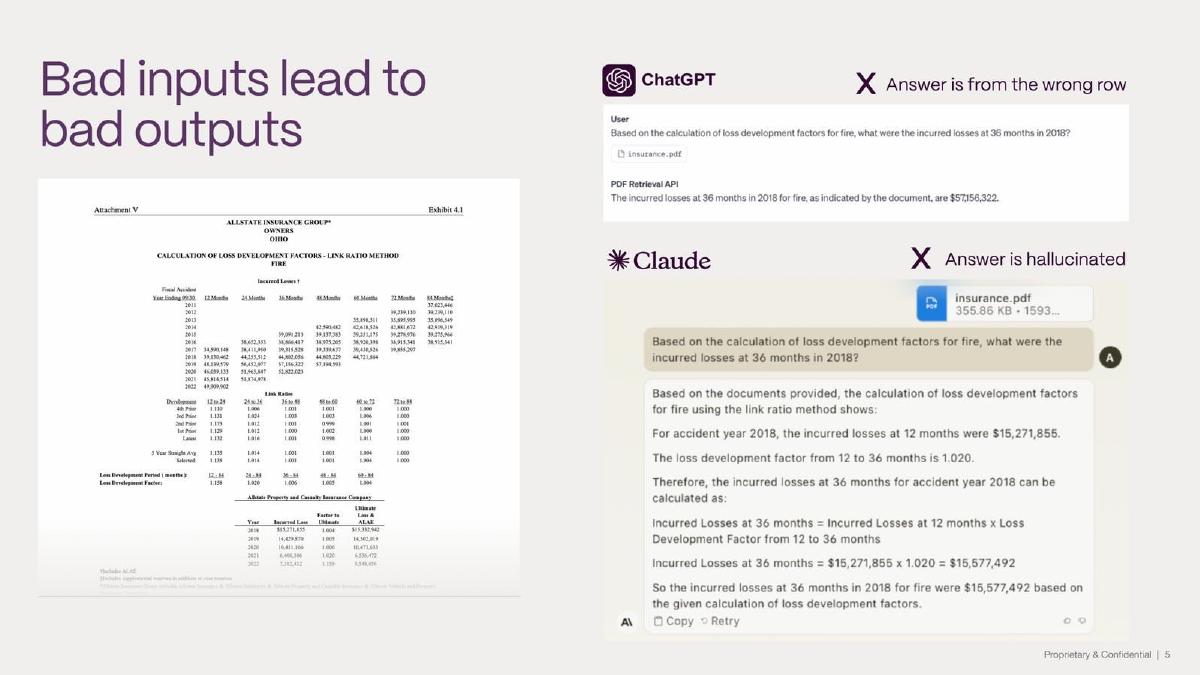
- The deck uses specific examples of 'hallucinated' and 'wrong row' answers from ChatGPT and Claude to prove the need for a better ingestion tool (Slide 5).
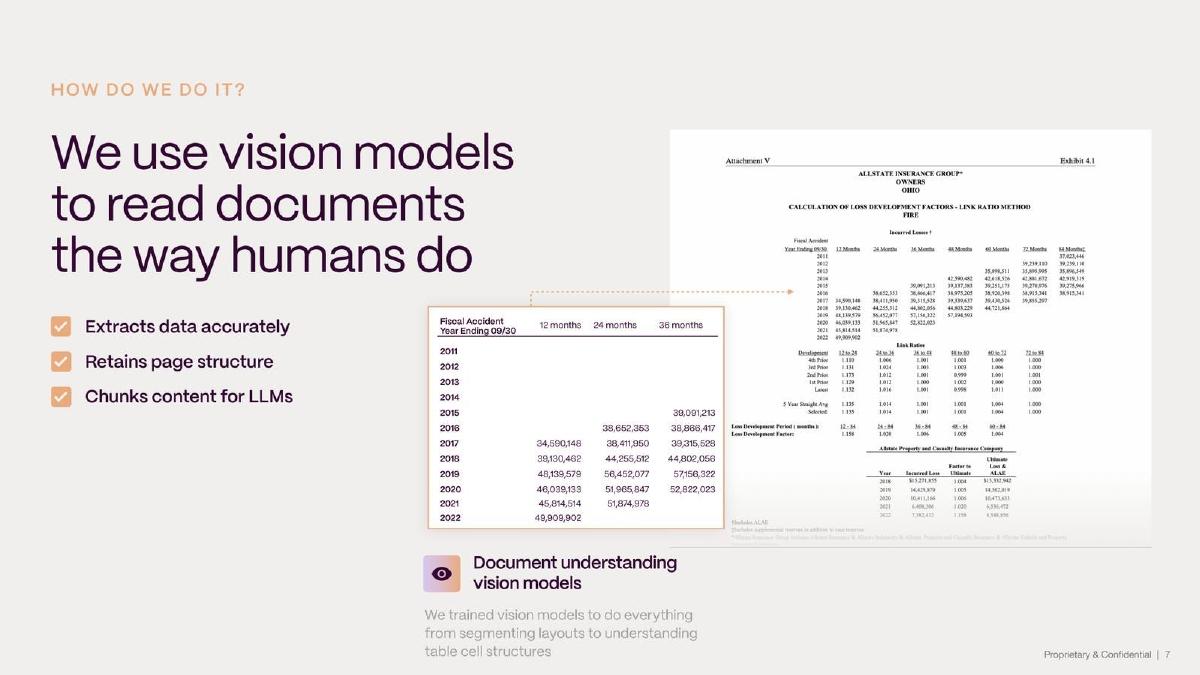
- The technical solution centers on using vision models to read documents 'the way humans do,' rather than relying on text-only parsing (Slide 7).
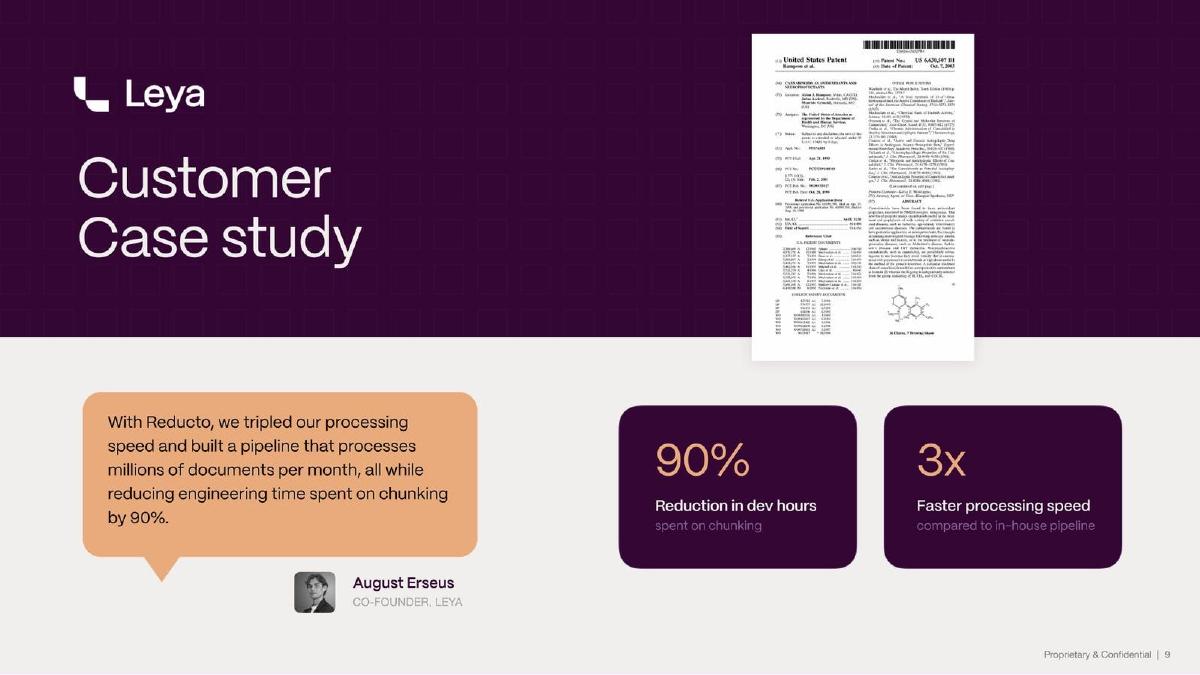
- A case study with Leya claims a 90% reduction in developer hours spent on chunking and 3x faster processing speeds (Slide 9).
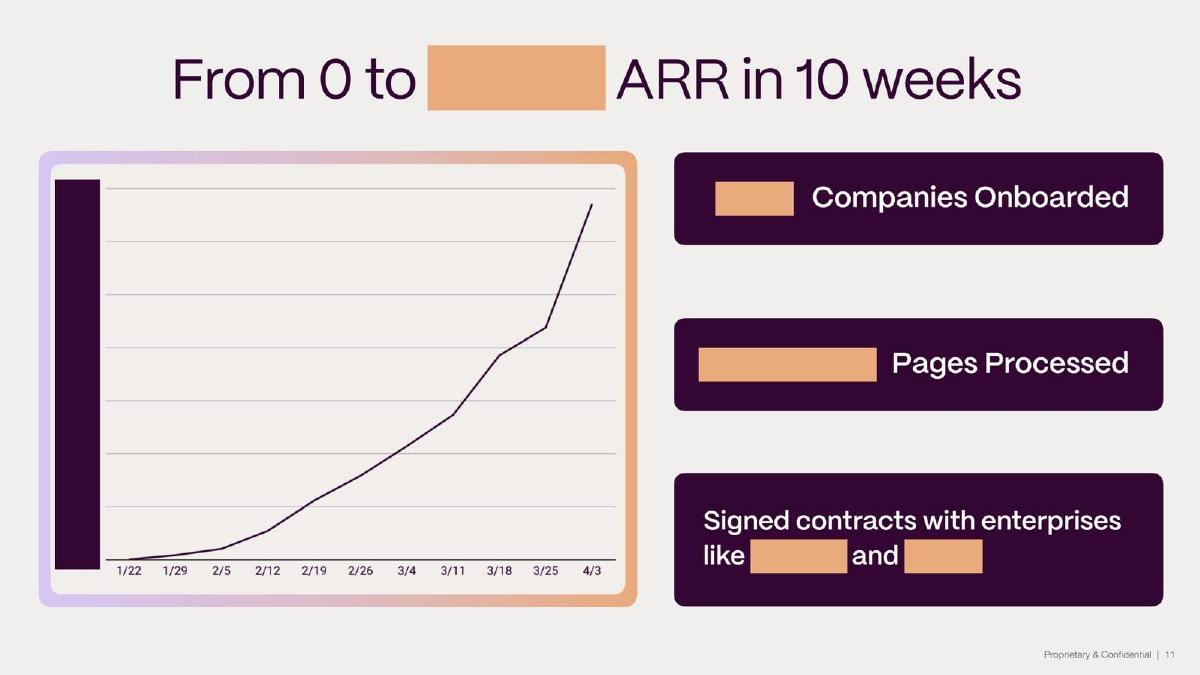
- Traction is demonstrated by a steep growth curve showing movement from 0 to an undisclosed ARR figure in 10 weeks (Slide 11).
- The deck omits a traditional team slide, competition matrix, and detailed financial projections in the provided 7-slide sample.
- Reducto reported raising $8.4M in 2024 for its North American-based AI operations (Business Insider).
- The value proposition is focused on three pillars: accurate data extraction, retention of page structure, and optimized chunking for LLMs (Slide 7).
The Infrastructure Layer for the LLM Era
Reducto’s pitch deck is a focused, technical argument for why the current AI boom is hitting a wall: data ingestion. While the industry has focused on bigger and better models, Reducto focuses on the 'garbage in' part of the equation. By the time a founder reaches the end of this 13-slide deck, they have been shown exactly why the world’s most famous AI models fail at basic business tasks and how Reducto’s vision-based approach fixes it. The reported $8.4M Seed round in 2024 suggests that investors bought into the idea that the 'unstructured data' bottleneck is one of the most lucrative problems to solve in the current market.
Slide 1: The Hook
The deck opens with a minimalist title slide. The logo is accompanied by a single, clear value proposition: "Accurately ingests unstructured data." There is no fluff about 'democratizing AI' or 'changing the world.' It defines the product as a utility, which is a strong positioning choice for an infrastructure play.
Slide 3: The Reality of Enterprise Data
Slide 3 introduces the problem statement with a stark statistic: "80% OF ENTERPRISE DATA IS UNSTRUCTURED." The slide uses a visual example of an Ameriprise financial statement. It highlights a specific failure point where a system "Does not parse data accurately" when asked about exposure to US treasuries. By showing a chat interface failing to extract data from a complex table, Reducto grounds a technical problem in a relatable business use case.
Slide 5: The 'Hallucination' Proof
This is arguably the most important slide in the deck. It shows side-by-side failures of ChatGPT and Claude. Using an Allstate Insurance Group document (Exhibit 4.1), the slide demonstrates that ChatGPT provides an "Answer from the wrong row" and Claude provides an "Answer is hallucinated." Specifically, it shows Claude calculating a value of $15,577,492 when the correct data was present in the document but misinterpreted. This 'Bad inputs lead to bad outputs' mantra is a direct attack on the current state of RAG (Retrieval-Augmented Generation) pipelines.
Slide 7: The Vision Model Solution
Reducto explains their 'secret sauce' on Slide 7. They claim to "use vision models to read documents the way humans do." The slide lists three key features: "Extracts data accurately," "Retains page structure," and "Chunks content for LLMs." The visual shows the model segmenting a complex insurance table, identifying specific cells for 'Fiscal Accident Year Ending 09/30.' This clarifies that they aren't just doing OCR (Optical Character Recognition); they are doing layout-aware document understanding.
Slide 9: The Leya Case Study
To prove the tech works at scale, Slide 9 features August Erseus, Co-Founder of Leya. The results are quantified clearly: "90% Reduction in dev hours spent on chunking" and "3x Faster processing speed compared to in-house pipeline." The testimonial mentions processing "millions of documents per month." This slide transitions the deck from 'cool tech' to 'viable business' by showing that even other AI companies struggle to build this internally and would rather pay Reducto for it.
Slide 11: The Traction Curve
Slide 11 is a classic 'up and to the right' graph. Titled "From 0 to [Redacted] ARR in 10 weeks," it shows a timeline from January 22nd to April 3rd. While the specific ARR and company counts are redacted, the visual representation of the growth curve is intended to show explosive market demand. The slide also mentions "Signed contracts with enterprises like [Redacted] and [Redacted]," signaling that they have moved past the pilot phase into recurring revenue.
Slide 13: The Closing
The deck ends as it began: minimalist. It provides a contact email (redacted in this version) and the logo. The lack of a complex 'thank you' or 'vision' slide reinforces the brand's identity as a straightforward, technical solution provider.
What Works in the Reducto Deck
Visual Proof over Claims: Instead of saying "LLMs are bad at PDFs," Reducto shows screenshots of ChatGPT and Claude failing. This makes the problem undeniable and the solution feel necessary.
Focus on a Single Bottleneck: The deck doesn't try to be an all-in-one AI platform. It focuses entirely on the ingestion and chunking layer. This clarity makes it easier for investors to understand where Reducto fits in the 'AI stack.'
Quantified ROI: The Leya case study provides the exact numbers (90% time reduction, 3x speed) that a CTO would need to see to justify a purchase, which in turn justifies the investment for a VC.
What is Missing
The Team Slide: In the provided 7-slide sample, there is no mention of the founders' backgrounds. For a Seed round, knowing if the founders come from OpenAI, Google Brain, or top-tier engineering schools is usually a critical component of the pitch.
Competitive Landscape: Reducto isn't the only company working on document parsing for LLMs (competitors like Unstructured.io or LlamaIndex exist). The deck doesn't explicitly state why their vision-based approach is superior to these specific competitors, only why it's better than 'in-house' or 'standard LLM' parsing.
Unit Economics: While the ARR growth is shown, there is no mention of margins or the cost of running these vision models. Vision models are computationally expensive, and a Seed-stage investor would likely want to see how Reducto plans to scale profitably.
Founder Takeaways
Show, Don't Just Tell: If your product fixes a flaw in a famous competitor (like ChatGPT), put their failure on a slide. It creates an immediate 'aha' moment for the investor.
Narrow the Scope: Reducto’s success in raising $8.4M shows that you don't need to promise a 'general intelligence' to get funded. Solving one specific, painful problem for enterprises (like parsing tables in PDFs) is enough if the market for that problem is large enough.
Speed as a Metric: The '10 weeks' timeframe on the traction slide is a powerful narrative tool. It suggests that the product is so necessary that customers are onboarding as fast as the company can handle them.
Frequently asked questions
- What is the core problem Reducto is solving?
- Reducto addresses the 'unstructured data' problem. As stated on Slide 3, 80% of enterprise data is unstructured. Current LLMs struggle to parse complex documents like financial statements or insurance tables, leading to hallucinations or incorrect data extraction. Reducto provides a vision-based ingestion layer that converts these documents into structured data that LLMs can actually use without errors.
- How does Reducto's technology differ from standard OCR or LLM parsing?
- According to Slide 7, Reducto uses 'vision models' to read documents the way humans do. Unlike standard text-based parsers that might lose the context of a table or layout, Reducto's models are trained to segment layouts and understand table cell structures. This allows the system to retain page structure and chunk content more effectively for LLM retrieval.
- What kind of ROI can customers expect based on the deck?
- Slide 9 features a case study with a company called Leya. The metrics reported include a 90% reduction in developer hours spent on data chunking and a 3x increase in processing speed compared to an in-house pipeline. The customer also notes they can now process 'millions of documents per month' using Reducto’s infrastructure.
- How fast is the company growing?
- Slide 11 shows a traction graph titled 'From 0 to [Redacted] ARR in 10 weeks.' The line graph shows an exponential upward trend starting in early February and peaking in early April. While the specific dollar amounts and number of companies are redacted in this version, the slope of the curve indicates significant early-market fit.
- What is missing from the Reducto pitch deck?
- The provided slides lack a dedicated Team slide, which is unusual for a Seed round where founder pedigree is a major factor. It also lacks a 'The Ask' slide detailing how the $8.4M will be spent, a competitive landscape analysis, and a long-term roadmap. These may have been in the 6 slides not included in the visual sample.