Crowdfunding Round on a Pitch Deck Ask Slide: 11 Real
How to present an equity or rewards crowdfunding round as part of your ask: how much, on which platform, how it fits with angels, loans and venture rounds.
How to Present a Crowdfunding Round on Your Ask Slide
Eleven slides from ten real pitch decks show how founders fit crowdfunding into what they are raising: as one line among several sources of money, as an early step before a seed round, as a test of demand, as proof that a community will back the company, and, once, as an honest admission that the campaign did not take off.
TL;DR
If crowdfunding is part of your raise, show it as one line in the full funding plan: the amount, the platform, the type (equity or rewards), when it happens, and how it fits with the other money. Alodmd lists $6,000,000 of crowdfunding beside $45,000,000 of debt and $57,000,000 from a property sale, totalling $108,000,000, then gives a separate slide on how the $6,000,000 will be spent; both slides add up. Blossom Protein puts crowdfunding ($145,000 in year 2) in a three-year table with savings, family money, a loan, an angel, venture capital and revenue, and each year's column adds up. Freetrade plans a £150K Crowdcube round, then a £1.5m seed round, then a £3.5m Series A, each tied to a stage of the product. Soccer Smart Wall plans a $10K Kickstarter to test demand before a $400K seed round. Holiday Online raises £200K from direct investors at a £1.3M pre-money valuation ahead of a Seedrs round. Legion M and Hardbacon present money raised from the crowd as evidence of support. Curastory lists Wefunder and Republic among its backers. Siembra is the honest example: it calls its $50,000 rewards campaign "limited traction". Billfolda adds context on how much companies can legally raise this way.
Crowdfunding round slides from real pitch decks
Each example shows the exact stored slide above its analysis and links to the full teardown. Stage and year are given only where the deck states them. Figures are the company's own claims.
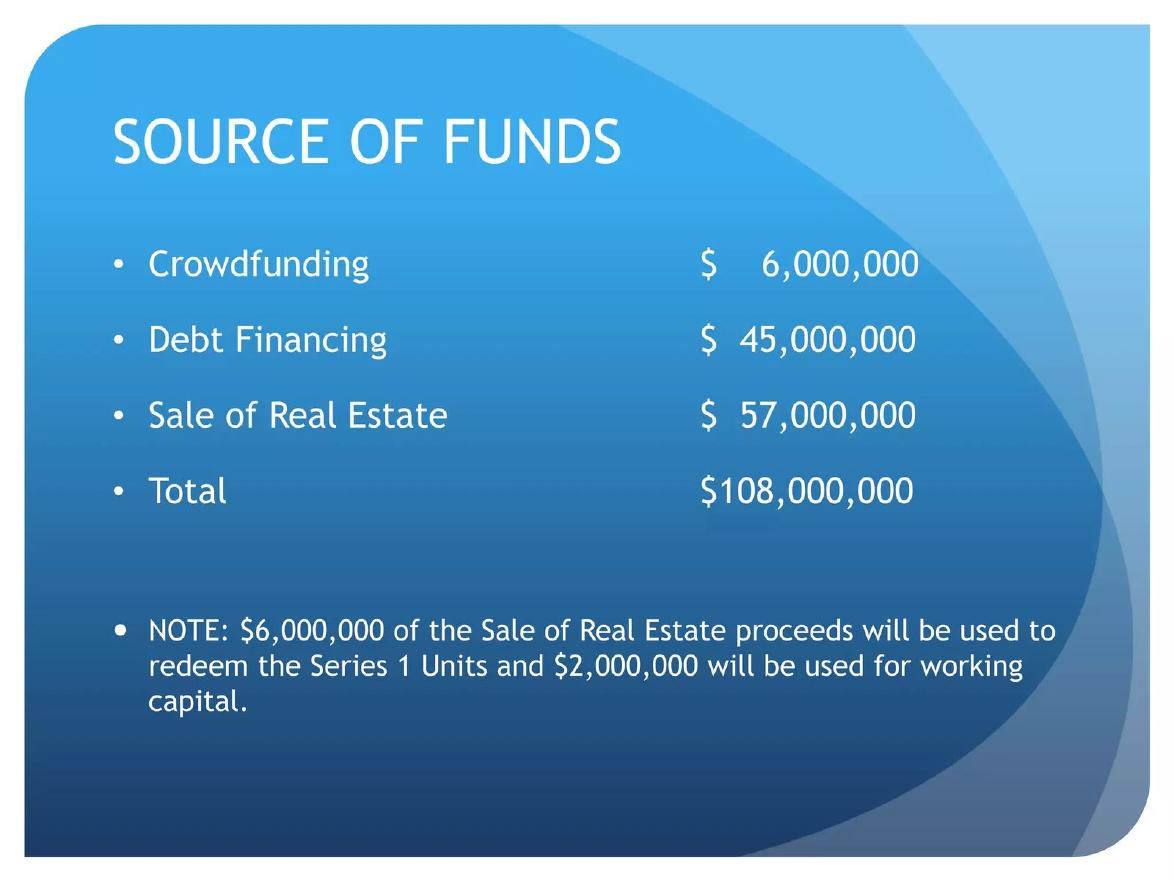
Alodmd ask slide — slide 14
Property development raising through crowdfunding, debt and a property sale.
Alodmd deck, slide 14. Exact stored slide matched to this analysis.
Our analysis: Crowdfunding sits beside every other source, and the three lines add up to the total.
Evidence and limitation: A crowdfunding figure shown on its own, with no total.
What a founder can adapt: Add the platform, timing and the terms crowd investors receive.
Supporting analysis
What the deck claims: Source of funds: crowdfunding $6,000,000; debt financing $45,000,000; sale of real estate $57,000,000; total $108,000,000.
Presentation choice: Crowdfunding sits beside every other source, and the three lines add up to the total.
When it does not fit: A crowdfunding figure shown on its own, with no total.
The same deck's breakdown of the crowdfunded money.
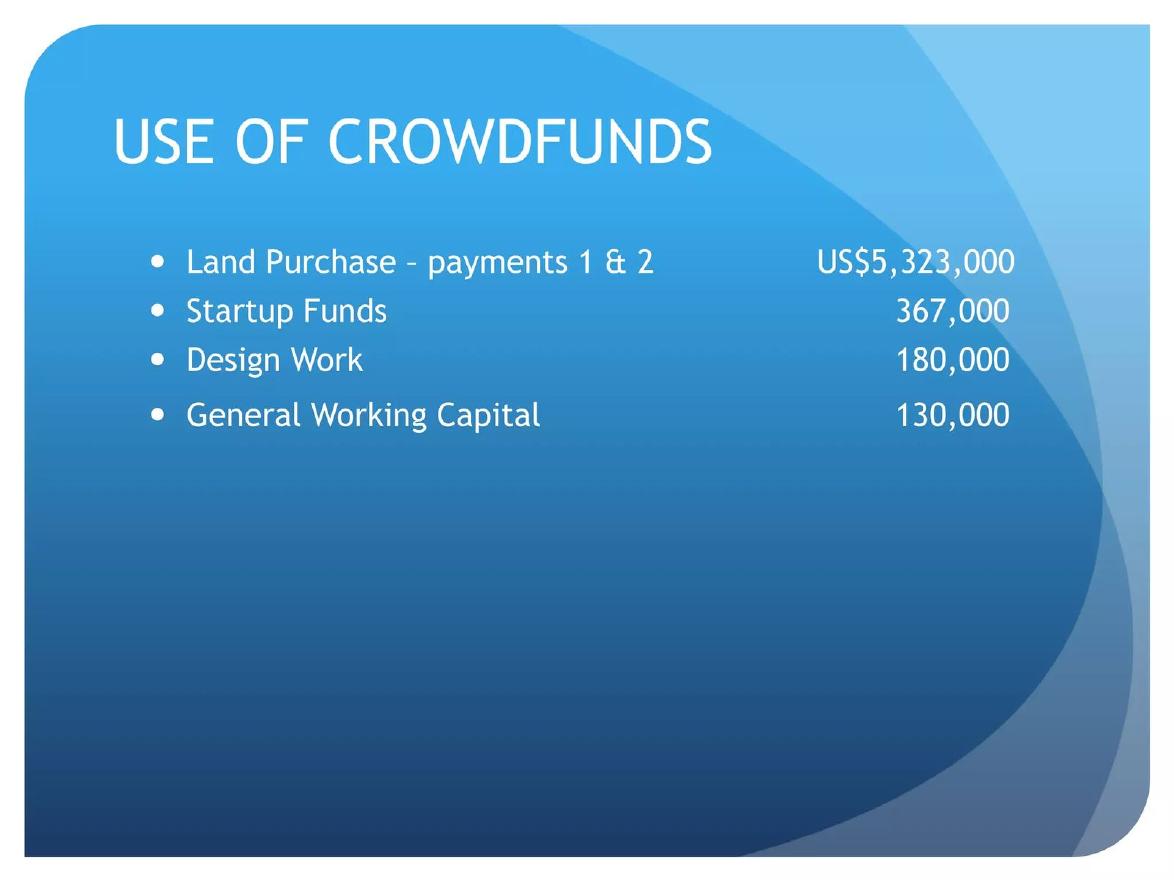
Alodmd deck, slide 30. Exact stored slide matched to this analysis.
Our analysis: The four lines add up to $6,000,000, matching the crowdfunding line on the sources slide.
Evidence and limitation: Use-of-funds figures that do not match the amount raised.
What a founder can adapt: Show a total line so readers do not have to add it themselves.
Supporting analysis
What the deck claims: Use of crowdfunds: land purchase payments 1 and 2 US$5,323,000; startup funds 367,000; design work 180,000; general working capital 130,000.
Presentation choice: The four lines add up to $6,000,000, matching the crowdfunding line on the sources slide.
When it does not fit: Use-of-funds figures that do not match the amount raised.
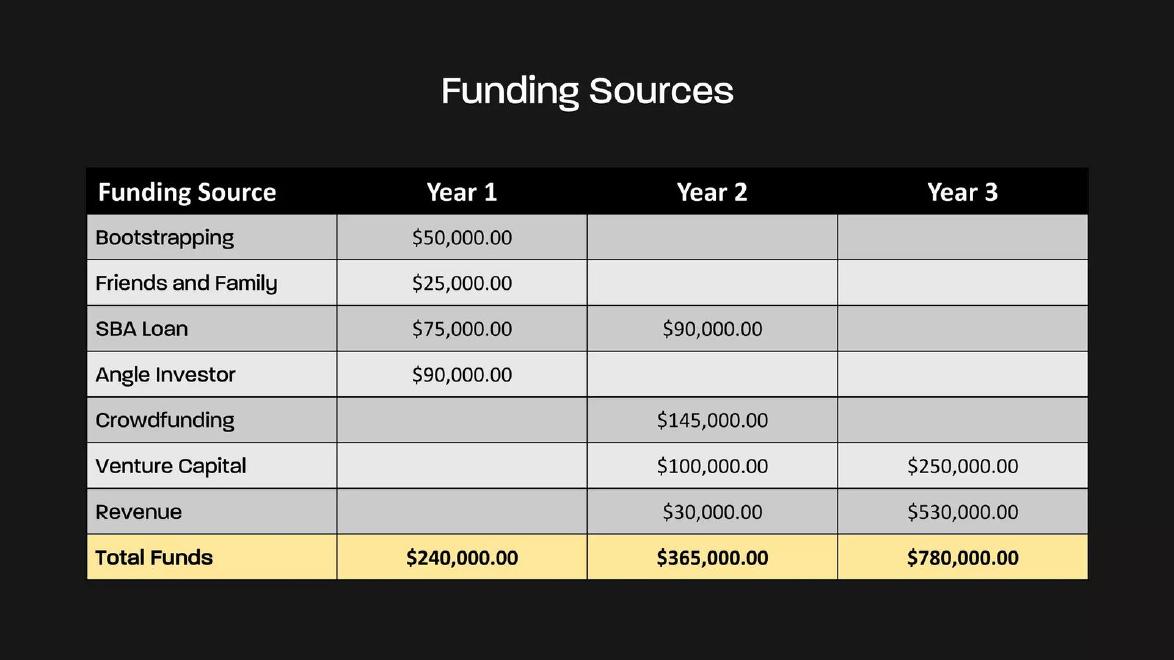
Blossom Protein deck, slide 10. Exact stored slide matched to this analysis.
Our analysis: Shows crowdfunding as a bridge between personal money and venture capital; every column adds up.
Evidence and limitation: Typos on funding slides ("Angle Investor").
What a founder can adapt: Name the platform and whether the round is equity or rewards.
Supporting analysis
What the deck claims: Funding sources by year. Year 1: bootstrapping, friends and family, SBA loan, angel, total $240,000. Year 2: SBA loan $90,000, crowdfunding $145,000, venture capital $100,000, revenue $30,000, total $365,000. Year 3: venture capital $250,000, revenue $530,000, total $780,000.
Presentation choice: Shows crowdfunding as a bridge between personal money and venture capital; every column adds up.
When it does not fit: Typos on funding slides ("Angle Investor").
UK share-trading app, pre-launch deck (launch marked early 2017).
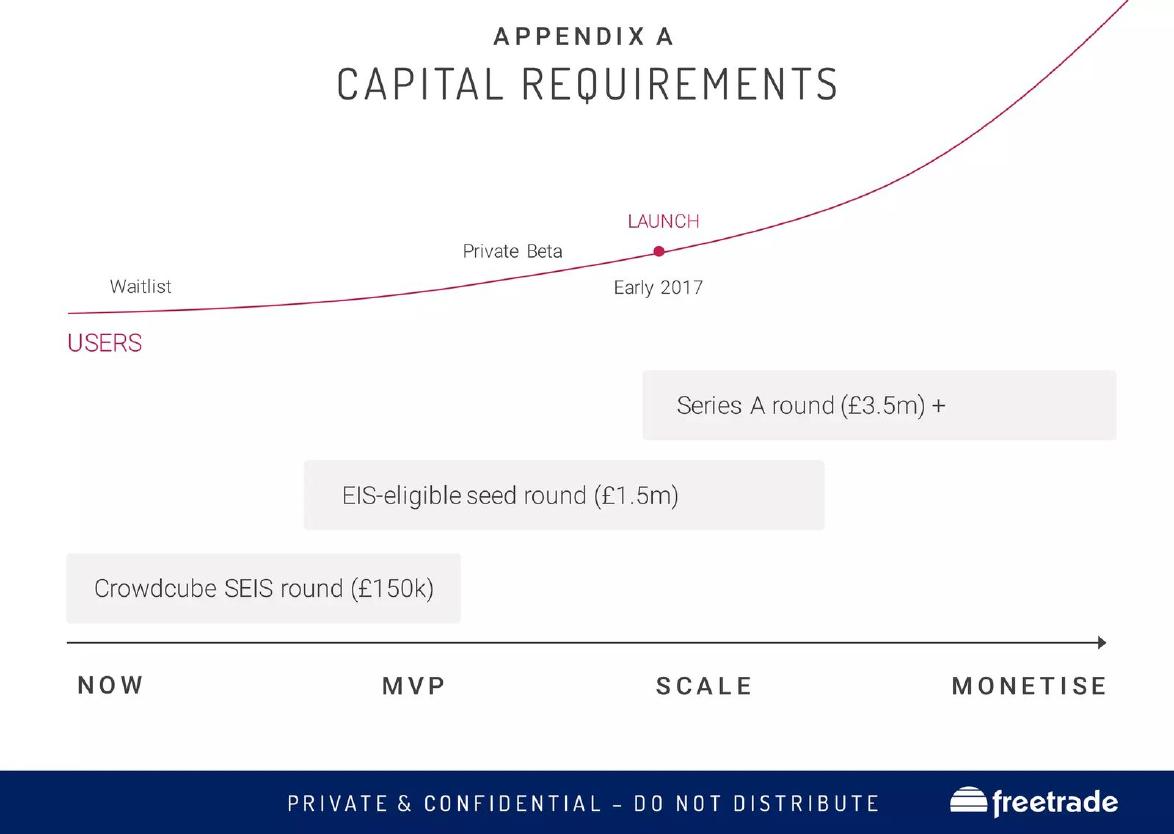
Freetrade deck, slide 16. Exact stored slide matched to this analysis.
Our analysis: Ties each round, starting with the crowd round, to a product stage, and names the tax scheme.
Evidence and limitation: A sequence of rounds with no milestones between them.
What a founder can adapt: Add the user numbers that mark each stage.
Supporting analysis
What the deck claims: Capital requirements: Crowdcube SEIS round (£150k) for now to MVP; EIS-eligible seed round (£1.5m) for MVP to scale; Series A round (£3.5m)+ for scale to monetise.
Presentation choice: Ties each round, starting with the crowd round, to a product stage, and names the tax scheme.
When it does not fit: A sequence of rounds with no milestones between them.
Curastory deck, slide 18. Exact stored slide matched to this analysis.
Our analysis: Names crowdfunding platforms in the same list as a venture firm and an accelerator.
Evidence and limitation: Hiding crowd money inside an unnamed total.
What a founder can adapt: Say how much came from each source.
Supporting analysis
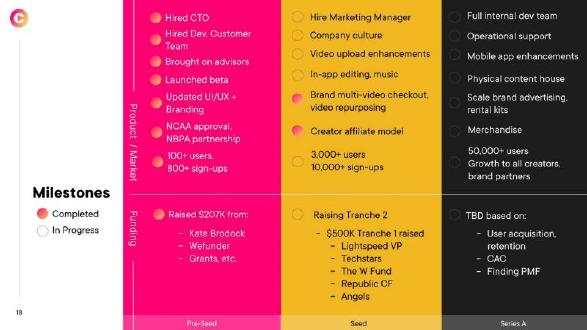
What the deck claims: Pre-seed: raised $207K from Kate Brodock, Wefunder, grants. Seed, in progress: $500K tranche 1 raised from Lightspeed VP, Techstars, The W Fund, Republic CF, angels.
Presentation choice: Names crowdfunding platforms in the same list as a venture firm and an accelerator.
When it does not fit: Hiding crowd money inside an unnamed total.
Fan-owned film and entertainment company; equity crowdfunding overview deck.
Legion M deck, slide 6. Exact stored slide matched to this analysis.
Our analysis: Makes the crowd of investors part of the business case, with a real amount raised.
Evidence and limitation: Mixing achieved figures with aspirations in the same box.
What a founder can adapt: Separate what has been raised from what a million investors might do.
Supporting analysis
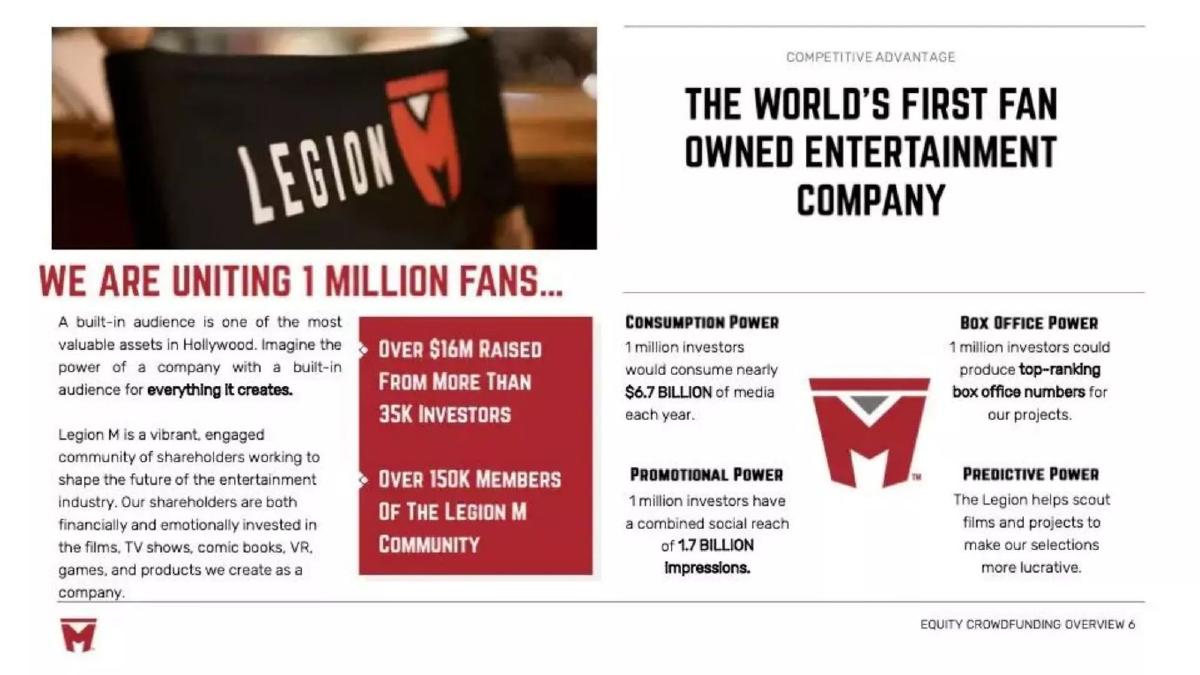
What the deck claims: Over $16M raised from more than 35K investors. Over 150K members of the Legion M community. 1 million investors would consume nearly $6.7 billion of media each year.
Presentation choice: Makes the crowd of investors part of the business case, with a real amount raised.
When it does not fit: Mixing achieved figures with aspirations in the same box.
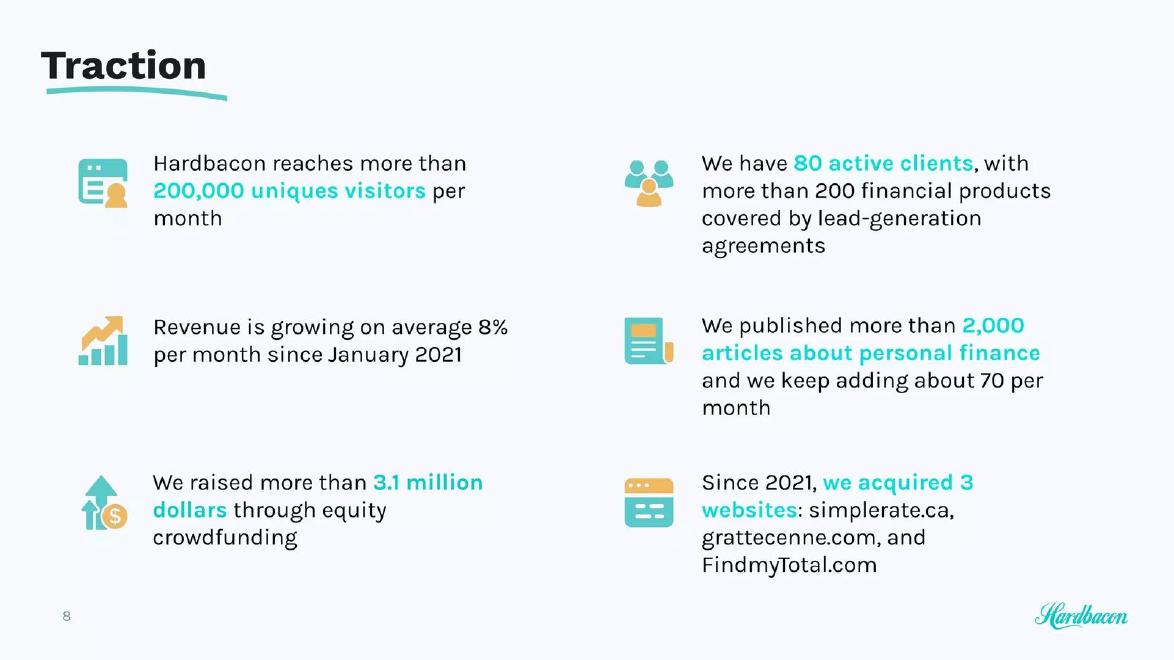
Hardbacon deck, slide 8. Exact stored slide matched to this analysis.
Our analysis: Presents repeated crowd raises as support from users, beside revenue figures.
Evidence and limitation: Using money raised as a substitute for revenue.
What a founder can adapt: Add the number of crowd investors and rounds.
Supporting analysis
What the deck claims: We raised more than 3.1 million dollars through equity crowdfunding. Revenue is growing on average 8% per month since January 2021. 80 active clients.
Presentation choice: Presents repeated crowd raises as support from users, beside revenue figures.
When it does not fit: Using money raised as a substitute for revenue.
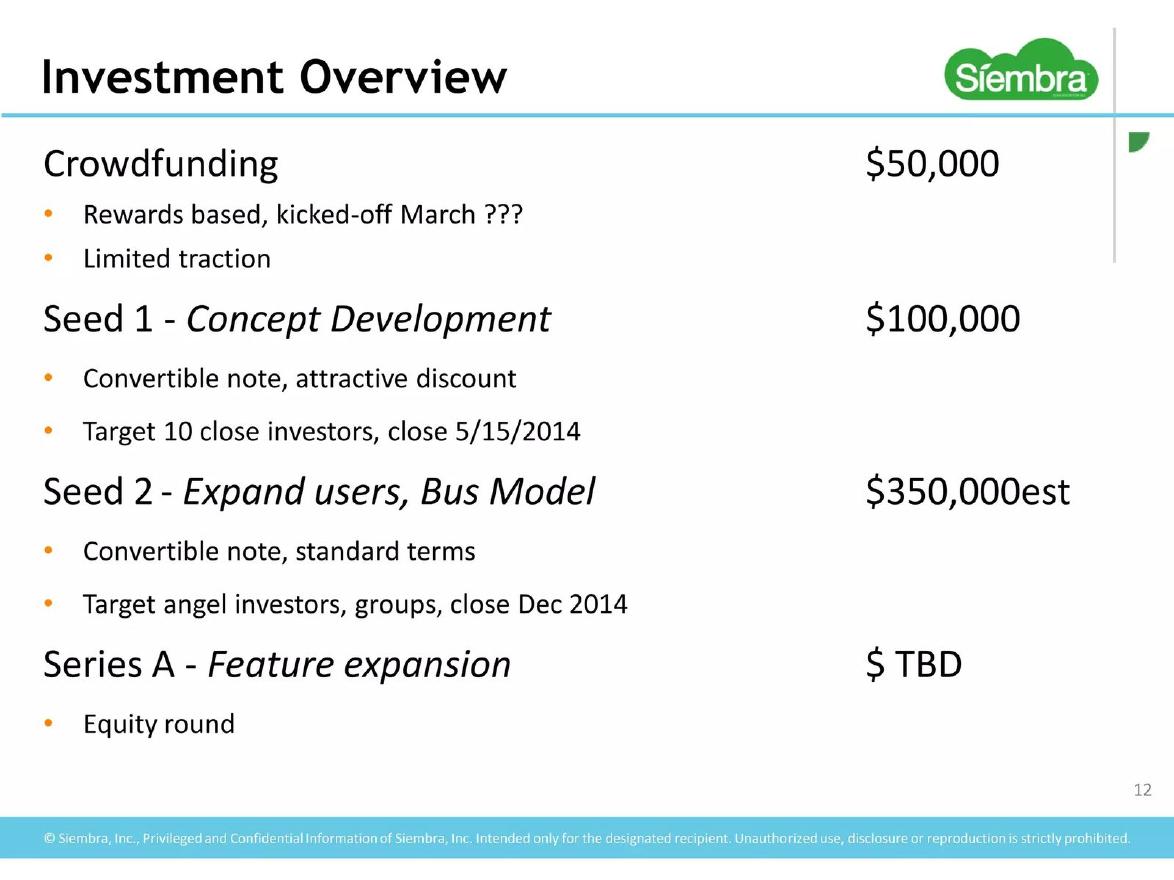
Siembra deck, slide 12. Exact stored slide matched to this analysis.
Our analysis: Admits the campaign underperformed and shows the rounds that follow.
Evidence and limitation: Leaving "???" on a slide sent to investors.
What a founder can adapt: Remove placeholders and give the amount actually raised.
Supporting analysis
What the deck claims: Crowdfunding $50,000: rewards based, kicked-off March ???; limited traction. Seed 1 $100,000 convertible note, close 5/15/2014. Seed 2 $350,000 est., close Dec 2014. Series A TBD.
Presentation choice: Admits the campaign underperformed and shows the rounds that follow.
When it does not fit: Leaving "???" on a slide sent to investors.
Equity crowdfunding platform pitching to angels. Context, not a company ask.
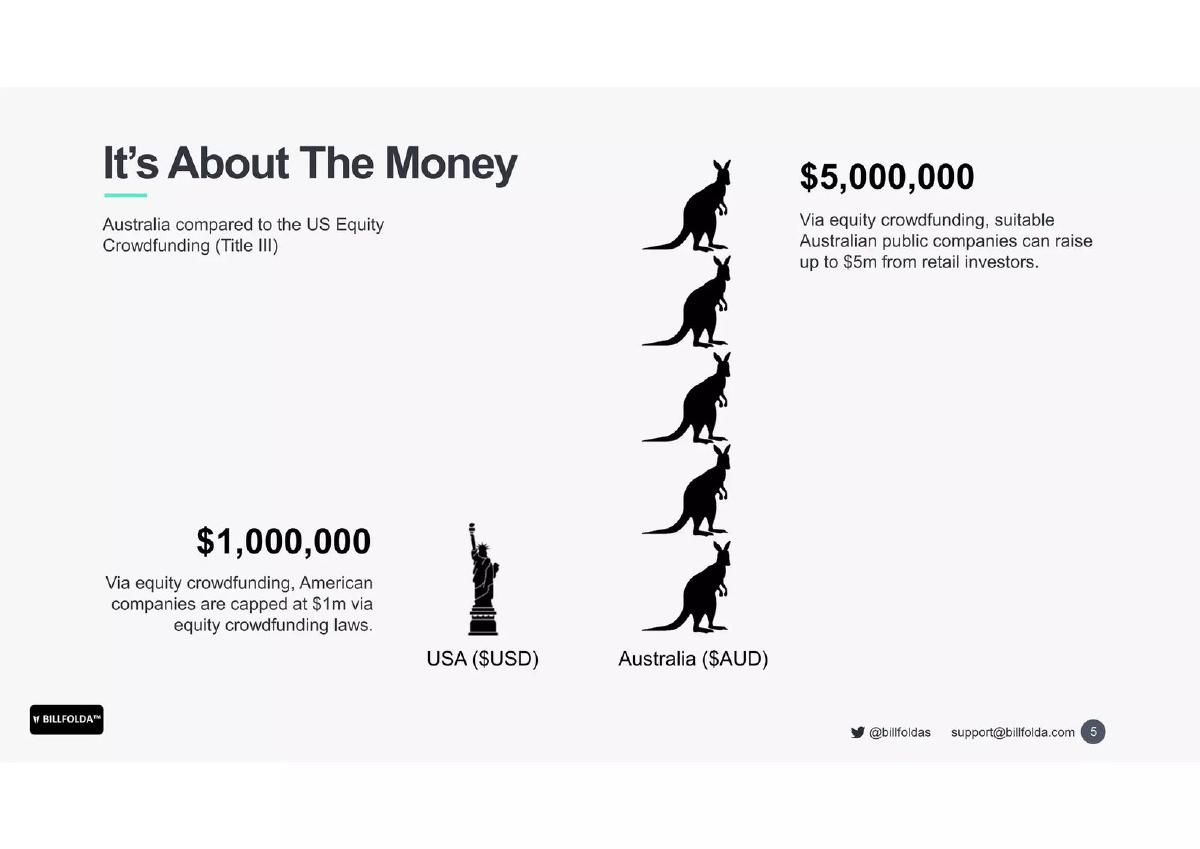
Billfolda deck, slide 5. Exact stored slide matched to this analysis.
Our analysis: A reminder that crowdfunding amounts are capped by law, and caps differ by country.
Evidence and limitation: Citing limits that have since changed.
What a founder can adapt: Check the current limit where you will raise.
Supporting analysis
What the deck claims: US equity crowdfunding (Title III): companies capped at $1,000,000. Australia: suitable public companies can raise up to $5,000,000 from retail investors.
Presentation choice: A reminder that crowdfunding amounts are capped by law, and caps differ by country.
When it does not fit: Citing limits that have since changed.
Most slides give the amount; few give the platform, timing, terms and use together.
Example
Amount
Platform named
Equity or rewards
Fits with other money
Alodmd (sources)
$6,000,000
No
Not stated
Yes, with total
Alodmd (uses)
$6,000,000
No
Not stated
Use breakdown
Blossom Protein
$145,000
No
Not stated
Yes, by year
Freetrade
£150k
Crowdcube
Equity (SEIS)
Yes, staged
Soccer Smart Wall
$10K
Kickstarter
Rewards
Yes, staged
Holiday Online
£200K direct
Seedrs (next)
Equity
Partly
Curastory
Within $207K / $500K
Wefunder, Republic
Equity
Listed with backers
Legion M
Over $16M raised
No
Equity
No
Hardbacon
Over $3.1M raised
No
Equity
No
Siembra
$50,000
No
Rewards
Yes, staged
Billfolda
Legal caps
Is a platform
Equity
Context
Key Takeaways
Put the crowdfunding amount in the same table as every other source of money, with a total.
Name the platform and say whether investors get shares or rewards.
Place the round in time: before, beside or after the seed round.
Say what the crowdfunded money pays for, separately if it is ring-fenced.
If a campaign underperformed, say so plainly and show what replaces it.
Test your crowdfunding line before you send it
Answer these with numbers, even if they are targets.
Amount. How much will you raise through crowdfunding?
Platform and type. Which platform, and do backers get shares or rewards?
Terms. At what valuation, and on the same terms as other investors?
Order. Does the crowd round come before, with or after the lead investor?
Use. What does the crowdfunded money pay for?
Copyable framework: Raising [total]: [lead] [amount] at [valuation]; [platform] equity crowdfunding [amount] on the same terms, opening after the lead commits; funds go to [use] [amount], [use] [amount]
Illustrative example 1 — written by us
Before: Crowdfunding $50,000. Rewards based, kicked-off March ???. Limited traction.
After: Rewards campaign on [platform], launched [month]: raised [amount] of a [target] target from [n] backers. Next: [amount] convertible note from [n] angels, closing [date]
What improved: Our illustrative rewrite, not Siembra's text. Bracketed parts are placeholders, not company facts. It replaces the placeholder with the result and keeps the honest tone.
What this guide covers
Crowdfunding comes in two forms that matter on a pitch deck. In equity crowdfunding, many people each buy a small number of shares through a regulated platform such as Crowdcube, Seedrs, Wefunder, Republic or StartEngine. In rewards crowdfunding, on sites such as Kickstarter or Indiegogo, backers get a product or perk, not shares. Both bring in money, but they mean different things to a professional investor reading your deck.
Equity crowdfunding adds shareholders. An investor will want to know how many, at what valuation, and whether they are held together in a nominee structure or sit individually on the share register. Rewards crowdfunding adds no shareholders but creates obligations: products have to be delivered to backers, and the money is closer to pre-sales than to investment.
This guide is about crowdfunding as part of the ask: how much you plan to raise this way, where it sits among your other sources, and what it pays for. Using a finished Kickstarter campaign as proof of demand is a different question, covered in our pre-orders guide. None of our seven existing ask-slide guides covers crowdfunding rounds. We searched the corpus for crowdfunding platforms and terms near a figure, read each candidate from images of the original deck pages, and kept eleven slides from ten private companies.
Show crowdfunding as one line in the whole plan
The most useful thing a crowdfunding line can do is sit beside everything else. An investor reading your ask wants to know the total, where each part comes from and whether the parts depend on each other.
Alodmd, a property development, does this in the simplest possible way. Its Source of Funds slide lists three lines: crowdfunding $6,000,000, debt financing $45,000,000 and sale of real estate $57,000,000, with a total of $108,000,000. The three add up. A note below says $6,000,000 of the property sale proceeds will be used to redeem the Series 1 Units and $2,000,000 will go to working capital, which tells the crowd investors when and how they may be paid back. Crowdfunding is only about 6% of the total here, and the slide makes that obvious without saying it.
Blossom Protein, a food company, uses a three-year table titled Funding Sources. Year 1 combines bootstrapping $50,000, friends and family $25,000, an SBA loan $75,000 and an angel investor $90,000, for $240,000. Year 2 adds a second SBA loan of $90,000, crowdfunding $145,000, venture capital $100,000 and revenue $30,000, for $365,000. Year 3 is venture capital $250,000 and revenue $530,000, for $780,000. Every column adds up. The table shows crowdfunding as a bridge between early personal money and venture capital, which is a common and sensible place for it. One small slip: the row says "Angle Investor". A typo on a funding slide is the kind of thing investors notice.
Say what the crowdfunded money pays for
If the crowd's money is ring-fenced for something specific, show it separately. Crowd investors often read the same deck as professional investors, and both want to know where their money goes.
Alodmd gives a second slide, Use of Crowdfunds: land purchase payments 1 and 2 US$5,323,000, startup funds $367,000, design work $180,000 and general working capital $130,000. Those four lines add up to $6,000,000, exactly matching the crowdfunding line on the sources slide. That match is the point. An investor can trace one figure from where it comes from to where it goes. Most decks give a single use-of-funds chart for the whole raise; when part of the raise comes from a different group of investors on different terms, a separate breakdown is clearer.
Place the round in time
Crowdfunding is often the first outside money, used to reach a point where a professional round becomes possible. If that is your plan, show the sequence and what each step unlocks.
Freetrade, a UK share-trading app, puts three rounds on a timeline under a user growth curve, in an appendix titled Capital Requirements. A Crowdcube SEIS round of £150k covers now to the minimum viable product. An EIS-eligible seed round of £1.5m covers the product to scale, around a launch marked early 2017. A Series A round of £3.5m-plus covers scale to making money. SEIS and EIS are UK tax relief schemes for investors in young companies, and naming them tells a UK investor that the shares qualify. The slide does not say how many users each stage needs, but it makes the logic clear: the small crowd round pays for the product that justifies the larger rounds. Freetrade did go on to raise repeatedly on Crowdcube.
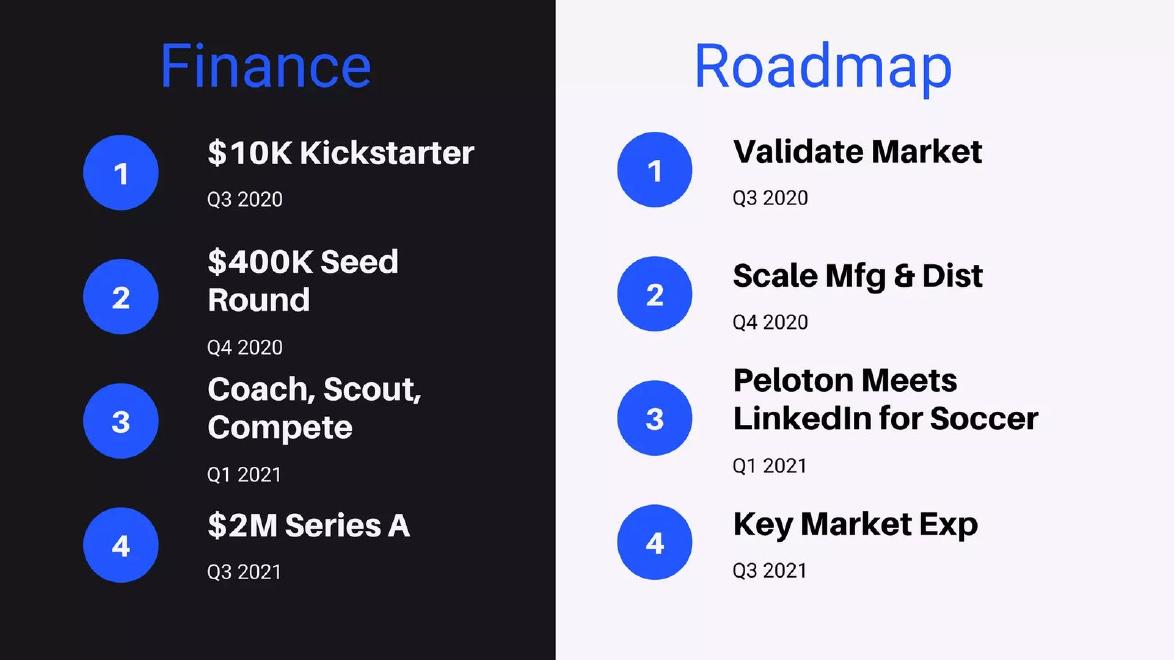
Soccer Smart Wall, a training wall for footballers, sets out a Finance column beside a Roadmap column. A $10K Kickstarter in Q3 2020 lines up with validate market; a $400K seed round in Q4 2020 with scale manufacturing and distribution; a $2M Series A in Q3 2021 with key market expansion. This is rewards crowdfunding used as a demand test before taking investors' money, and the side-by-side layout shows what each round is for. The $10K target is small enough that hitting it proves little; the slide would be stronger if it said what result would count as validation.
Siembra, an early-stage app, lists its rounds in an Investment Overview: crowdfunding $50,000, then Seed 1 (concept development, $100,000, convertible note, target 10 close investors, close 5/15/2014), then Seed 2 ($350,000 estimated, angel investors and groups, close December 2014), then a Series A to be decided.
Be honest when a campaign falls short
Siembra is also the most candid slide in this set. Under the crowdfunding line it writes "Rewards based, kicked-off March ???" and "Limited traction". The question marks look like a placeholder left in by mistake and should have been fixed. But "limited traction" is exactly the kind of plain statement investors respect. A crowdfunding campaign is public; anyone can look up how it did. Saying so on the slide, and then showing the convertible-note rounds that follow, is better than leaving an investor to find a stalled campaign page on their own.
Crowdfunding alongside direct investors
Some companies run a private round first, then open a crowdfunding round on the same or later terms. The crowd round can bring in many small investors after the lead investors have set the price.
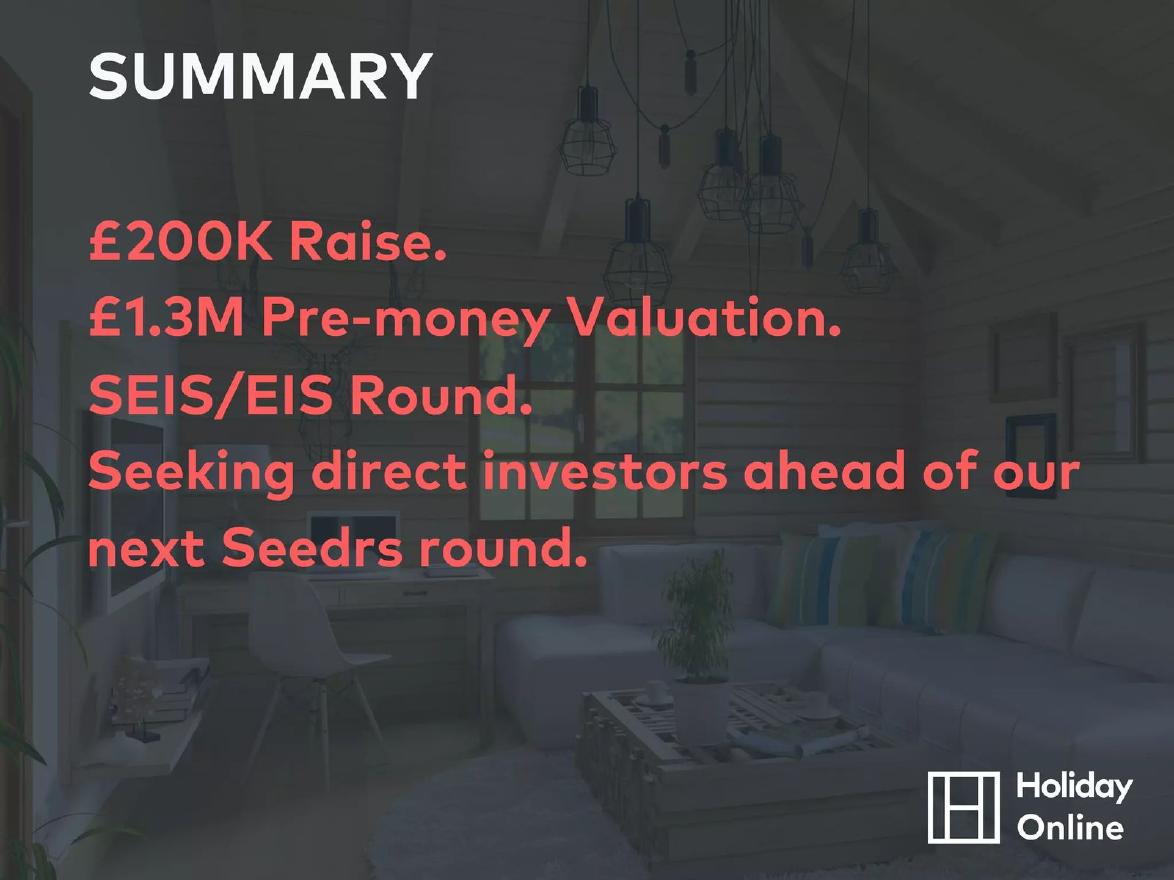
Holiday Online, a holiday rental business, ends its deck with a Summary slide: £200K raise, £1.3M pre-money valuation, SEIS/EIS round, "seeking direct investors ahead of our next Seedrs round". That gives an investor the three facts they need: the amount, the price and the tax status, plus the reason to move now, which is getting in before the crowd. The slide does not say how much the Seedrs round will be or at what valuation, which is the next question an investor will ask.
Curastory, a video platform for creators, shows funding inside a milestones grid. Its pre-seed column says it raised $207K from Kate Brodock, Wefunder and grants. Its seed column, still in progress, lists a $500K first tranche from Lightspeed VP, Techstars, The W Fund, Republic CF and angels. Crowdfunding platforms sit in the same list as a venture firm and an accelerator, which is how they should appear: as one kind of backer, named, not hidden. Records show Curastory's Republic campaign closed in January 2022 with $535,000 from 996 investors, so the crowd part of that tranche was real money from a large number of people.
When the crowd is the argument
For a few companies, the crowd of investors is part of the product. Legion M, a film and entertainment company, calls itself "the world's first fan owned entertainment company". Its slide says it has raised "over $16M from more than 35K investors" and has "over 150K members of the Legion M community", and argues that a million fan investors would bring consumption power, promotional reach and box office support. The money raised is a fact; the projected million investors and the $6.7 billion of media they would consume are aspirations. A reader should keep the two apart, and so should the slide.
Hardbacon, a personal finance app, puts "we raised more than 3.1 million dollars through equity crowdfunding" on its Traction slide, beside monthly visitors, revenue growth of 8% a month since January 2021 and 80 active clients. Presenting crowdfunding as traction is reasonable when the raise is large and repeated, because it shows customers were willing to become shareholders. It is weaker evidence of a working business than revenue, and it belongs beside revenue, not in place of it.
Know the limits before you plan the round
Equity crowdfunding is regulated, and the rules cap how much you can raise. Billfolda, an equity crowdfunding platform pitching to Melbourne angels, compares the two systems on one slide titled It's About The Money: in the US, equity crowdfunding under Title III was capped at $1,000,000, while suitable Australian public companies could raise up to AUD $5,000,000 from retail investors. The slide reflects the rules when the deck was made; the US limit has since been raised. The lesson for founders is to check the current limit in your country before putting a crowdfunding amount on your ask. An amount above the legal cap tells an investor you have not done the work.
A worked example
Here is how a founder might set out a mixed round. All figures are illustrative, not from any company in this guide.
Total raise £1,000,000. Lead angel syndicate £600,000 at a £4,000,000 pre-money valuation. Equity crowdfunding on a named platform £300,000 on the same terms, through a nominee so the crowd sits as one line on the share register. Existing investors £100,000. The three parts add up to £1,000,000. The crowd round opens only after the lead commits, and closes within six weeks. Use of funds: product £450,000, sales £350,000, working capital £200,000, again adding up to £1,000,000.
That is four facts an investor will look for: the total, each source with its terms, the order in which they happen and what the money buys. Every slide in this guide gives some of them; Alodmd and Blossom Protein come closest to giving all of them.
Common mistakes
Crowdfunding on its own. Show it with every other source and a total.
No platform or type. Name the platform and say equity or rewards.
No order. Say whether the crowd round comes before or after the lead.
Amounts above legal caps. Check current limits in your country.
Placeholders left in. Remove "???" and draft notes before sending.
Diagnostic checklist
Crowdfunding amount in the full funding table, with a total.
Platform named; equity or rewards stated.
Valuation and terms for crowd investors.
Timing relative to other rounds.
Use of the crowdfunded money.
Frequently asked questions
How we chose these examples
Corpus: published pitch deck teardowns on StartupFundraising.com. Founder-uploaded private decks are excluded.
Selection (2026-10-01): we searched extracted slide text for crowdfunding platforms and terms near a figure, then read each candidate from images made from the original deck files.
Eligibility: each company was private when its deck was made. Legion M (Regulation Crowdfunding filer, unlisted), Curastory (Republic campaign closed January 2022), Hardbacon (equity crowdfunding on FrontFundr; announced an intention to list in 2021, no listing found) and Freetrade (Crowdcube rounds; acquired by IG Group in 2025, never listed itself) were checked against public sources. Alodmd, Blossom Protein, Siembra, Soccer Smart Wall, Holiday Online and Billfolda rest on their own decks and the absence of any known listing.
Not used: Stack Em (deck file missing), Wirex (cover slide only), Equity Endeavor and several decks where crowdfunding appeared only in passing.
Arithmetic: Alodmd sources $6,000,000 + $45,000,000 + $57,000,000 = $108,000,000 and uses $5,323,000 + $367,000 + $180,000 + $130,000 = $6,000,000; Blossom Protein columns $240,000, $365,000 and $780,000 all match their rows.
Overlap check: the pre-orders guide covers finished Kickstarter and Indiegogo campaigns as demand evidence; no guide covers crowdfunding as part of the ask. None of these slides appears in another guide.
Review: all eleven slide images were inspected on 2026-10-01 and matched to company, deck and slide number (AI editorial model review). No person has yet completed an editorial review of this page. The worked example uses illustrative figures, not company data.
Figures are the companies' own claims; we did not verify underlying data. We make no claim that any slide caused a fundraising outcome.