Hardbacon’s deck positions the company as a comprehensive financial tool for the Canadian market, addressing gaps in financial planning, budgeting, and investment confidence. The business model is built on high-value lead generation, claiming payouts between $25 and $400 per lead (Slide 4). With a reported reach of 200,000 unique monthly visitors and a library of 2,000 articles, the startup leverages content to drive traffic and conversion (Slide 8). While the deck shows strong historical growth and ambitious projections reaching $4 million by 2024 (Slide 10), it lacks a specific funding ask,…
Key takeaways
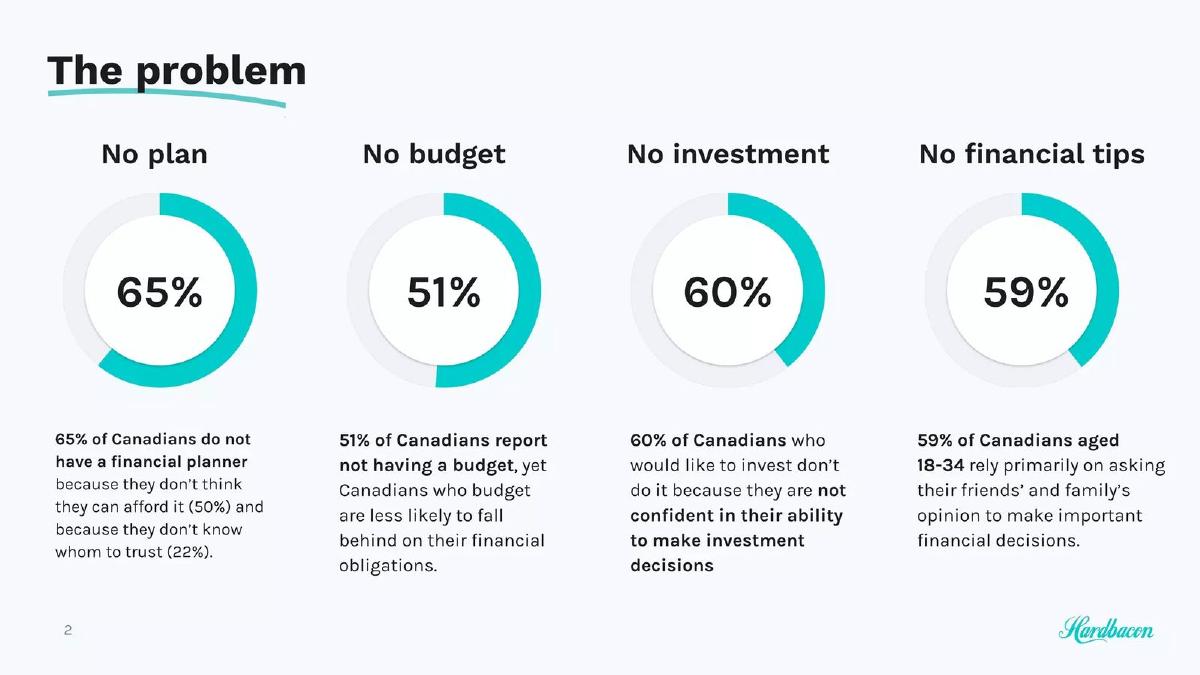
- The company identifies that 65% of Canadians lack a financial planner and 51% do not have a budget (Slide 2).
- Monetization is driven by lead generation, earning between $25 and $400 per lead for financial products (Slide 4).
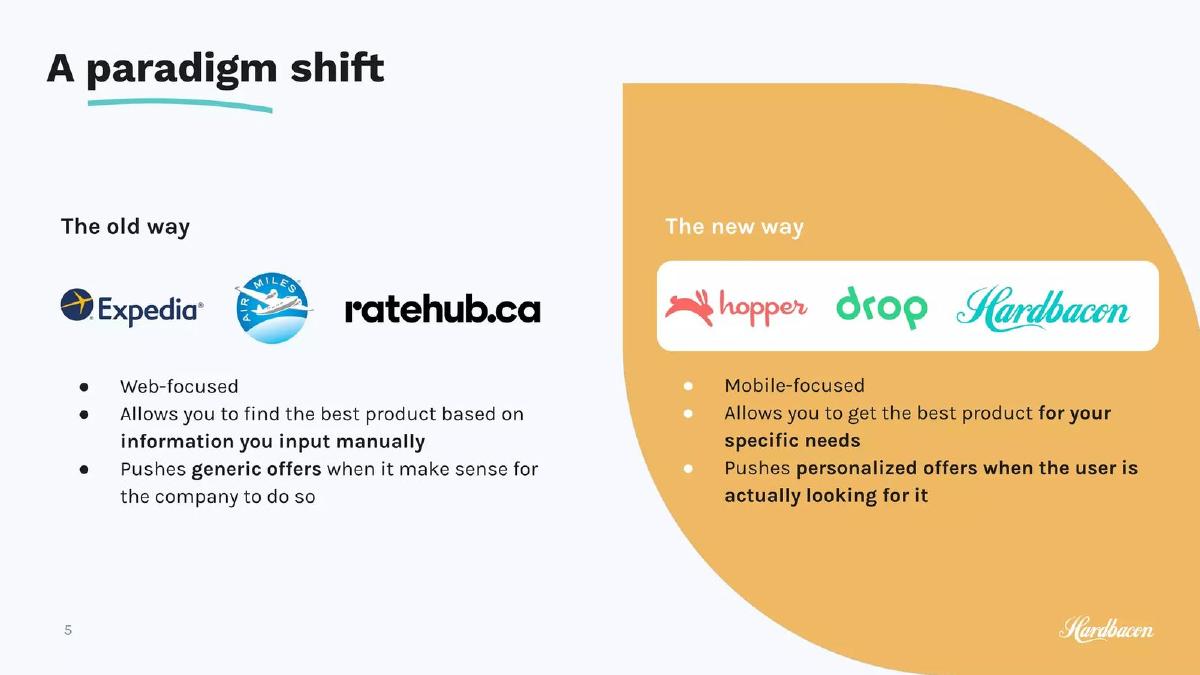
- Hardbacon differentiates itself from 'old way' competitors like Expedia by offering a mobile-focused, personalized experience (Slide 5).
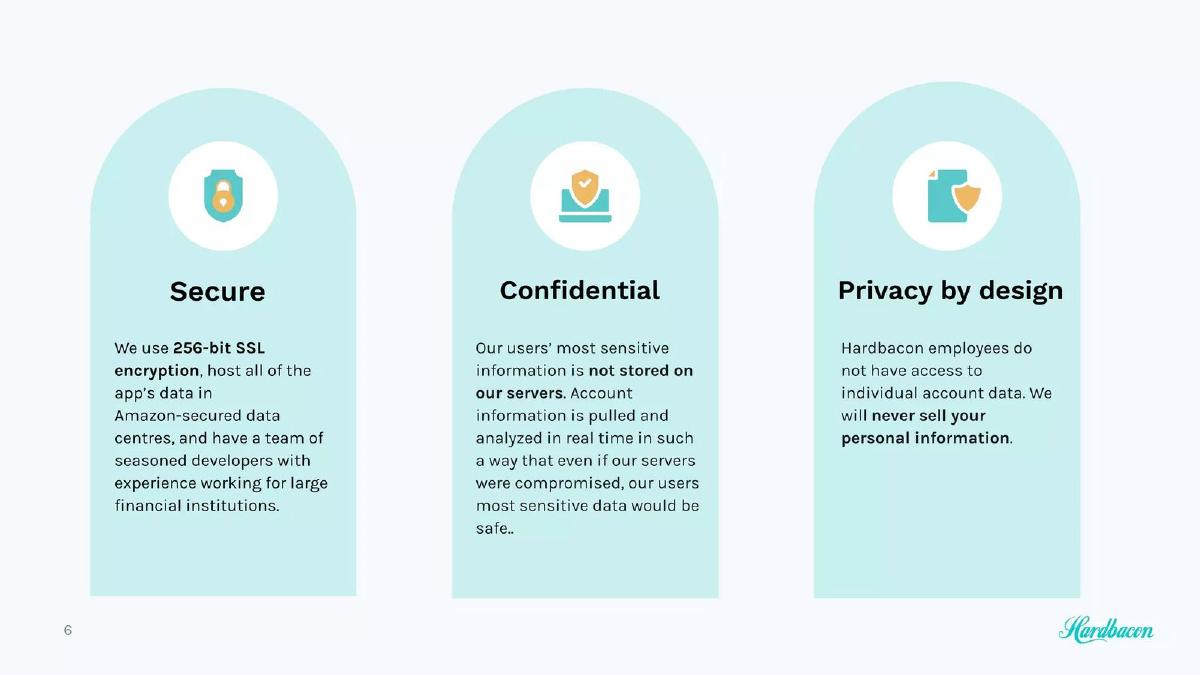
- Security measures include 256-bit SSL encryption and a policy of not storing sensitive account information on their own servers (Slide 6).
- Traction includes 200,000 unique monthly visitors and 80 active clients with lead-gen agreements (Slide 8).
- The company has acquired three websites since 2021: simplerate.ca, grattecenne.com, and FindmyTotal.com (Slide 8).
- Revenue is projected to grow from a real figure of $368,320 in 2021 to over $4 million in 2024 (Slide 10).
- The leadership team includes a founder who is a former business journalist and growth marketer for a fintech VC (Slide 11).
Hardbacon Pitch Deck Analysis
Hardbacon positions itself as a comprehensive financial tool for the Canadian market. The deck is structured to demonstrate a clear transition from a content-heavy traffic engine to a high-margin lead-generation platform. By focusing on the 'all-in-one' nature of the app, the founders attempt to solve the fragmentation of personal finance tools.
Slide 1: Title and Contact
The cover slide introduces the brand name, Hardbacon, and the tagline 'Make better financial decisions.' It features screenshots of both the mobile app and the web interface, indicating a multi-platform presence. Contact information for CEO Julien Brault is provided, along with a link to a FrontFundr campaign, suggesting this deck was used for equity crowdfunding.
Slide 2: The Problem
The problem is framed through four statistics specific to Canadians: 65% lack a financial planner, 51% lack a budget, 60% lack investment confidence, and 59% of those aged 18-34 rely on friends and family for advice. This slide effectively establishes a large, underserved market that lacks professional guidance and structured financial habits.
Slide 3: The Solution
Hardbacon is presented as an 'All-in-one personal finance app.' The slide lists the core functionalities: planning, budgeting, and investment tracking. It emphasizes the ability to sync with credit cards, bank accounts, and investment accounts, which is a critical technical requirement for modern fintech aggregators.
Slide 4: Monetization
This is a pivotal slide that defines the business model. Hardbacon does not charge users directly; instead, it monetizes through personalized offers. The slide explicitly states that the company makes between $25 and $400 per lead . This high range suggests they are targeting high-value products like mortgages, insurance, and premium credit cards.
Slide 5: A Paradigm Shift
The company compares itself to 'old way' web-focused platforms like Expedia and Ratehub.ca. Hardbacon claims the 'new way' is mobile-focused and provides personalized offers only when the user is actively looking for them. This slide attempts to position the company alongside successful mobile-first disruptors like Hopper and Drop.
Slide 6: Security and Privacy
Given the sensitivity of financial data, this slide addresses trust. It highlights 256-bit SSL encryption and Amazon-secured data centers. A key technical claim is that sensitive information is not stored on their servers but is pulled and analyzed in real-time. They also commit to never selling personal information, a standard but necessary promise in fintech.
Slide 7: Competitive Landscape
A feature-comparison matrix pits Hardbacon against Ratehub.ca, Ratesdotca, Intuit Mint, and Wealthica. Hardbacon claims to be the only platform that offers budgeting, financial planning, investment tracking, crypto tracking, and personalized recommendations all in one place. This slide is designed to show that while competitors exist for individual features, none offer the full suite.
Slide 8: Traction
This slide provides several key performance indicators (KPIs):
Over 200,000 unique monthly visitors. · Average 8% monthly revenue growth since January 2021. · Over $3.1 million raised through equity crowdfunding. · 80 active clients with 200+ financial products. · 2,000+ articles published with 70 added monthly. · Acquisition of three websites: simplerate.ca, grattecenne.com, and FindmyTotal.com.
This mix of organic reach, revenue growth, and M&A activity suggests a multi-pronged approach to scaling.
Slide 9: Brand Partnerships
A logo wall displays 18 brands, including major Canadian banks like RBC, BMO, CIBC, Scotiabank, and TD, as well as fintechs like Wealthsimple and American Express. This serves as social proof and validates the lead-generation model mentioned on slide 4.
Slide 10: Projected Revenue
The financial slide shows a bar chart with one 'Real' data point ($368,320 in 2021) and three 'Projected' data points. The company projects reaching $4,004,139 in revenue by 2024. The jump from 2021 to 2022 is more than double, and the projection assumes continued aggressive scaling of their lead-gen engine.
Slide 11: Leadership Team
The team slide features five individuals. Founder Julien Brault is highlighted as a former business journalist and growth marketer for a fintech VC. Other roles include Head of Monetization, CTO, Head of Growth, and Editor-in-Chief. The presence of an Editor-in-Chief reinforces the importance of their content-driven acquisition strategy.
Slide 12: Closing
The final slide repeats the cover imagery and contact information. It serves as a placeholder for Q&A but does not add new data.
What Hardbacon Does Well
The deck is visually clean and follows a logical progression. The monetization slide (Slide 4) is particularly strong because it gives a specific dollar range for lead value, which allows investors to model potential returns against their traffic numbers. The traction slide (Slide 8) is also comprehensive, showing that the company isn't just building an app, but is actively acquiring assets and producing content to own the top-of-funnel traffic in the Canadian finance space.
What is Missing from the Deck
The most significant omission is a clear Ask . While the deck mentions previous crowdfunding success, it does not state how much they are currently raising, at what valuation, or how the funds will be allocated. Furthermore, there is no mention of Unit Economics beyond the lead payout. Investors would want to see the Customer Acquisition Cost (CAC) compared to the Lifetime Value (LTV) of a user. The deck also lacks a Roadmap ; while revenue is projected to grow, the specific product milestones or market expansion plans required to hit those numbers are not detailed.
Founder Takeaways
Founders should note how Hardbacon uses content as a moat . By citing 2,000 articles and 200,000 visitors, they demonstrate that they aren't solely reliant on expensive paid ads for growth. The use of a Competitive Matrix (Slide 7) is a standard but effective way to highlight a 'Swiss Army Knife' product strategy. However, founders should be careful with revenue projections (Slide 10) that show a 10x increase over three years without explaining the specific drivers (e.g., new product launches or headcount increases) that make such growth possible.
Frequently asked questions
- How does Hardbacon generate revenue?
- Hardbacon uses a lead-generation model. According to slide 4, the app analyzes user accounts and transactions to provide personalized offers for financial products. The company earns a commission ranging from $25 to $400 for every lead generated through these recommendations. This is supported by agreements with 80 active clients covering over 200 financial products as noted on slide 8.
- What is Hardbacon's primary target market?
- The deck focuses exclusively on the Canadian market. Slide 2 cites statistics regarding Canadian financial habits, and slide 8 mentions the acquisition of Canadian-specific domains like simplerate.ca and grattecenne.com. The competitive matrix on slide 7 also compares Hardbacon against other Canadian-focused platforms like Ratehub.ca and Wealthica.
- What is the company's growth strategy?
- Hardbacon employs a content-heavy acquisition strategy combined with M&A. Slide 8 highlights that they have published over 2,000 articles and add 70 more per month to drive their 200,000 monthly unique visitors. Additionally, they have acquired three websites since 2021 to expand their digital footprint and lead-generation capabilities.
- How does the app handle user data security?
- Slide 6 outlines a 'Privacy by Design' approach. The company uses 256-bit SSL encryption and hosts data in Amazon-secured centers. Notably, they claim that sensitive account information is pulled and analyzed in real-time rather than being stored on Hardbacon's own servers, and they state that employees do not have access to individual account data.
- What are the financial projections for the company?
- Slide 10 shows a transition from 'Real' revenue to 'Projected' revenue. In 2021, the company recorded $368,320 in revenue. They projected a significant ramp-up: $848,340 in 2022, $2,033,013 in 2023, and $4,004,139 in 2024. The deck claims an average monthly revenue growth rate of 8% since January 2021.