HaxAsia’s pitch deck outlines a highly structured 9-month program designed to take hardware startups from prototype to mass manufacturing. The model is built on three distinct phases: a 4-month design-for-manufacturing (DFM) stage in Singapore, a 30-day media launch tour in Silicon Valley, and a 120-day delivery program involving contract manufacturers in Asia. The deck leans heavily on social proof, showcasing over $2 million raised across several Indiegogo campaigns, including projects like Touchjet and CreoPop. While the deck effectively communicates the operational workflow and geographic…
Key takeaways
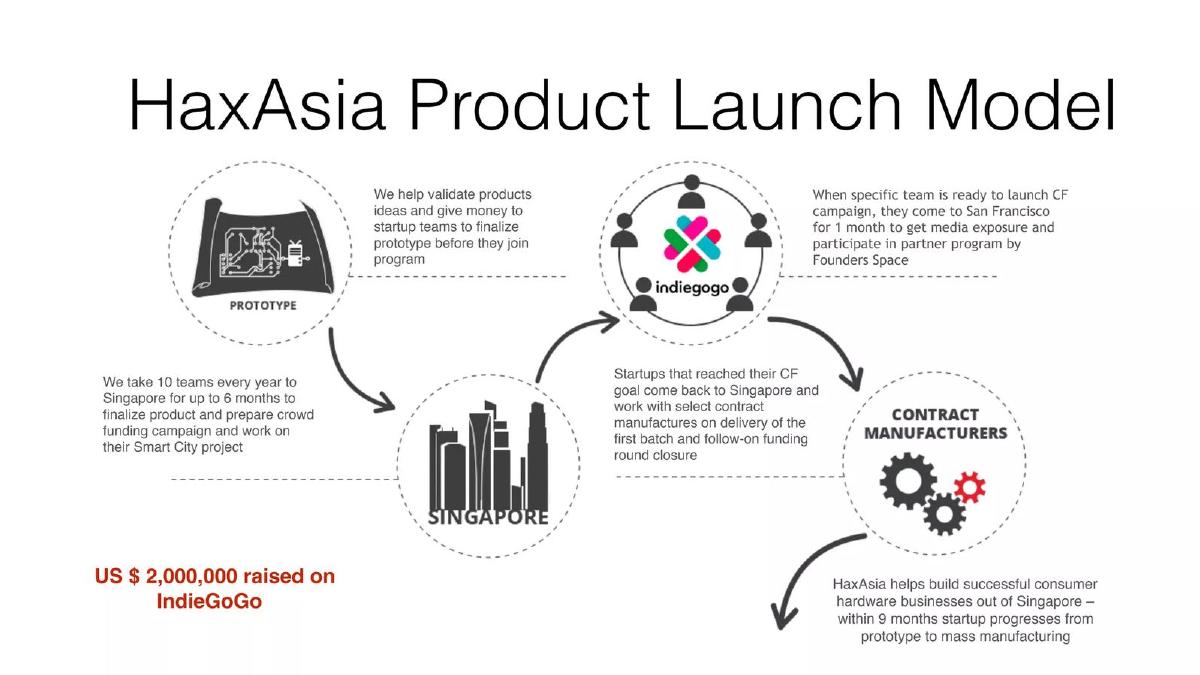
- The program follows a 9-month timeline to move startups from prototype to mass manufacturing (Slide 2).
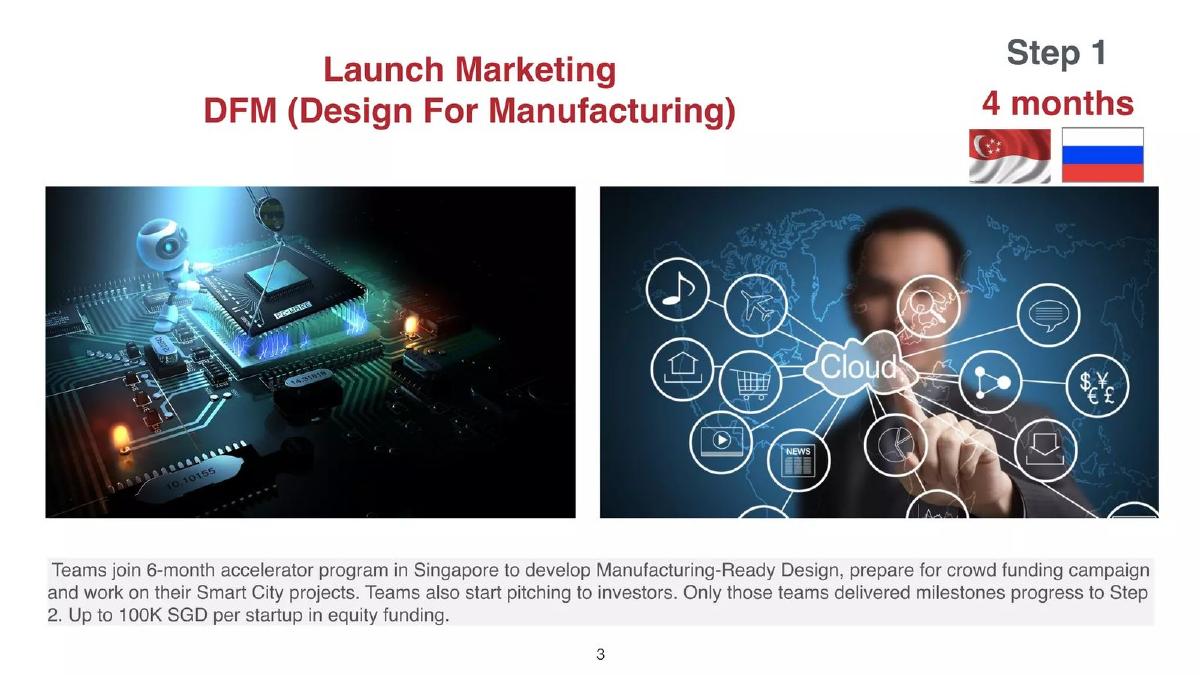
- Startups receive up to 100K SGD in equity funding upon reaching specific milestones in Step 1 (Slide 3).
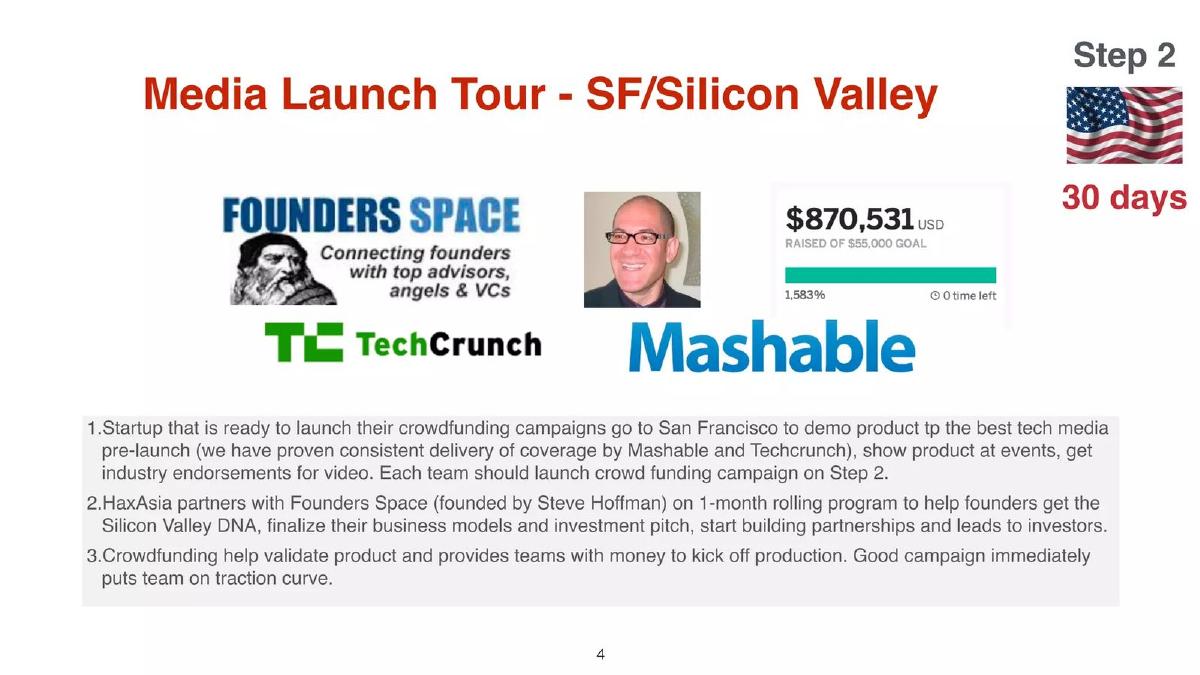
- The model relies on a partnership with Founders Space in San Francisco for a 1-month media and investor tour (Slide 4).
- HaxAsia claims a track record of over $2,000,000 raised on Indiegogo across its portfolio projects (Slide 2, Slide 8).
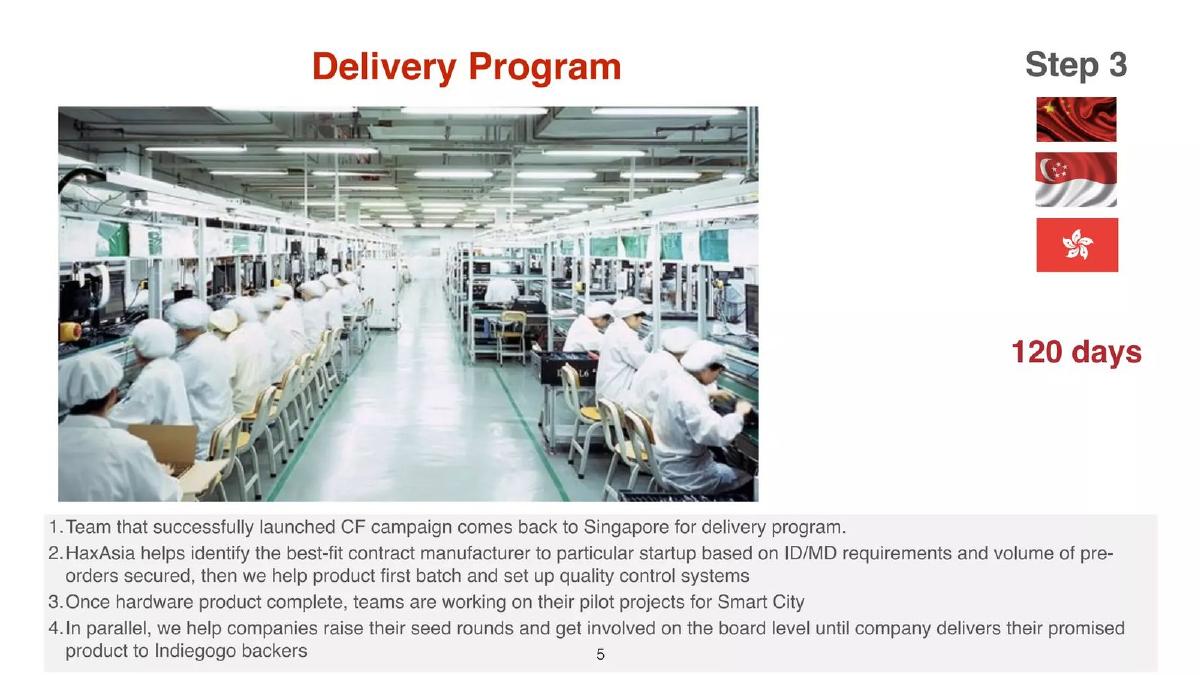
- The delivery phase (Step 3) spans 120 days and focuses on contract manufacturing and quality control (Slide 5).
- The accelerator maintains a physical presence in Singapore (BLK 71), Shenzhen (Innozen), and San Francisco (Slide 6, Slide 7).
- Portfolio success is highlighted by individual campaign totals, such as Touchjet Pond raising $921,249 (Slide 9).
- The deck lists a network of over 200 VC partners across the USA, China, Singapore, and Russia (Slide 10).
Introduction and Program Overview
The HaxAsia Acceleration Program deck is a process-oriented presentation that focuses on the mechanics of hardware startup growth. Rather than pitching a single product, it pitches a methodology for scaling consumer electronics. The visual style is functional, utilizing flowcharts and photographic evidence of facilities to establish credibility in the physical goods space.
Slide 1: Title Slide
The deck opens with a minimalist red background featuring the HaxAsia logo and the title HaxAsia Acceleration Program . It is a standard introductory slide that establishes the brand identity but offers no immediate value proposition or tagline.
Slide 2: HaxAsia Product Launch Model
This slide serves as the executive summary of the program's operations. It outlines a circular workflow starting with Prototype validation and funding. It notes that 10 teams are taken to Singapore annually for up to 6 months to finalize products and prepare for crowdfunding. The process then moves to San Francisco for a 1-month media exposure phase with Founders Space , followed by a return to Singapore to work with Contract Manufacturers . A key metric is highlighted in red text: US $2,000,000 raised on IndieGoGo . The slide concludes by stating that startups progress from prototype to mass manufacturing within 9 months.
Slide 3: Step 1 - Launch Marketing & DFM
Focusing on the first 4 months of the program, this slide emphasizes Design For Manufacturing (DFM) . The text explains that teams join a 6-month program in Singapore to develop manufacturing-ready designs and work on 'Smart City' projects. Crucially, it mentions the financial component: Up to 100K SGD per startup in equity funding , though it notes this is milestone-dependent. The inclusion of the Singaporean and Russian flags suggests the geographic origin or target market of the participating teams.
Slide 4: Step 2 - Media Launch Tour
Step 2 is a 30-day phase located in SF/Silicon Valley . The slide features logos for Founders Space, TechCrunch, and Mashable . The text claims a 'proven consistent delivery of coverage' by these outlets. The goal of this phase is to demo products to tech media, get industry endorsements, and launch the crowdfunding campaign. It explicitly mentions a partnership with Steve Hoffman of Founders Space to help founders acquire 'Silicon Valley DNA' and finalize investment pitches.
Slide 5: Step 3 - Delivery Program
The final phase lasts 120 days and is centered on manufacturing. The slide shows a factory floor and flags for China, Singapore, and Hong Kong. HaxAsia’s role here is identifying the best-fit contract manufacturer based on Industrial Design (ID) and Mechanical Design (MD) requirements. They also assist with quality control systems and help companies raise seed rounds while the first batch is being produced. This slide positions the accelerator as a long-term partner that stays involved until the product is delivered to backers.
Slide 6: Offices in Singapore
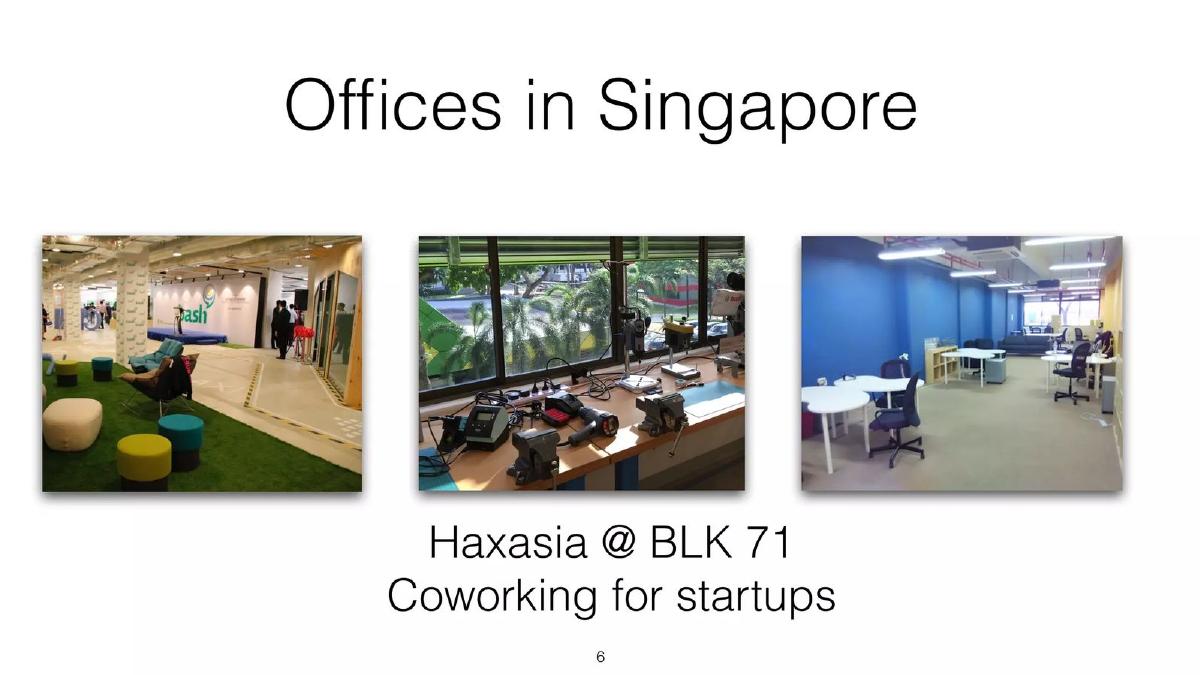
This slide provides visual proof of the accelerator's infrastructure. It features three photos of Haxasia @ BLK 71 , a well-known startup hub in Singapore. The images show a coworking space, a hardware lab bench with soldering stations and vices, and a general office area. This is intended to reassure investors or applicants that the program has the physical tools necessary for hardware development.
Slide 7: Offices in Shenzhen & San Francisco
Continuing the infrastructure theme, this slide shows the Office Innozen in Shenzhen and a modern office space in San Francisco . By showing these locations, HaxAsia reinforces its claim of being a global bridge, providing startups with direct access to the world's manufacturing capital (Shenzhen) and its venture capital capital (San Francisco).
Slide 8: Crowdfunding Success
A simple transition slide with the Indiegogo logo and the text: Our projects raised over 2 min on Indiegogo . Note: The '2 min' is likely a typo intended to mean '2 million,' as referenced on Slide 2 and Slide 9.
Slide 9: We Hacked Crowdfunding
This is the 'Traction' slide for the accelerator. It displays screenshots of six Indiegogo campaigns with overlaid labels showing their total raises. The featured projects include Touchjet Pond ($900,000+) , Touchjet WAVE ($700,000+) , CreoPop ($200,000+) , EzeeCube ($160,000+) , SmartMio ($120,000+) , and Codie ($90,000+) . This slide is the most compelling evidence in the deck, demonstrating that the 'HaxAsia Model' produces repeatable, high-dollar results in the public market.
Slide 10: Investor Network
The final slide is a logo wall divided into three tiers: Investors that had already invested in our portfolio companies (e.g., 500 Startups, Mophie), VCs we are closely connected on the partner level (e.g., Gobi Partners, Monk's Hill), and Partners of VC firms we know (e.g., Andreessen Horowitz, Sequoia Capital, Bessemer). The footer claims they know more than 200 partners in total across the USA, China, Singapore, and Russia. This slide aims to demonstrate the 'exit' or 'follow-on' potential for startups entering the program.
What HaxAsia Does Well
The deck excels at defining a clear, time-bound process. Hardware is notoriously difficult due to manufacturing delays and 'hardware hell,' so providing a 9-month roadmap with specific durations for each phase (4 months, 30 days, 120 days) is highly effective. The geographic strategy is also a strong point; it acknowledges that a successful hardware startup needs to be in Singapore/Shenzhen for making things and San Francisco for selling/funding them.
The use of social proof on Slide 9 is the deck's strongest asset. By showing actual Indiegogo campaign pages with high dollar amounts, HaxAsia moves from theoretical claims to proven results. This 'hacked crowdfunding' angle is a unique selling proposition that differentiates them from generic software accelerators.
What is Missing from the HaxAsia Deck
The most glaring omission is a Team Slide . For an accelerator, the value lies almost entirely in the expertise of the mentors and the connections of the partners. While Steve Hoffman is mentioned in the text of Slide 4, the core HaxAsia management team is never introduced. Investors need to know who is managing the 100K SGD investments and who has the manufacturing expertise to vet contract manufacturers.
There is also no Business Model slide for the accelerator itself. While it mentions taking equity in exchange for 100K SGD, it doesn't specify the percentage or how the accelerator sustains its own operations (e.g., management fees, corporate sponsorships, or success fees from crowdfunding). Furthermore, there is no Ask . It is unclear if HaxAsia is looking for LPs for a new fund, corporate partners for their Smart City projects, or simply using this deck to recruit new startups.
Founder Takeaways
Process is a Product: If you are building a service or an accelerator, treat your workflow as a product. HaxAsia’s breakdown of the 9-month journey makes a complex process feel manageable and professional. · Quantify Your Success: The 'We Hacked Crowdfunding' slide is a masterclass in using third-party validation. Instead of just saying 'we are good at marketing,' they showed the receipts from Indiegogo. · Leverage Geography: If your business operates across borders, highlight why those specific locations matter. HaxAsia doesn't just say they have offices; they explain that Singapore is for DFM, SF is for Media, and Shenzhen is for Manufacturing. · Don't Forget the People: Never leave out a team slide. Even if you have great logos and metrics, venture capital is a people business. Omitting the founders and key mentors leaves a gap in the narrative that investors will immediately question.
Frequently asked questions
- What is the core value proposition of HaxAsia?
- HaxAsia positions itself as a bridge for hardware startups to navigate the 'valley of death' between prototyping and mass production. By providing 100K SGD in funding, DFM expertise in Singapore, and a high-profile media tour in Silicon Valley, they aim to de-risk hardware ventures through successful crowdfunding campaigns and subsequent manufacturing support in Asia.
- How does HaxAsia use crowdfunding in its model?
- Crowdfunding is the central validation pillar of the HaxAsia program. As shown on slide 4, it is used to validate product-market fit and provide the necessary capital to kick off the first production run. The deck highlights that a successful campaign 'immediately puts the team on a traction curve,' making them more attractive for follow-on seed rounds.
- What geographic regions does the program cover?
- The program is international, utilizing Singapore for initial development and DFM (Slide 3), San Francisco for media exposure and investor networking (Slide 4), and a combination of Singapore, Shenzhen, and Hong Kong for manufacturing and delivery (Slide 5). This 'tri-city' approach leverages the specific strengths of each tech ecosystem.
- What specific startups has HaxAsia accelerated?
- Slide 9 lists several successful graduates: Touchjet Pond ($921,249 raised), Touchjet WAVE ($704,879), CreoPop ($212,100), EzeeCube ($160,410), SmartMio ($122,931), and Codie ($96,306). These examples serve as the primary evidence for HaxAsia's claim that they have 'hacked crowdfunding.'
- What critical information is missing from this deck?
- The deck is missing a 'Team' slide, which is unusual for an accelerator where the mentors' and partners' backgrounds are critical. It also lacks a clear 'Ask'—it is unclear if they are raising a fund or seeking corporate partners. Finally, there is no mention of the accelerator's specific equity take or long-term management fees.