Harvest is an automated debt management platform aiming to solve the 'debt cycle' for the 8 in 10 Americans carrying liabilities. Their 14-slide pre-seed deck relies heavily on macroeconomic trends, specifically the $4.0 trillion non-housing debt balance in the US as of Q3 2016. The product strategy involves 'fractional refinancing' and AI-driven principal payments to accelerate debt payoff. The business model is purely affiliate-based, mirroring the lead-generation tactics of Mint and Credit Karma but applied to debt reduction. While the deck features a strong founding team with experience a…
Key takeaways
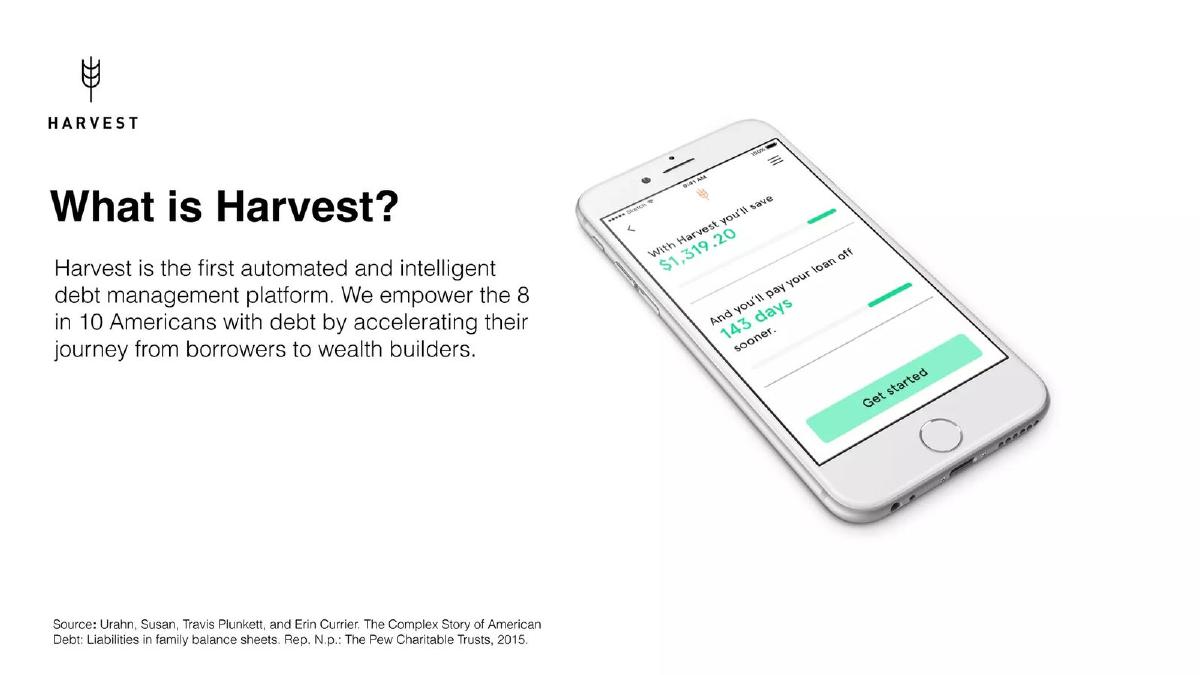
- The platform targets the 80% of Americans with debt, positioning itself as an intelligent manager to accelerate the journey to wealth (Slide 3).
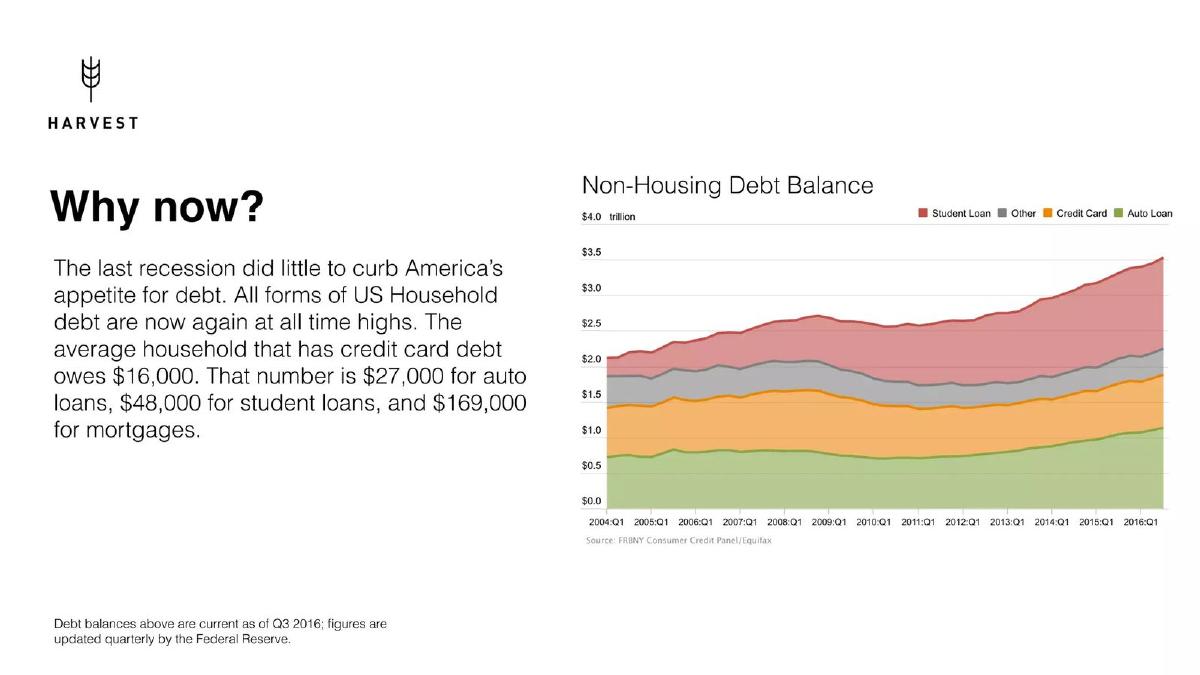
- Macroeconomic data from Q3 2016 shows a total non-housing debt balance approaching $3.5 trillion, with average student loans at $48,000 (Slide 4).
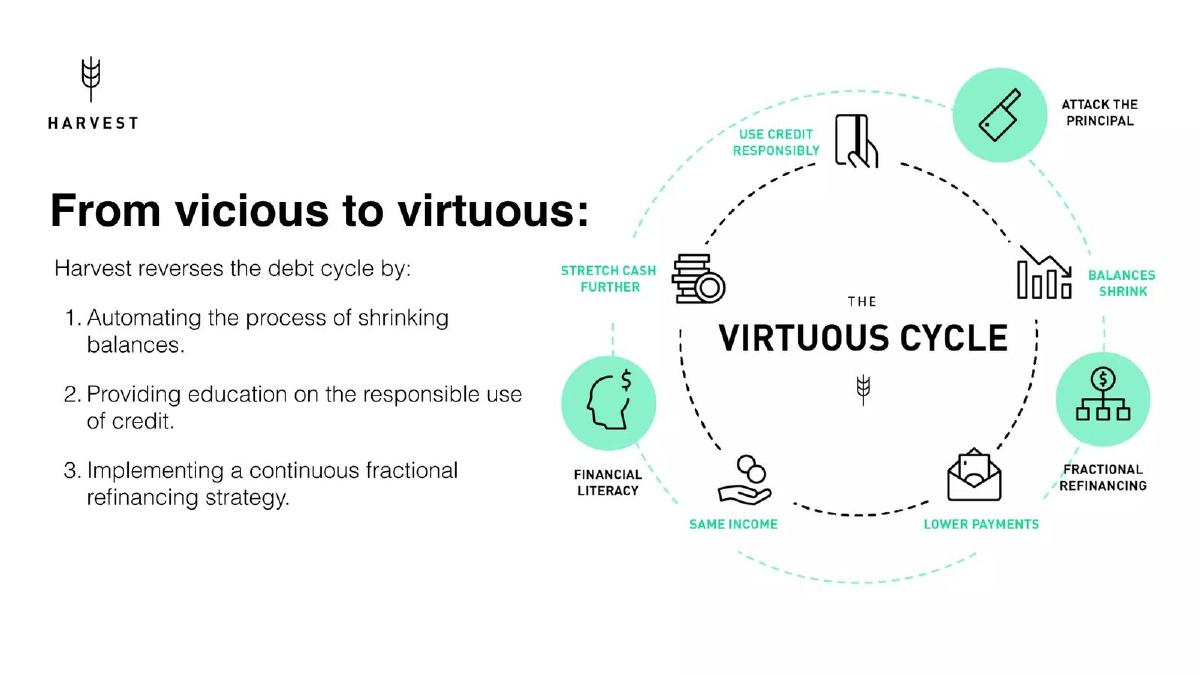
- The 'Virtuous Cycle' product hook relies on three pillars: automated balance shrinking, financial education, and fractional refinancing (Slide 6).
- Monetization is strictly affiliate-based, following the models of NerdWallet and Credit Karma by earning revenue from financial product referrals (Slide 8).
- The go-to-market strategy identifies a 'gaping hole' left by the closure of competitor Ready for Zero (Slide 10).
- The long-term vision involves moving users from a 'Debt Platform' to a 'Wealth Platform,' eventually competing with Robinhood and Fundrise (Slide 11).
- The founding team includes members with backgrounds from Lob, Microsoft, Medium, Uber, Simple, and One Medical (Slide 2).
- The $600,000 pre-seed ask is allocated for a 12-month runway to hire a developer, designer, and marketer, and to acquire 10,000 customers (Slide 14).
Executive Summary and Team
Slide 1: Title Slide
The deck opens with a lifestyle image of a woman with arms outstretched toward the ocean at sunset. The branding is minimal, featuring the Harvest logo (a stylized wheat stalk) and the tagline: Eliminate debt, grow your wealth.
Slide 2: The Team
Harvest introduces a three-person founding team with significant tech pedigree. Tory Reiss (Business) is credited with experience at Lob and Microsoft. Michael Distefano (Engineering) brings a background from Medium, Uber, and Simple. Dairien Boyd (Design) lists experience at One Medical, Rise, and Google. The slide uses logos to emphasize the high-growth environments the founders originated from, establishing immediate professional credibility.
Problem and Market Opportunity
Slide 3: What is Harvest?
This slide defines the product as the first automated and intelligent debt management platform. It cites a 2015 Pew Charitable Trusts report stating that 8 in 10 Americans carry debt. The stated mission is to accelerate the journey from 'borrowers to wealth builders.' A mobile mockup shows a user interface claiming to save a user $1,319.20 and pay off a loan 143 days sooner.
Slide 4: Why now?
The deck leverages macroeconomic urgency. A chart titled Non-Housing Debt Balance shows a steady climb toward $4.0 trillion as of Q3 2016. Specific debt averages are listed: $16,000 for credit cards, $27,000 for auto loans, $48,000 for student loans, and $169,000 for mortgages. The slide argues that the last recession did not curb the American appetite for debt, which is again at all-time highs.
Slide 5: What's the cause?
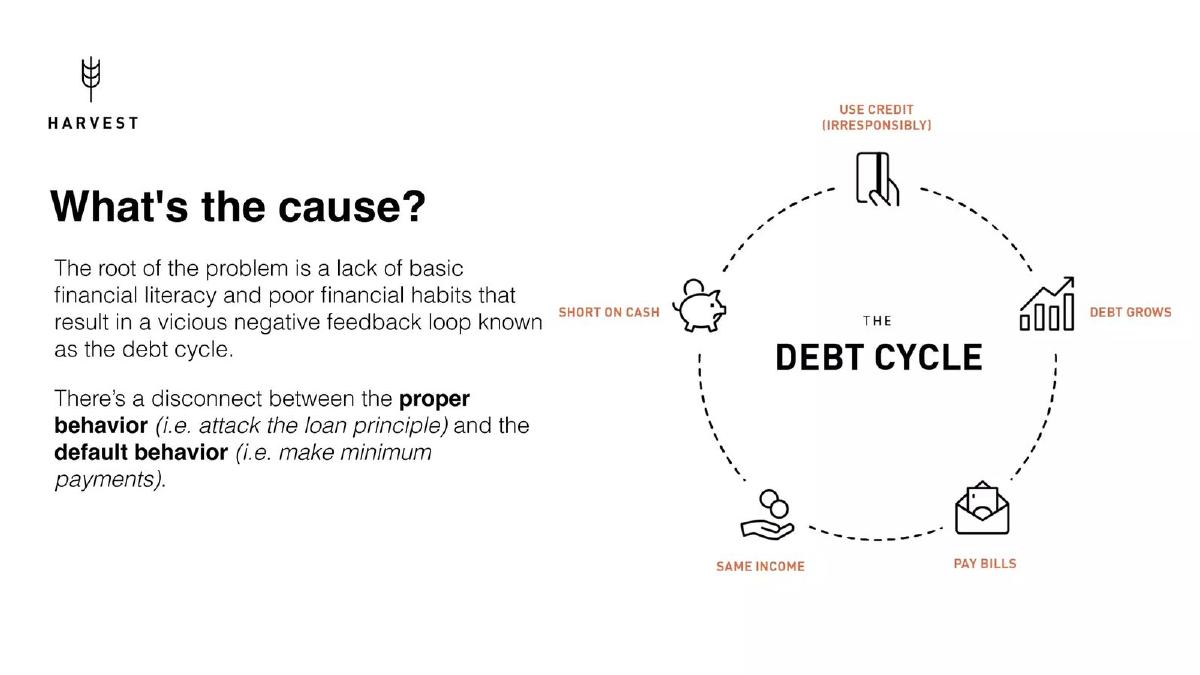
Harvest identifies the root cause as a lack of financial literacy and a vicious negative feedback loop called the 'Debt Cycle.' The cycle consists of being short on cash, using credit irresponsibly, debt growing, paying bills with the same income, and returning to a cash shortage. They highlight the gap between 'proper behavior' (attacking principal) and 'default behavior' (minimum payments).
The Harvest Solution
Slide 6: From vicious to virtuous
This slide introduces the Virtuous Cycle . Harvest proposes to reverse the debt cycle by: 1. Automating the shrinking of balances, 2. Providing education on responsible credit use, and 3. Implementing a continuous fractional refinancing strategy. The graphic shows how these interventions lead to lower payments and shrinking balances.
Slide 7: How does Harvest help?
The solution is broken down into three functional areas. Attack the Principal uses AI to analyze spending and income to implement optimal pay-down strategies. Financial Literacy uses behavioral psychology to provide 'bite-sized chunks' of education. Fractional Refinancing automates the market search for consolidation opportunities, only showing them when they benefit the user. A mockup shows a student loan of $30,232 with a 'Harvest back' savings of 302 days and $3,289.
Business Model and Strategy
Slide 8: Business Model
Harvest positions its business model against established fintech players. They list Digit (automated savings), Credit Karma (credit scores), Mint (budgeting), and NerdWallet (content) as companies that 'Give Away' a service to 'Monetize' via affiliate revenue or interest differentials. Harvest follows this lead-generation model , offering its debt management and literacy tools for free while generating Affiliate Revenue from the backend.
Slide 9: The Opportunity: Aggregation
This slide explains the strategic value of user aggregation. By earning trust and saving users money, Harvest aims to build a large enough user base that lenders will compete for their users. This competition is intended to drive down origination fees and interest rates, further benefiting the consumer.
Slide 10: Initial Markets
The go-to-market strategy is multi-pronged. They identify a specific market gap created by the Ready for Zero acquisition and closure , noting that hundreds of thousands of users are looking for an alternative. Other targets include millennials with student debt, homeowners (using public record data), personal finance influencers, and lenders who want to reduce delinquency costs (which they claim cost 5x more than on-time borrowers).
Vision and Competition
Slide 11: Vision
The vision slide uses a diagonal arrow moving from 'From Debt' to 'To Wealth.' Harvest starts as a Debt Platform , competing with Frank, Tally, and Payoff. As users clear their debt, Harvest intends to evolve into a Wealth Platform , eventually sitting alongside Robinhood, Fundrise, and Wunder. This suggests a long-term play for the entire lifecycle of a consumer's financial health.
Slide 12: Competition
The competitive landscape is visualized as a four-leaf clover. Harvest places itself at the center of Lenders (SoFi, Earnest), PFMs (Mint, YNAB), Investing (Wealthfront, Stash), and Comparison/Education (Bankrate, Credit Karma). The slide includes a defensive statement: 'If you try to be everything to everyone, you will fail,' asserting that Harvest is specifically a debt management tool, not a 'Swiss army knife.'
Execution and The Deal
Slide 13: 2017 Timeline
This slide provides a monthly breakdown for 2017. It tracks Funds remaining (starting at $600,000 in March and ending near $250,000 in December) against a Burn Rate that peaks around $43,000. Key milestones include hiring a Full-Stack Dev and Designer in June, a Growth Marketing Manager in July, a Private Launch in the summer, and a V0 Public Launch in Q4.
Slide 14: The deal
The final slide outlines the funding terms. Harvest states they have raised a $600,000 Pre-Seed round for 12 months of runway. The goals for this capital are to make 3-4 key hires, launch the mobile client, build channel and lending partnerships, start content generation, and acquire 10,000 early customers. The slide includes placeholders for 'Who Invested?' and 'From where?' which are left blank in this version of the deck.
What Works and What is Missing
What Works: The deck is exceptionally clear about its business model. By comparing itself to Mint and Credit Karma, it avoids the confusion often associated with 'AI-driven' fintech startups. The team slide is a major asset, showing that the founders have worked at the exact types of companies (Uber, Simple, Microsoft) required to build a high-scale consumer financial product. The identification of the 'Ready for Zero' closure as a market entry point shows tactical awareness.
What is Missing: The deck is entirely pre-traction. There are no pilot results, waitlist numbers, or user feedback data. While the 2017 timeline is detailed, it is purely speculative. Additionally, the 'Fractional Refinancing' feature is a complex technical and regulatory undertaking, yet the deck does not address the specific lending licenses or bank partnerships required to execute this beyond simple affiliate links. The 'The deal' slide is also incomplete, lacking the names of the investors who participated in the round.
Founder Takeaways
Use Macro Trends to Create Urgency: Slide 4 is a masterclass in using Federal Reserve data to make a problem feel massive and inevitable. By showing the $4 trillion debt mountain, the founders make their solution feel like a necessary utility rather than a luxury.
Define Your Category by What You Are Not: Slide 12 is effective because it explicitly states, 'We are not a Personal Finance Manager (PFM). We are not a Swiss army knife.' This helps investors bucket the company correctly and prevents them from comparing Harvest to generic budgeting apps that have historically struggled to monetize.
Map the User Evolution: The Vision slide (Slide 11) is crucial for pre-seed decks. It shows that while the company is starting with a niche (debt management), the Total Addressable Market (TAM) expands as the product succeeds. Moving from a 'Debt Platform' to a 'Wealth Platform' gives the company a path to a much higher valuation than a simple utility app would have.
Frequently asked questions
- What is the core problem Harvest aims to solve?
- According to Slide 5, the core problem is the 'debt cycle' caused by a lack of financial literacy and poor habits. Harvest identifies a disconnect between 'proper behavior' (attacking the principal) and 'default behavior' (making minimum payments). They aim to automate the proper behavior to help users escape this cycle.
- How does Harvest plan to make money?
- Slide 8 explicitly states that Harvest uses an affiliate revenue model. While they 'give away' automated debt management, financial literacy, and fractional refinancing, they monetize by referring users to lenders and financial products, similar to how Mint and Credit Karma operate.
- What is the specific funding ask and how will it be used?
- On Slide 14, Harvest states they have raised a $600,000 pre-seed round for a 12-month runway. The funds are earmarked for hiring a Full Stack Developer, a Designer, and a Growth Marketer, launching the v0 mobile client, building partnerships, and acquiring 10,000 early customers.
- Who are the primary competitors identified in the deck?
- Slide 12 provides a comprehensive competitive landscape. It categorizes competitors into Lenders (SoFi, LendingClub, Tally), PFM tools (Mint, YNAB, Prosper), Investing platforms (Wealthfront, Betterment), Comparison sites (Bankrate, Credible), and Education sources (SmartAsset, StockTwits).
- What is the 'Fractional Refinancing' feature mentioned in the slides?
- As described on Slide 7, fractional refinancing is an AI-driven process that continuously checks the market for refinance and consolidation opportunities. The system only surfaces these options to the user when they provide a clear financial benefit, automating a traditionally manual and difficult process.