Hashtag Pay Me is a platform designed to help social media creators price their sponsored content through data-driven benchmarking. The 9-slide deck used for their 2023 pre-seed round, which reportedly raised $200,000, leans heavily on the founder's domain expertise and early organic traction. By focusing on the 'chaotic' workflow of brand deals, the deck positions its pricing calculator as the core value proposition. While the deck lacks a formal competitive landscape or detailed unit economics, it successfully demonstrates product-market fit through a growth chart showing accelerating ARR a…
Key takeaways
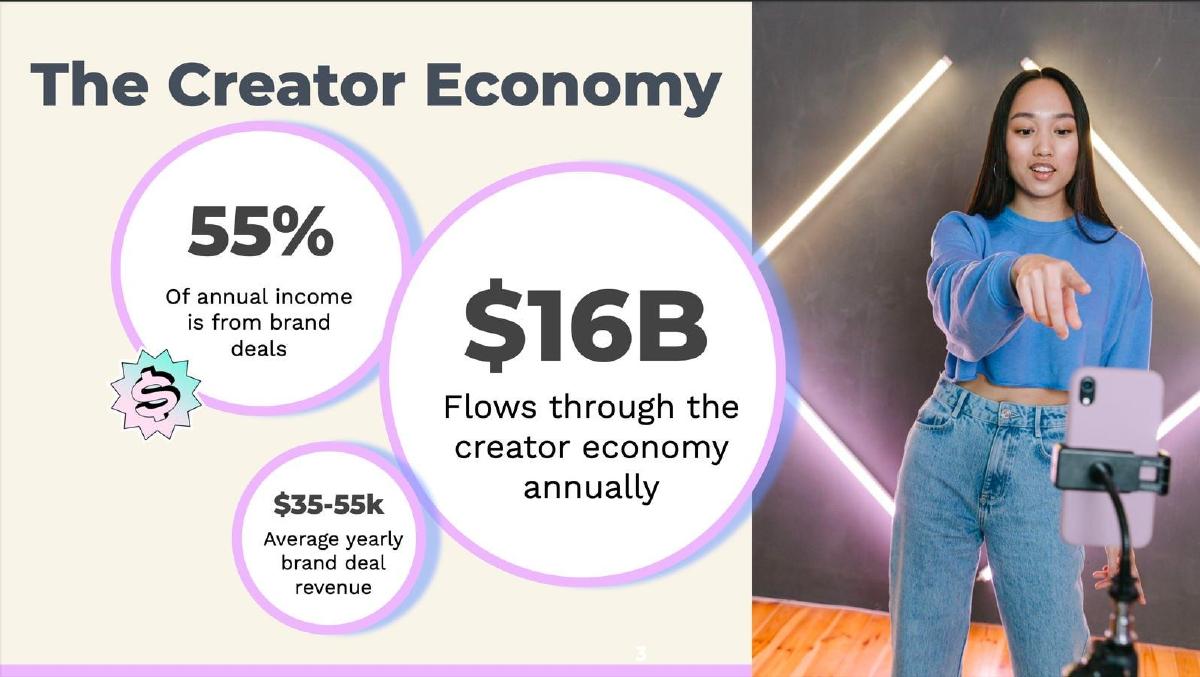
- The creator economy market is valued at $16B annually, with 55% of creator income derived from brand deals as stated on Slide 2.
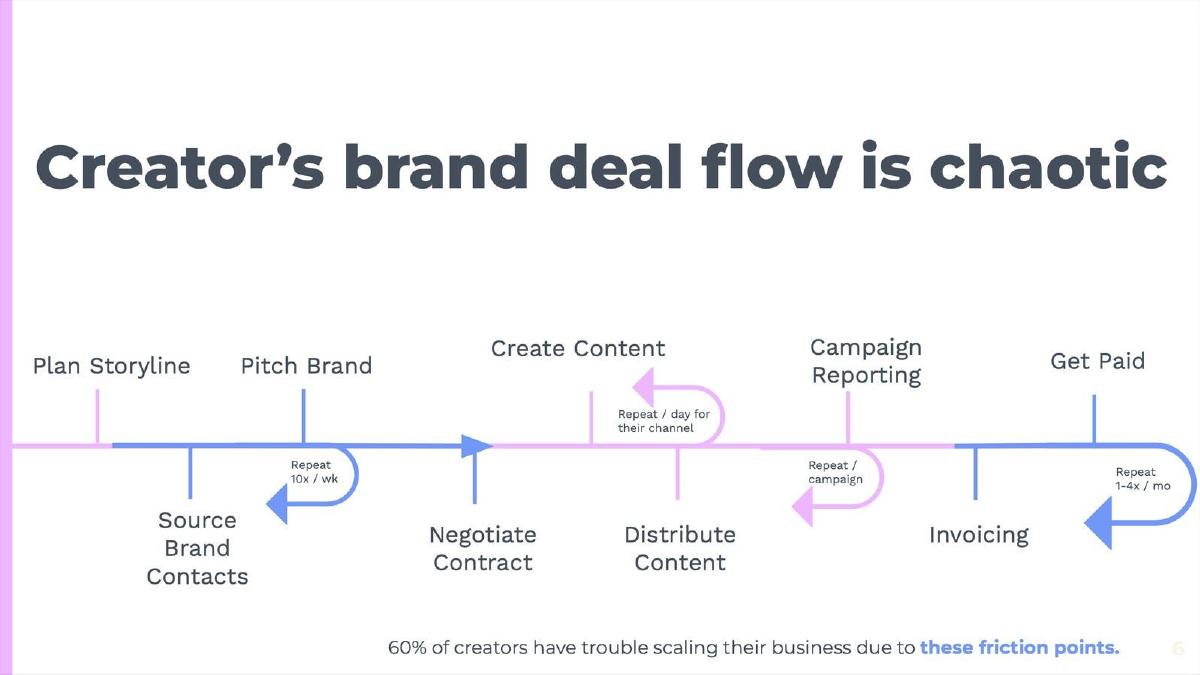
- Slide 3 identifies a specific friction point where 60% of creators struggle to scale due to chaotic brand deal workflows.
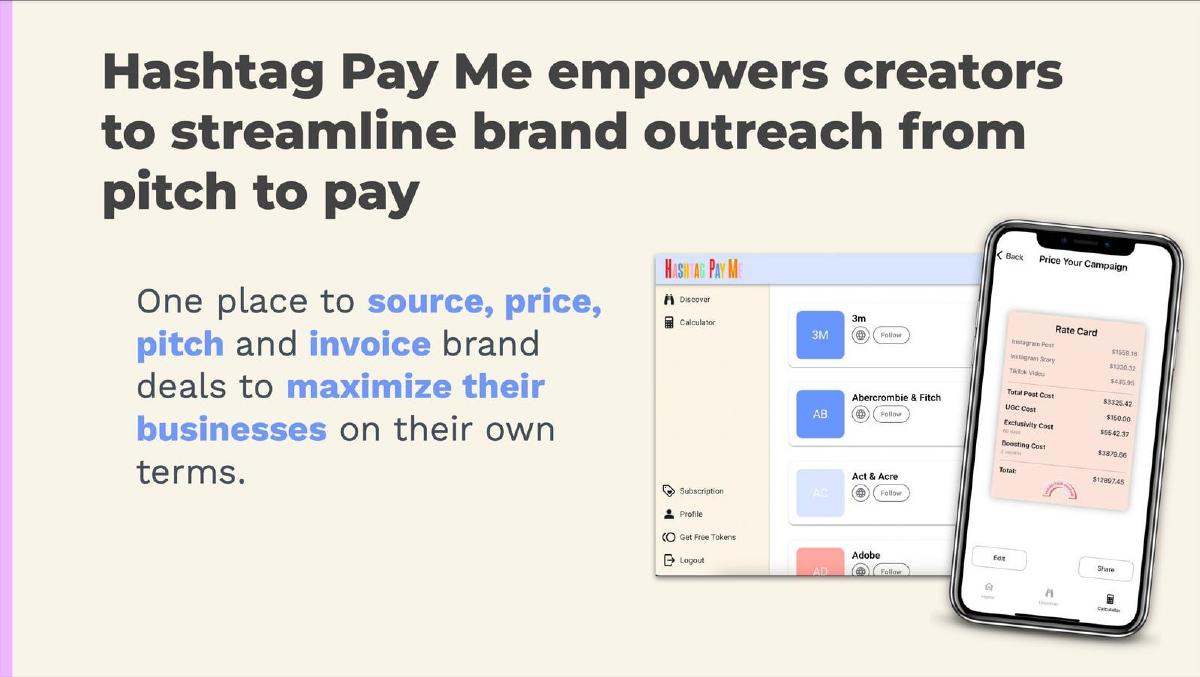
- The product is positioned as an all-in-one tool to source, price, pitch, and invoice brand deals on Slide 4.
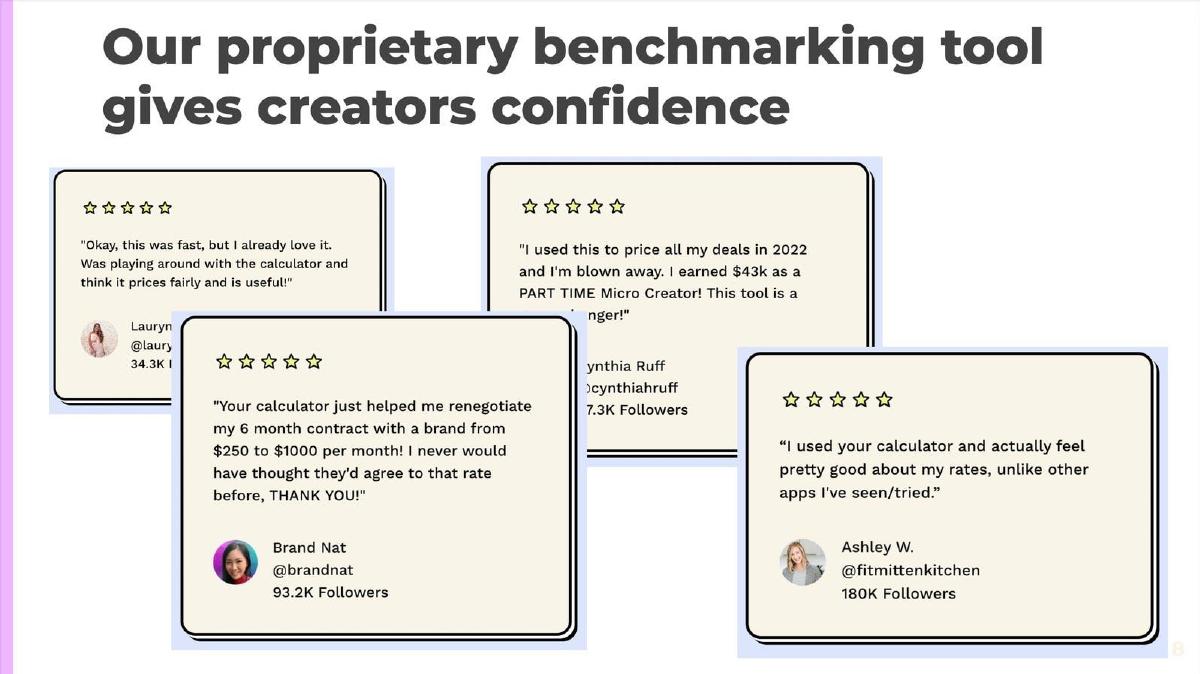
- Slide 5 uses social proof through four creator testimonials, including one citing a rate increase from $250 to $1,000 per month.
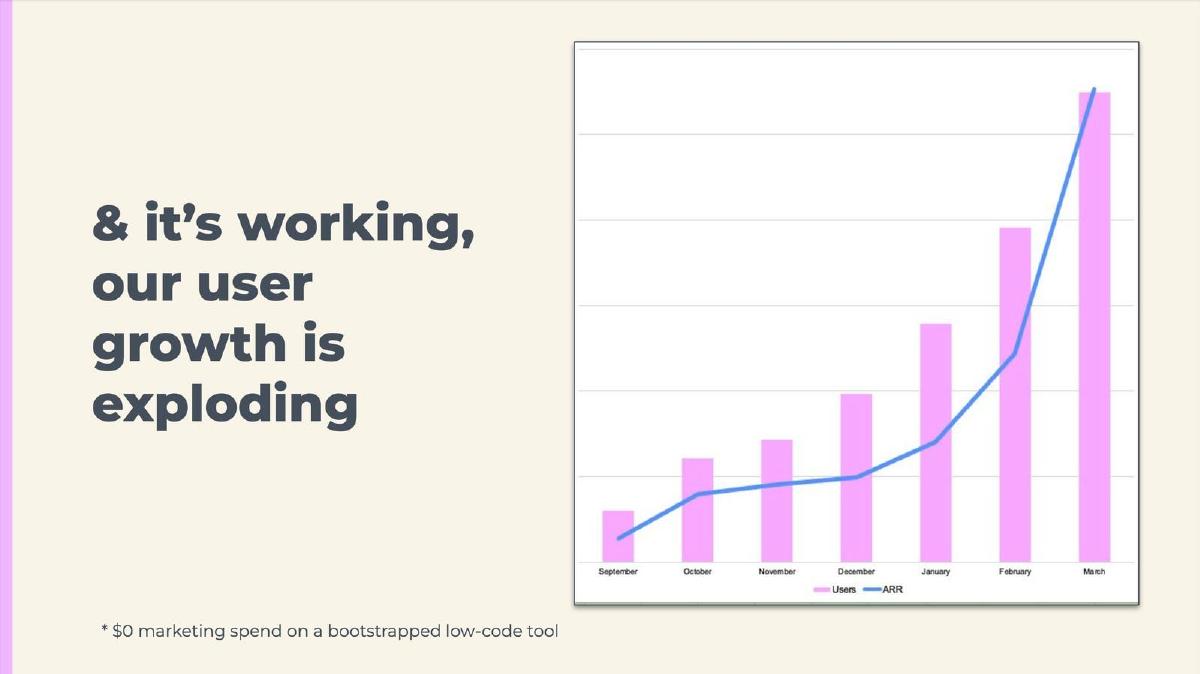
- Traction is demonstrated on Slide 6 with a chart showing monthly growth in both Users and ARR from September through March.
- The growth shown on Slide 6 was achieved with $0 marketing spend using a bootstrapped low-code tool.
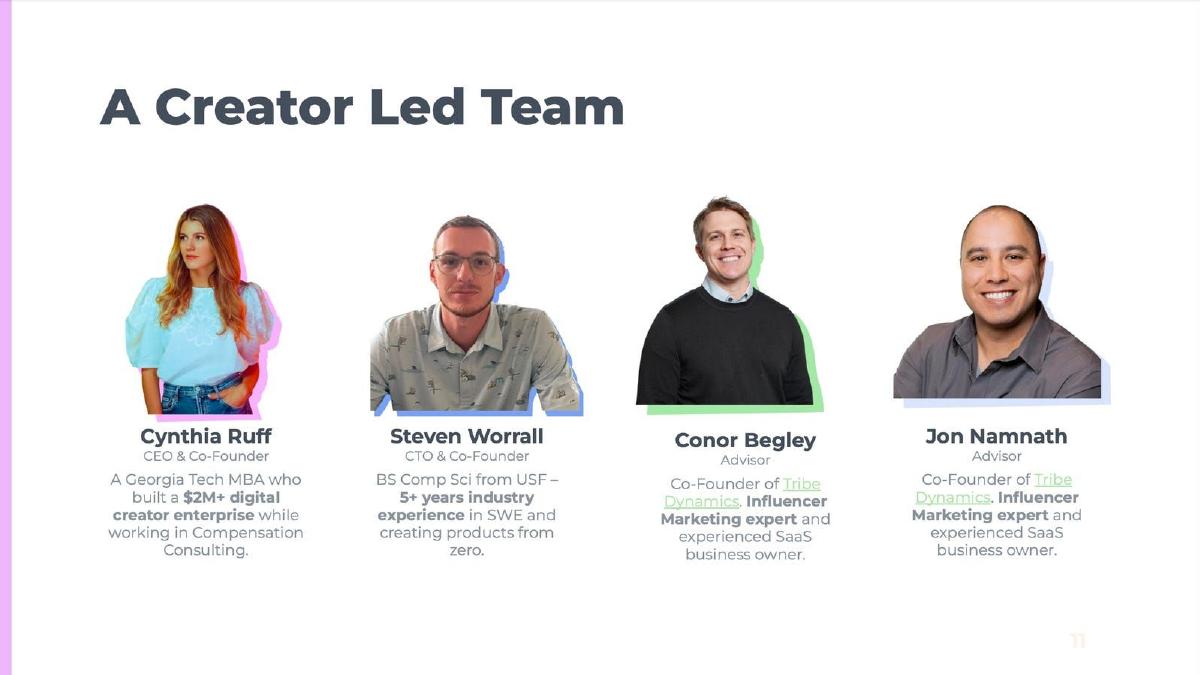
- Founder Cynthia Ruff is highlighted on Slide 7 for building a $2M+ digital creator enterprise while working in compensation consulting.
- The team includes two advisors who are co-founders of Tribe Dynamics, providing deep industry credibility on Slide 7.
Introduction
Hashtag Pay Me entered the market at a time when the creator economy was shifting from a hobbyist landscape to a professionalized industry. Their 9-slide pre-seed deck, used to raise $200,000 in 2023, is a study in brevity and focus. Instead of over-explaining the technology, the deck focuses on the founder's unique insight into compensation and the organic traction generated by a simple, effective tool. This teardown examines how they leveraged a 'low-code' start into a successful early-stage raise.
Slide 1: Title Slide
The deck opens with a minimalist title slide featuring the company name and the tagline: 'The easiest way to go from pitch to pay.' The branding uses a soft pink-to-orange gradient, which aligns with the aesthetic often found in creator-facing tools. It immediately establishes the value proposition: streamlining the financial workflow for creators.
Slide 2: The Creator Economy Opportunity
Slide 2 sets the stage with three key metrics. It claims that $16B flows through the creator economy annually. More importantly, it notes that 55% of annual income for these creators comes from brand deals, with an average yearly brand deal revenue of $35-55k . By highlighting that over half of a creator's income is tied to the specific problem Hashtag Pay Me solves, the slide validates the market size and the necessity of the tool.
Slide 3: The Problem Statement
The deck defines the problem as a 'chaotic' workflow. Slide 3 provides a linear timeline of a creator's brand deal flow: Plan Storyline, Source Brand Contacts, Pitch Brand, Negotiate Contract, Create Content, Distribute Content, Campaign Reporting, Invoicing, and Get Paid. It highlights that pitching happens 10 times per week and invoicing occurs 1-4 times per month. The kicker is at the bottom: 60% of creators have trouble scaling their business due to these friction points. This slide effectively moves the conversation from 'market size' to 'user pain.'
Slide 4: The Solution
Slide 4 introduces the platform as the 'one place to source, price, pitch and invoice brand deals.' The slide includes two mockups: a desktop view showing a brand discovery feed (featuring brands like Adobe and Abercrombie & Fitch) and a mobile view of a 'Price Your Campaign' tool. The mobile screen is particularly detailed, showing a 'Rate Card' with specific line items like 'Instagram Post ($1559.16)' and 'Exclusivity Cost ($5542.37).' This demonstrates that the product isn't just a generic CRM, but a specialized financial tool.
Slide 5: Social Proof and Benchmarking
Slide 5 focuses on the 'proprietary benchmarking tool.' Rather than explaining the algorithm, the founders use four testimonials to prove it works. One creator, Brand Nat (93.2K followers), claims the calculator helped her renegotiate a contract from $250 to $1000 per month . Another creator, Cynthia Ruff (7.3K followers), mentions earning $43k as a part-time micro-creator using the tool. This slide is critical because it proves the tool provides immediate, tangible ROI to the user.
Slide 6: Traction and Growth
This is arguably the most important slide in the deck. It features a bar and line chart showing growth from September to March. While the Y-axis lacks specific dollar amounts, the visual trend for both 'Users' and 'ARR' (Annual Recurring Revenue) shows a sharp upward curve, particularly in the final three months. A footnote adds significant weight to these numbers: '$0 marketing spend on a bootstrapped low-code tool.' This tells investors that the product has high viral potential and that the founders are capital-efficient.
Slide 7: The Team
Slide 7 highlights a 'Creator Led Team.' CEO Cynthia Ruff is positioned as the ideal founder for this niche, possessing both a Georgia Tech MBA and the experience of building a $2M+ digital creator enterprise while working in compensation consulting. This 'founder-market fit' is bolstered by CTO Steven Worrall and two advisors, Conor Begley and Jon Namnath, who are the co-founders of Tribe Dynamics. The inclusion of these advisors adds significant industry authority to a pre-seed stage startup.
Slide 8: The Ask and Roadmap
Slide 8 outlines the plan for 2023. The roadmap is divided into four quarters: Q1 focuses on expanding the pay database; Q2 on releasing the new mobile and web app; Q3 on testing the GTM (Go-To-Market) strategy; and Q4 on starting the search for Seed funding. The 'Use of Funds' list mirrors these goals, though it lacks specific percentages or dollar allocations for each category. It serves as a high-level operational plan rather than a detailed budget.
Slide 9: Conclusion
The final slide is a simple 'Thank you' with a reiteration of the mission: 'We’re empowering the creator economy to expand their brand sponsorships.' It maintains the clean, minimalist aesthetic of the rest of the deck.
What Works in This Deck
Founder-Market Fit: The CEO’s background is the strongest asset here. Having someone who has actually built a multi-million dollar creator business and understands compensation consulting makes the 'proprietary benchmarking' claim much more believable.
Organic Traction: The claim of zero marketing spend on Slide 6 is a massive green flag for pre-seed investors. It suggests that the problem is so acute that creators are seeking out the solution and sharing it with their peers without being prompted by paid ads.
Specific ROI: The testimonials on Slide 5 aren't just 'I love this app.' They include specific financial outcomes, such as a 4x increase in contract value. This makes the value proposition concrete.
What Is Missing
Competitive Landscape: The deck does not mention other creator platforms or pricing tools. Investors would likely want to know how Hashtag Pay Me differentiates itself from established talent agencies or other fintech tools for creators.
Business Model Details: While Slide 6 mentions ARR, the deck doesn't explain the pricing tiers or how the company actually makes money. Is it a SaaS subscription, a percentage of the deal, or a freemium model? This is a significant omission for a pitch deck.
Detailed Financials: There is no mention of CAC (Customer Acquisition Cost), churn, or projected revenue. While these are often estimated at the pre-seed stage, having some targets would show a more rigorous approach to business planning.
Founder Takeaways
Start with a 'wedge': Hashtag Pay Me didn't try to build a full creator ERP on day one. They started with a 'low-code' pricing calculator that solved one specific, painful problem. · Leverage your advisors: If you are a first-time founder, having industry heavyweights (like the Tribe Dynamics founders) on your team slide can bridge the credibility gap. · Show, don't just tell, the growth: Even if your revenue is small, showing a consistent upward trend in users and ARR—especially if it's organic—is more persuasive than any market size slide. · Keep it brief: At 9 slides, this deck is extremely digestible. It respects the investor's time by focusing only on the most compelling parts of the story.
Frequently asked questions
- How much did Hashtag Pay Me raise with this deck?
- According to publisher-reported facts from Business Insider, the company raised $200,000 in a pre-seed round in 2023. The deck itself mentions 'raising funds to fuel growth' on Slide 8 but does not specify the exact dollar amount or valuation sought during the pitch.
- What is the core problem Hashtag Pay Me solves?
- The deck identifies the 'chaotic' nature of brand deals on Slide 3. Specifically, it targets the lack of pricing transparency and the high frequency of repetitive tasks, noting that 60% of creators have trouble scaling because of these friction points.
- Who are the founders and what is their background?
- As shown on Slide 7, the team is led by CEO Cynthia Ruff, a Georgia Tech MBA with experience in compensation consulting and a $2M+ creator business. CTO Steven Worrall brings 5+ years of software engineering experience. They are supported by advisors from Tribe Dynamics.
- Is there evidence of product-market fit in the deck?
- Yes, Slide 6 displays a growth chart showing a steady increase in both users and ARR over a seven-month period. Notably, the slide claims this was achieved with zero marketing spend, suggesting strong organic demand for their pricing benchmarking tool.
- What is missing from this pitch deck?
- The deck is very lean at only 9 slides. It omits a dedicated competitor slide, detailed unit economics (LTV/CAC), a clear exit strategy, and a specific breakdown of how the $200,000 would be allocated beyond general categories like 'hire key employees'.