Headout's 18-slide deck from 2015 is a masterclass in the 'X for Y' positioning strategy, explicitly labeling itself as the 'HotelTonight for tours & activities' on the cover. The deck identifies a massive $84 billion market opportunity driven by last-minute travelers and highlights a critical supplier pain point: 35% unsold inventory. With a lean, visual-heavy design, the presentation emphasizes rapid growth—65% month-over-month—and a clear product-market fit through 4,000+ travelers served. While it lacks a traditional team slide with professional bios or a specific financial 'ask' slide, t…
Key takeaways
- The deck uses a strong 'X for Y' analogy on Slide 1, positioning Headout as the HotelTonight for tours and activities.
- Slide 2 identifies an $84 billion market for local experiences booked less than 24 hours in advance in 2014.
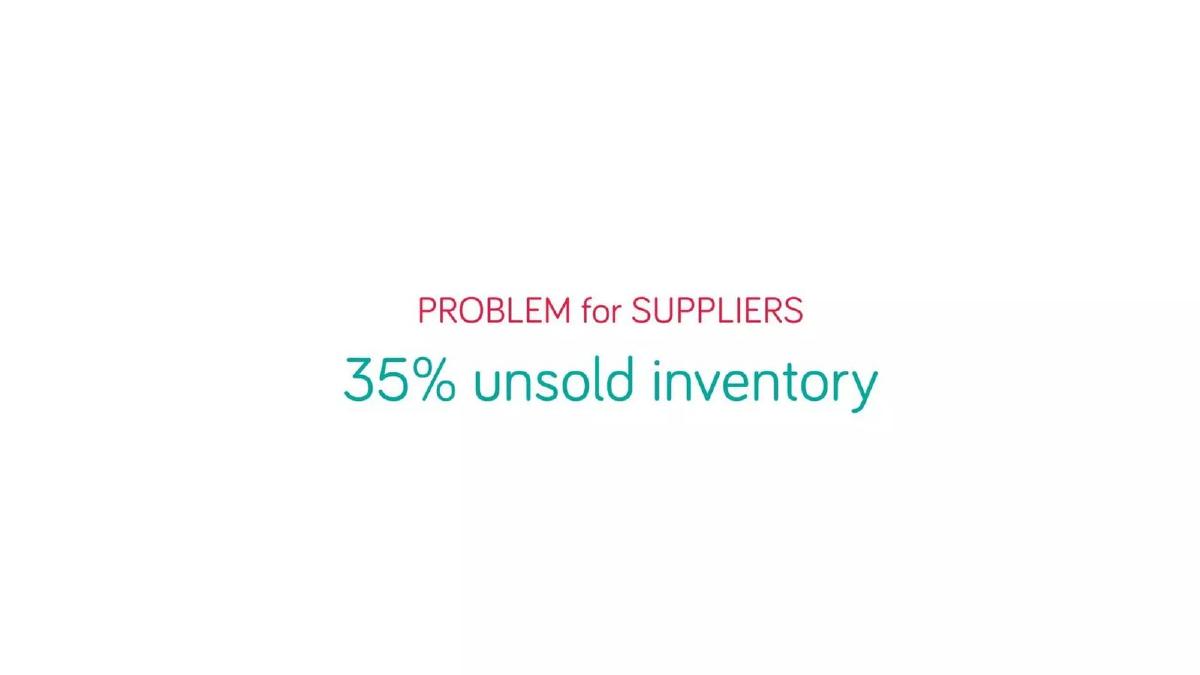
- Suppliers face a significant efficiency problem with 35% unsold inventory, as stated on Slide 5.
- The company demonstrated strong early traction with 65% month-over-month growth shown on Slide 10.
- Headout claims a distinct inventory advantage, offering 14x more last-minute seats than competitors Peek and Viator on Slide 14.
- The platform promises 20% better prices for users, according to Slide 15.
- Slide 17 illustrates a massive mobile adoption gap, showing only 2% of tours and activities booked on mobile compared to 65% for hotels.
- The deck omits a formal team slide with names and titles, though founders appear in a photo on Slide 18.
Executive Summary: The Mobile-First Pivot for Local Experiences
Headout’s 2015 pitch deck is a focused, high-energy presentation that targets a very specific inefficiency in the travel market: the lack of a mobile-first, last-minute booking platform for activities. By 2015, travelers were already accustomed to booking last-minute hotels via apps like HotelTonight, but the 'things to do' segment remained fragmented and offline. Headout’s deck argues that by digitizing this $84 billion market, they can solve the 35% unsold inventory problem for suppliers while giving travelers better prices and a 60-second booking flow.
Slides 1-5: The Problem and Market Opportunity
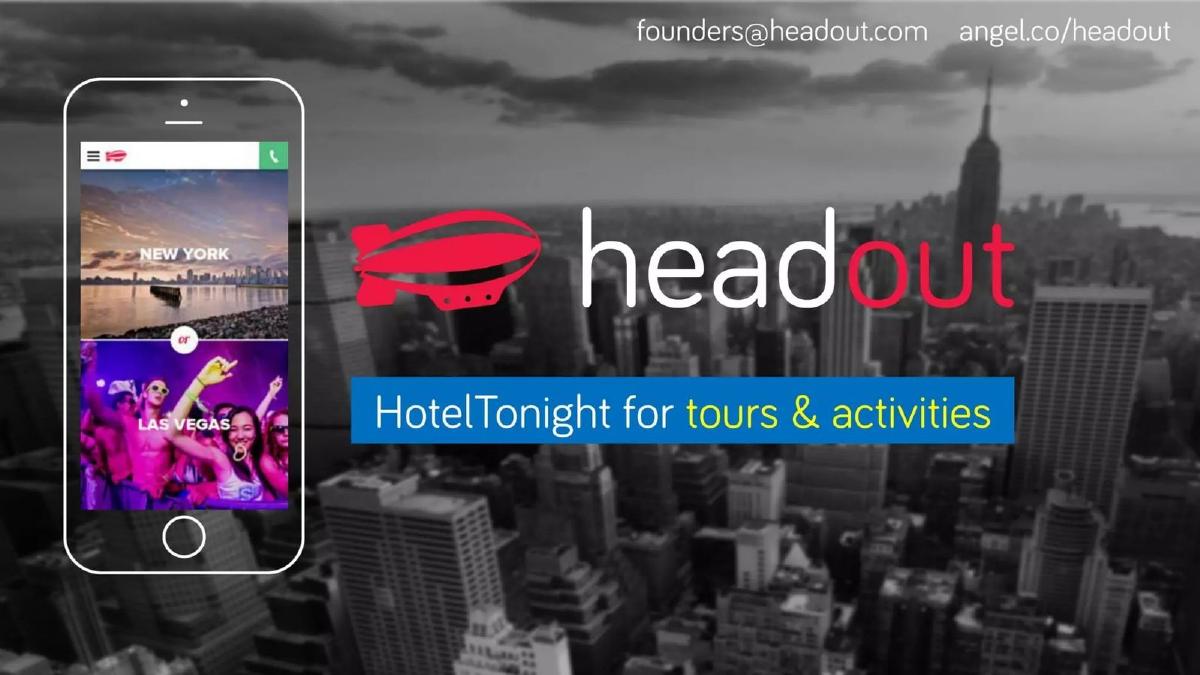
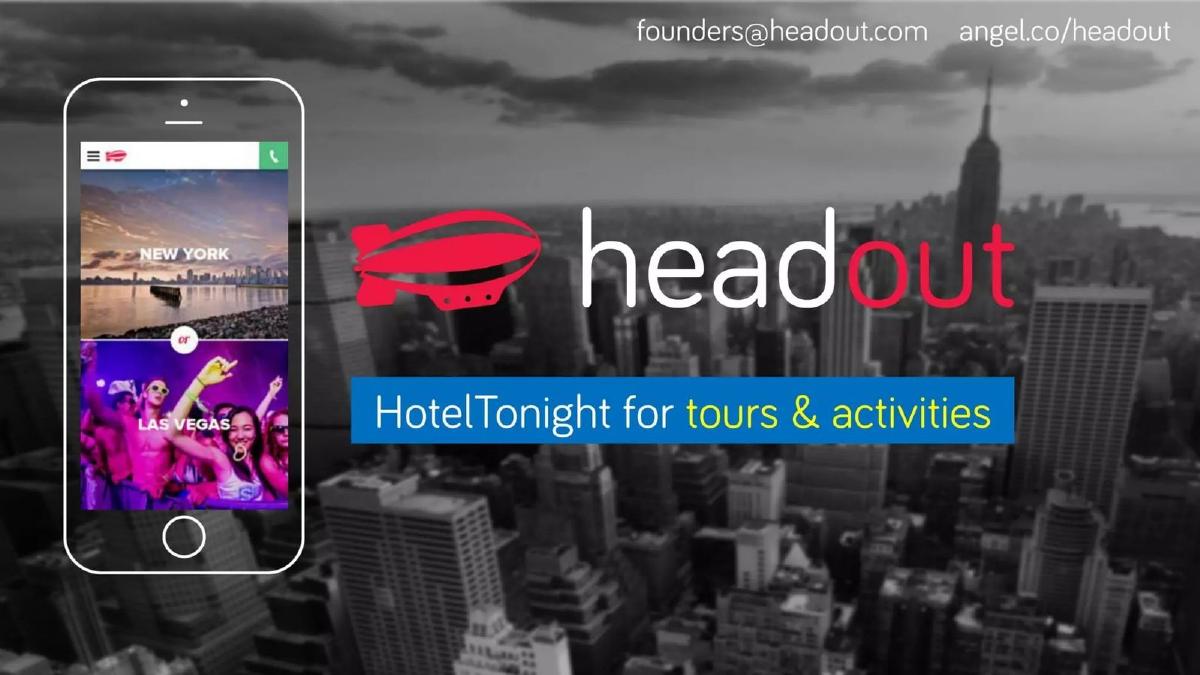
Slide 1: The Hook The deck opens with a clear, bold analogy: "HotelTonight for tours & activities." This immediately tells the investor what the business model is, who the target customer is, and what the user behavior looks like without needing a long explanation. The background image of New York City and a mobile mockup reinforce the urban, on-the-go nature of the product.
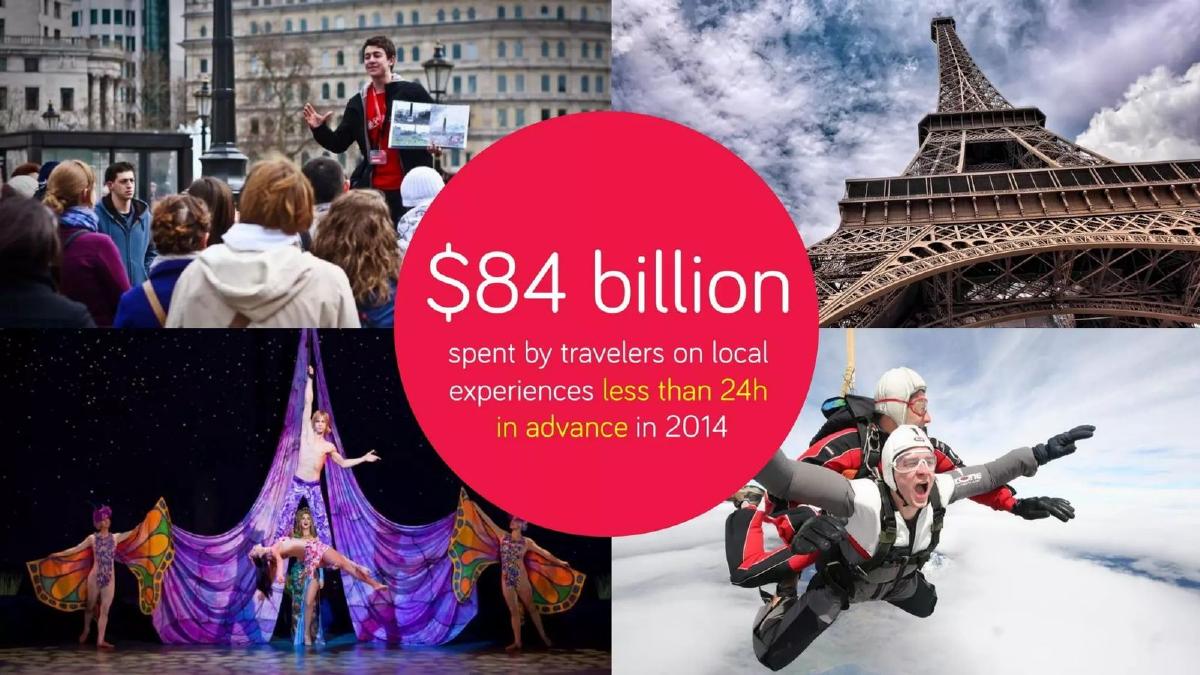
Slide 2: The $84 Billion Market Headout defines its market size not by the total travel industry, but by the specific behavior they want to capture. They quote $84 billion spent by travelers on local experiences less than 24 hours in advance in 2014. This is a crucial distinction; they aren't fighting for the planning phase of a trip, but for the 'in-destination' spend.
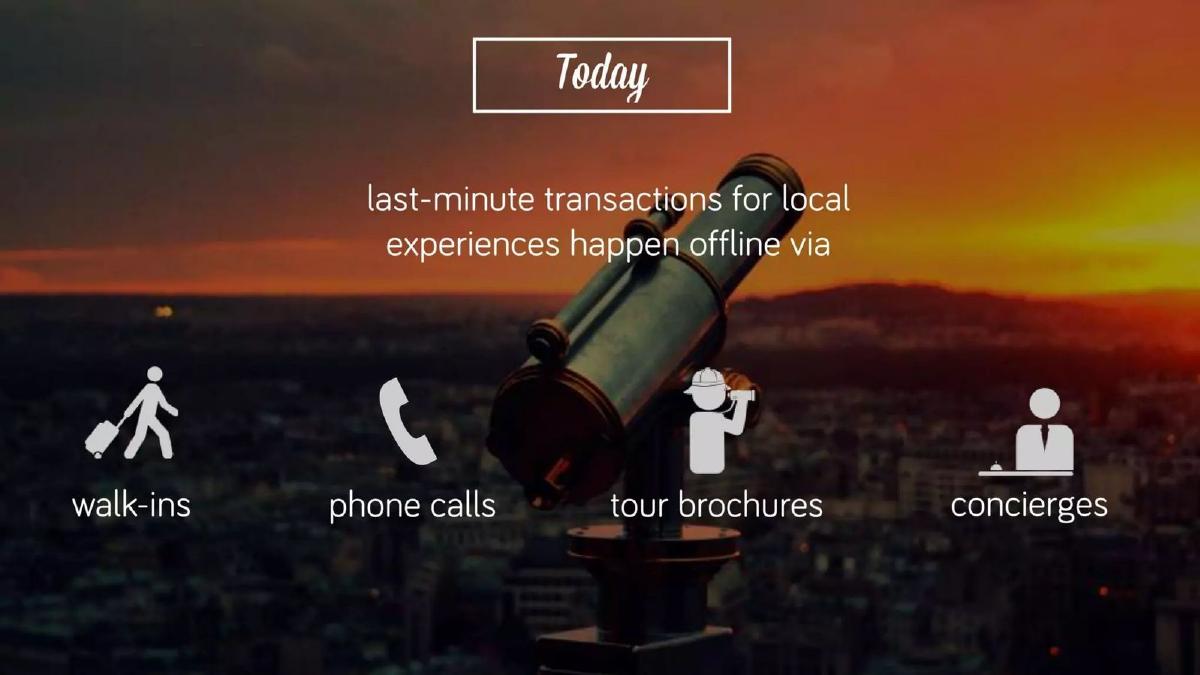
Slide 3: The 'Today' Status Quo This slide visualizes the current friction. Last-minute transactions happen offline via walk-ins, phone calls, tour brochures, and concierges. By highlighting these antiquated methods, Headout sets the stage for a digital disruptor.
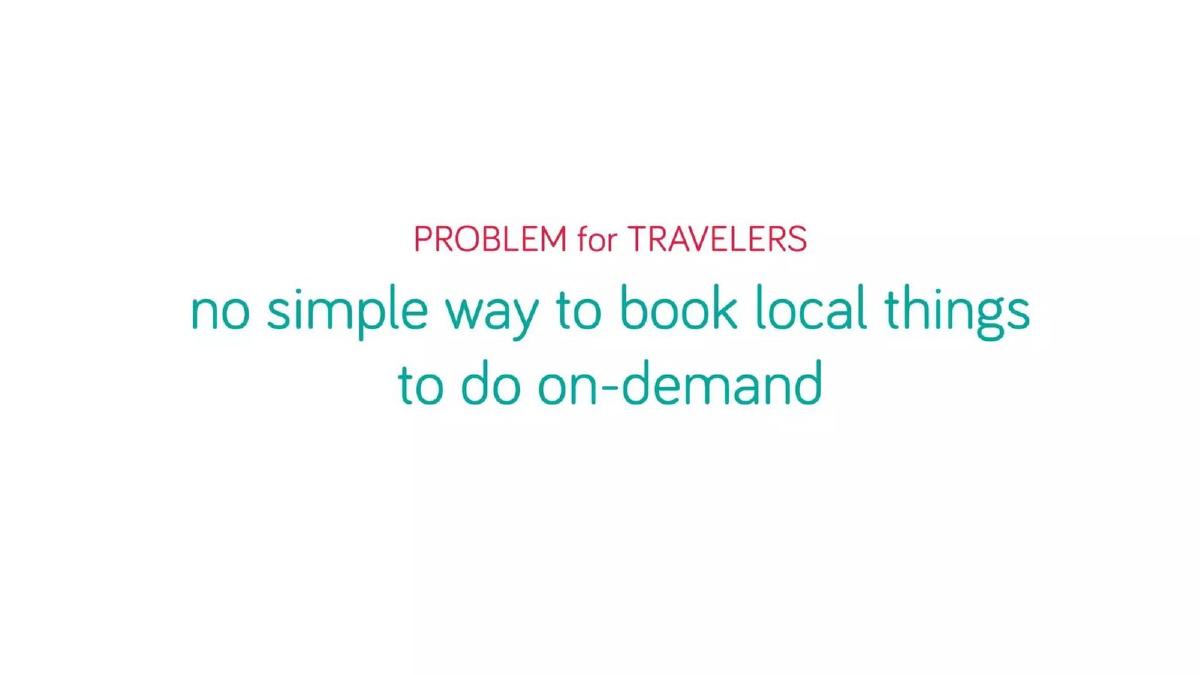
Slides 4-5: The Dual-Sided Problem The deck breaks down the pain points for both sides of the marketplace. For travelers (Slide 4), there is "no simple way to book local things to do on-demand." For suppliers (Slide 5), the problem is even more quantifiable: "35% unsold inventory." This 35% figure is the 'why' behind the business—it represents the lost revenue that Headout intends to recover.
Slides 6-8: The Headout Solution
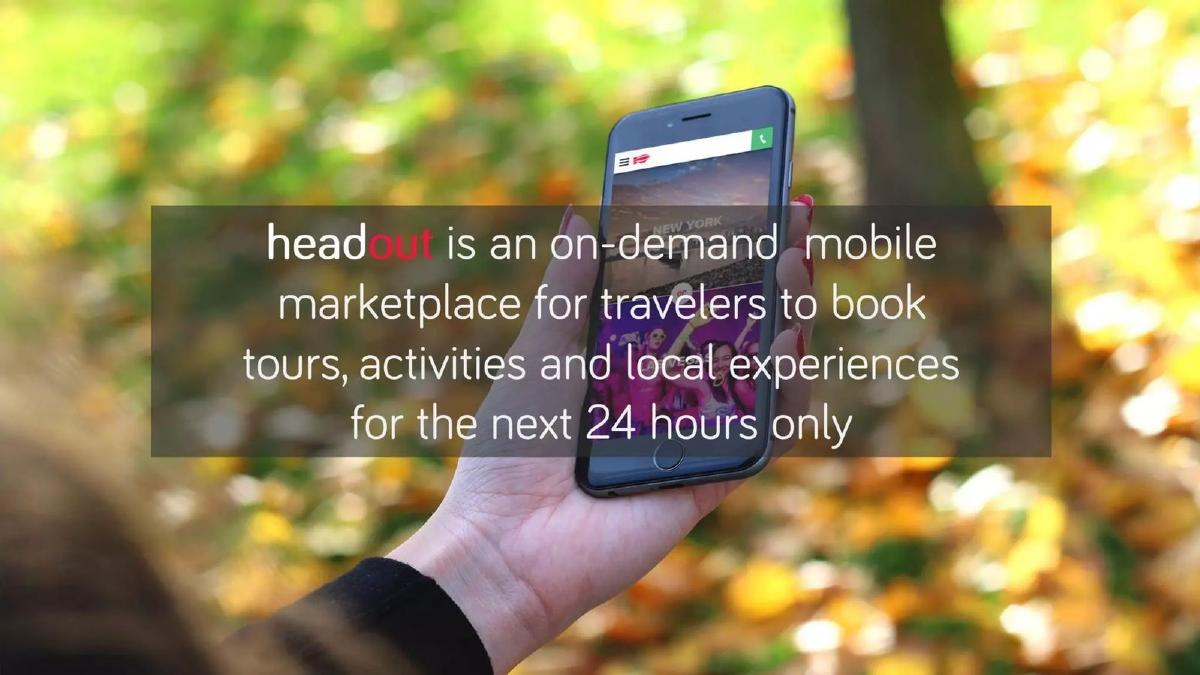
Slide 6: The Mission Statement Headout defines itself as an "on-demand mobile marketplace for travelers to book tours, activities and local experiences for the next 24 hours only." The time constraint is presented as a feature, not a limitation, creating a sense of urgency and exclusivity.
Slide 7: Bringing Industry to Mobile This slide features a clean mobile mockup showing categories like Walking Tours, Food & Drink, and Broadway. It emphasizes the transition from the offline world described in Slide 3 to a mobile interface.
Slide 8: Expanding the Market The claim here is that a "seamless delightful experience expands use case, grows market." This suggests that by making booking easier, Headout isn't just taking market share from offline players; they are actually increasing the frequency with which travelers book activities.
Slides 9-12: Traction and Expansion
Slide 9: Social Proof Under the brand name 'Tourlandish' (an earlier name for the company), the slide shows a collage of happy customers and states "4000+ travelers served." This provides immediate evidence of product-market fit.
Slide 10: The Growth Curve A simple line graph shows "65% growth m-o-m" from July to December. While the Y-axis lacks specific dollar amounts, the steepness of the curve is designed to excite investors about the company's momentum.
Slides 11-12: Geographic Rollout Slide 11 shows 11 markets being rolled out in the USA in 2015, including major hubs like New York, Las Vegas, and San Francisco. Slide 12 looks forward to 2016, showing an aggressive global expansion plan across Europe, Asia, and Australia. This demonstrates the scalability of the marketplace model.
Slides 13-17: The Competitive Edge and The Gap
Slide 13: 100% Last-Minute Mobile This slide reiterates the core focus. By being 100% mobile and 100% last-minute, they differentiate themselves from traditional desktop-era travel agents.
Slide 14: Inventory Advantage This is perhaps the most aggressive slide in the deck. Headout claims to have "14X last-min seats v/s Peek, Viator." In a marketplace business, supply is everything. If Headout truly has 14 times the available inventory for immediate booking, they have a significant moat against larger incumbents who may be focused on advance bookings.
Slide 15: Pricing Advantage By tapping into the 35% unsold inventory mentioned earlier, Headout claims to offer "20% better prices." This gives the traveler a rational reason to use the app beyond just convenience.
Slide 16: Speed of Transaction "60 seconds that's all it takes." The deck emphasizes the efficiency of the mobile UI, showing a booking screen with clear adult/child selection and a 'Reserve' button. This contrasts sharply with the 'phone calls and brochures' mentioned in Slide 3.
Slide 17: The Opportunity Gap The deck concludes its argument with a comparison of mobile adoption. In 2014, 65% of last-minute hotel bookings were on mobile, while only 2% of tours and activities were. The large teal bar representing the "opportunity" for 2020 visualizes the massive upside for the first company to successfully digitize this behavior.
Slide 18: The Team (Or Lack Thereof)
Slide 18: Contact The final slide shows three men jumping in a park with the text "Download the app NOW!" and contact information. Notably, there are no names, titles, or professional backgrounds listed. In a standard pitch deck, this is a significant omission. However, given the traction and market timing, the founders likely relied on their metrics to speak for their capability.
What Works in This Deck
The Analogy: Using 'HotelTonight for X' is a perfect shortcut for investors. It explains the supply side (distressed inventory), the demand side (last-minute travelers), and the platform (mobile-only) in four words. · The Supplier Pain Point: Identifying the 35% unsold inventory (Slide 5) gives the business a clear economic reason to exist. It explains why suppliers would be willing to give Headout better prices and more seats than competitors. · Visual Simplicity: The deck is not cluttered. Each slide has one primary message, usually backed by a single large number or a clear graphic. This makes it very easy to digest during a quick pitch. · The Adoption Gap: Slide 17 is a powerful way to end. It shows that Headout isn't just a good idea; it's an inevitable shift in consumer behavior that has already happened in the hotel sector.
What is Missing
Detailed Team Bios: As mentioned, the lack of a formal team slide is a major gap. Investors want to know if the founders have experience in travel, marketplaces, or engineering. · Unit Economics: While the deck mentions 65% growth, it doesn't mention take rates, customer acquisition costs (CAC), or lifetime value (LTV). For a Series B deck, these metrics are usually mandatory. · The Ask: The deck does not state how much money they are raising or what the milestones for the next 18 months are. This information might have been reserved for a separate document or a verbal discussion, but its absence in the primary deck is notable. · Financial Projections: There is no mention of revenue targets or a path to profitability. The focus is entirely on market share and user growth.
What a Founder Should Copy
The Market Definition: Don't just say you are in a $1 trillion industry. Define your market by the specific behavior you are targeting, as Headout did with "local experiences booked less than 24h in advance." · The Competitive Comparison: Slide 14 is excellent because it compares a specific, measurable metric (last-minute seats) rather than just a vague list of features. Find the one metric where you crush the incumbents and highlight it. · The 'Today vs. Tomorrow' Framing: The contrast between the offline 'Today' (Slide 3) and the mobile 'Headout' (Slide 7) is a classic storytelling technique that clearly illustrates the value of the innovation. · The 'Why Now' Slide: Slide 17 is the perfect 'Why Now' slide. It uses a related industry (hotels) to prove that the change is coming, making the investment feel like a bet on a sure trend rather than a wild guess.
Frequently asked questions
- What is Headout's core value proposition according to the deck?
- Headout positions itself as an on-demand mobile marketplace specifically for travelers to book tours, activities, and local experiences for the next 24 hours only. As seen on Slide 6, the focus is strictly on the last-minute window, which allows them to secure discounted inventory and provide a seamless booking experience that takes only 60 seconds (Slide 16).
- How does Headout differentiate itself from established competitors like Viator?
- The deck highlights two primary differentiators on Slides 14 and 15. First, Headout claims to have 14x more last-minute seats available compared to Peek and Viator. Second, it leverages unsold inventory to offer users 20% better prices. By focusing exclusively on the 24-hour window, they capture supply that traditional platforms often overlook or fail to display effectively for mobile users.
- What market gap does the deck identify?
- Slide 17 presents a 'mobile opportunity' gap. It compares the hotel industry, where 65% of last-minute bookings happened on mobile in 2014, to the tours and activities industry, where only 2% were mobile-based at the time. Headout aims to bridge this gap by bringing an offline-heavy industry (walk-ins, phone calls, brochures) into a 100% mobile environment.
- What traction metrics are shared in the presentation?
- Headout shares three key traction points: they served over 4,000 travelers (Slide 9), achieved 65% month-over-month growth (Slide 10), and were in the process of rolling out to 11 markets in 2015 (Slide 11). The growth chart on Slide 10 shows a consistent upward trajectory from July through December, though specific revenue or GMV figures are not disclosed.
- Is the team information sufficient for a Series B pitch?
- Technically, the deck is very light on team details. Slide 18 shows a photo of three individuals (presumably the founders) in a park, but it does not list their names, roles, or prior experience. For a Series B round, investors typically expect detailed bios. However, the catalogue facts indicate this deck was used in 2015, and the company has since raised over $57 million, suggesting the traction metrics outweighed the lack of formal team bios.