Ingoude Company (identified as Ingoude Company on Slide 1) is a service-based startup offering brand building, digital marketing, and PR support. The deck follows a standard 15-slide structure, beginning with a broad problem statement regarding brand differentiation and ending with a team overview. While the deck includes specific financial figures, such as a 20% annual revenue growth claim on Slide 10 and a tiered pricing model starting at $135 per month on Slide 11, it suffers from significant internal inconsistencies. For example, Slide 14 lists three different individuals as 'Chief Execut…
Key takeaways
- The company claims a 20% annual revenue growth and a 90% customer satisfaction rating on Slide 10.
- Market sizing is based on 32 million US small businesses, with a target of 5% (480,000 businesses) as the Serviceable Obtainable Market on Slide 7.
- The revenue model utilizes three tiers: Basic ($135/mo), Standard ($175/mo), and Premium ($220/mo) as shown on Slide 11.
- The 'Use of Funds' slide (Slide 13) allocates 40% to product development and 30% to marketing and sales.
- The team slide (Slide 14) contains a major error, listing three separate people—Dani Martinez, Harper Russo, and Morgan Maxwell—as 'Chief Executive Officer'.
- The deck lacks a specific 'Ask' amount, despite including a percentage-based allocation for investment on Slide 13.
- Competitive advantages are described in generic terms such as 'Expert Team' and 'Cutting-Edge Technology' on Slide 9 without specific proof points.
- The timeline on Slide 12 claims the company achieved profitability in the 'Present' period, following a 2025 funding round.
Deck Overview and Visual Style
The Ingoude Company pitch deck, presented by Neil Tran, utilizes a high-contrast 'Black Elegant and Modern' aesthetic. It relies heavily on dark backgrounds, white typography, and abstract, colorful glass-like shapes. While visually cohesive, the content frequently leans on placeholder-style language and generic definitions rather than specific, proprietary business data. The deck consists of 15 slides, including a table of contents that repeats several headers, suggesting a potential error in the template's structure.
Slide 1: Title Slide
The opening slide introduces 'Ingoude Company' with a logo consisting of a circular, segmented icon. The presentation is attributed to Neil Tran. Contact information at the bottom includes a generic URL (reallygreatsite.com), a generic email, and a placeholder address (123 Anywhere Street). This immediately signals that the deck may be a template or a draft rather than a finalized investor document.
Slide 2: Today's Agenda
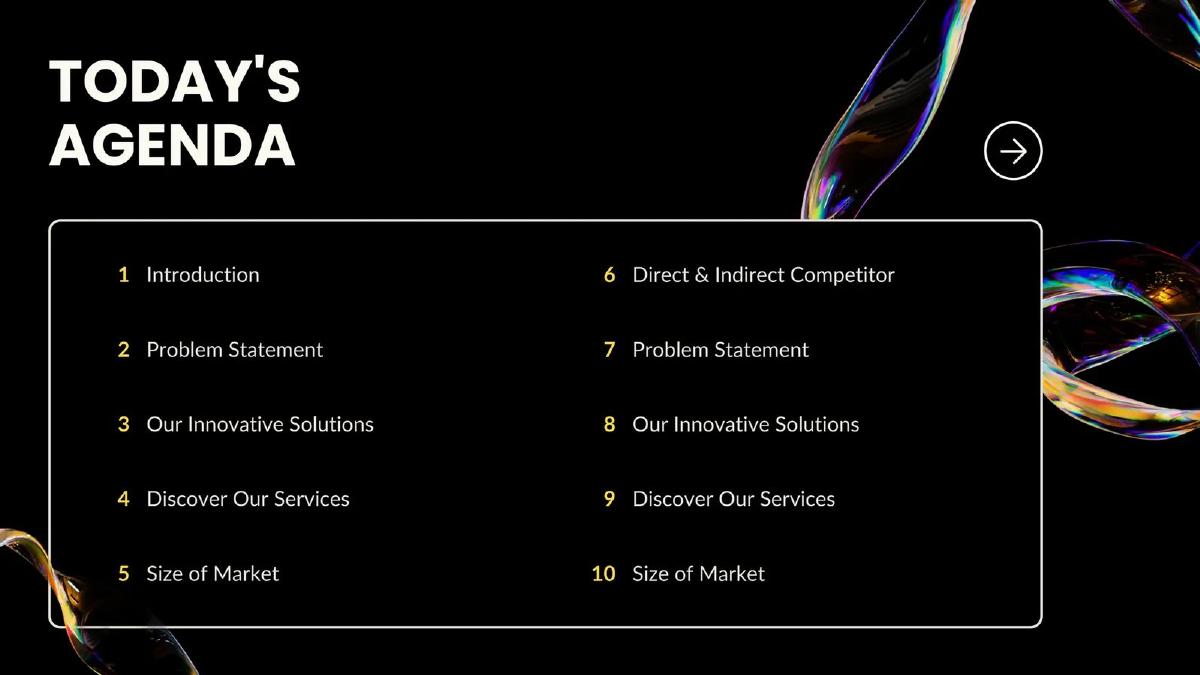
The agenda lists ten items, but items 7 through 10 are exact duplicates of items 2 through 5: Problem Statement, Our Innovative Solutions, Discover Our Services, and Size of Market. This repetition is a significant structural flaw that suggests the deck was not thoroughly proofread before distribution.
Slide 3: Introduction
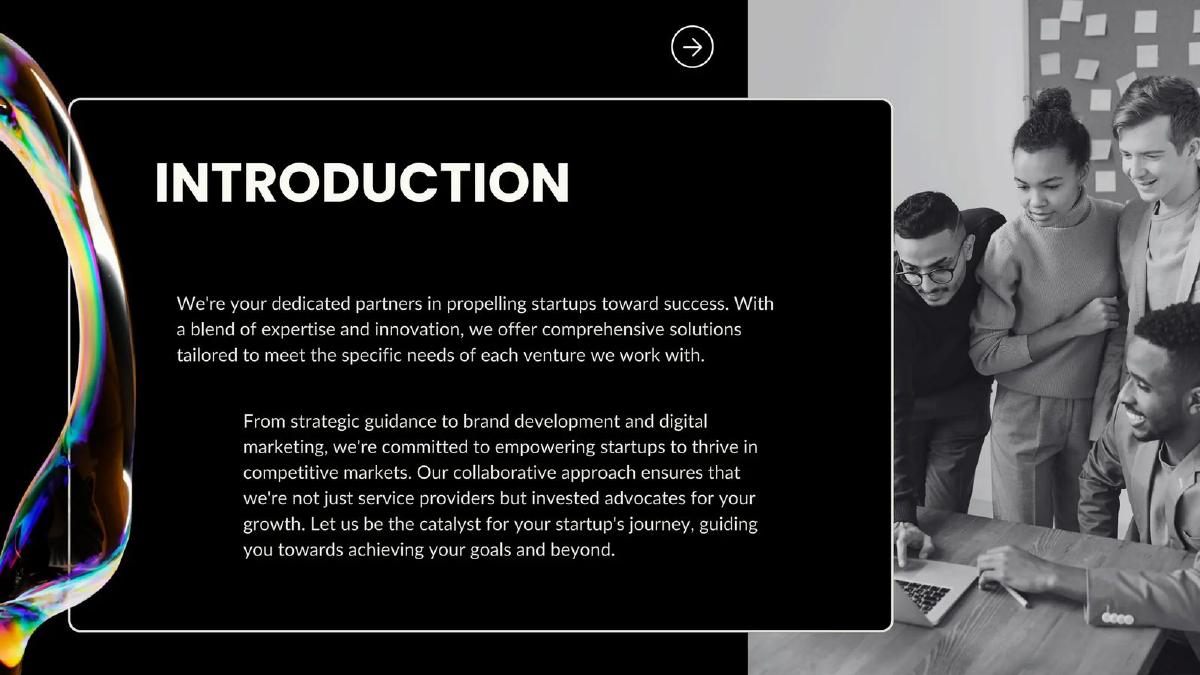
This slide positions the company as a 'dedicated partner' for startups. It mentions strategic guidance, brand development, and digital marketing. The language is broad, stating they are 'not just service providers but invested advocates.' It lacks a specific value proposition or a 'hook' that differentiates Ingoude from thousands of other marketing agencies.
Slide 4: Problem Statement
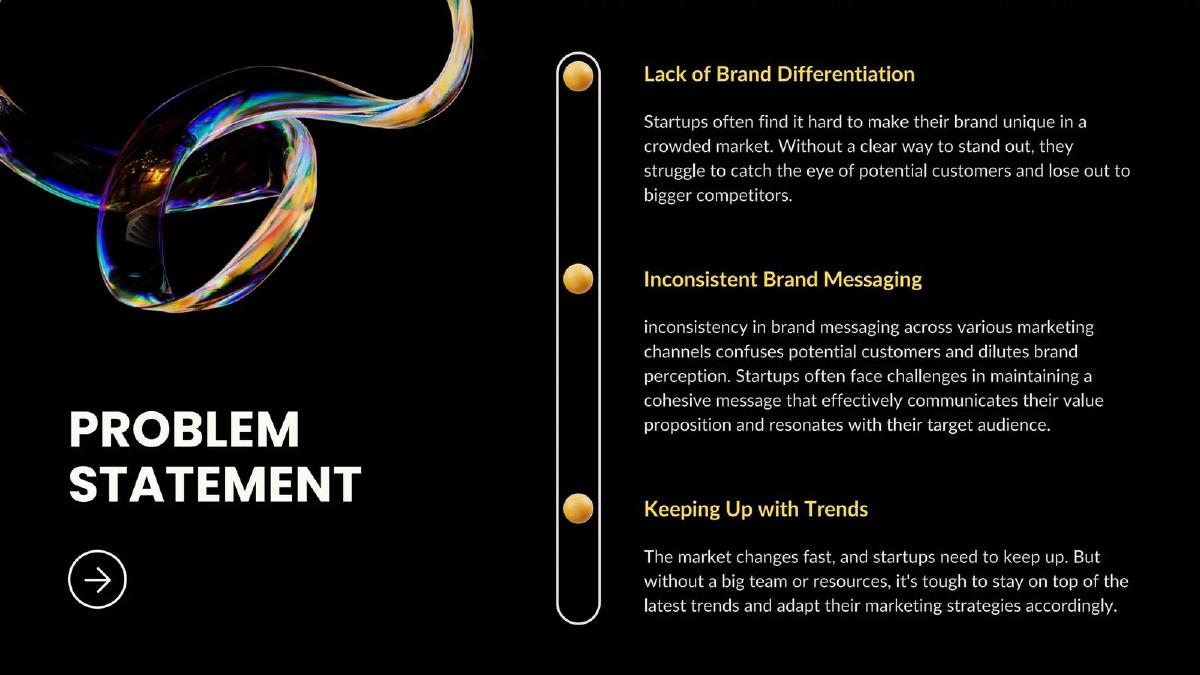
Ingoude identifies three pain points for startups: Lack of Brand Differentiation , Inconsistent Brand Messaging , and Keeping Up with Trends . The slide notes that startups struggle to 'catch the eye of potential customers' and lack the resources to adapt marketing strategies quickly. While these are valid problems, they are presented as general industry observations rather than problems validated by Ingoude's specific target audience.
Slide 5: Our Innovative Solutions
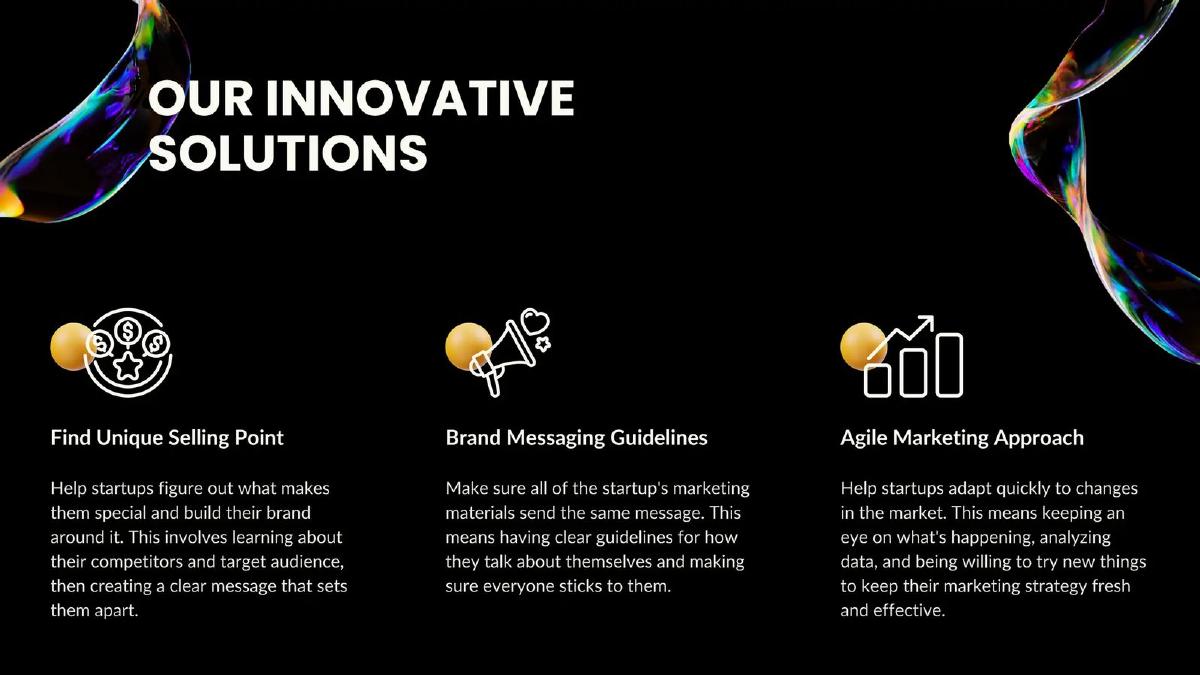
The solutions directly mirror the problems: Find Unique Selling Point , Brand Messaging Guidelines , and Agile Marketing Approach . The descriptions are process-oriented (e.g., 'learning about their competitors,' 'analyzing data') rather than product-oriented. This reinforces the company's identity as a service-based agency.
Slide 6: Discover Our Services
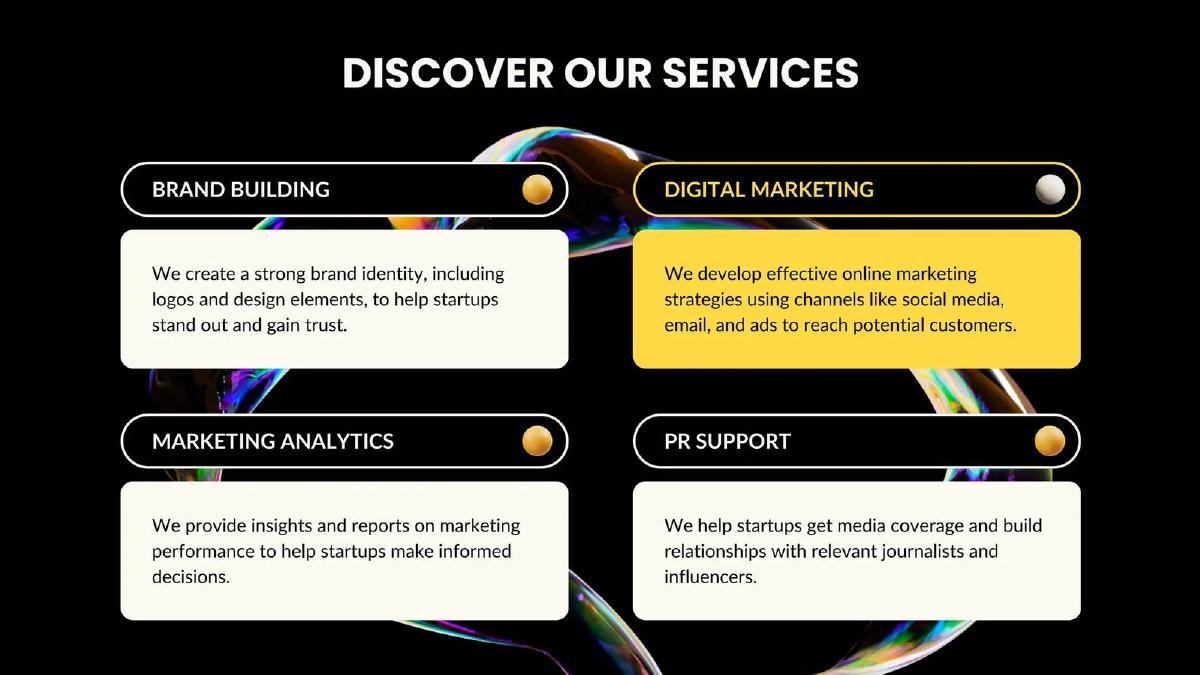
This slide breaks down the offering into four quadrants: Brand Building , Digital Marketing , Marketing Analytics , and PR Support . Each box contains a brief description of the service, such as creating logos or building relationships with journalists. This is the most informative slide regarding what the company actually does on a day-to-day basis.
Slide 7: Size of Market
Using a concentric circle diagram (TAM/SAM/SOM), the company presents the following figures:
Total Addressable Market: 32 Million (Total US small businesses). · Serviceable Addressable Market: 9.6 Million (30% of small businesses in tech, e-commerce, and professional services). · Serviceable Obtainable Market: 480,000 (a 5% target of the SAM).
The text explains that these numbers help them 'know who to target,' but the leap to 480,000 customers for a service agency is exceptionally ambitious without a highly automated product component.
Slide 8: Direct & Indirect Competitor
This slide is a major missed opportunity. Instead of naming actual competitors (like HubSpot, specialized agencies, or freelance platforms), it provides textbook definitions of what direct and indirect competitors are. For example, it states that a direct competitor 'Offers similar services or products to ours.' This provides zero competitive intelligence to a potential investor.
Slide 9: Key Competitive Advantages
The company lists four advantages: Expert Team , Cutting-Edge Technology , Customer Focus , and Proven Success . These are 'table stakes' rather than unique advantages. There is no mention of proprietary software, exclusive partnerships, or a unique methodology that others cannot easily replicate.
Slide 10: Traction
This slide features a line graph with three data points (Item 1 through Item 5) and three specific metrics:
20% annual revenue growth · 90% maintain customer satisfaction ratings · 15% market share in key segments
The graph is not labeled on the Y-axis, making the visual representation of the 'Item' data points (ranging from 0 to 50) unclear. The 15% market share claim also appears to conflict with the 5% target mentioned on the Market Size slide.
Slide 11: Revenue Model
Basic Plan ($135/month): Limited features, basic support, no customization. · Standard Plan ($175/month): More features, standard support, some customization. · Premium Plan ($220/month): Full features, priority support, full customization, and consulting.
This pricing is very low for agency-level 'Brand Building' and 'PR Support,' suggesting either a highly automated platform or a mismatch between service descriptions and price points.
Slide 12: Accomplishments Date
2021: Launched new product/service and formed partnerships. · 2023: Expanded into new markets and improved efficiency. · 2025: Secured funding for growth and refined offerings. · Present: Achieved profitability and expanded product line.
The inclusion of '2025' as a past event suggests the deck was either created in the future or, more likely, uses placeholder dates that were not updated to reflect the current year.
Slide 13: Use of Funds
A pie chart breaks down the intended use of investment: 40% Product Development, 30% Marketing and Sales, 20% Infrastructure and Operations, and 10% Expansion. The text describes this as a 'straightforward' plan. However, the absence of a total 'Ask' (e.g., 'We are seeking $1M') makes the percentages purely theoretical.
Slide 14: Meet the Team
This slide features four individuals: Dani Martinez, Harper Russo, Morgan Maxwell, and Neil Tran. A critical error occurs here: Martinez, Russo, and Maxwell are all given the title 'Chief Executive Officer.' Neil Tran is listed as 'Director.' The lack of bios or professional history makes it impossible to verify the 'Expert Team' claim made on Slide 9.
Slide 15: Thank You
The final slide repeats the contact information from Slide 1, including the placeholder URL and address. It serves as a standard closing slide.
What Ingoude Company Does Well
The deck is visually professional in terms of layout and color palette. The use of a tiered revenue model (Slide 11) is a clear way to communicate how the business scales, and the TAM/SAM/SOM breakdown (Slide 7) shows an attempt to quantify the opportunity, even if the numbers are broad. The categorization of services (Slide 6) provides a clear menu of what the company offers, which is often missing in more abstract agency decks.
What is Missing from the Deck
The most glaring omission is a specific investment 'Ask.' Investors need to know how much capital is being requested to evaluate the 'Use of Funds' percentages. Furthermore, the competitive analysis (Slide 8) is entirely generic; it fails to name a single real-world competitor. There are no case studies or logos of past clients to support the 'Proven Success' claim on Slide 9. Finally, the team slide lacks any information regarding the founders' backgrounds, previous exits, or relevant industry experience.
What a Founder Should Copy
Founders should emulate the clean, high-contrast design which makes the text easy to read. The structure of the 'Discover Our Services' slide (Slide 6) is an excellent way to present multiple service lines without cluttering the page. Additionally, the 'Revenue Model' table (Slide 11) is a standard, effective way to show pricing tiers and feature differentiation. However, founders must ensure that every data point is specific to their business and that all placeholder text and duplicate titles are removed before the deck reaches an investor's inbox.
Frequently asked questions
- What is the primary service offered by Ingoude Company?
- According to Slide 6, Ingoude Company provides four main services: Brand Building (logos and design), Digital Marketing (social media and ads), Marketing Analytics (performance reporting), and PR Support (media coverage and influencer relationships). They position themselves as a 'dedicated partner' for startups looking to differentiate themselves in crowded markets.
- How does the company plan to spend investor capital?
- Slide 13 outlines a four-part allocation strategy: 40% for Product Development, 30% for Marketing and Sales, 20% for Infrastructure and Operations, and 10% for Expansion and Growth Initiatives. However, the deck does not state the total dollar amount they are seeking to raise, making these percentages difficult to contextualize for an investor.
- What are the specific pricing tiers for their services?
- Slide 11 details a subscription-based revenue model. The Basic Plan is $135/month with limited features and storage. The Standard Plan is $175/month with 'more features' and optional add-ons. The Premium Plan is $220/month, offering 'full features,' unlimited usage, and included consulting services. This suggests a high-volume, low-touch agency model.
- Is the market size data realistic for this startup?
- Slide 7 uses a top-down approach, starting with the 32 million small businesses in the US. They narrow this to 9.6 million (30%) in tech, e-commerce, and professional services. Their goal is to capture 5% of that segment, or 480,000 businesses. For a service-based agency, acquiring nearly half a million clients at their price points would represent a massive operational undertaking.
- What are the most significant red flags in this deck?
- The most prominent red flag is on Slide 14, where three different team members are listed with the identical title of 'Chief Executive Officer.' Additionally, the competitive analysis on Slide 8 defines what direct and indirect competitors *are* in general terms, rather than naming actual companies that Ingoude competes with in the real world.