Bit Gold, a subsidiary of GoldMoney Inc., positions itself as a bridge between traditional gold investment and modern digital payments. The deck centers on the 'Aurum' digital ledger, which facilitates the custody, trading, and movement of gold across global networks. By highlighting gold's historical outperformance against fiat currencies—averaging between 7.3% and 12.7% annual returns across major markets from 2000 to 2015—the company builds a case for gold as the 'optimal currency.' The presentation is heavy on traction, showcasing a user growth curve that purportedly outpaces early-stage…
Key takeaways
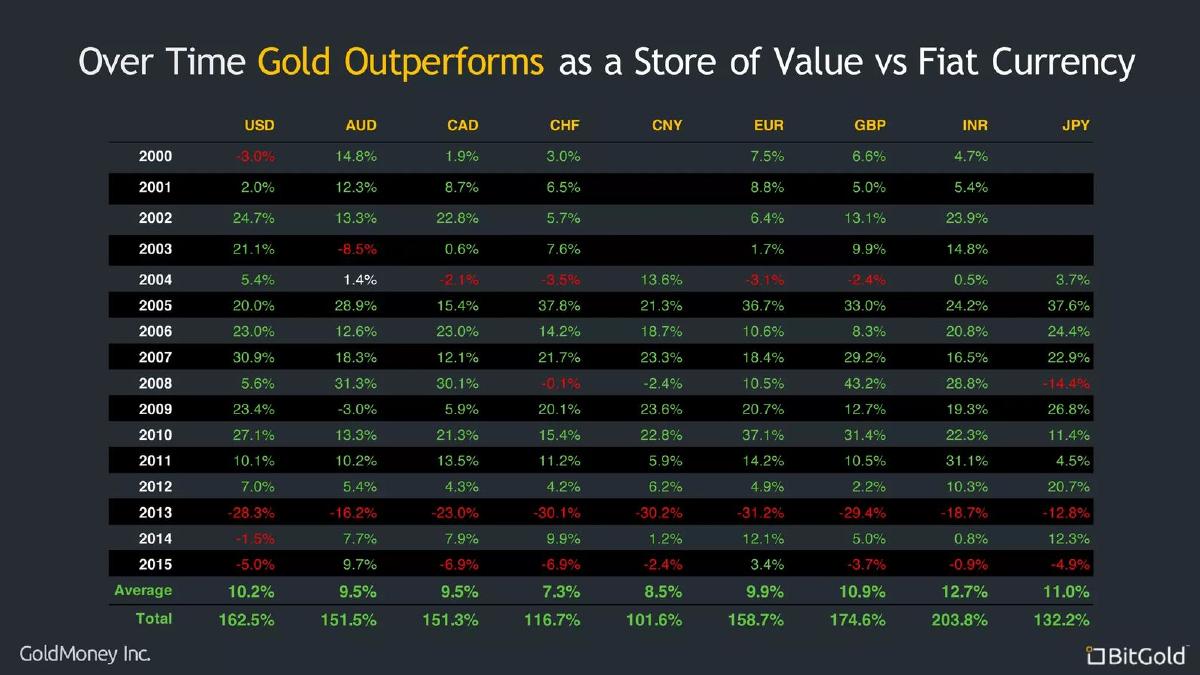
- Gold outperformed all major fiat currencies between 2000 and 2015, with a total return of 162.5% against the USD (Slide 2).
- The parent company, GoldMoney, manages over $1.4 billion in client assets for more than 20,000 active clients (Slide 4).
- Bit Gold utilizes a proprietary 'Aurum' digital ledger to provide 24/7 bid/ask spreads across multiple vault locations (Slide 5).
- The platform integrates with diverse payment processors including Visa, MasterCard, Bitcoin, and China Union Pay (Slide 5).
- Bit Gold charges a 1% fee on funds entering the vault system (Slide 6).
- The company reached 509,209 users within its first six months of operation (Slide 8).
- User growth is benchmarked against PayPal, which took approximately 24 months to reach 1 million users (Slide 7).
- The service is active in over 100 countries, emphasizing a global commerce strategy (Slide 8).
Slide-by-Slide Analysis
Slide 1: Title Slide
The opening slide introduces Bit Gold as 'A GoldMoney Company.' The visual design uses gold cubes marked '10g' to reinforce the physical nature of the underlying asset. The branding is clean, positioning the company as a modern fintech player within the precious metals space.
Slide 2: Gold vs. Fiat Performance
This is a data-heavy slide designed to establish the 'Problem/Solution' context through historical performance. It tracks gold's performance against nine fiat currencies (USD, AUD, CAD, CHF, CNY, EUR, GBP, INR, JPY) from 2000 to 2015. Key figures: Gold's average annual return against the USD was 10.2%, with a total 15-year return of 162.5%. The highest total return was against the INR at 203.8%. This slide serves to justify why a user would want to hold wealth in gold rather than traditional currency.
Slide 3: Modern Day Money 3.0
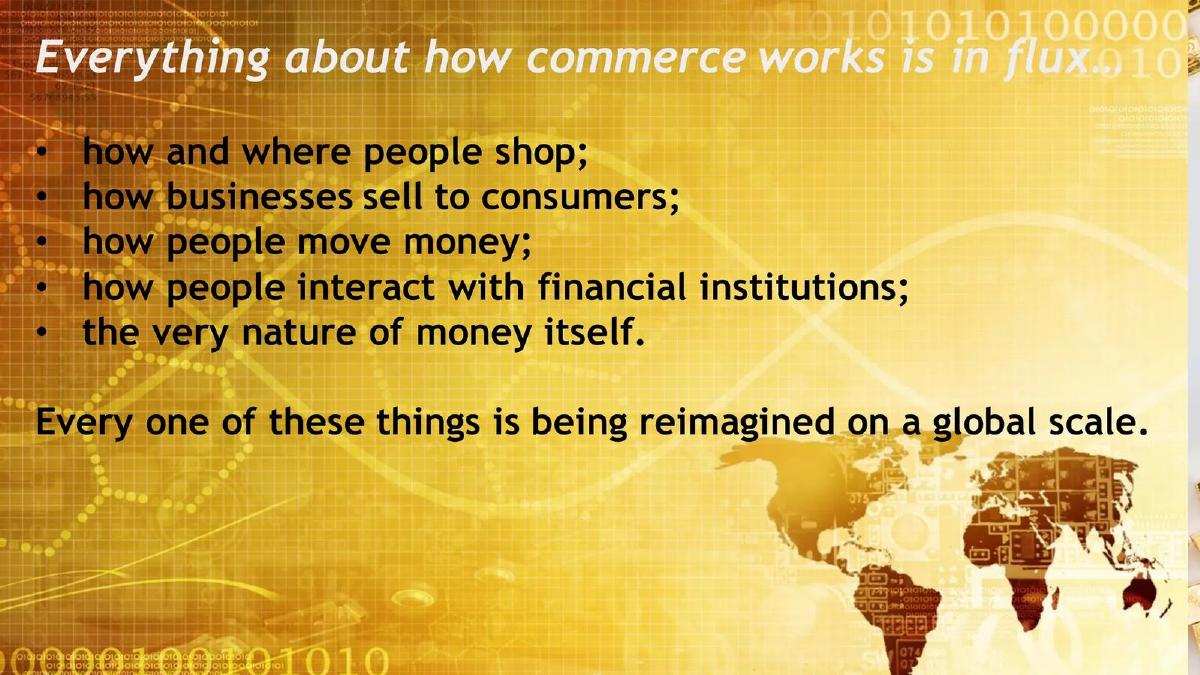
This serves as a transition slide, framing the company's mission: 'The Need for An Optimal Currency for Global Commerce.' The use of '3.0' suggests an evolutionary step beyond traditional banking and early digital payments, though the slide itself is purely conceptual and lacks specific data.
Slide 4: GoldMoney Institutional Credibility
This slide focuses on the parent company to provide 'social proof' and stability. It describes GoldMoney as 'The World’s Most Trusted Precious Metal Custodian.' Metrics cited: Founded in 2001, 20,000+ active clients, and $1.4B+ in client assets. This is a critical slide for a fintech startup, as it demonstrates that the 'startup' is actually backed by a regulated entity with significant Assets Under Management (AUM).
Slide 5: The Aurum Digital Ledger
This slide explains the technology stack. The 'Aurum' ledger is described as a 'leap forward in democratizing the access of Gold.' It breaks the ecosystem into three pillars: 1. Aurum Ledger: Proprietary pricing and exchange. 2. Global Vault Operators: Physical security and storage. 3. Global Digital Value Processors: Integration with networks like Visa, MasterCard, and Bitcoin. This slide effectively communicates how the company bridges the gap between physical vaults and digital wallets.
Slide 6: How Bit Gold Works
A product demonstration slide showing the user interface. It highlights the ease of depositing funds. Key metric: A '1%' fee is displayed in a blue triangle for 'Funds In.' The UI shows options for Bank Transfer, Bitcoin, Credit Card, and regional networks like China UnionPay and Interac. It also shows the vault selection screen, allowing users to choose specific global jurisdictions for their gold.
Slide 7: Threshold to Relevance (PayPal Benchmark)
This is a classic 'Traction' slide. It plots a growth curve toward 1 million users, using PayPal as the gold standard. The chart indicates that PayPal took roughly 24 months to hit the 1 million user milestone. This sets the stage for the next slide's comparison.
Slide 8: User Growth Comparison
This is the most aggressive slide in the deck. It overlays Bit Gold's growth against the benchmark. Metric cited: Bit Gold reached 509,209+ users in its first 6 months. The text notes they are 'outpacing in first 6 months of growth with users in 100+ countries.' The visual intent is to show a steeper growth trajectory than established payment giants, implying massive market fit.
Slide 9: Product Integration
The final slide in the set shows the mobile application interface on multiple devices. It displays a 'Vault Balance' of £8,174.82 and a 'Gold Amount' of 301.073g. This slide emphasizes the 'Bringing it All Together' theme, showing that the complex backend (vaults, ledgers, compliance) is distilled into a simple consumer app.
What Works
1. Institutional Backing: By leading with GoldMoney’s $1.4B AUM and 2001 founding date (Slide 4), the deck immediately solves the 'trust' problem inherent in new financial platforms. Investors are not betting on a brand-new vaulting system, but a new digital interface for an existing one.
2. Clear Value Proposition: Slide 2 does an excellent job of using long-term historical data to make the case for gold. It moves the conversation from 'speculation' to 'wealth preservation,' which is a much stronger hook for a global audience.
3. Massive Traction: The growth numbers on Slide 8 are the 'star' of the deck. Claiming half a million users in six months is a powerful signal of viral growth or highly effective acquisition channels.
What is Missing
1. The Ask: In the provided selection of 9 slides, there is no mention of how much capital is being raised, the valuation, or the intended use of funds. Without this, the deck is a presentation of facts rather than a request for investment.
2. Team Slide: While GoldMoney is mentioned, the specific individuals leading the Bit Gold initiative are not profiled. Investors back people, especially in highly regulated fintech sectors.
3. Unit Economics: We see a 1% deposit fee (Slide 6), but there is no information on Customer Acquisition Cost (CAC), Lifetime Value (LTV), or the costs associated with physical storage and insurance. A 1% fee on deposits is a thin margin if acquisition costs are high.
4. Regulatory Detail: While Slide 5 mentions 'Legal, Compliance, Audit,' it does not specify which licenses the company holds in the 100+ countries it claims to operate in. This is a significant omission for a company handling physical assets and cross-border payments.
Founder's Playbook: What to Copy
Use Benchmarking Wisely: Bit Gold’s use of PayPal as a growth benchmark (Slide 7 and 8) is a masterclass in framing. By comparing themselves to a known success story, they give investors a mental model for what 'success' looks like for this specific type of company.
Bridge the Physical and Digital: The way Slide 5 explains the 'Aurum' ledger is very effective. It doesn't get bogged down in code; it explains the function of the technology (pricing, vaulting, processing) in a way that a non-technical investor can understand.
Data-Driven Problem Statements: Instead of saying 'inflation is bad,' Slide 2 shows exactly how much fiat currencies lost against gold over 15 years. Using a table with specific percentages for nine different countries makes the problem feel global and urgent.
Final Thoughts
This deck is a high-signal traction piece. It relies heavily on the 'GoldMoney' pedigree and the explosive user growth of the Bit Gold app. While it lacks the granular financial modeling and team depth found in later-stage decks, it succeeds in creating a sense of inevitability. The core message is clear: Gold is a superior store of value, and Bit Gold has finally made it as easy to use as a credit card.
Frequently asked questions
- What is the core technology behind Bit Gold?
- The core technology is the 'Aurum' Digital Ledger. According to Slide 5, this proprietary IP functions as a global pricing ledger and exchange. It aggregates feeds from counterparties to provide real-time bid/ask spreads across various physical vault locations 24/7, effectively digitizing the ownership and transferability of physical gold.
- How does Bit Gold generate revenue based on these slides?
- Slide 6 explicitly identifies a '1%' fee on 'Funds In.' While the deck mentions trading and execution services on Slide 4, the primary transaction fee highlighted for the Bit Gold platform specifically is this 1% deposit fee. The deck does not detail withdrawal fees or storage premiums in the provided selection.
- How does Bit Gold compare its growth to other fintech giants?
- Bit Gold uses PayPal as its primary benchmark for 'relevance.' Slide 7 shows PayPal reaching 1 million users at the 24-month mark. Slide 8 then overlays Bit Gold's trajectory, showing it reached over 500,000 users in just 6 months, suggesting a significantly faster adoption rate than the early days of digital payments.
- Is the gold physically stored, and where?
- Yes, the gold is physical. Slide 5 mentions 'Global Vault Operators' who provide security, storage, and insurance. Slide 6 shows a user interface for selecting vault locations, specifically listing Toronto, New York, London, Zurich, Dubai, Hong Kong, and Singapore as available geographic options for storage.
- What is the relationship between Bit Gold and GoldMoney?
- Bit Gold is presented as 'A GoldMoney Company' on the title slide. Slide 4 clarifies that GoldMoney is the established custodian (founded in 2001) with $1.4B+ in assets, while Bit Gold appears to be the modern, consumer-facing digital application layer built upon that institutional infrastructure.