The BioShock pitch deck, dated 2002, is an atypical fundraising document that prioritizes creative vision and mechanical depth over traditional business metrics. Developed by Irrational Games, the deck positions BioShock as the 'spiritual successor to System Shock 2' (Slide 4), leaning heavily on the team's existing reputation in the gaming industry. It utilizes a narrative-first approach, opening with a prose-heavy 'mood' slide to immerse the reader in its horror-action world. While it lacks a traditional 'Ask' or financial projections, it provides an exhaustive breakdown of gameplay innovat…
Key takeaways
- The deck establishes immediate credibility by citing the team as the creators of System Shock 2 and Freedom Force (Slide 1).
- It uses a narrative hook on Slide 2 to set the 'First Person Action Horror' tone before discussing any mechanics.
- The technical foundation is built on the 'Unreal Warfare engine' and 'Karma physics engine' to promise high-end visuals and realism (Slide 4).
- BioShock's core value proposition is player agency, categorized into three axes: Weapons, Environmental manipulation, and Genetic modifications (Slide 6).
- The deck proposes a 'Story Based Deathmatch' for multiplayer, a feature that would change significantly by the 2007 release (Slide 4).
- It explicitly targets the 'next Halo or Half Life' as its market opportunity in the PC and console space (Slide 9).
- The document includes a detailed Table of Contents (Slide 3) that suggests a much larger 20+ page design document than the 10 slides shown here.
- There is a total absence of budget requirements, development timelines, or revenue sharing models in this version of the deck.
The Narrative-First Pitch: BioShock's 2002 Vision
The BioShock pitch deck from 2002 is a fascinating artifact of game development history. It doesn't look like a modern SaaS deck because it isn't one. It is a creative design document intended to sell a high-concept, high-budget entertainment product. At its core, the deck is selling the Irrational Games brand and their ability to execute on a 'modern day nightmare' (Slide 4).
Slide 1: Title and Pedigree
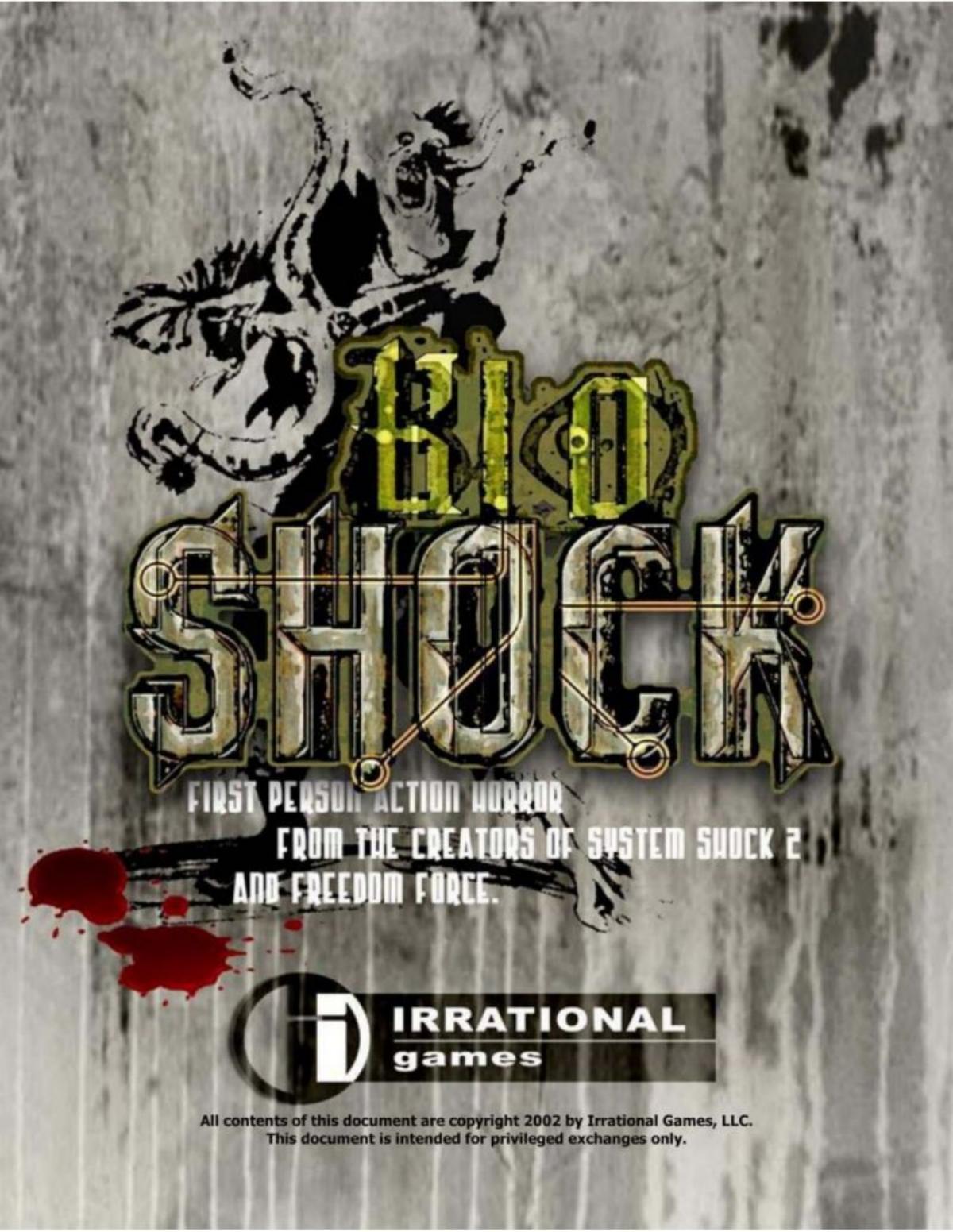
The cover slide immediately establishes the genre: 'FIRST PERSON ACTION HORROR.' It also leverages the most important asset the team has: their track record. By stating they are 'FROM THE CREATORS OF SYSTEM SHOCK 2 AND FREEDOM FORCE,' they are telling the investor that they have already built successful, critically acclaimed products. The copyright date of 2002 and the 'privileged exchanges only' disclaimer mark this as a confidential business proposal.
Slide 2: The Hook
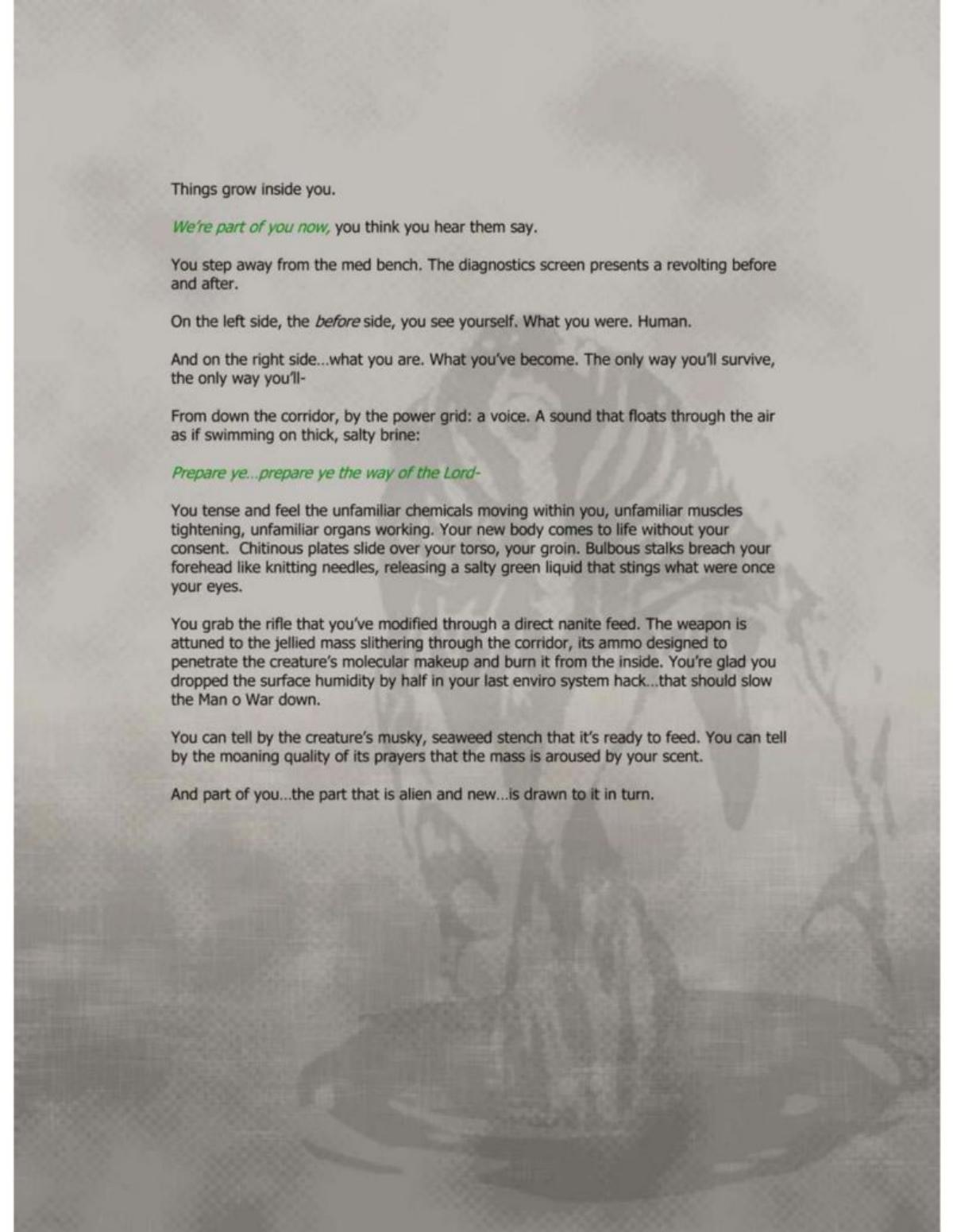
Slide 2 is entirely prose. It is a narrative excerpt designed to make the reader feel the horror of the game. It describes biological transformation ('Things grow inside you') and mechanical interaction ('You grab the rifle that you’ve modified through a direct nanite feed'). This is a 'Show, Don't Tell' approach to the product's unique selling point: the fusion of biology and technology.
Slide 3: The Roadmap (Table of Contents)
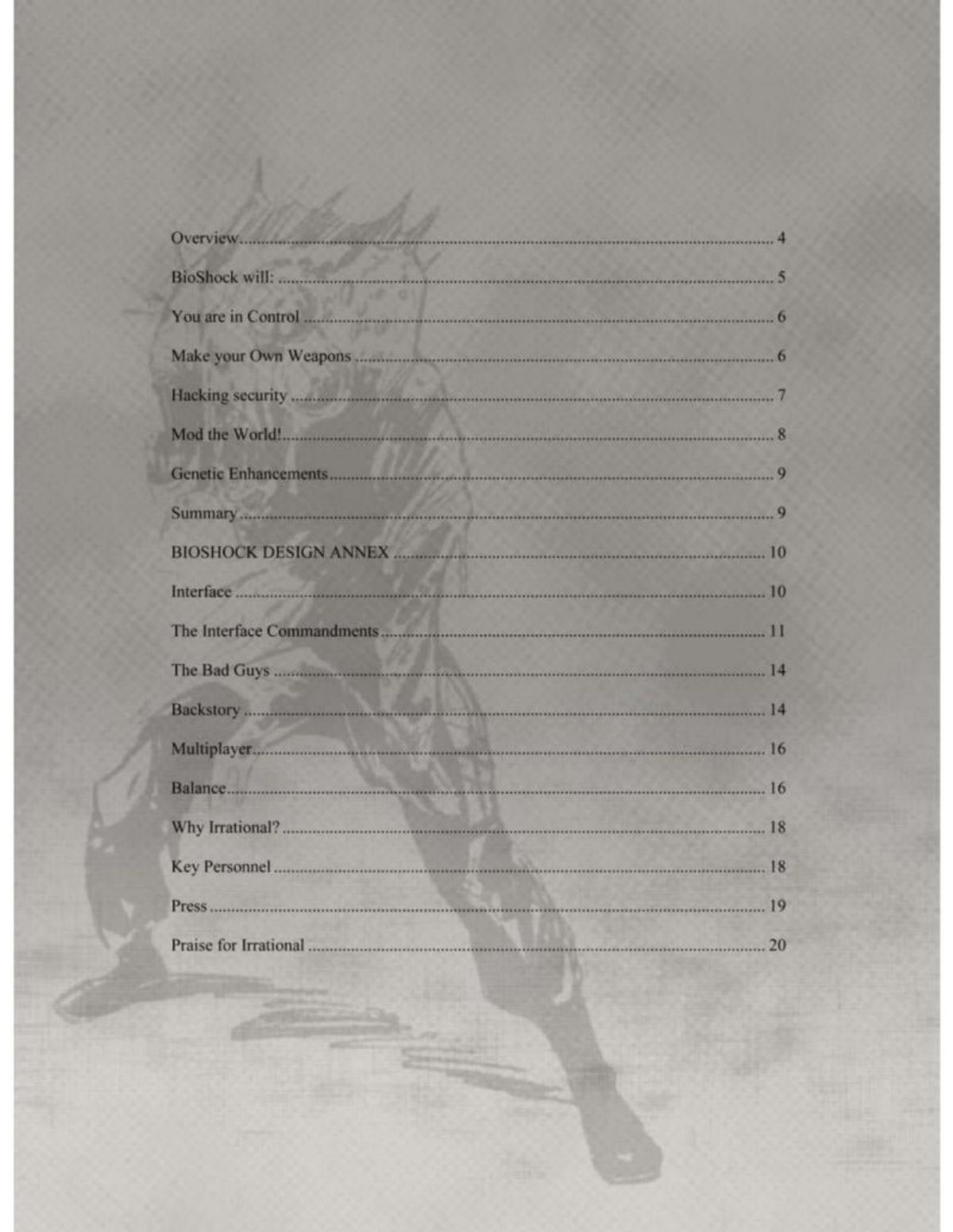
The Table of Contents reveals that the full document is at least 20 pages long. It includes sections on 'The Interface Commandments,' 'The Bad Guys,' 'Backstory,' and 'Multiplayer.' This indicates a high level of pre-production planning, which reduces the perceived risk for a publisher. It shows that the team isn't just pitching an idea, but a fully realized world with specific rules and mechanics.
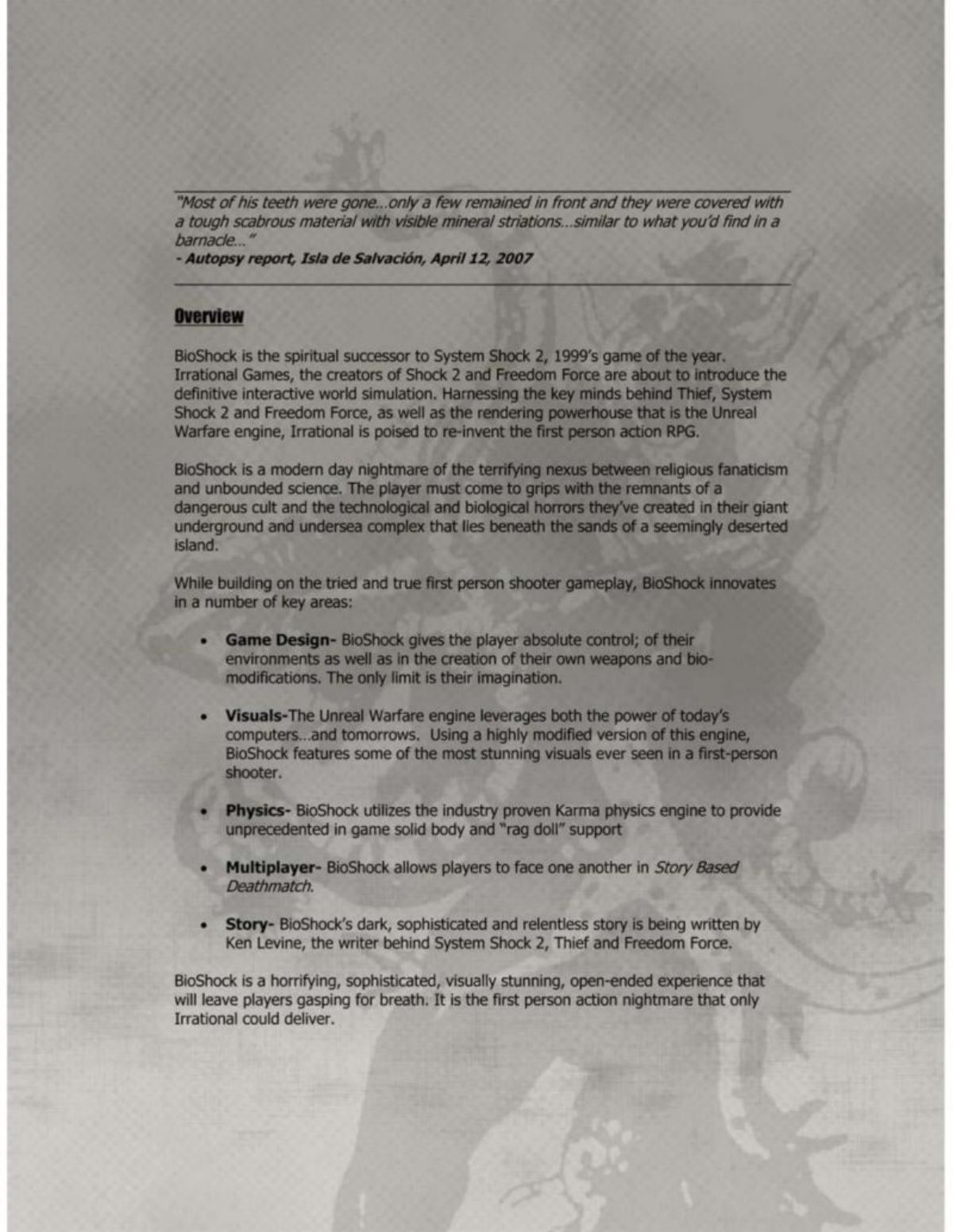
Slide 4: Overview and Technical Stack
Slide 4 defines BioShock as the 'spiritual successor to System Shock 2.' It lists the technical pillars that will make the game a 'rendering powerhouse': the Unreal Warfare engine and the Karma physics engine . By citing these industry-standard tools, Irrational Games demonstrates that they are building on a stable, high-performance foundation. The slide also mentions 'Story Based Deathmatch' as a multiplayer feature, showing an early intent to maximize the game's longevity and market appeal.
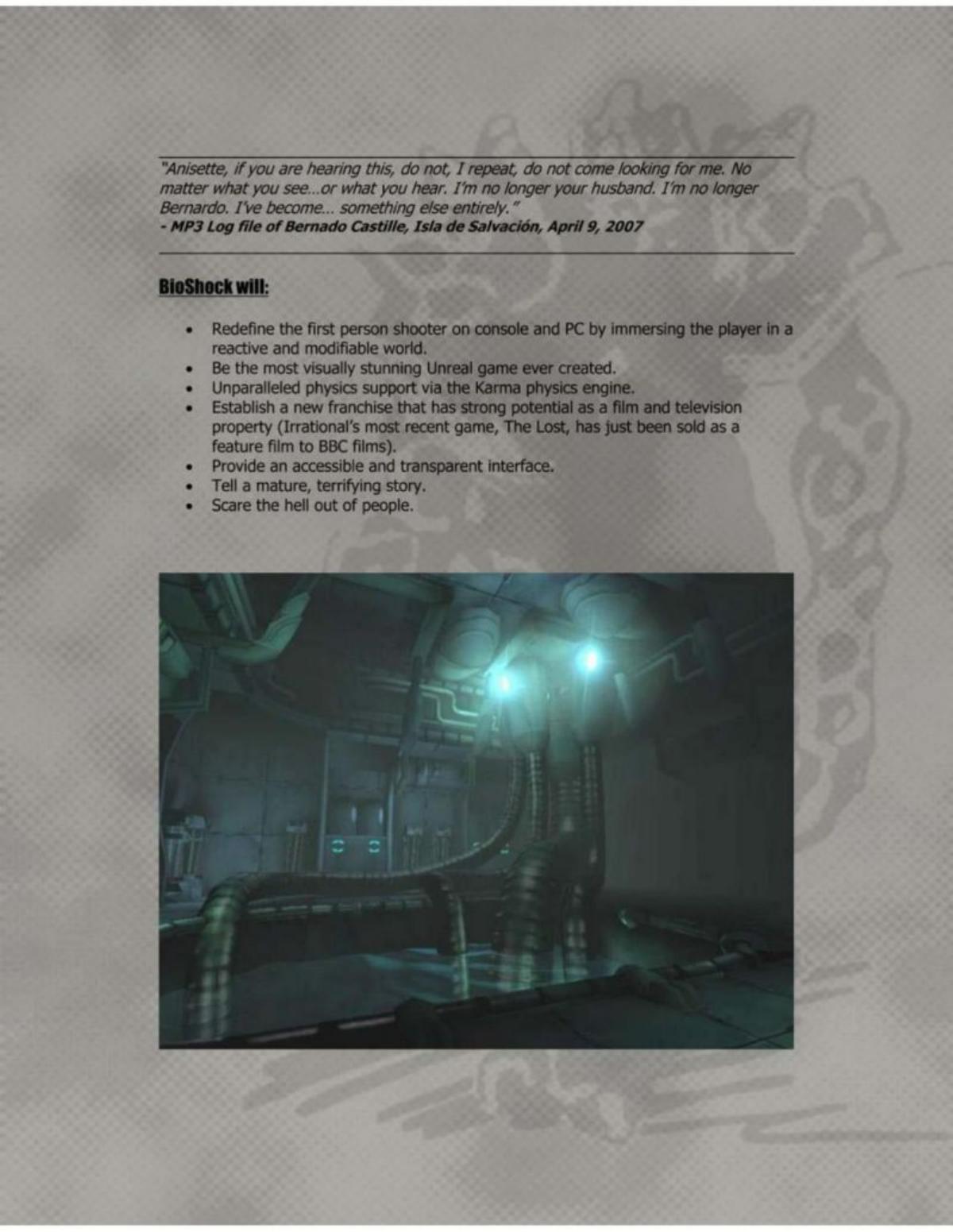
Slide 5: The 'BioShock Will' List
This slide functions as the 'Value Proposition' slide. It lists seven key goals, including 'Redefine the first person shooter on console and PC' and 'Establish a new franchise that has strong potential as a film and television property.' The mention of their previous game, The Lost , being sold to BBC films is a strategic inclusion to show that their IP has cross-media value—a major selling point for publishers looking for the next big franchise.
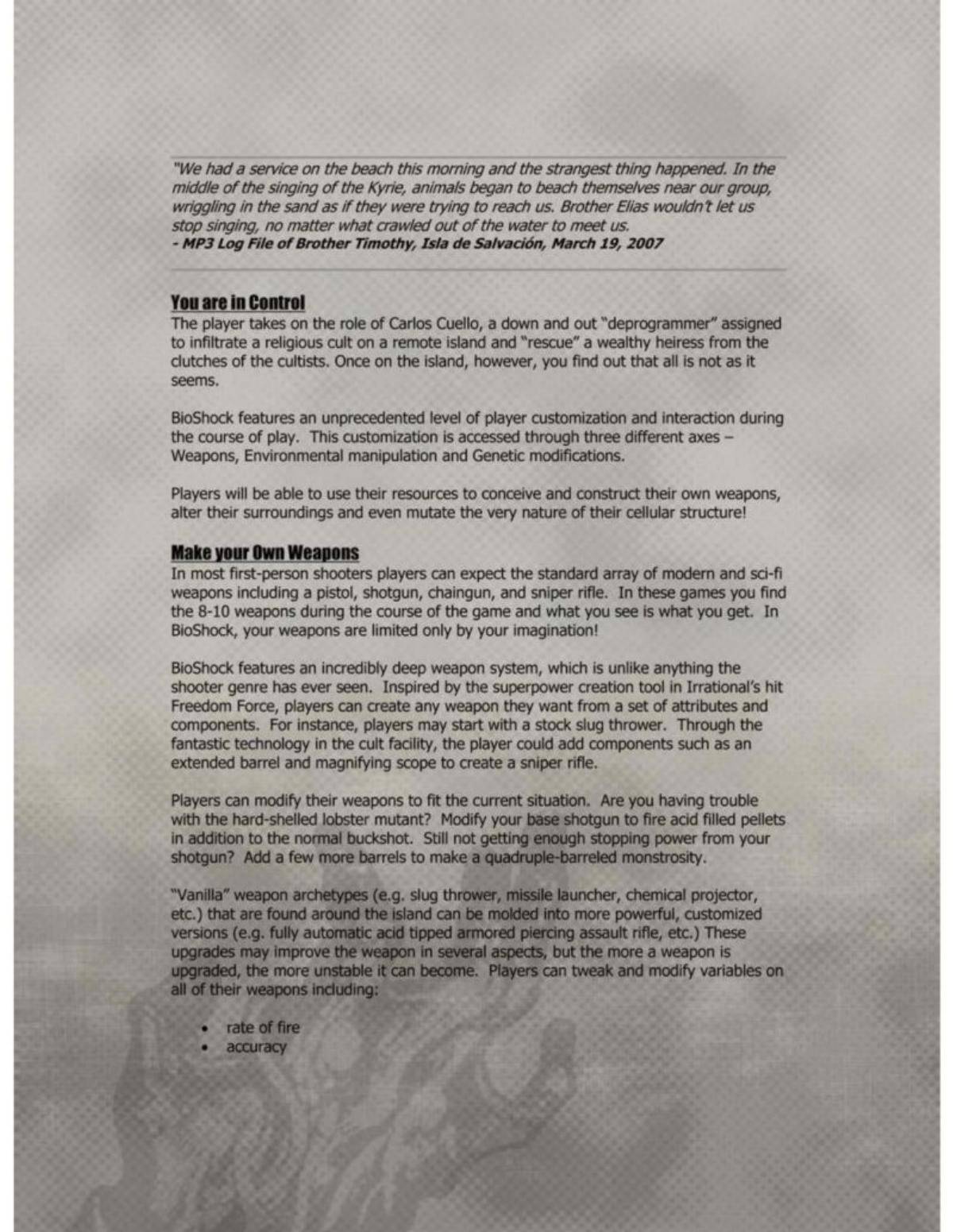
Slide 6: Player Agency and Customization
Under the heading 'You are in Control,' the deck introduces the protagonist, Carlos Cuello, and the mission: infiltrating a religious cult on a remote island. This slide introduces the three axes of gameplay: Weapons, Environmental manipulation, and Genetic modifications . The 'Make your Own Weapons' section promises a system where players aren't limited to a standard array of guns but can construct their own, such as a 'quadruple-barreled monstrosity.'
Slide 7: Mechanics and Hacking
Slide 7 continues the deep dive into mechanics, specifically 'Hacking security.' It lists specific player actions, such as shutting down cameras or commandeering security robots. This level of detail is crucial in a game pitch because it explains exactly what the player will be doing for 20+ hours, proving the 'fun factor' and the depth of the simulation.
Slide 8: Mod the World!
This slide focuses on environmental interaction. It lists creative ways the player can manipulate the game space, such as increasing oxygen content to make explosives more deadly or ionizing the air to boost electrical weapons. This reinforces the 'emergent gameplay' philosophy that Irrational Games is known for—giving players tools rather than scripted sequences.
Slide 9: Genetic Enhancements and Market Summary
The final content slide introduces 'Genetic Enhancements' (later known as Plasmids in the final game). It describes 'genotypes' like the Hydrozoan (jellyfish) or Crustacean that give the player physical mutations. The 'Summary' section at the bottom is the closest the deck gets to a market analysis, stating that the 'race is on to figure out who is going to be the next Halo or Half Life' and positioning BioShock as the realization of that promise.
What Works in the BioShock Deck
Atmospheric Consistency: The background art and the tone of the writing never break character. The deck feels like the game it is trying to sell. · Technical Specificity: By naming the Unreal and Karma engines, the team avoids 'vague-ware' and shows they have a concrete plan for development. · Pedigree: The constant references to System Shock 2 and Thief act as a powerful social proof, suggesting that this team is one of the few capable of delivering such a complex vision. · Feature Depth: The detailed lists of weapon variables (rate of fire, accuracy, reliability) and environmental hacks show a sophisticated understanding of game balance.
What is Missing from the BioShock Deck
The 'Ask': There is no slide detailing how much capital is required to build this 'rendering powerhouse.' · Timeline: The deck does not provide a development roadmap or a projected release date. · Budget and Unit Economics: There is no mention of the cost per unit, marketing spend, or projected sales figures. · Team Bios: While Ken Levine is mentioned, the specific 'Key Personnel' slide (page 18) is missing from this version, leaving the broader team's experience to be inferred.
What Founders Should Copy
The Narrative Hook: If you are building a product that relies on a specific 'feeling' or user experience, don't be afraid to use a slide to set the mood before you show the metrics. · Leverage Your 'Spiritual Successors': If you have built something successful before, make that the centerpiece of your credibility. · Define Your Pillars: Irrational Games clearly defined their 'three axes' of gameplay. Founders should be able to boil their product's innovation down to 3-4 clear, distinct pillars. · Show the 'How': Don't just say your product is 'innovative.' List the specific features (like the 'Ionize the air' hack) that prove how it is different from the competition.
Frequently asked questions
- Who was the intended audience for this pitch?
- The deck was intended for 'privileged exchanges only' (Slide 1) and was likely used to secure a publishing deal or funding from a major game publisher like 2K Games. Unlike a startup pitch to VCs, this is a creative pitch to a strategic partner who understands the gaming industry's technical requirements and the value of intellectual property (IP) with 'film and television property' potential (Slide 5).
- How does the deck handle competition?
- Instead of a competition grid, the deck uses 'spiritual succession' and market leaders as benchmarks. It identifies the team's own past work (System Shock 2) as the standard to beat and mentions Halo and Half-Life as the market titans it intends to join (Slide 9). It positions BioShock as an evolution of the genre rather than a direct clone.
- What are the primary 'innovations' pitched?
- The deck highlights three major pillars: deep weapon customization where 'weapons are limited only by your imagination' (Slide 6), environmental hacking that allows players to change oxygen levels or magnetize floors (Slide 8), and genetic enhancements (genotypes) that allow players to mutate their character's cellular structure (Slide 9).
- Is there a team slide in the BioShock deck?
- The Table of Contents on Slide 3 lists 'Key Personnel' on page 18 and 'Praise for Irrational' on page 20, but these slides are not included in this 10-slide summary. However, Slide 4 explicitly mentions Ken Levine as the writer and highlights the studio's history with System Shock 2 and Thief to establish founder-market fit.
- How does the 2002 pitch differ from the final 2007 game?
- The pitch describes the protagonist as 'Carlos Cuello,' a deprogrammer sent to a remote island to rescue a wealthy heiress from a cult (Slide 6). This is a significant departure from the final game's setting of Rapture (an underwater city) and the protagonist Jack. The pitch also emphasizes a 'Story Based Deathmatch' (Slide 4) which was not a core feature of the original release.