Biodel Inc.’s 2010 investor presentation, delivered at the J.P. Morgan Healthcare Conference, serves as a technical deep-dive into the company's proprietary insulin formulations, specifically VIAject. The deck emphasizes the market shift toward rapid-acting insulins, which commanded a 3x price premium over regular human insulin as of 2008 (Slide 4). Biodel positions itself as a solution to the 'Big Picture' problem: endocrinologists' demand for faster meal-time insulin (Slide 11). The presentation relies heavily on clinical data, showing VIAject’s superior glycemic control in Phase 2 trials c…
Key takeaways
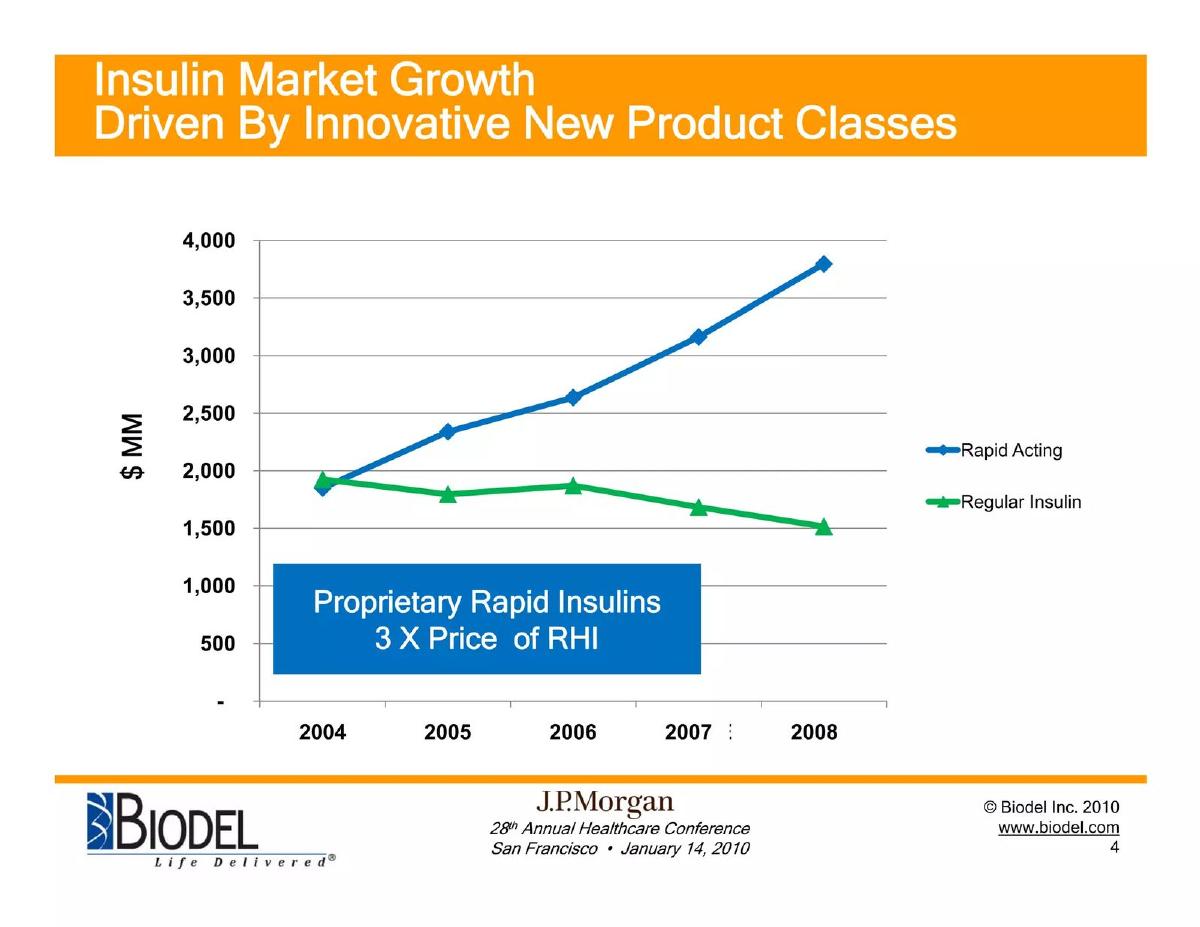
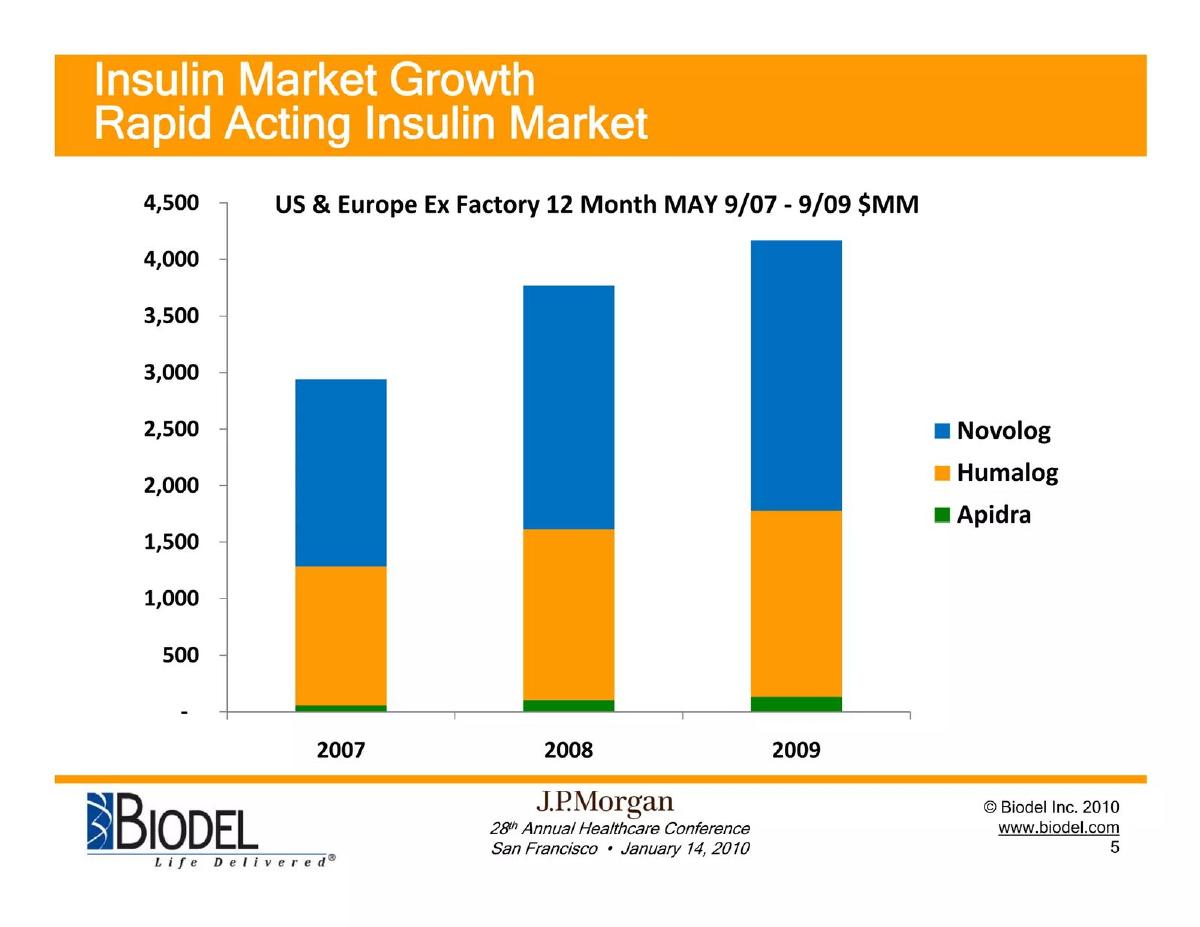
- The insulin market is shifting toward rapid-acting products, which reached nearly $4,000 MM in 2008 (Slide 4).
- Proprietary rapid insulins command a 3x price premium over Regular Human Insulin (Slide 4).
- Independent market research indicates a strong consensus among endocrinologists for insulins that work faster than current analogs (Slide 11).
- Biodel holds U.S. Patent No. 7,279,457, which is set to expire in January 2026 (Slide 12).
- Phase 2 meal study data shows VIAject provides better postprandial glycemic control than Humalog and Humulin R (Slide 20).
- The company successfully mitigated tolerability concerns by bridging from a pH 4 to a pH 7 formulation (Slide 24).
- Biodel's proprietary GRAS excipients reduced Lantus activity duration by over 30% in Type 1 diabetics (Slide 32).
- The BIOD-G-008 glucagon formulation shows significantly higher stability at 37°C compared to the Lilly control over 15 days (Slide 36).
Biodel Inc. 2010 Investor Presentation: A Technical Deep Dive
The Biodel Inc. presentation from the 28th Annual J.P. Morgan Healthcare Conference is a quintessential example of a late-stage biotech investor deck. Rather than focusing on the 'visionary' storytelling common in seed-stage tech, this deck is built on a foundation of clinical data, intellectual property, and market dynamics. With 39 slides in the full version, the 10 slides analyzed here provide a clear picture of a company transitioning from R&D to strategic commercial positioning.
Slide 1: Title and Branding
The cover slide establishes the context: a high-profile presentation at the J.P. Morgan Healthcare Conference in San Francisco, dated January 14, 2010. The tagline 'Life Delivered' and the subtitle 'The future of diabetes control' immediately anchor the company in the metabolic disease space. The imagery of a smiling mother and child is standard pharmaceutical fare, intended to humanize the technical data that follows.
Slide 4: Market Dynamics and Pricing Power
Slide 4 is one of the most critical slides for an investor. It charts 'Insulin Market Growth Driven By Innovative New Product Classes.' The graph shows a clear divergence: while Regular Insulin sales are stagnant or declining (dropping from ~$2,000 MM to ~$1,500 MM between 2004 and 2008), 'Rapid Acting' insulin is in a steep climb, reaching nearly $4,000 MM. The key takeaway is highlighted in a blue box: 'Proprietary Rapid Insulins 3 X Price of RHI.' This slide justifies Biodel's focus on rapid-acting formulations by proving that the market rewards speed with significant price premiums.
Slide 8: The VIAject Technology
This slide is a visual representation of the VIAject technology. While it lacks text, the graphic depicts a molecular structure breaking apart. In the context of insulin, this typically represents the dissociation of insulin hexamers into monomers, which is the biological mechanism that allows for faster absorption into the bloodstream. It serves as a visual bridge between the market need (speed) and the biological solution.
Slide 11: The Big Picture - Market Validation
Biodel uses third-party validation to reinforce its thesis. Citing a 'Diabetes Close Up HCP Survey - ADA 2009,' the slide shows that a vast majority of endocrinologists believe 'we need insulins that work faster than current rapid-acting analogs.' The red circles emphasize this specific data point. By framing the problem through the lens of healthcare providers (HCPs), Biodel demonstrates that there is 'pull' from the market, not just 'push' from their lab.
Slide 12: Intellectual Property Protection
For a biotech firm, the deck is only as strong as its patents. Slide 12 lists U.S. Patent No. 7,279,457, expiring in January 2026, and a corresponding European patent expiring in March 2025. The slide notes that these are 'Composition of matter patents'—the strongest form of IP protection—and that all IP was 'invented in-house.' This reduces concerns about licensing fees or third-party litigation, making the company a cleaner acquisition or investment target.
Slide 20: Clinical Proof of Concept
Slide 20 provides the 'meat' of the clinical argument. The 'Phase 2 Meal Study Mean Curves' compare VIAject against two industry standards: Humulin R and Humalog. The graph shows VIAject (the blue line) maintaining a lower and more stable blood glucose curve post-meal. Specifically, it avoids the high peaks seen in Humulin R and returns to the target range faster than Humalog. This is the direct evidence that Biodel's technology delivers the 'faster' performance demanded by doctors on Slide 11.
Slide 24: Addressing Regulatory and Safety Hurdles
Clinical development is rarely linear. Slide 24 reveals that Biodel had to 'bridge' from a pH 4 formulation to a pH 7 formulation to mitigate 'Tolerability Concern.' This is an honest admission of a technical hurdle that was successfully cleared. The slide notes that the new formulation 'Successfully met primary endpoint' regarding Area Under the Curve (AUC) and Maximum serum insulin concentration (Cmax). This slide is designed to de-risk the investment by showing that a known safety/comfort issue has been resolved.
Slide 28: Strategic Positioning
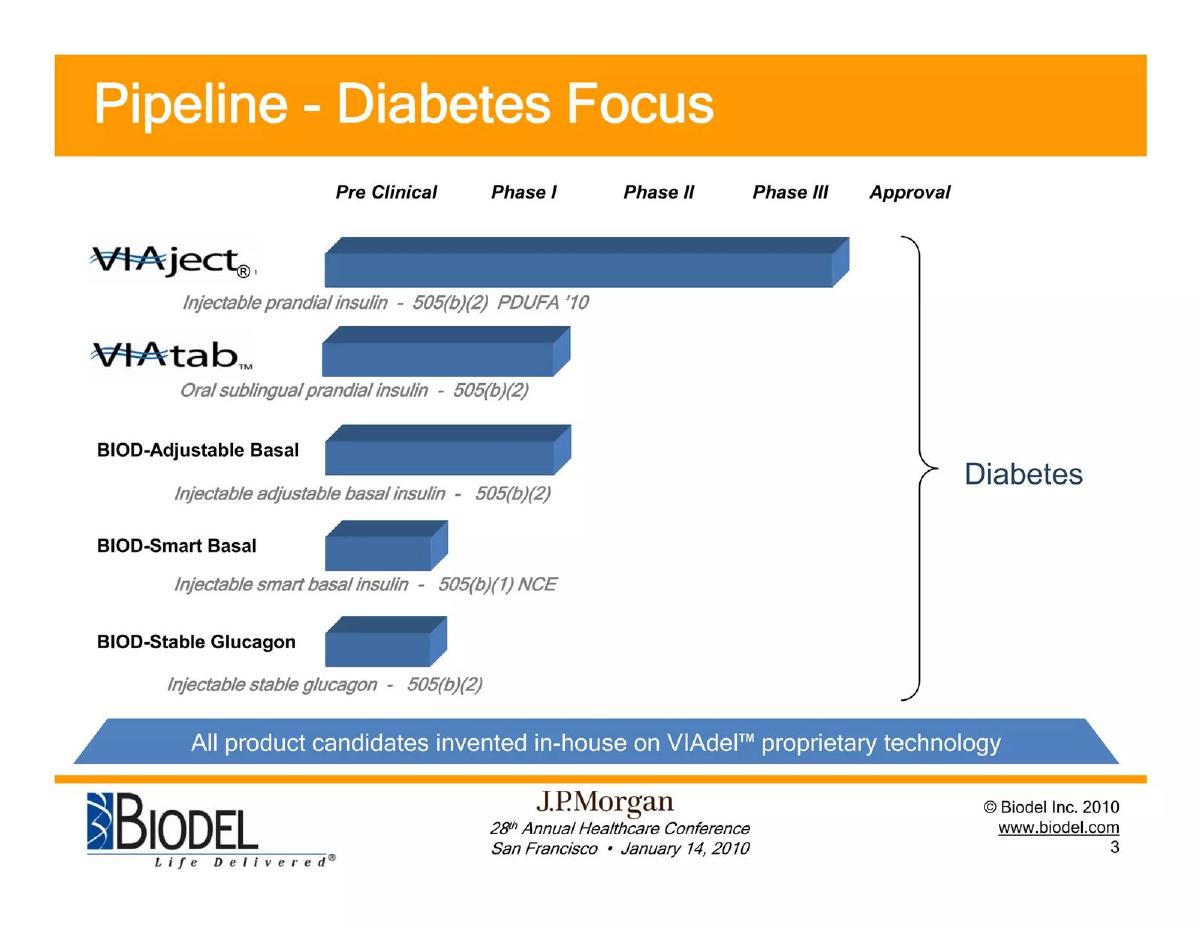
Under the heading 'Diabetes Focus Pipeline Repositioning Rationale,' Biodel explains why it is doubling down on this sector. The bullets mention leveraging 'in-house expertise,' increasing 'strategic value,' and creating 'low-risk investment opportunities with short timeline to significant step-up in value.' This is a clear signal to investors that the company is optimizing its portfolio for an exit or a major partnership.
Slide 32: Expanding the Portfolio - Lantus Activity
Biodel shows that its technology isn't a one-trick pony. Slide 32 demonstrates how its proprietary 'GRAS' (Generally Recognized As Safe) excipients can reduce the duration of Lantus (a long-acting insulin). The bar chart shows a 'Percent reduction in duration' of over 30% with 6 units of excipient. This suggests Biodel has a platform technology that can be applied to various insulin types to tune their performance.
Slide 36: Glucagon Stability
The final slide in the selection focuses on Glucagon formulation at 37°C. Stability is a major challenge for glucagon, which usually requires reconstitution right before use. The graph shows Biodel’s formulation (BIOD-G-008) maintaining high stability over 15 days, while the Lilly control fails almost immediately. This data point opens the door to use in 'artificial pancreas' pumps, where the drug must remain stable at body temperature for several days.
What Works in This Deck
1. Data-Driven Narrative: The deck avoids fluff. Every claim about market need is backed by a survey (Slide 11), and every claim about product performance is backed by a clinical graph (Slides 20, 32, 36). This is essential for the J.P. Morgan audience, which consists of sophisticated institutional investors.
2. Clear Competitive Benchmarking: Biodel doesn't operate in a vacuum. By plotting their data directly against market leaders like Humalog and Lantus, they make the value proposition immediately clear: 'We are better than the current gold standard.'
3. IP Transparency: Providing specific patent numbers and expiration dates (Slide 12) builds immediate trust. It allows analysts to verify the company's defensive moat without having to dig through SEC filings first.
What Is Missing
1. Management Team: In the provided 10-slide selection, there is no mention of the leadership team. In biotech, the 'who' is often as important as the 'what,' especially regarding previous FDA successes or exits.
2. Financial Ask and Use of Proceeds: The deck describes a 'repositioning' and 'value step-up' but does not state how much capital is being raised or how it will be spent. While this might be in the omitted 29 slides, its absence here leaves the 'so what?' of the presentation unanswered.
3. Clear Milestones: While the deck mentions Phase 2 data, it doesn't provide a roadmap for Phase 3, NDA filing, or commercial launch. Investors need a timeline to calculate their internal rate of return (IRR).
Lessons for Founders
1. Quantify the 'Why Now': Biodel’s Slide 4 is a masterclass in market justification. They don't just say the market is big; they show that the specific sub-sector they are targeting (rapid-acting) is the only one growing and that it carries a 3x price premium. Founders should always aim to show why their specific niche is the most lucrative part of a larger market.
2. Use 'Third-Party Pull': Instead of saying 'We think patients need this,' Biodel uses Slide 11 to show that 'Endocrinologists believe a faster meal time insulin is needed.' Using independent research to validate your problem statement is far more persuasive than founder opinion.
3. Address the 'Warts': Slide 24 addresses a tolerability concern. Founders are often afraid to mention past failures or pivots. However, showing how you identified a technical problem (acidity/volume) and solved it (bridging to pH 7) demonstrates engineering competence and regulatory maturity.
4. Platform vs. Product: By including slides on Lantus (Slide 32) and Glucagon (Slide 36), Biodel shows that they aren't just a 'VIAject company.' They are a formulation technology company. If you have a platform technology, always show at least two distinct applications to prove the platform's versatility and reduce the 'binary risk' of a single drug candidate failing.
Frequently asked questions
- What is the primary market opportunity identified by Biodel?
- Biodel identifies the rapid-acting insulin segment as the primary growth driver. According to Slide 4, this market grew from under $2,000 MM in 2004 to nearly $4,000 MM in 2008. The company notes that these proprietary formulations sell for three times the price of regular human insulin, representing a high-value niche that addresses the clinical need for faster meal-time glucose control.
- How does Biodel protect its technology?
- The company relies on a robust intellectual property portfolio. Slide 12 details U.S. Patent No. 7,279,457 and an intent to issue from the European Patent Office. These are 'composition of matter' patents covering both VIAject and VIAtab. The U.S. patent is stated to expire in 2026, and all IP was reportedly invented in-house, providing a long runway for commercial exclusivity.
- What clinical evidence supports VIAject's efficacy?
- Slide 20 presents 'Phase 2 Meal Study Mean Curves' for 16 patients. The data shows that VIAject results in a lower peak blood glucose level (approximately 140 mg/dl) shortly after a meal compared to Humalog (approx. 150 mg/dl) and Humulin R (approx. 165 mg/dl). VIAject also returns blood glucose to baseline faster than the competitors, supporting the claim of improved postprandial control.
- What was the 'Pipeline Repositioning Rationale' mentioned in the deck?
- Slide 28 explains that Biodel is focusing on diabetes to leverage existing in-house expertise and increase the strategic value of the company. The goal is to allow the company and potential partners to build a 'diabetes franchise.' They characterize these as 'low-risk investment opportunities' because they offer a short timeline to a significant step-up in valuation.
- How does Biodel's glucagon formulation compare to existing products?
- Slide 36 displays a stability study at 37°C. The BIOD-G-008 formulation maintains over 80% of its remaining glucagon after 15 days. In contrast, the 'Control-Lilly' product drops to below 40% within one day and continues to degrade to approximately 20% by day two. This suggests a significant advantage in shelf-life or device-wearability for Biodel's formulation.