The Billfolda deck, presented to the Melbourne Angels, is a specialized document that leans heavily into the regulatory environment of Australian equity crowdfunding. Rather than focusing on product-market fit or user traction, the available slides prioritize the legal and structural advantages of the Australian market, specifically noting the $5,000,000 AUD cap for retail raises compared to the $1,000,000 USD cap in the US (Slide 5). The deck functions as an educational tool for angel investors, outlining the transition from private to public-style fundraising and the specific protections af…
Key takeaways
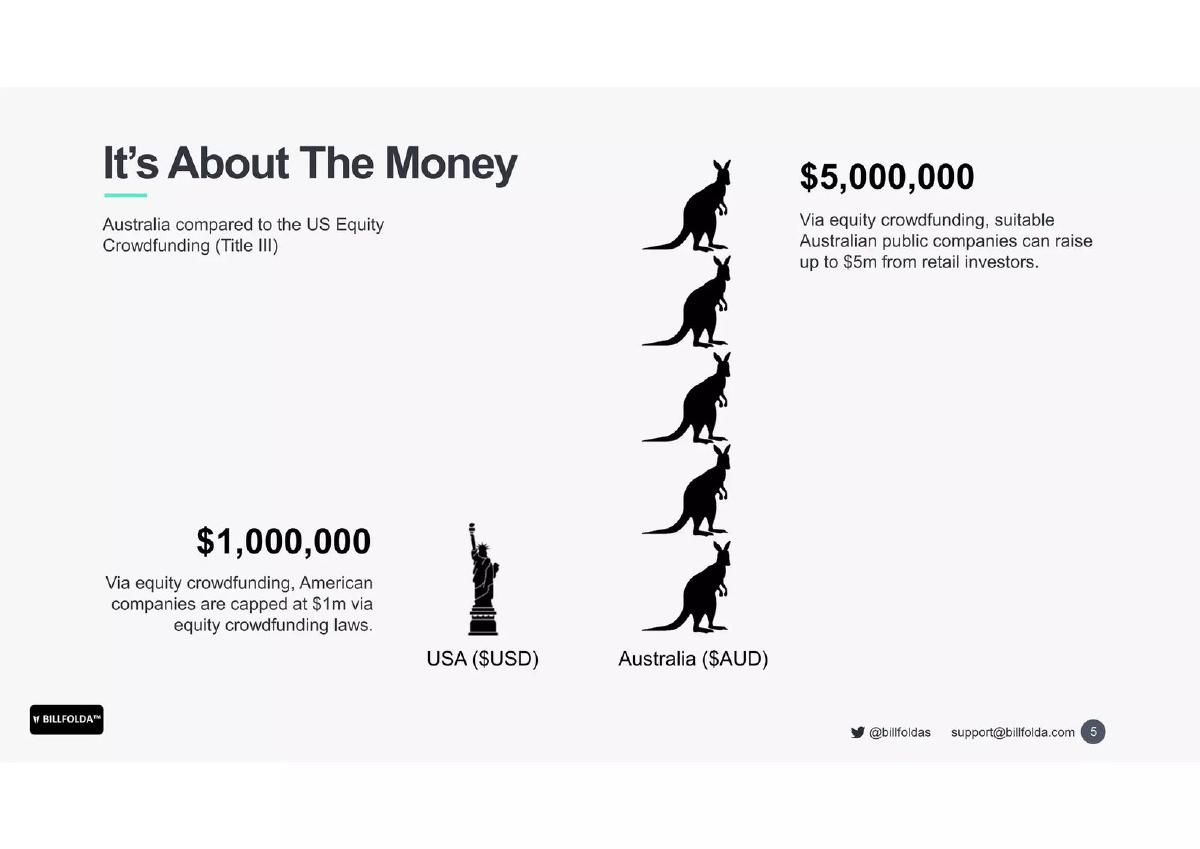
- Australia allows companies to raise up to $5m from retail investors via equity crowdfunding, significantly higher than the $1m cap cited for the US (Slide 5).
- Crowdfunding is positioned as a way to reach 500+ investors, moving beyond the traditional limits of friends, family, and angel groups (Slide 7).
- Retail investments are capped at $10,000 per issuer per annum to mitigate individual risk (Slide 9).
- The platform operates under AFS Licence No. 503322, emphasizing the necessity of regulatory oversight in the 'grey market' (Slide 3).
- Specific structural requirements for issuers include being an Australian Public Company and issuing only one type of share (Slide 9).
- Proposed changes for Proprietary Companies include an audit requirement for raises exceeding $3m and a minimum of two directors (Slide 11).
- The deck omits standard startup pitch elements such as a team slide, competitive analysis, and specific business model mechanics.
- The presentation focuses on transparency, citing mandatory 5-day cooling-off periods and upfront fee disclosures (Slide 9).
Introduction: A Regulatory-First Approach
The Billfolda deck presented to the Melbourne Angels is a distinct departure from the high-growth, metric-heavy decks typical of Silicon Valley. Instead, it is a localized, regulatory-heavy presentation designed to educate sophisticated investors on the burgeoning equity crowdfunding (CSF) landscape in Australia. The deck serves as both a pitch for the platform's utility and a compliance roadmap for companies looking to leverage the Crowd-Sourced Funding (CSF) regime.
Slide 1: Title and Branding
The cover slide is minimalist, featuring a high-resolution image of a professional using a tablet, with the text "HIGHLIGHTS: FULLY ALIGNED INVESTMENT" . The Billfolda logo is tucked into the bottom right corner. It sets a professional, corporate tone, signaling that the platform is aimed at serious investment rather than casual 'kickstarter-style' backing.
Slide 3: Important Notices & Disclaimer
Slide 3 is a dense legal disclaimer. It identifies the entity as Billfolda Pty Ltd (ABN 65 620 995 548) and explicitly states they hold AFS Licence No. 503322 . This is a critical piece of information for an angel group, as it establishes the platform's legal right to operate in the regulated financial services space in Australia. The slide covers advice warnings, accuracy of information, and the governing law of New South Wales.
Slide 5: The Macro Opportunity - Australia vs. USA
This is the 'Why Now' and 'Market Size' slide. It uses a visual comparison between the US (Statue of Liberty) and Australia (a stack of kangaroos). The slide notes that under US Title III, companies are capped at $1,000,000 USD , whereas Australian public companies can raise up to $5,000,000 AUD from retail investors via equity crowdfunding. This slide effectively argues that the Australian regulatory environment is significantly more favorable for mid-stage capital raises than the American counterpart.
Slide 7: Scaling Investor Reach
Slide 7 addresses the 'Problem/Solution' of investor access. It uses a progression of icons: a radio for Friends/Family (20 investors), a boombox for Angels (50 investors), and a stadium for the Crowd/IPO (500+ investors). The text states, "Crowd offers can help maximize your reach." This is a strategic pitch to the Melbourne Angels, suggesting that crowdfunding is not a replacement for them, but a follow-on mechanism to fill out a larger round that traditional angel groups might not cover entirely.
Slide 9: Crowdfunding as an Investment
This slide breaks down the mechanics of the CSF regime into four categories: Headline, Structural, Transparency, and Oversight . Key data points include:
Retail investment capped at $10,000 per issuer per annum . · A 5-day cooling-off period for investors. · Requirement to be an Australian Public Company (noting this is subject to change). · Prohibition on Related Party Lending . · Mandatory AFSL requirement , which Billfolda uses to distance itself from 'grey market platforms'.
This slide is designed to de-risk the concept for angel investors who might be wary of the 'messiness' of a large cap table.
Slide 11: Proprietary Fundraising Proposals
Slide 11 focuses on the then-proposed (and now largely implemented) changes allowing Proprietary (Pty Ltd) companies to access crowdfunding. It outlines the requirements for at least 2 Directors and an Audit Requirement for raises over $3m . It also mentions that CSF shareholders would not count toward the 50 non-employee shareholder limit that usually forces Australian companies to convert to Public status. This is a technical slide meant for founders and sophisticated investors to understand the long-term cap table implications.
Slide 13: Keeping in Touch
The final slide provides contact information, including their website, social media handles, and a support email. It maintains the professional imagery of the cover slide. Notably, there is no specific 'Ask' slide in this sequence—no mention of how much Billfolda is raising, at what valuation, or what the funds will be used for. This suggests the deck may have been used more as a partnership or educational presentation than a direct capital raise for the platform itself.
What Works in This Deck
Regulatory Clarity: For a fintech platform in a highly regulated space, showing the AFS license number early (Slide 3) and detailing the specific investor protections (Slide 9) is essential. It builds immediate trust with sophisticated angel groups like Melbourne Angels.
Market Comparison: The comparison between the US and Australian caps (Slide 5) is a powerful way to highlight the unique opportunity in the local market. It justifies why a founder would choose this route over traditional private placements.
Visual Metaphors: The use of the stadium icon (Slide 7) to represent the 'Crowd' vs. the 'Radio' for friends and family is a simple, effective way to communicate the value of reach without using overly complex charts.
What Is Missing
The Team: There is no mention of who is running Billfolda. In early-stage investing, the pedigree of the founders is often more important than the regulatory environment. The absence of a team slide is a significant gap.
Business Model: The deck explains how crowdfunding works, but not how Billfolda makes money. Are there listing fees? Success fees? AUM fees? Without this, it is impossible to evaluate the platform as a business opportunity.
Traction: There are no metrics regarding how many companies have successfully raised on the platform, the total volume of capital moved, or the size of their investor database. For a pitch to an angel group, these 'proof of life' metrics are mandatory.
The Ask: As noted, the deck ends without a call to action regarding investment into Billfolda itself. If this was intended as a fundraising deck for the company, the omission of the round size and use of proceeds is a major oversight.
Founder's Takeaway
Founders in the fintech or regulated services space should copy the way Billfolda breaks down complex legislation into digestible bullet points (Slide 9). However, they should avoid the mistake of making the deck purely educational. A pitch deck must eventually pivot from 'how the industry works' to 'why our specific company will win.' Billfolda spends too much time on the former and not enough on the latter. If you are pitching to an angel group, ensure you include a clear slide on your team's unique ability to execute and a specific financial ask.
Frequently asked questions
- What is the primary value proposition of Billfolda according to the deck?
- The deck positions Billfolda as a gateway to the Australian equity crowdfunding market, which offers a much higher capital ceiling ($5m AUD) than the US Title III equivalent ($1m USD). It emphasizes the ability to scale investor reach from dozens (angels/VCs) to hundreds (the crowd) while maintaining regulatory compliance through their AFS license.
- What are the specific limits for retail investors mentioned?
- According to Slide 9, retail investors are capped at $10,000 per issuer per year. This is presented alongside other protections such as a 5-day cooling-off period and mandatory disclosure via a standard offer document to ensure transparency and risk management for non-professional investors.
- How does Billfolda differentiate between traditional and crowd funding?
- Slide 7 uses a visual metaphor of audio equipment to show scale. Friends and family are represented by a small radio (20 investors), Angels and VCs by a stereo system (50 investors), and the Crowd/IPO by a stadium (500+ investors). This illustrates the reach advantage of crowdfunding platforms.
- What legal structures are required for companies using this platform?
- Slide 9 states that issuers must be Australian Public Companies (though this was noted as 'subject to change'). Slide 11 details proposals for Proprietary Companies, including requirements for at least two directors, financial reporting to ASIC, and audit requirements for raises over $3 million.
- What critical business information is missing from this teardown?
- The provided slides lack a 'Team' slide, which is essential for angel investors to evaluate execution capability. It also omits unit economics, a specific 'Ask' (how much Billfolda itself is raising), a roadmap, and a competitive landscape analysis comparing them to other Australian platforms like Birchal or Equitise.