Bidzuku's pitch deck, likely dating to early 2012 based on slide 4, outlines a two-sided marketplace designed to streamline the car-buying process. The company positions itself against incumbents like TrueCar and CarWoo by offering a 100% automated process for both new and used vehicles. The strength of the deck lies in its industry-specific team, claiming 9 years of shared automotive experience and direct connections to major groups like Hendrick Automotive. However, the presentation is heavily weighted toward product screenshots and high-level market statistics, failing to provide a clear b…
Key takeaways
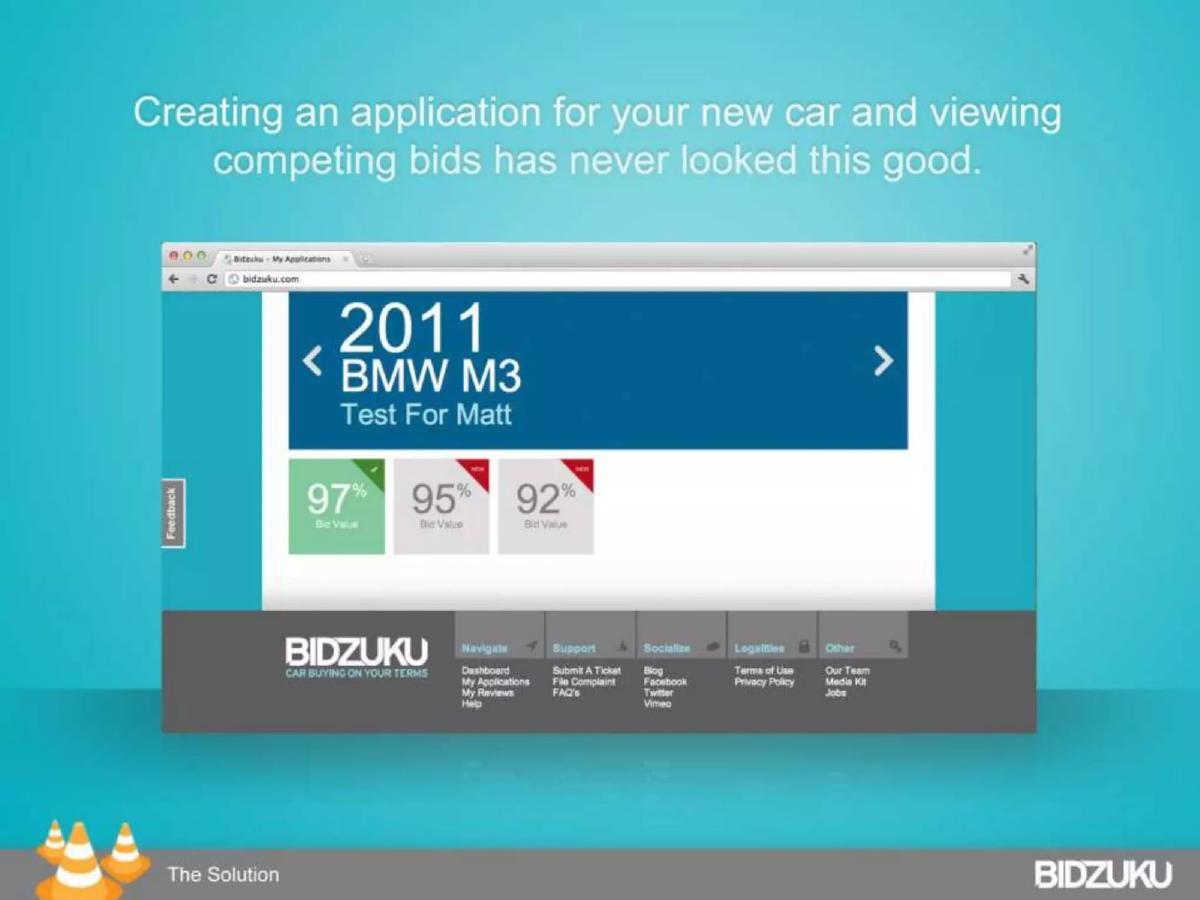
- The platform uses a proprietary relevance value to help buyers filter dealer bids, as shown on slide 4.
- The founders claim a combined 9 years of automotive industry experience and relationships with distributors representing over 250 stores (slide 7).
- Bidzuku targets a market with 11.5M+ new car sales and 41M+ used car sales, citing a $5.9B+ spend in new car advertising (slide 6).
- The product includes a dealership-facing dashboard with integrated appointment calendars and reporting tools (slide 5).
- The company identifies CarWoo as its key competitor, criticizing their model for being costly to buyers and limited to new cars (slide 8).
- The team consists of three founders: Joshua (UI/Biz Dev), Chris (Front-end), and Joel (Development/DB Management) (slide 9).
- A specific bid expiration date of January 14, 2012, in a screenshot suggests the deck's vintage (slide 4).
- The deck emphasizes a 100% automated process to maintain low overhead compared to competitors requiring call centers (slide 8).
Bidzuku Pitch Deck Analysis
Bidzuku enters the crowded automotive lead-generation space with a focus on the 'reverse auction' model. The deck is a product-centric presentation that leans heavily on the founders' industry pedigree to establish credibility. While the UI shown in the screenshots is dated by modern standards, the underlying logic of using a 'relevance score' to filter dealership noise remains a relevant concept in marketplace design.
Slide 1: Title Slide
The cover slide introduces the brand name 'Bidzuku' with the tagline 'Car Buying On Your Terms.' It lists the three founders: Joshua Hays, Christopher Campbell, and Joel Ruisi. The visual identity uses a light blue gradient and a thought-bubble icon containing a car, signaling a focus on the consumer's desires.
Slide 2: The Problem
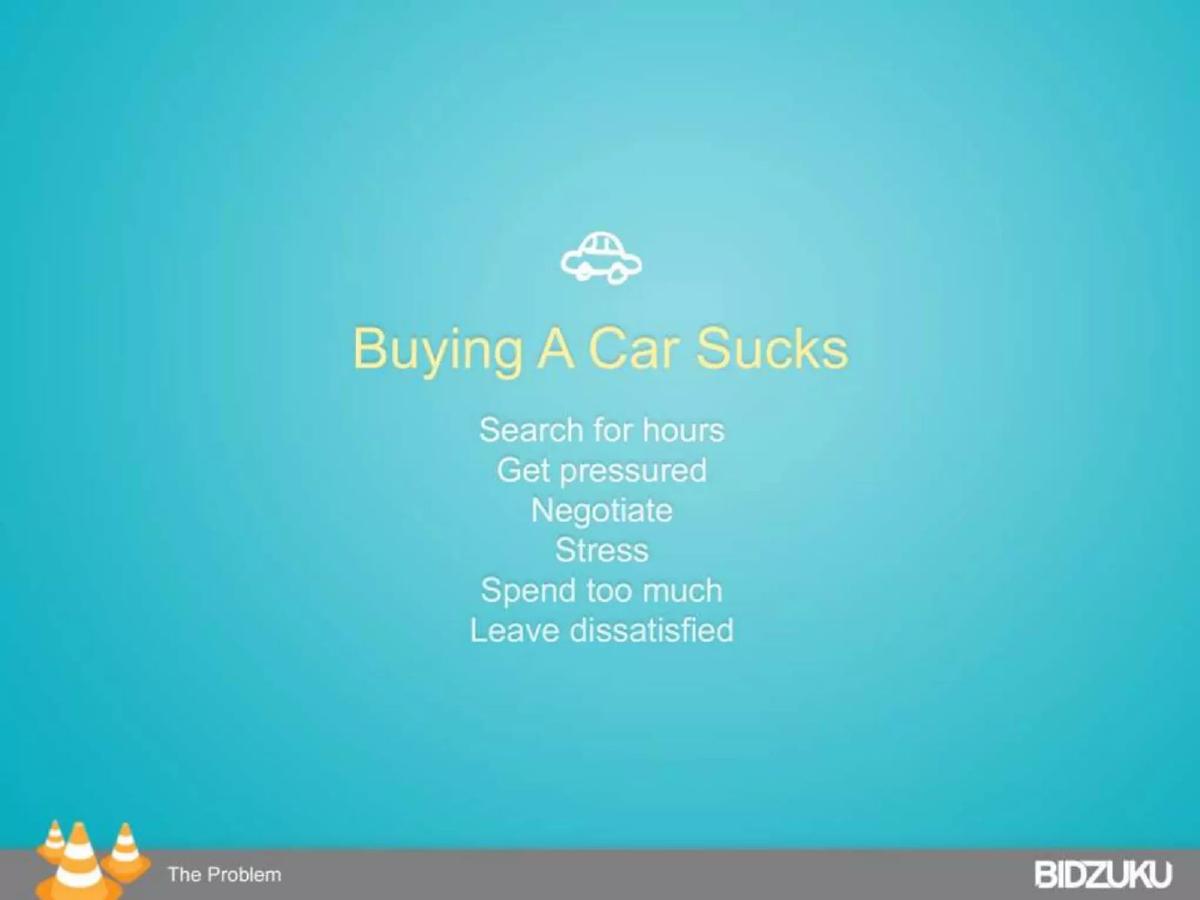
Slide 2 uses a minimalist approach to define the pain points of the automotive industry. Under the header 'Buying A Car Sucks,' the slide lists six emotional and practical grievances: 'Search for hours,' 'Get pressured,' 'Negotiate,' 'Stress,' 'Spend too much,' and 'Leave dissatisfied.' This is a standard 'emotional hook' slide designed to build consensus with the investor before presenting the solution.
Slide 3: The Solution (Overview)
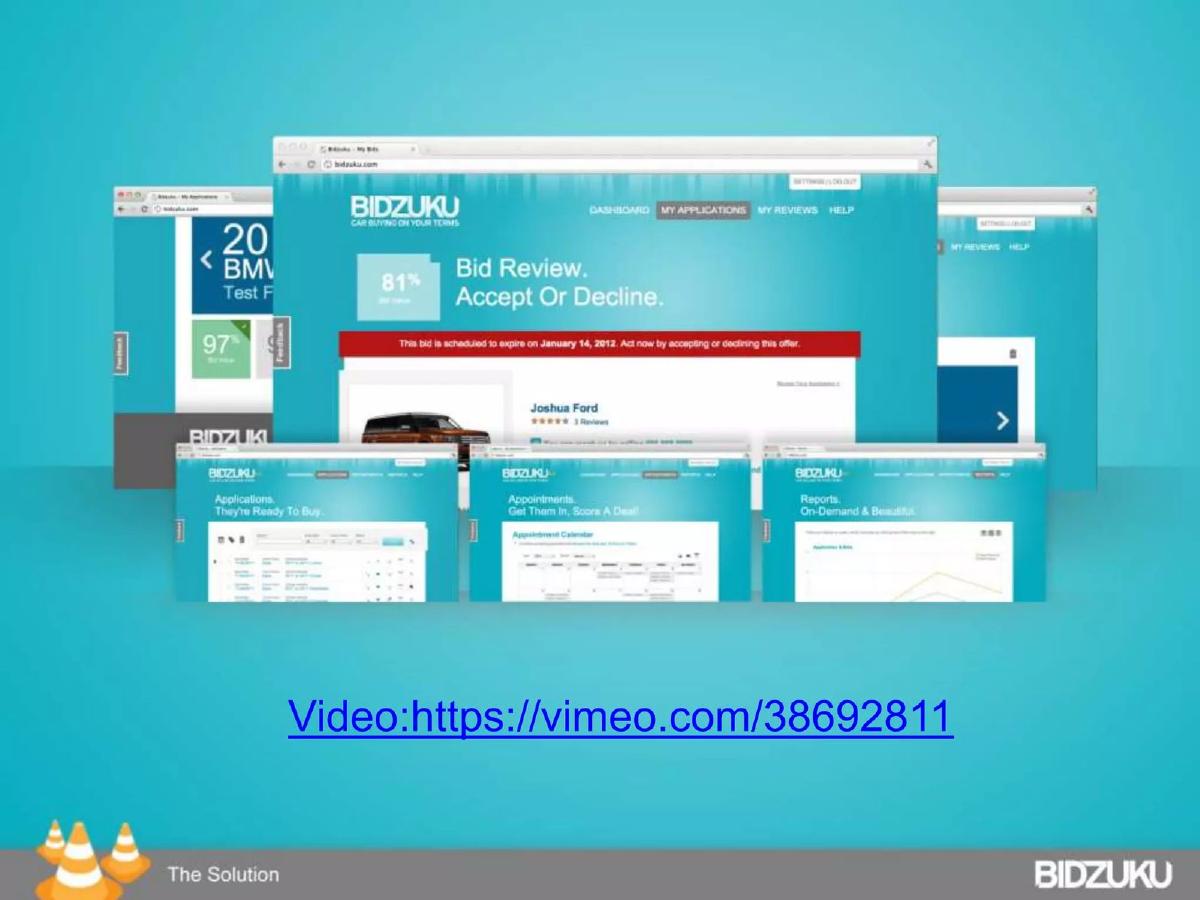
This slide provides a visual collage of the platform's interface across different devices and user types. It includes a link to a Vimeo video, which suggests the deck was intended for digital viewing rather than a live presentation. The screenshots show a 'Bid Review' screen for consumers and various management screens for dealers, including 'Applications,' 'Appointments,' and 'Reports.'
Slide 4: The Solution (Consumer Bid Review)
Slide 4 focuses on the 'relevance value' system. The text states, 'Bids are assigned a relevance value so buyers can quickly pick the deal that best matches their requests.' A screenshot shows a bid from 'Joshua Ford' with an '81% Bid Value.' Notably, the screenshot includes an expiration date of January 14, 2012, which serves as a timestamp for the product's development stage.
Slide 5: The Solution (Dealership Dashboard)
The focus shifts to the B2B side of the marketplace. The slide claims that dealerships get access to 'local applications,' an 'integrated appointment calendar,' and 'beautiful reports.' The screenshot displays a list of applications with details like 'Time Frame' and 'Vehicle Desired' (e.g., '2011 to 2011 Luxury'), positioning the tool as a CRM-lite for sales teams.
Slide 6: Market Size
This slide attempts to quantify the opportunity using 2011 data. It cites 11.5M+ new car sales and 41M+ used car sales. On the customer side, it notes 14,383+ franchised dealerships and 119,450+ used car facilities. The slide also mentions a $5.9B+ spend in new car advertising and a trend of allocating 2-3% more annually to web advertising. While the numbers are large, the slide fails to define Bidzuku's specific Serviceable Obtainable Market (SOM).
Slide 7: Proprietary Technology & Expertise
This slide serves as a 'Why Us' argument. It highlights that the founders share 9 years of automotive experience and possess 'close relationships' with distributors representing over 250 stores, including specific mentions of Hendrick Automotive Group and Chrysler Corporate. It also mentions an 'Unmatched proprietary bid value system,' though it does not explain the algorithm behind it.
Slide 8: Competition
Bidzuku identifies CarWoo as its primary competitor, criticizing it for being 'costly to car buyers,' limited to 'new cars only,' and requiring a 'call center to keep dealers involved.' It also lists TrueCar, AutoTrader, cars.com, and eBay Motors as general market competitors. Bidzuku's stated advantages are its 100% automated process, inclusion of used cars, and the team's industry experience.
Slide 9: Team
The final slide in the provided set introduces the three founders with headshots and bios. Joshua is listed as the Founder focused on UI Design and Business Development, citing 7 years of dealership experience. Chris is the Co-founder handling front-end work (CSS, Javascript) with 2 years of dealership experience. Joel is the Co-founder and technical lead, with 10 years of web development experience and multiple degrees in Information Systems and Risk Management.
What Bidzuku Does Well
The deck excels at establishing founder-market fit . In a sector as insular and difficult to penetrate as automotive retail, having founders who have actually worked in dealerships is a significant asset. The mention of specific relationships with Hendrick Automotive Group (Slide 7) provides a tangible 'unfair advantage' that investors look for in early-stage startups.
The product focus on automation (Slide 8) is also a strong point. By positioning themselves against a competitor that requires a human call center, Bidzuku is arguing for a more scalable, high-margin business model. The 'relevance value' (Slide 4) is a smart way to productize the 'matching' aspect of a marketplace, moving beyond simple price comparisons.
What is Missing from the Deck
The most glaring omission is the Business Model . While the deck explains how the product works, it never explains how the company makes money. Does the dealer pay per lead, per subscription, or per successful sale? Without this, the market size numbers on Slide 6 lack context.
Furthermore, there is no Traction slide . Given that the screenshots show a functional product with specific dates in 2012, an investor would expect to see how many dealers have signed up, how many bids have been placed, or the results of a pilot program. The deck also lacks a Financial Ask and a Use of Funds slide, leaving the reader unclear on what the company needs to reach its next milestone.
What a Founder Should Copy
Founders should emulate the clear competitive positioning found on Slide 8. Instead of a generic 'feature matrix' (the checkmark grid), Bidzuku uses specific, qualitative criticisms of their main competitor (CarWoo) to highlight their own strategic choices (automation and used car support). This tells a much more compelling story about why the startup exists.
The problem-solution alignment in the early slides is also well-executed. The pain points listed on Slide 2 are directly addressed by the features shown on Slides 4 and 5. This logical flow ensures that the product doesn't feel like a 'solution in search of a problem.'
Frequently asked questions
- What is Bidzuku's core value proposition for car buyers?
- According to slide 2 and slide 4, Bidzuku aims to eliminate the stress and negotiation of traditional car buying. It allows buyers to receive bids from dealers, which are then assigned a 'relevance value' percentage. This enables buyers to quickly identify which offers best match their specific requests without the pressure of a physical dealership environment.
- How does Bidzuku differentiate itself from competitors like TrueCar?
- On slide 8, Bidzuku claims several advantages over 'Market Competitors' like TrueCar, AutoTrader, and eBay Motors. Specifically, they highlight their inclusion of both new and used cars, a 100% automated process that ensures low overhead, and a founding team with deep, existing relationships in the automotive industry that competitors supposedly lack.
- What features does the platform offer to car dealerships?
- As shown on slide 5, the dealership side of the platform includes a dashboard for managing 'local applications' from buyers who are 'ready to buy.' It also features an integrated appointment calendar to schedule test drives and a reporting suite described as 'on-demand and beautiful' to track sales performance.
- What is the background of the founding team?
- Slide 9 details a three-person team. Joshua, the founder, has 7 years of dealership experience and a 10-year marketing career. Chris, the co-founder, has 2 years of dealership experience and handles front-end development. Joel, the technical co-founder, has 10 years of web development experience and holds a Master's in Management Information Systems.
- Is there a clear business model or financial ask in the deck?
- No. The provided slides focus almost entirely on the problem, product features, market size, and team. There is no mention of how Bidzuku charges dealers or buyers, no revenue projections, and no slide indicating how much capital the company is seeking to raise or how it will be used.