BidFlat48 is a Berlin-based proptech startup attempting to compress the rental search timeline from months to just 48 hours. The platform operates on a unique auction model where tenants bid on a one-time booking fee rather than the monthly rent itself. This creates a dual-incentive structure: tenants gain speed and a 'fair chance' regardless of income, while landlords receive a portion of the booking fee profit and lower administrative overhead. The deck highlights a Total Addressable Market in Berlin of €45 million based on an average €250 starting bid. While the team features a mix of stud…
Key takeaways
- The platform aims to reduce the time to find a flat in Berlin from 3 months to 48 hours (Slide 2, Slide 4).
- Revenue is generated by keeping a percentage of a one-time booking fee that tenants bid on during a 48-hour auction (Slide 5).
- Landlords are incentivized to use the platform by sharing in the profit of the booking fee (Slide 6).
- The Berlin market is valued at €45 million based on 180,000 annual moves and a €250 average starting bid (Slide 8).
- BidFlat48 claims to be the only auction-based rental platform in Germany (Slide 9).
- The startup positions itself as a low-price, fast-renting alternative to competitors like Wunderflats and Spotahome (Slide 10).
- FasterCapital is listed as both a seed investor and the provider of a 'CTO' service for the company (Slide 12).
- The deck provides a link to a live MVP but omits a specific capital requirement or 'Ask' slide (Slide 7, Slide 13).
Slide-by-Slide Analysis
Slide 1: Title Slide
The deck opens with a high-angle architectural shot of a skyscraper. The branding is clear: 'BIDFLAT48' with the tagline 'fastest way to find your home.' The name itself suggests the core value proposition—a 48-hour turnaround time.
Slide 2: The Problem
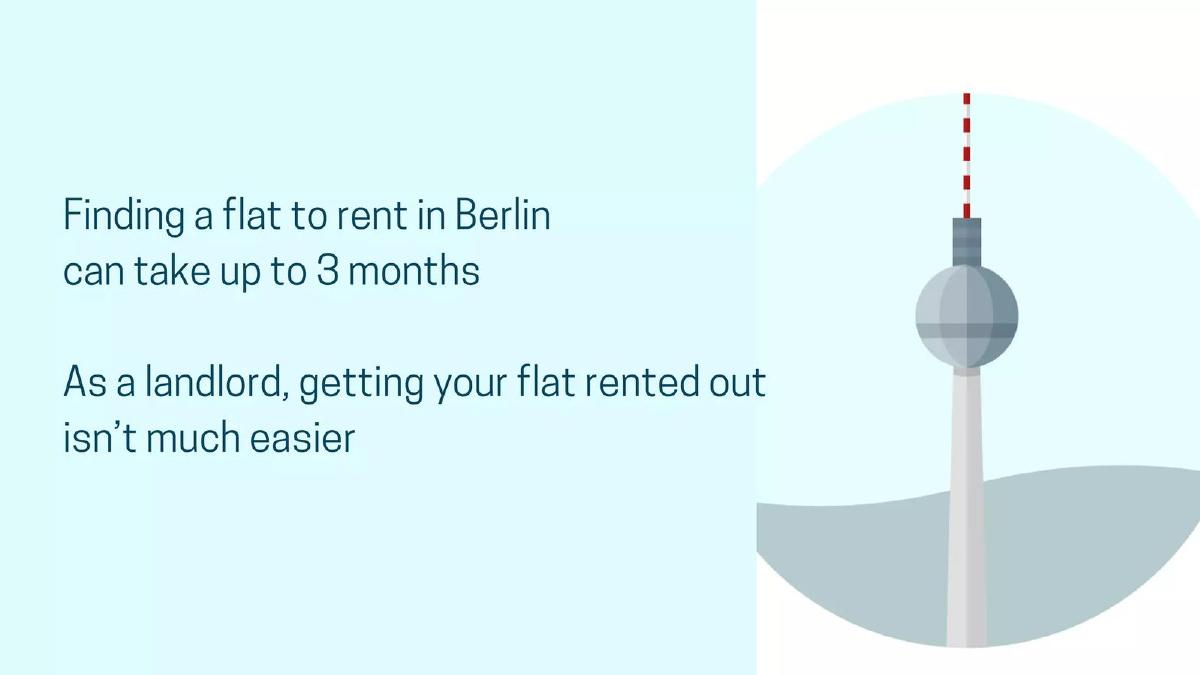
This slide identifies the friction in the Berlin rental market. It states that finding a flat can take up to 3 months and notes that landlords face similar difficulties in getting properties rented out. An illustration of the Berlin TV Tower (Fernsehturm) anchors the geographic focus.
Slide 3: The Solution Statement
A simple transition slide featuring a lightbulb icon. It claims BidFlat48 is designed to solve both tenant and landlord issues on a single platform. It lacks specific detail but sets the stage for the mechanism.
Slide 4: The Value Proposition
The core promise is quantified here: 'Tenants get their desired flats in 48 hours or faster.' It mirrors this for landlords, promising the same timeframe for renting out a property. A key icon is used to represent the outcome of a successful rental.
Slide 5: How It Works
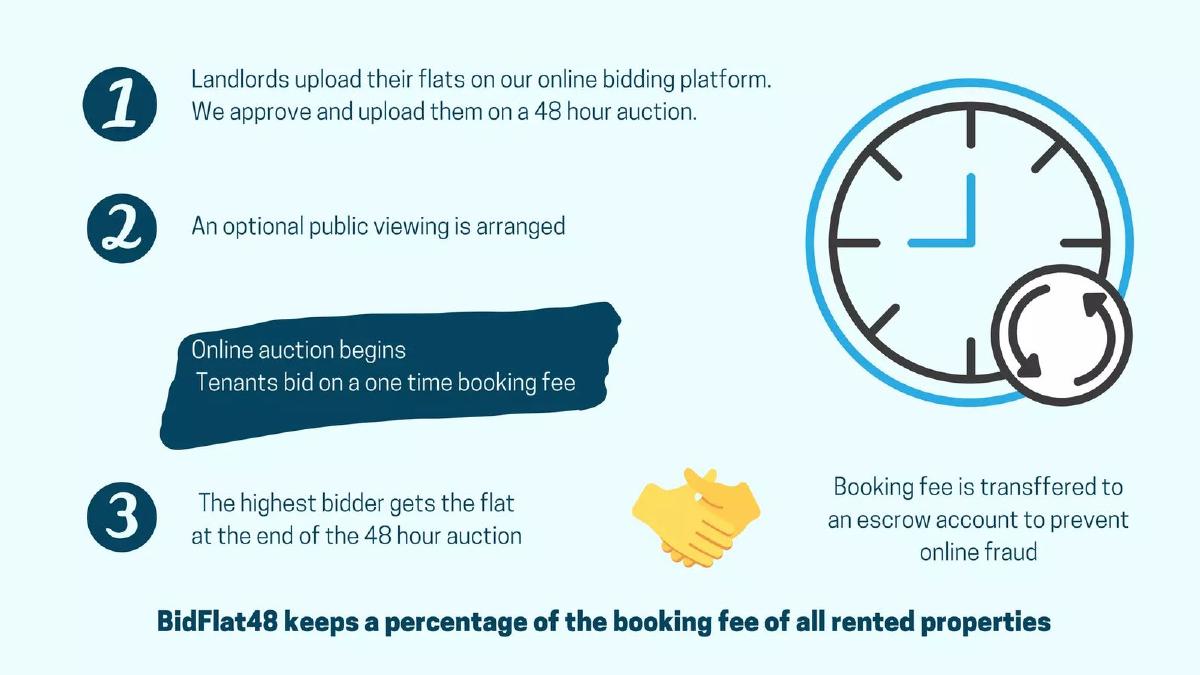
This is the most critical slide in the deck. It outlines a three-step process: 1) Landlords upload flats for a 48-hour auction. 2) Optional public viewings occur while tenants bid on a 'one-time booking fee.' 3) The highest bidder wins, and the fee is held in escrow to prevent fraud. The slide explicitly states that BidFlat48 keeps a percentage of this booking fee.
Slide 6: Dual-Sided Benefits
The deck splits benefits between the two user groups. For landlords: lower admin costs, quicker decisions, no application reviews, and profit-sharing from the booking fee. For tenants: speed (48 hours), skipping competition, and control over the price they pay to secure the unit. The use of cartoon avatars makes the slide feel consumer-oriented.
Slide 7: MVP Link
A minimalist slide providing the URL to the current Minimum Viable Product. This serves as a proof-of-concept indicator, showing that the founders have moved beyond the ideation phase.
Slide 8: Market Opportunity
The deck focuses on Berlin, citing a population of 3 million and 180,000 annual moves. It calculates a Total Addressable Market (TAM) of €45 million for Berlin alone, based on an 'anyalasis' (sic) of a €250 average starting bid. It also mentions the opportunity for rapid expansion to other cities.
Slide 9: Competition and Advantages
Competitors listed include Spotahome, Rentberry, WG-Gesucht, eBay Kleinanzeigen Berlin, and Immobilienscout24. BidFlat48 claims several advantages: being the only auction-based platform in Germany, ensuring 48-hour rentals, and offering a 'fair chance' where selection is not based on income.
Slide 10: Competitive Positioning Map
A standard 2x2 matrix. The Y-axis measures housing price (High to Low) and the X-axis measures renting process speed (Slow to Fast). BidFlat48 positions itself in the bottom-right quadrant: Low housing price and Fast renting process. Competitors like Wunderflats and Spotahome are placed in the High price/Fast process quadrant.
Slide 11: Milestones and Goals
A linear timeline shows the company's progress. Key points include the founding team coming together, the first prototype, FasterCapital joining the team and providing investment, and the current stage of 'Build market ready product.' The final milestone is the official 'Launch.'
Slide 12: The Team
The team consists of Allyson Gamboa (CTO), Trevon Vivens (COO), and Lazar Mikov (CEO). Notable details include Vivens' experience generating €2 million in revenue for boat rental startup Zizoo, and Mikov's background with the Krinova Incubator. Interestingly, 'FasterCapital' is listed as a second CTO, described as a seed investor and technical co-founder with a mentor network.
Slide 13: Contact Information
The final slide provides a Berlin office address, two phone numbers, and a company email address. A 'Thank You' message is accompanied by a prayer/gratitude emoji icon.
What BidFlat48 Does Well
The deck is exceptionally clear about its unique mechanism . Unlike many proptech decks that vaguely promise 'better matching,' BidFlat48 explicitly describes an auction for a booking fee. This differentiates them immediately from listing aggregators like Immobilienscout24. By focusing on the speed of the transaction (48 hours), they address the primary pain point of the Berlin market—extreme scarcity and long lead times.
The incentive alignment for landlords is also a strong point. Most platforms ask landlords to pay for listings; BidFlat48 suggests landlords can actually 'profit' from the booking fee. This is a clever way to solve the 'cold start' problem of marketplace supply by turning the platform into a revenue generator for the property owner rather than just a utility.
What Is Missing from the Deck
The most glaring omission is a specific Ask slide . There is no mention of how much capital the company is seeking, what the valuation expectations are, or how the funds will be allocated (e.g., marketing vs. engineering). Without an 'Ask,' the deck functions more as a company profile than a fundraising tool.
Furthermore, the financial projections are nearly non-existent. While they mention a €45 million TAM, there is no breakdown of the commission percentage, projected burn rate, or a path to profitability. The regulatory landscape is also ignored. Germany has strict rental laws (Mietpreisbremse); while the auction is for a 'booking fee' rather than rent, a sophisticated investor would want to see a legal justification for why this doesn't violate local housing regulations or 'key money' prohibitions.
Finally, the unit economics are missing. The deck doesn't explain the Cost Per Acquisition (CPA) for a landlord versus the Lifetime Value (LTV) of that relationship, which is critical for a marketplace business.
Founder Takeaways: What to Copy and What to Avoid
Copy the clarity of the process: Slide 5 is a model for how to explain a complex marketplace transaction. Using a simple 1-2-3 numbered list to explain how the auction works, where the money goes (escrow), and how the platform takes a cut is excellent. It removes ambiguity about the business model.
Avoid the 'Student Project' aesthetic: While the team is transparent about their backgrounds, listing a CTO as a current 'student at Austin Community College' (Slide 12) alongside a corporate entity (FasterCapital) as a co-CTO creates confusion about who is actually writing the code and who owns the IP. Founders should present a unified technical front.
Don't skip the 'Ask': Every pitch deck intended for investors must conclude with what you want from them. Even if you are in 'stealth' or 'pre-seed,' providing a range of capital needed to reach the next milestone is essential for a productive conversation. Leaving it out makes the deck feel incomplete.
Proofread for professional impact: Small errors like 'anyalasis' (Slide 8) and 'tennants' (Slide 9) can undermine the credibility of a team asking for millions of euros. In a high-stakes rental market where trust is the primary currency, attention to detail in the deck reflects the attention to detail in the product's security and escrow features.
Frequently asked questions
- How does BidFlat48 actually make money?
- According to slide 5, the platform uses a commission-based business model. Tenants bid on a 'one-time booking fee' to secure a flat. BidFlat48 keeps a percentage of this fee. Interestingly, slide 6 notes that landlords also 'profit from the booking fee,' suggesting a revenue-share model between the platform and the property owner to encourage listing supply.
- Is the monthly rent part of the auction?
- No. Slide 5 specifically states that tenants bid on a 'one-time booking fee.' Slide 9 further clarifies that the platform offers 'affordable unfurnished apartments' where the tenant has a fair chance to win regardless of income. This implies the rent remains fixed or regulated, while the 'right to rent' is what is being auctioned.
- What is the current stage of the product?
- The company is in the post-prototype phase. Slide 11 shows a timeline where the 'first prototype' has been built and the current goal is to 'build market ready product.' Slide 7 provides a URL for a current MVP, indicating that functional software exists, though the 'Launch' milestone is still positioned in the future on the timeline.
- Who is behind the technical development of the platform?
- The technical leadership is split. Slide 12 lists Allyson Gamboa as the CTO and creator of the current MVP, noting she is an IT and Cybersecurity student. However, the slide also lists 'FasterCapital' as a second CTO entity, providing ten years of experience as a technical co-founder and acting as a seed investor.
- What are the primary risks identified in the deck?
- The deck does not include a formal risk or 'moat' slide. However, slide 5 mentions the use of an escrow account to 'prevent online fraud,' acknowledging the inherent trust issues in rapid online rental transactions. The reliance on a bidding model for booking fees may also face regulatory scrutiny in the German rental market, though this is not addressed in the slides.