BidAway presents a solution to the perishable inventory problem in the luxury travel sector, specifically citing $39 billion in lost sales due to unoccupied rooms. The deck highlights a year of early traction, including 35,000 registered users and $100,000 in sales at a healthy 25% margin. While the deck effectively demonstrates product-market fit through user testimonials and high-profile partnerships with brands like Vodafone and various European hotel chains, it suffers from significant omissions. There is no team slide, no clear financial ask, and no detailed breakdown of unit economics o…
Key takeaways
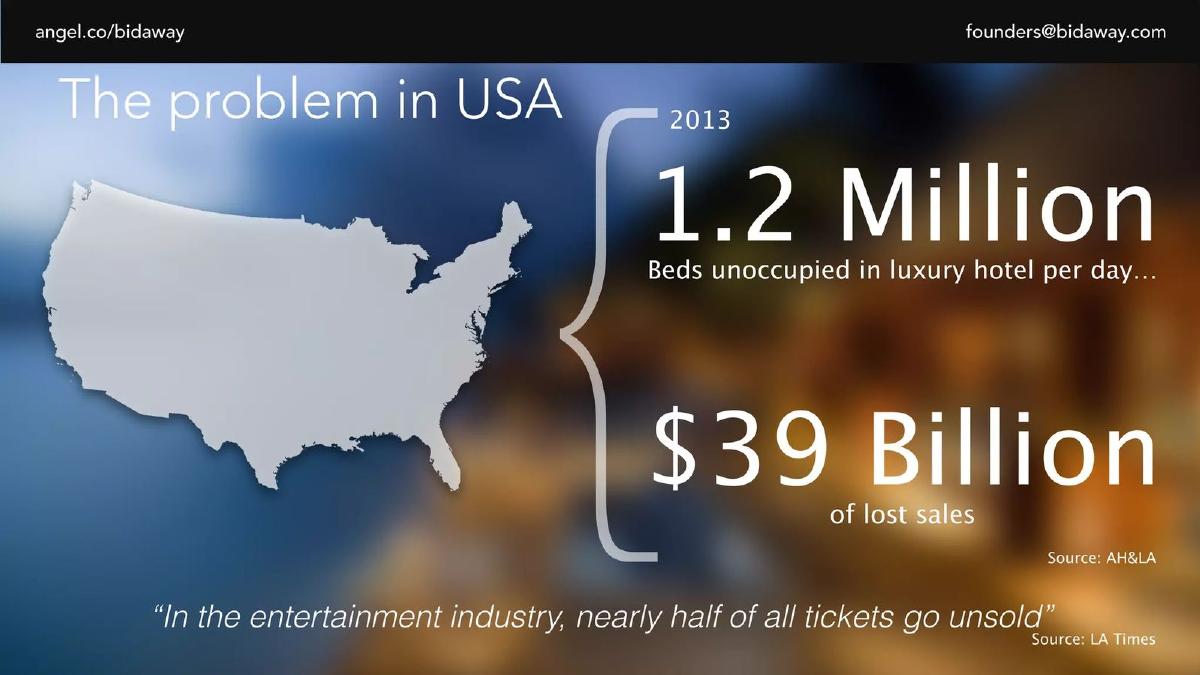
- The company identifies a massive market inefficiency: 1.2 million unoccupied luxury hotel beds per day in the USA, resulting in $39 billion of lost sales (Slide 2).
- BidAway claims a 20% month-over-month growth rate during its first year of activity (Slide 4).
- Early traction metrics include 35,000 registered users and $100,000 in total sales (Slide 4).
- The business model operates on a 25% average margin, which is high for the travel intermediary sector (Slide 4).
- The platform has secured partnerships with major travel brands including Eurostars Hotels, Hotusa, and Costa Cruises (Slide 5).
- BidAway is expanding beyond travel into 'CauseVault' charity auctions featuring high-profile tech figures like Connie Chan and Sarah Lacy (Slide 6).
- The company is moving toward industry-standard integrations with Pegasus Solutions, TripAdvisor, and Expedia (Slide 7).
- The deck completely omits a team slide, leaving investors unaware of the founders' backgrounds or execution capabilities.
BidAway: Gamifying the Luxury Travel Liquidation Market
The BidAway investor deck from May 2014 focuses heavily on the 'perishable inventory' problem within the luxury travel industry. By framing unoccupied hotel rooms not just as a missed opportunity but as a specific $39 billion loss, the company sets a high-stakes stage for its auction-based solution. The deck is visually driven, utilizing high-quality travel photography and clean data visualizations to demonstrate early traction and a growing partner ecosystem.
Slide 1: Title and Value Proposition
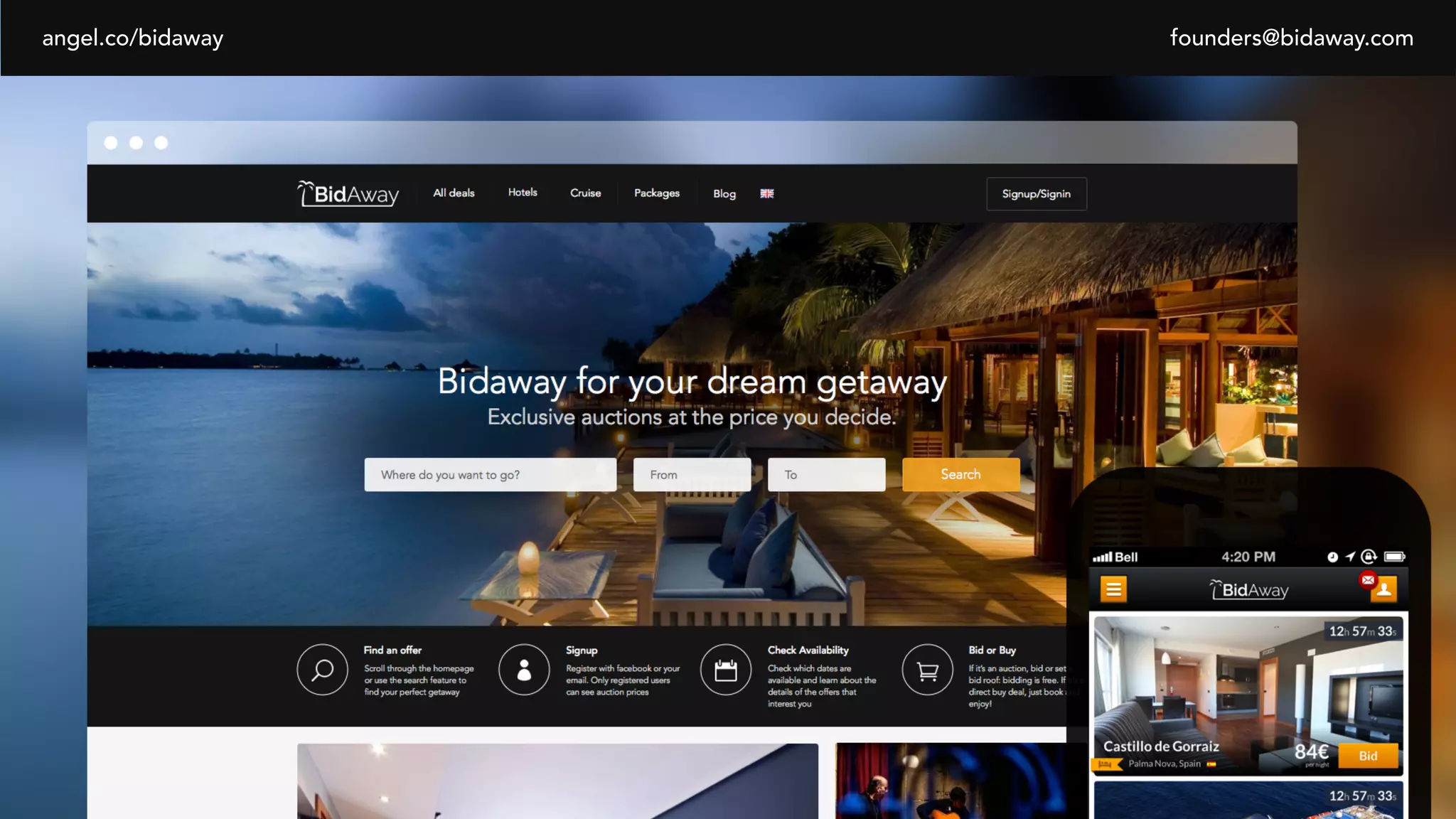
The opening slide serves as a visual introduction to the product. It features a high-resolution background of a luxury overwater bungalow, immediately signaling the 'dream getaway' niche. The text 'Exclusive auctions at the price you decide' clearly defines the business model: a consumer-facing auction platform. The slide also includes mockups of both the web interface and a mobile app, suggesting a multi-platform approach from the outset. Contact information and an AngelList link are prominently displayed in the header, which is a standard but effective practice for early-stage decks.
Slide 2: The $39 Billion Problem
Slide 2 is the 'Problem' slide, and it uses a 'Shock and Awe' strategy. It focuses specifically on the USA market, citing that in 2013, 1.2 million beds in luxury hotels went unoccupied every single day. The slide quantifies this as '$39 Billion of lost sales.' By citing the AH&LA (American Hotel & Lodging Association) and the LA Times, the founders provide third-party validation for their market thesis. The inclusion of a quote regarding the entertainment industry—'nearly half of all tickets go unsold'—hints at a future expansion beyond just hotels, which is later confirmed in the deck.
Slide 3: The Gamification Hook
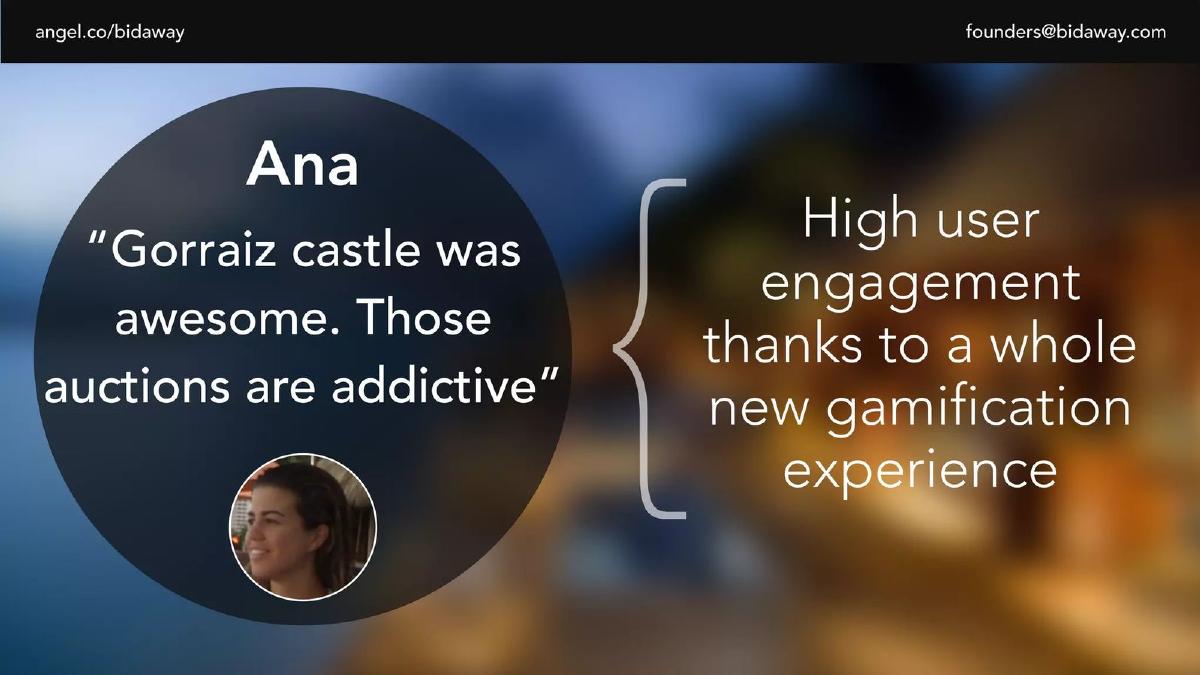
Rather than explaining the technology, Slide 3 uses a customer testimonial to prove the 'stickiness' of the product. A user named Ana is quoted saying, 'Those auctions are addictive.' The right side of the slide explicitly labels this as 'High user engagement thanks to a whole new gamification experience.' This is a strategic move to differentiate BidAway from traditional discount sites like Groupon or Priceline. The goal here is to convince investors that BidAway isn't just a utility, but a destination that users return to for the thrill of the win.
Slide 4: Traction and Unit Economics
This is the most critical slide in the deck for demonstrating viability. BidAway reports 35,000 registered users and $100,000 in sales within their first year. The most impressive figure is the 'Average margin of 25%.' In the travel industry, where margins are often squeezed by heavy competition, a 25% take-rate is significant. The slide also notes a 20% month-over-month growth rate. However, the statement 'We’re currently completing our tests to conveniently commence paid traffic acquisition' suggests that the previous growth was likely organic or partnership-driven, which raises questions about how well these margins will hold up once marketing spend is introduced.
Slide 5: The Partner Ecosystem
Slide 5 displays a 'wall of logos' to demonstrate supply-side credibility. The partners are categorized into 'Hotels' (Husa, Fiesta, Hotusa, Eurostars) and 'Cruise lines' (MSC, Ibero, Costa). Many of these are prominent European brands, suggesting that while the problem slide focused on the USA, the company’s actual operations were likely centered in Europe at the time. The teaser text 'But not only travel...' at the bottom right acts as a transition to their expansion plans.
Slide 6: Expansion and Distribution
Slide 6, titled 'Exciting new developments,' shows how the company plans to scale. They highlight distribution partnerships with Vodafone and 'la Caixa,' which are massive channels for customer acquisition. They also introduce 'CauseVault,' a charity auction vertical. The visual shows auctions for private dinners with venture capitalists like Connie Chan (Andreessen Horowitz) and Sarah Lacy (PandoDaily). This is a clever way to build brand prestige while testing the auction engine on non-travel assets. Finally, they mention a partnership with TravelBird, providing access to 4,500+ offers in Germany, Austria, and Switzerland.
Slide 7: Roadmap and Integrations
The 'Under way...' slide focuses on technical scaling. It lists 'Industry integrations' with Pegasus Solutions, TripAdvisor, and the Expedia Affiliate Network. These integrations are vital for a travel startup to move beyond manual inventory management and into real-time booking. The slide also features a mobile app mockup, reinforcing the idea that the service is designed for 'on-the-go' bidding, which aligns with the 'addictive' gamification theme mentioned earlier.
Slide 8: Closing and Contact
The final slide is a standard 'Thank You' page with the company logo and a contact email (founders@bidaway.com). It also includes their Twitter handle. While clean, it misses an opportunity to reiterate a 'Call to Action' or a summary of the investment opportunity.
What BidAway Does Well
The deck excels at identifying a massive, quantifiable pain point. By putting a $39 billion price tag on the problem, they immediately justify why a solution needs to exist. The focus on 'gamification' is also a strong strategic choice; it moves the conversation away from a race-to-the-bottom on price and toward user retention and psychological engagement. Furthermore, the 25% margin figure is a standout metric that would likely catch any investor's eye, as it suggests a very healthy business model if it can be maintained at scale.
What is Missing from the Deck
The most glaring omission is the Team Slide . In early-stage fundraising, investors are primarily betting on the founders' ability to execute. Without knowing who is behind BidAway, it is impossible to assess the technical or operational risk. Additionally, there is no Competition Slide . The travel space is notoriously crowded with giants like Expedia and Booking.com, as well as niche players like Secret Escapes or Luxury Escapes. Failing to acknowledge how they will defend their territory against these incumbents is a major oversight. Finally, the lack of a Financial Ask means the deck feels more like a partnership pitch than an investor pitch. Founders should always specify how much they are raising and what milestones that capital will unlock.
Founder's Guide: What to Copy
Founders should emulate BidAway’s use of third-party data to validate their market size. Citing the LA Times and industry associations adds immediate credibility to the 'Problem' slide. The Traction Slide (Slide 4) is also a model of clarity; it uses large fonts for the most important numbers and provides a mix of volume (users/sales) and efficiency (margins). Lastly, the Distribution Partnerships (Slide 6) demonstrate a 'work smarter, not harder' approach to growth. Showing that you have access to millions of customers through existing giants like Vodafone is often more impressive to investors than a plan to spend millions on Google Ads.
Frequently asked questions
- What is the core problem BidAway is solving?
- BidAway addresses the 'perishable inventory' problem in luxury travel. According to Slide 2, 1.2 million luxury hotel beds go unoccupied every day in the US, leading to $39 billion in lost revenue. By using an auction model, BidAway allows hotels to monetize rooms that would otherwise remain empty, while offering consumers 'dream getaways' at prices they decide.
- How does BidAway differentiate itself from standard booking sites?
- The deck emphasizes 'gamification' as a key differentiator. Slide 3 features a user testimonial stating that the auctions are 'addictive,' suggesting that the platform relies on psychological engagement rather than just price comparison. This approach aims for high user engagement and repeat visits, which is often a struggle for traditional Online Travel Agencies (OTAs).
- What kind of traction did BidAway have at the time of this deck?
- Slide 4 reports that in their first year, they reached 35,000 registered users and generated $100,000 in sales. They also claim to have sold over 2,000 room nights. Most importantly for investors, they reported a 20% month-over-month growth rate and a 25% average margin, indicating a potentially profitable and scalable model.
- Who are BidAway's primary partners?
- The company has a strong European partner base. Slide 5 lists hotel groups like Husa, Fiesta, Hotusa, and Eurostars, alongside cruise lines like MSC and Costa. Slide 6 also mentions distribution partnerships with major corporations like Vodafone and 'la Caixa' bank, which provides a massive pre-existing audience for their auction offers.
- What is missing from the BidAway investor deck?
- The deck is missing several critical components required for a professional fundraise. There is no team slide, which is usually the most important factor for early-stage investors. It also lacks a competitive landscape analysis, a detailed financial forecast, and a specific funding ask. Without these, the deck functions more as a high-level teaser than a complete investment proposal.