PT Media Kolaborasi Bicara Berita (Bicara Berita) is an Indonesian media startup proposing a decentralized, collaborative approach to news production. By partnering with Promedia Teknologi, the company aims to lower the barrier to entry for journalists and 'mediapreneurs' who are otherwise priced out by large media conglomerates. Their revenue model is strictly tied to programmatic advertising, where they claim a 10% take rate on an estimated market of Rp 1 Triliun. While the deck identifies a clear problem—the high cost of media ownership and the prevalence of hoaxes—it lacks critical financ…
Key takeaways
- The company operates through a partnership with Promedia Teknologi to enable profit-sharing and a large number of domains (Slide 3).
- Bicara Berita targets the 18-35 age demographic across Indonesia with a focus on factual, timely news (Slide 7).
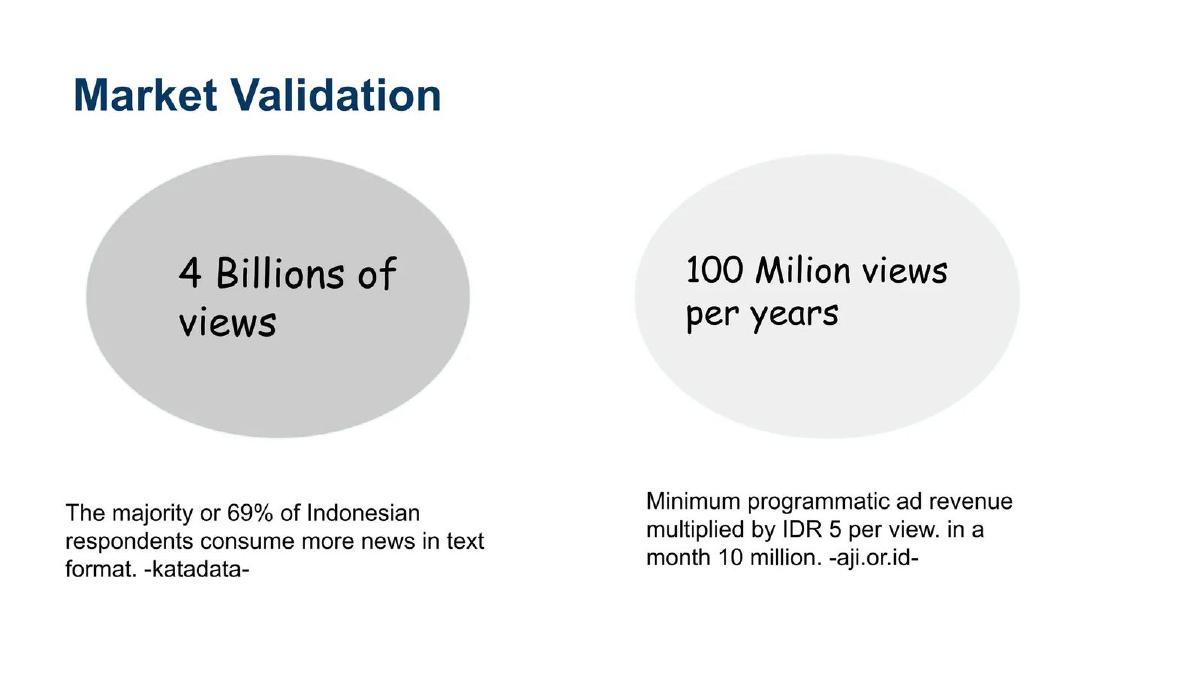
- Market validation is based on a figure of 4 billion views and an estimated programmatic ad revenue of IDR 5 per view (Slide 5).
- The business model is built on taking a 10% share of programmatic advertising, targeting a Rp 100 Miliar slice of a Rp 1 Triliun market (Slide 12).
- The team consists of three primary editorial roles: Founder/Editor-in-Chief, Deputy Editor-in-Chief, and Managing Editor (Slide 8).
- The product is already live across web and social platforms, including TikTok, Instagram, and YouTube, though follower counts shown are currently low (Slide 11).
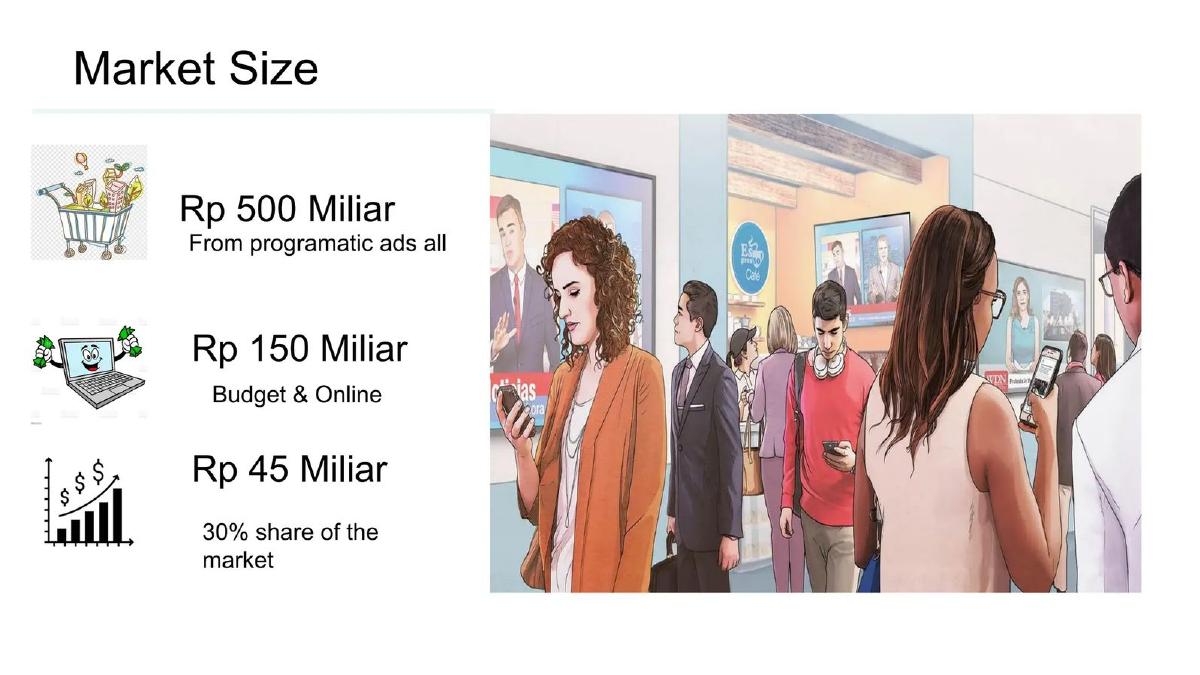
- The deck identifies a total addressable market for programmatic ads at Rp 500 Miliar, with a goal to capture a 30% share worth Rp 45 Miliar (Slide 6).
- There is no mention of a specific investment ask, valuation, or use of funds anywhere in the 12-slide presentation.
Executive Summary
PT Media Kolaborasi Bicara Berita presents a 2023 pitch deck focused on the Indonesian digital news landscape. The company positions itself as a solution to the high barriers to entry in the media industry, which they claim is currently dominated by large corporations with high capital requirements. By leveraging a partnership with Promedia Teknologi, Bicara Berita aims to create a network of 'mediapreneurs' who produce factual content monetized through programmatic advertising. The deck is primarily a conceptual and market-validation document, lacking the specific financial 'ask' typically found in a seed or Series A presentation.
Slide 1: Title Slide
The deck opens with the company name, PT Media Kolaborasi Bicara Berita , and the tagline "Unlocking Value Through Reliable News." The date 2023 is clearly marked. The visual features a man in a suit reading a traditional newspaper, which contrasts with the digital-first nature of the business described in later slides.
Slide 2: The Problem
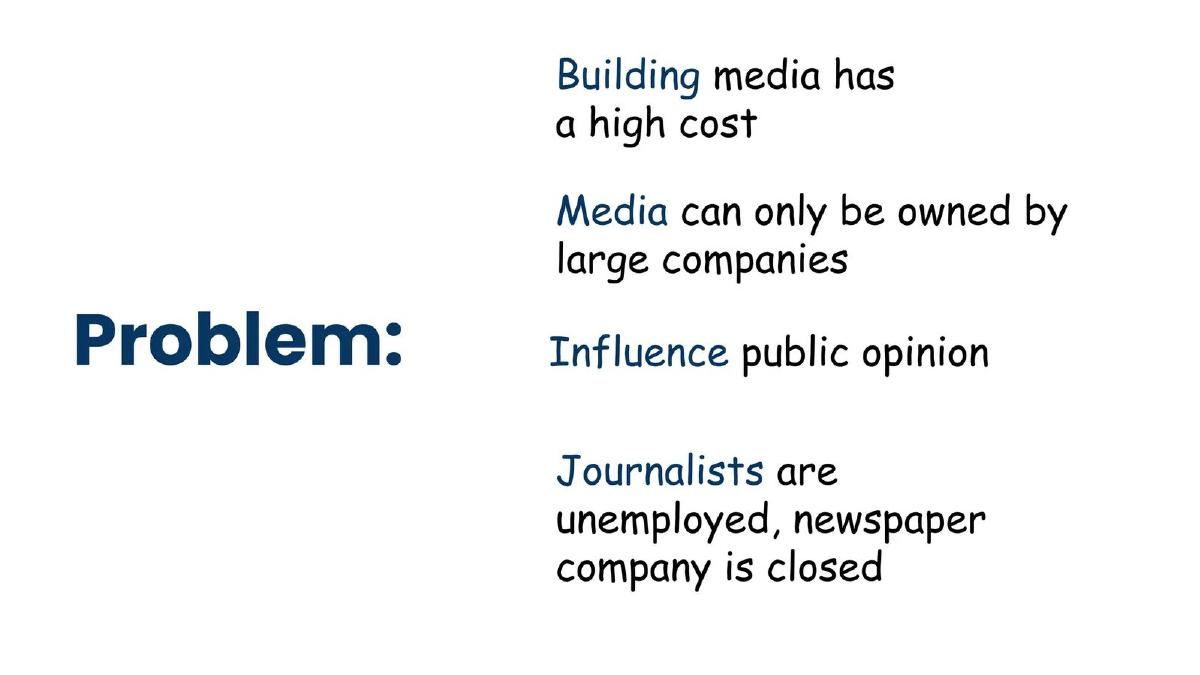
Slide 2 identifies four core problems in the current media landscape:
Building media has a high cost. · Media can only be owned by large companies. · Influence on public opinion is concentrated. · Journalists are unemployed and newspaper companies are closing.
This slide sets the stage for a disruptive, lower-cost model that democratizes media ownership.
Slides 3-4: The Solution
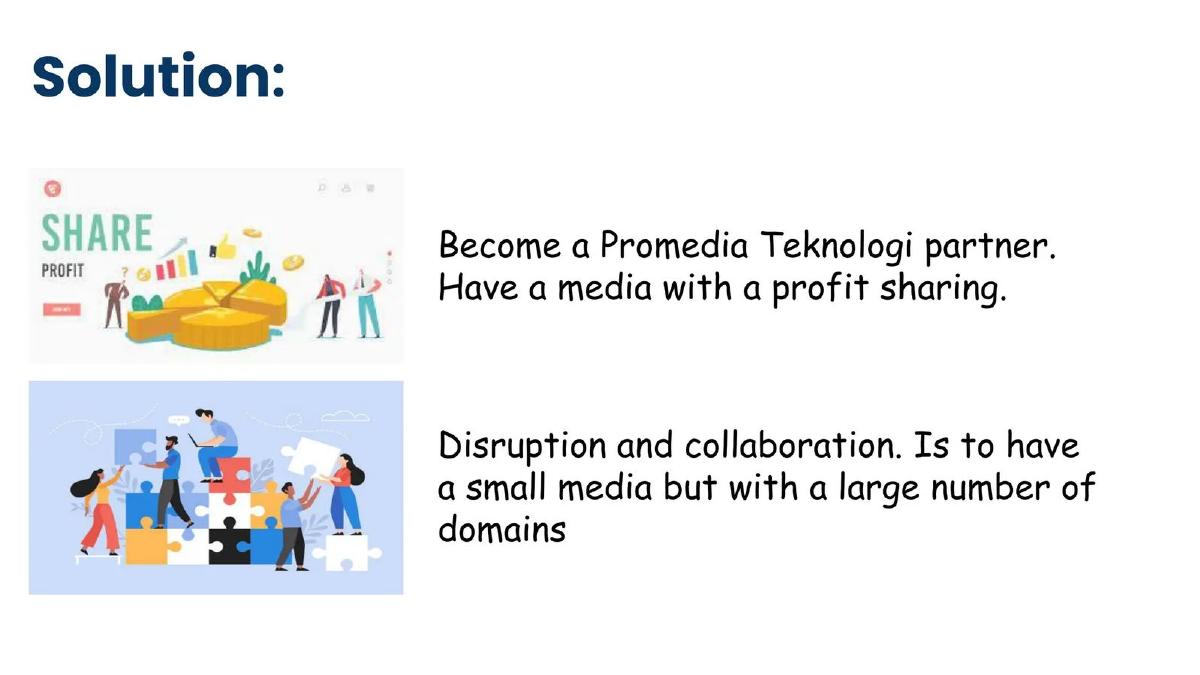
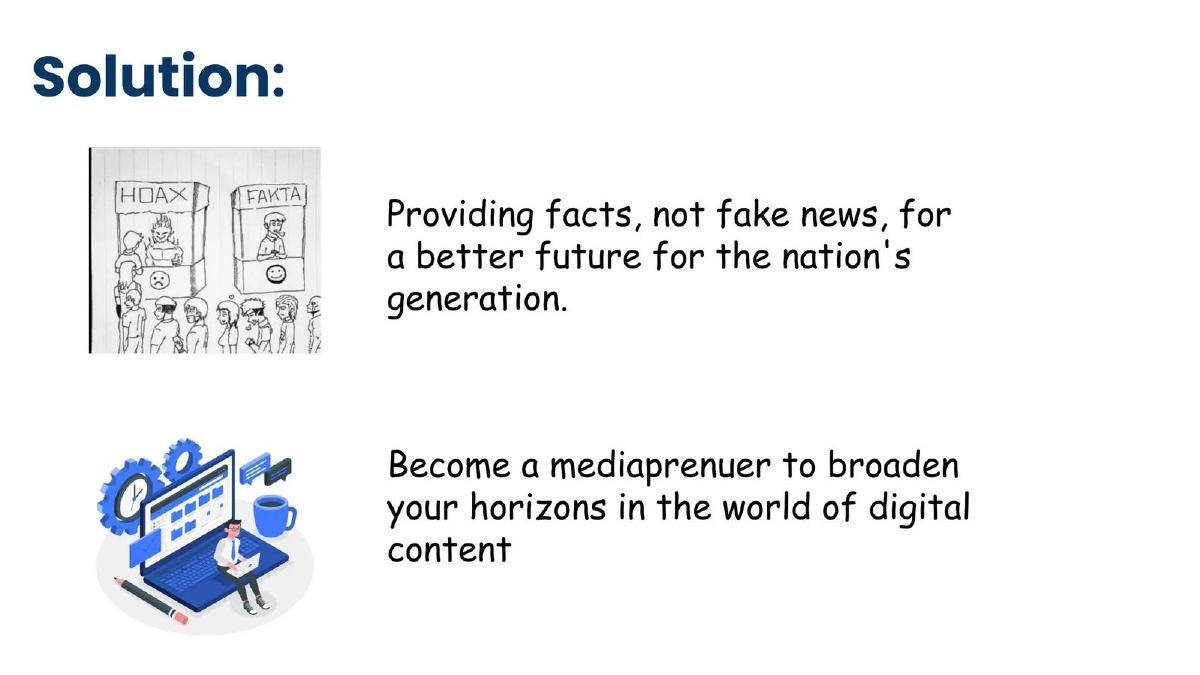
The solution is split across two slides. Slide 3 introduces the partnership with Promedia Teknologi , highlighting a profit-sharing model. It emphasizes "disruption and collaboration" by managing a small media entity that controls a "large number of domains." Slide 4 focuses on the social impact, promising to provide facts over "fake news" (hoaxes) and encouraging individuals to become "mediapreneurs" to broaden their digital content horizons.
Slide 5: Market Validation
This slide uses external data to justify the business model. It cites 4 Billions of views and 100 Million views per year as benchmarks. It references katadata , stating that 69% of Indonesians consume news in text format. Crucially, it provides a revenue benchmark from aji.or.id : a minimum programmatic ad revenue of IDR 5 per view , totaling 10 million in a month (though the specific currency unit for the 10 million is not explicitly stated, it likely refers to IDR).
Slide 6: Market Size
Slide 6 breaks down the financial opportunity in Indonesian Rupiah (Rp):
Rp 500 Miliar: Total market from programmatic ads. · Rp 150 Miliar: Budget for online media. · Rp 45 Miliar: The company's target of a 30% share of the market.
The slide uses clip-art style icons to represent shopping carts, laptops, and growth charts, which detracts slightly from the professional tone of the data.
Slide 7: Introduction and Mission
This slide provides a text-heavy introduction in Indonesian. It defines the target audience as 18-35 year olds across Indonesia. It reiterates the goal of revolutionizing news delivery through factual, timely information and mentions the dual monetization strategy: programmatic advertising and direct sales.
Slide 8: The Team
The team is represented by three avatars rather than professional photographs:
Vito Adhitya: Founder/Editor-in-Chief, responsible for news content. · Asjeni Putri: Deputy Editor-in-Chief, responsible for news schemes and traffic. · Istiqomatudz Dzakiroh: Managing Editor, responsible for quantity and creative quality.
The use of generic avatars instead of real photos or LinkedIn profiles is a notable omission for a professional pitch.
Slides 9-11: Product and Platform Presence
Slide 9 is a transition slide showing a hand holding a smartphone. Slide 10 shows the Bicara Berita website on mobile, featuring headlines about Korean dramas and local tourism in Sukabumi. It also shows a Google Ad placement, proving the monetization model is active. Slide 11 displays social media profiles. The TikTok account ( bicaraberita.tv ) shows 881 followers and 1.3k views on a video. The Instagram ( bicaraberitacom ) and YouTube ( Bicara Berita ) accounts show very low engagement (5 followers and 7 subscribers, respectively).
Slide 12: Business Model
The final slide clarifies the revenue split. The company states, "We take 10 percent of programmatic advertising." It estimates this to be Rp 100 Miliar , based on a 10% interpretation of a Rp 1 Triliun total programmatic results for online media. This slide provides the clearest look at how the company intends to generate corporate-level revenue from its network of domains.
What Works
Clear Revenue Mechanism: The deck does not hide how it makes money. The 10% take rate on programmatic ads is a straightforward business model that is easy for investors to understand. Market Context: By citing sources like Katadata and AJI, the founders show they have researched the local market's consumption habits and the standard rates for digital advertising in Indonesia. Niche Targeting: Identifying the 18-35 demographic provides a clear focus for content creation and advertiser targeting.
What is Missing
The Ask: The most significant omission is the lack of a funding request. There is no mention of how much capital is being raised, the equity offered, or the valuation. Financial Projections: While the deck mentions market sizes (Rp 1 Triliun), it does not provide a pro-forma statement showing expected expenses, burn rate, or a path to profitability. Team Credibility: Using avatars instead of real photos and omitting the professional backgrounds or past successes of the founders makes it difficult to assess their ability to execute. Competitive Analysis: The deck mentions "large companies" as a problem but does not name specific competitors or explain how Bicara Berita will win traffic away from established giants like Detik or Kompas.
Founder Recommendations
Professionalize the Team Slide: Replace avatars with high-quality headshots and include 2-3 bullet points per person highlighting their specific experience in media or technology. Define the 'Mediapreneur' Journey: The deck mentions a partnership with Promedia Teknologi and a profit-sharing model. A slide explaining how a journalist joins the platform and how the revenue flows between the journalist, Bicara Berita, and Promedia would add much-needed operational clarity. Include a Roadmap: Investors need to see what has been accomplished (e.g., "Website launched July 2023") and what the next 12-18 months look like. Quantify the 'Large Number of Domains': The solution mentions having a large number of domains. Specifying how many are currently active versus the goal would help quantify the scale of the network.
Frequently asked questions
- What is the core business model of Bicara Berita?
- Bicara Berita operates on a programmatic advertising model. According to slide 12, they intend to take 10% of programmatic advertising revenue generated through their network. They position themselves as a partner to Promedia Teknologi, allowing them to manage a large number of domains and share profits with content creators or 'mediapreneurs' who contribute to the platform.
- Who is the target audience for this media platform?
- As stated on slide 7, the company targets a young audience aged 18-35 years old throughout Indonesia and its surroundings. The content strategy focuses on delivering factual and timely information to this demographic to counter the rise of 'hoaxes' or fake news, which they identify as a significant social problem on slide 4.
- What evidence of traction does the deck provide?
- The deck provides screenshots of their active platforms on slides 10 and 11. These show a mobile-optimized website and social media profiles on TikTok (881 likes/followers), Instagram (5 followers), and YouTube (7 subscribers). While the platforms are functional, the current engagement metrics shown in the screenshots are in the very early stages.
- How does the company plan to compete with large media conglomerates?
- Bicara Berita identifies the high cost of building media and the monopoly of large companies as a primary problem on slide 2. Their solution, detailed on slide 3, is 'disruption and collaboration.' By using a decentralized model with a 'large number of domains' and a profit-sharing structure, they aim to scale without the massive overhead typically associated with traditional media houses.
- What is missing from this pitch deck that an investor would need?
- The deck is missing several standard components: a specific funding ask (how much money they want), a use of funds breakdown, detailed financial projections (burn rate, CAC, LTV), and a competitive landscape analysis. It also lacks a roadmap showing milestones achieved to date versus future goals, making it difficult to assess the investment's timeline.