BettorUP Sports presents a social-first approach to sports wagering, targeting casual fans who wish to bet against friends rather than the house. The deck emphasizes the elimination of 'costly casino or bookie fees' and highlights non-provisional patents for specific betting types like 'Auction' and 'Invisible' bets. However, the presentation suffers from exceptionally low growth projections, forecasting only 1,000 total users after 18 months, which is significantly below venture scale. While the intellectual property and real-time features are clearly defined, the lack of financial modeling,…
Key takeaways
- The company identifies a $585B worldwide sports wagering market but focuses on the niche of peer-to-peer social betting (Slide 3).
- BettorUP claims to hold non-provisional patents for 'Auction Bet,' 'Invisible Bet,' and 'Counter Bet' mechanics (Slide 5).
- Product features include a real-time shot clock for betting and an in-game store for monetization (Slide 4).
- User growth projections are unusually conservative, targeting only 1,000 total users by the 18-month mark (Slide 6).
- The monetization strategy relies on in-game features and a 'GPS Ad Platform' (Slide 7).
- The team is composed of one founder and three representatives from external agencies, Cultivate Studios and Simplified Solutions (Slide 8).
- The deck omits a specific funding ask, use of proceeds, or detailed financial projections.
- Market data is dated, citing figures from 2014, including $3.2B wagered in Las Vegas (Slide 3).
Executive Summary
BettorUP Sports presents a vision for a socialized, mobile-first sports betting experience. The deck focuses on the 'casual fan'—a demographic that may be intimidated by traditional sportsbooks or simply wants to engage socially with peers. While the deck highlights interesting intellectual property and a clear product feature set, it lacks the aggressive growth metrics and financial depth typically required for a successful seed or Series A raise. The reliance on external agencies for the bulk of the leadership team also raises questions about long-term operational sustainability.
Slide 1: Title Slide
The cover slide introduces the company name, BettorUP Sports , and the tagline: "Raise the stakes from the stands." The branding is clean, utilizing a blue and white color palette. Notably, the logo for Cultivate Studios appears in the bottom right corner, suggesting a partnership or that the deck was produced by this agency. This branding remains consistent throughout the presentation.
Slide 2: The Niche
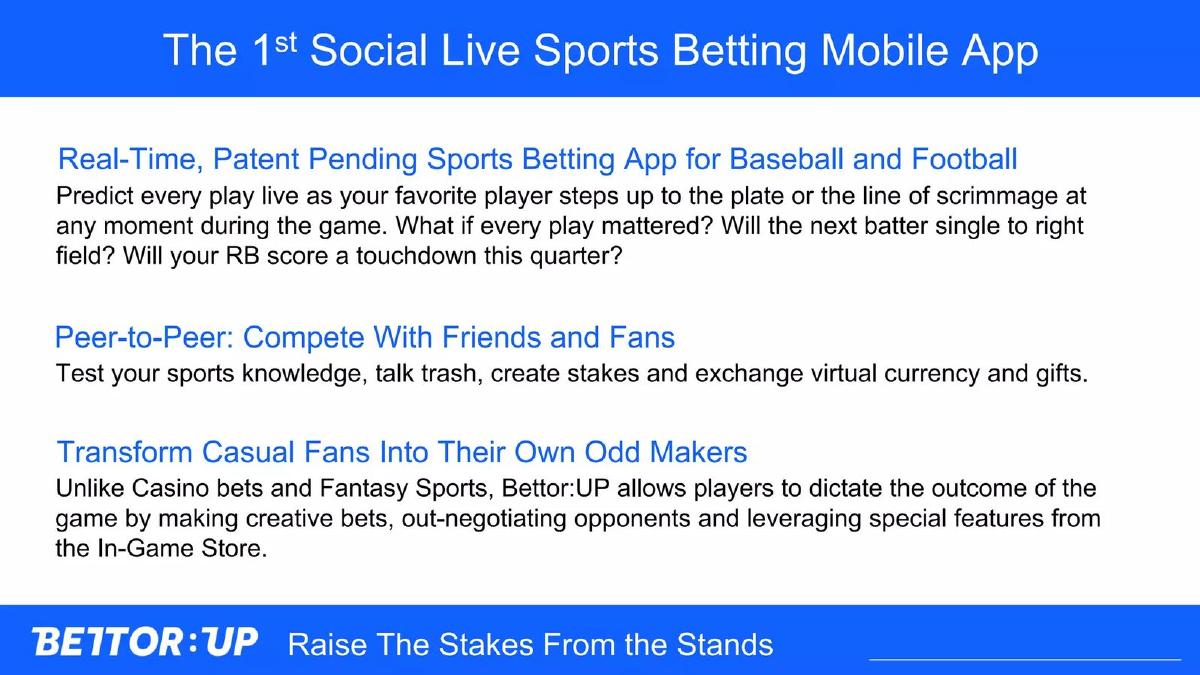
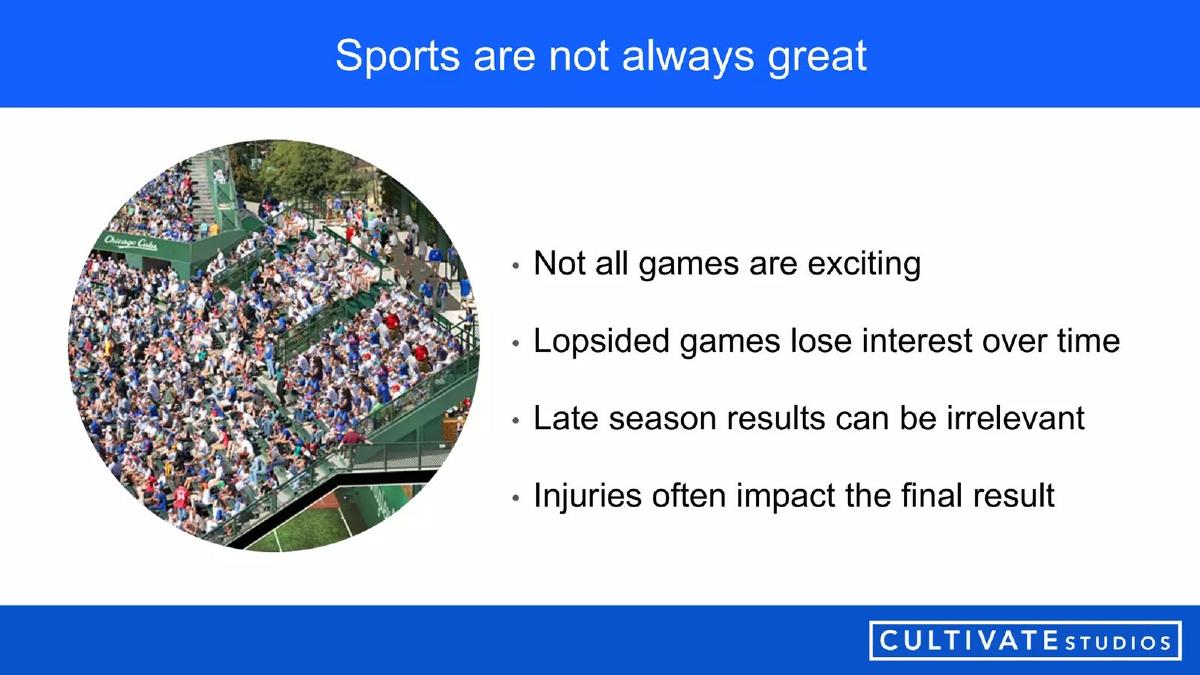
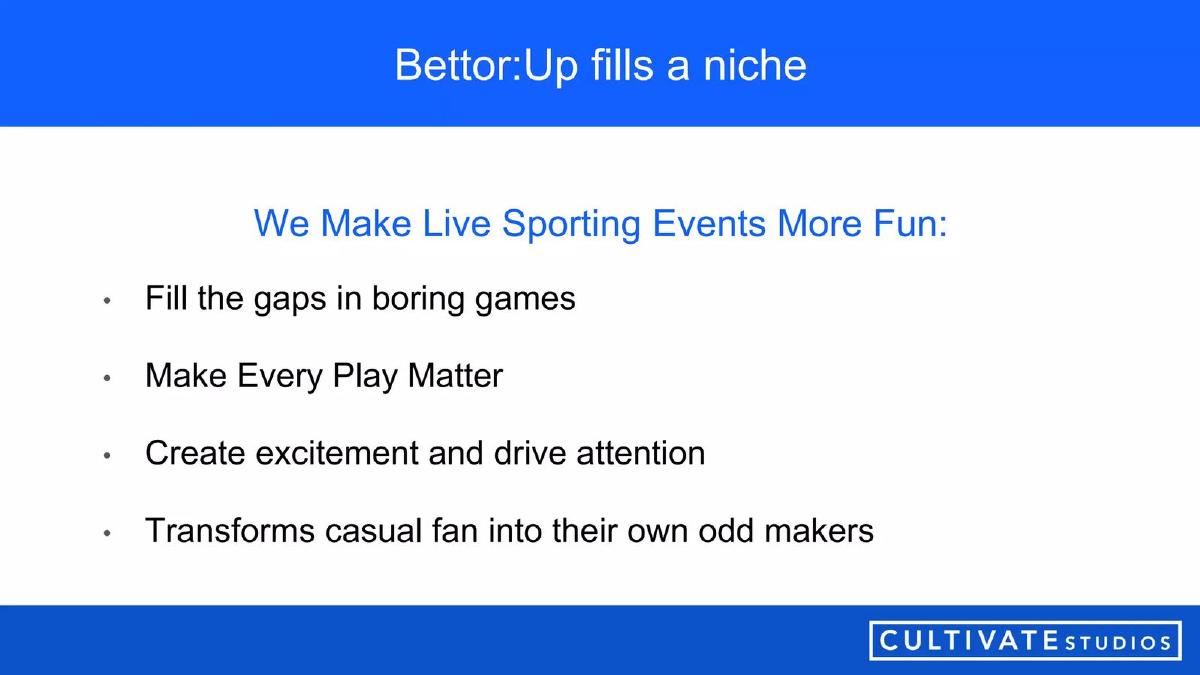
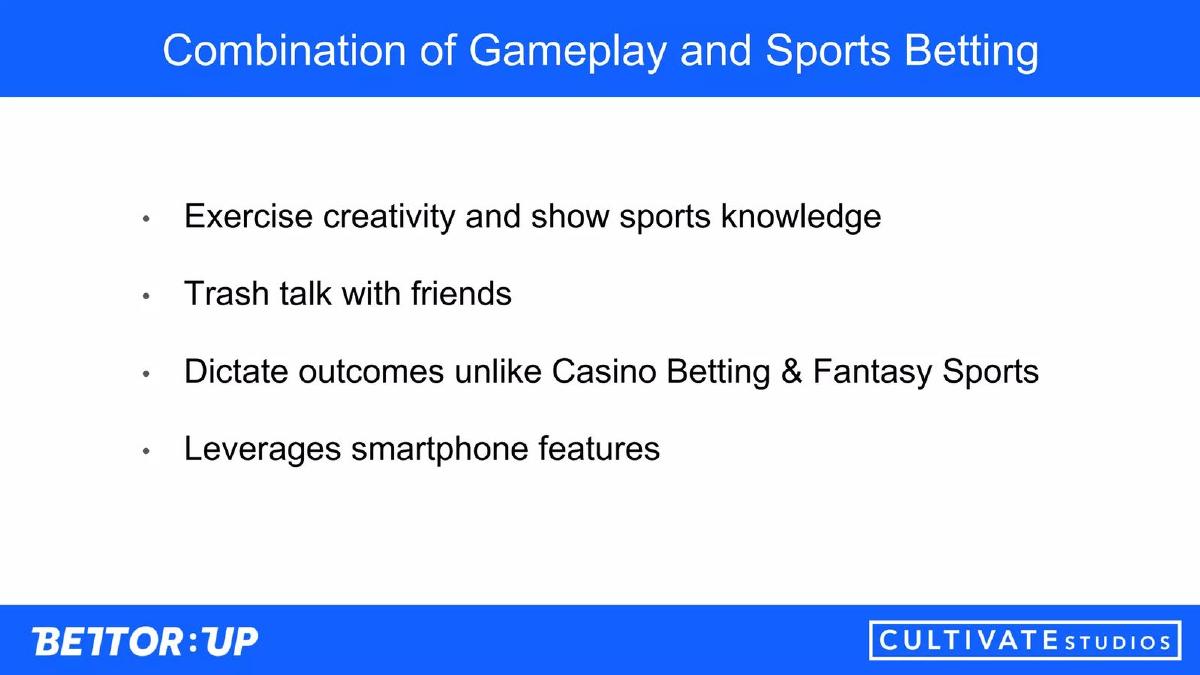
Slide 2 attempts to define the problem and solution under the header "Bettor:Up fills a niche." The company claims to make live sporting events more fun by filling gaps in "boring games" and making "every play matter." The most significant claim here is that the app "Transforms casual fan into their own odd makers." This suggests a peer-to-peer (P2P) model where users set the terms of the wagers rather than following a centralized sportsbook line.
Slide 3: Market Opportunity
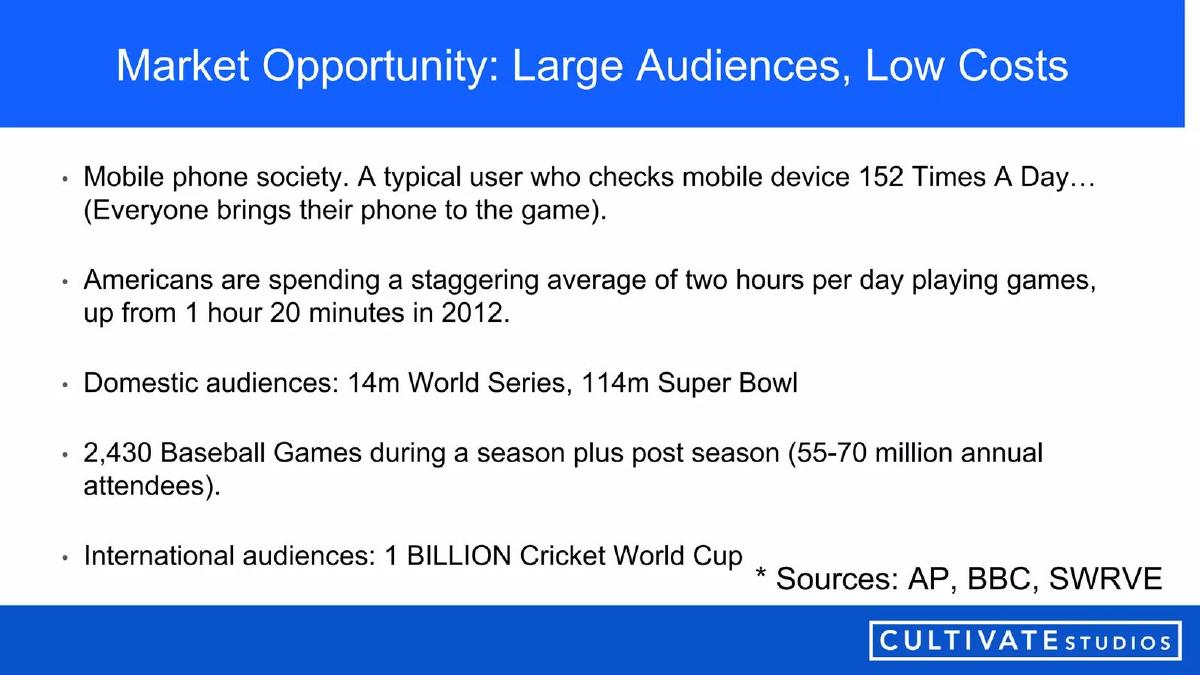
This slide provides macro-level data to justify the business. It cites $3.2B wagered on Sports in Las Vegas in 2014 and $3.6B wagered on Fantasy Sports in 2014 , alongside a $585B worldwide sports wagering figure. The slide identifies two specific gaps in the current market: the lack of a mobile app for betting against friends/family and the presence of "costly casino or bookie fees." The data sources include the American Gambling Association and the Nevada Gaming Control Board. However, the data is nearly a decade old, which is a significant drawback in the rapidly evolving post-PASPA legal betting landscape.
Slide 4: Key Product Features
Slide 4 lists the functional requirements of the app. Key features include Real-time Betting with a built-in shot clock , Custom Bets and Odds , and Prepopulated Bets . The app also includes social and utility features such as a Leaderboard , In-Game Store , Live Chat , and Bet Notifications . This slide effectively communicates that the product is intended to be a comprehensive social platform, not just a simple wagering tool.
Slide 5: Intellectual Property
One of the stronger slides in the deck, Slide 5, details the company's Non-Provisional Patents and Trademarks . It claims patents for the "Entire Game with real-time feeds and automatic closing of bets," as well as specific bet types: Auctions Bet, Invisible Bet, and Counter Bet. Trademarks are held for the company name and the tagline. For investors, this provides a potential 'moat' against larger incumbents who might try to replicate these specific social betting mechanics.
Slide 6: User Growth Projections
Slide 6 presents a bar chart for user growth over 18 months, broken down by sport (Baseball, Cricket, Football, Soccer). The projections are surprisingly small. The Total Users target at 12 months is approximately 300 , and the target at 18 months is 1,000 . In the context of mobile apps and social networks, 1,000 users after a year and a half is generally considered a failure of scale. Most venture-scale decks would look for these numbers in the first week or month of a soft launch.
Slide 7: Growth Strategy and Monetization
This slide outlines the roadmap for revenue and expansion. Monetization is planned through in-game features like Auction Bet and BettorUP Emoticons . The Extend category mentions adding support for Cricket, NASCAR, and a Japan Baseball Version . The Platform section notes an upcoming Android Version and a GPS Ad Platform . Finally, the Leaderboard section mentions driving tournament play and a "friends tracker." The inclusion of a GPS Ad Platform suggests a secondary revenue stream based on location-based marketing at stadiums.
Slide 8: The Team
The final slide lists the leadership team. Steve Turek is the only person listed as a Founder . The other three members— Nathan Uno, Bryon Martin, and Tom Casale —are all affiliated with external agencies ( Cultivate Studios and Simplified Solutions ). While these individuals hold titles like VP Product Engineering and VP Marketing, their primary affiliation with outside studios may signal to investors that the company lacks a full-time, dedicated internal core team.
What BettorUP Sports Does Well
The deck is visually consistent and easy to read. It avoids the common mistake of overcrowding slides with text. The Intellectual Property slide is a highlight, as it gives the company a tangible asset to discuss during due diligence. By focusing on specific, named betting types (Auction, Invisible), they differentiate themselves from generic 'social betting' apps. The focus on the 'casual fan' is also a well-defined target market, providing a clear alternative to the high-stakes, professional-leaning environment of major sportsbooks.
What is Missing from the Deck
The most glaring omission is a Financial Ask . There is no slide indicating how much money the company is raising, at what valuation, or how the funds will be allocated. Furthermore, the deck lacks a Regulatory/Legal Slide . Sports betting is a highly regulated industry; an investor would immediately ask how the company plans to navigate state-by-state licensing, especially if they are facilitating actual wagers (even peer-to-peer). The Unit Economics are also absent; there is no mention of Customer Acquisition Cost (CAC) or Lifetime Value (LTV), which are critical for a consumer app. Finally, the Competition Slide is missing, leaving the investor to wonder how BettorUP compares to incumbents like DraftKings or social competitors like Sleeper.
Founder Takeaways: What to Copy and What to Avoid
Copy the IP clarity: If you have patents or trademarks, dedicate a slide to them. It proves you have built something defensible. BettorUP does this well by naming the specific patented mechanics.
Avoid under-projecting: While it is good to be realistic, venture capital is a game of outliers. Projecting 1,000 users after 18 months (Slide 6) suggests a lifestyle business rather than a high-growth tech startup. If your market is truly $585B, your user acquisition strategy needs to reflect that scale.
Avoid the 'Agency Team' trap: Investors want to back founders and teams who are 'all in.' Listing your agency partners as your VPs (Slide 8) can be a red flag. It is better to list them as 'Advisors' or 'Partners' and show who the full-time, equity-holding core team is.
Update your data: Using 2014 data (Slide 3) in a deck makes the project look stale. Always use the most recent industry reports to show you are current with market trends, especially in a fast-moving sector like gaming.
Frequently asked questions
- What is the core value proposition of BettorUP Sports?
- BettorUP Sports aims to make live sporting events more engaging for casual fans by allowing them to act as their own oddsmakers. The platform facilitates peer-to-peer betting among friends and family, specifically designed to 'fill the gaps in boring games' and avoid the fees associated with traditional casinos or bookmakers.
- Does the company have any proprietary technology?
- Yes, according to Slide 5, the company has established non-provisional patents and trademarks. The patents cover real-time feeds with automatic closing of bets, as well as specific wagering formats titled 'Auctions Bet,' 'Invisible Bet,' and 'Counter Bet.' They also trademarked the slogan 'Raise the Stakes From the Stands.'
- How does BettorUP plan to generate revenue?
- The growth strategy on Slide 7 outlines two primary revenue streams: in-game features and advertising. Specifically, they mention monetizing through 'Auction Bet' access and 'BettorUP Emoticons.' Additionally, they plan to implement a 'GPS Ad Platform' to serve location-based advertisements to users during live events.
- Who is leading the company?
- The team slide (Slide 8) lists Steve Turek as the Founder. However, the rest of the leadership consists of external partners: Nathan Uno and Bryon Martin from Cultivate Studios (handling Brand, Technology, and Product Engineering) and Tom Casale from Simplified Solutions (handling Marketing).
- Are the growth projections realistic for a venture-backed startup?
- The projections on Slide 6 are remarkably low for a tech startup. They forecast reaching approximately 300 users at 12 months and 1,000 total users at 18 months. In a sector like sports betting where scale is critical for liquidity and network effects, these figures may be perceived as insufficient by venture capital investors.