Bespoke Habitat’s 2021 deck positions the company as a multifaceted player in the Asian co-living market, operating under the entity Bespoke Investments Pte Ltd. The deck emphasizes a vertically integrated business model that spans property management, joint ventures, and a suite of services including interior design, maintenance, and even educational intellectual property. While the deck successfully establishes the founders' relevant experience—citing a personal portfolio of over 20 properties and management of 100+ units—it relies heavily on external market data from the U.S. to validate i…
Key takeaways
- The company operates as a holding company, Bespoke Investments Pte Ltd, with diversified revenue streams across co-living management and services (Slide 7).
- Founder Ernee Ong brings direct real estate experience, having grown a personal portfolio to 20+ properties in Singapore (Slide 3).
- The business model includes 100% owned stakes and joint ventures, alongside service-based revenue from cleaning, air-conditioning, and construction (Slide 7).
- The deck identifies a global co-living market size of $7.952 billion in 2020, with 89% of activity concentrated in Asia (Slide 5).
- A core 'Unique Selling Point' is an educational series featuring a proprietary board game designed to teach clients about the co-living industry (Slide 4).
- Market validation is partially supported by a list of top-funded U.S. co-living startups, though two of the listed companies are noted as 'now closed' (Slide 6).
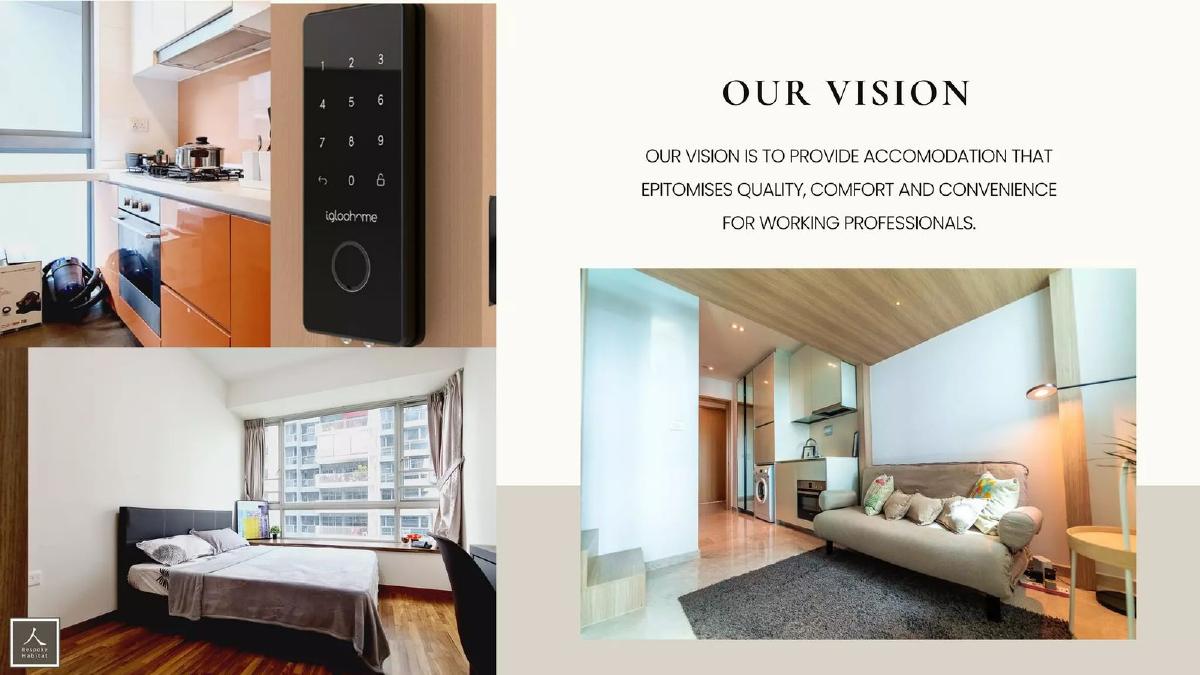
- The vision is specifically targeted at 'working professionals,' emphasizing quality, comfort, and convenience (Slide 2).
- The team includes specialized roles for finance, business development, project management, and operations, with experience from firms like Apple and HPE (Slide 3).
Bespoke Habitat: A Multi-Pronged Approach to Asian Co-Living
The Bespoke Habitat pitch deck, dated 2021, presents a corporate strategy for a Singapore-based co-living operator. Rather than focusing solely on property acquisition, the deck outlines a vision for a vertically integrated ecosystem that includes property management, maintenance services, and investor education. The following is a slide-by-slide breakdown of the narrative and data provided.
Slide 1: Title Slide
The deck opens with a high-contrast, black-and-white image of a city skyline viewed through a large window, featuring three silhouetted figures. The text identifies the entity as Bespoke Investments Pte Ltd and labels the document as a "Corporate Pitch Deck." The year "2021" is noted in the top left corner, establishing the timeframe for the data and strategy presented.
Slide 2: Our Vision
Slide 2 defines the company's core mission: "To provide accommodation that epitomises quality, comfort and convenience for working professionals." The slide uses a collage of interior photography to establish a brand aesthetic. Images include a modern kitchen with an igloohome smart lock, a minimalist bedroom, and a living area. The focus is clearly on high-density, high-quality urban living solutions.
Slide 3: Our Team
The team slide provides professional biographies for six key members. Ernee Ong (Co-Founder and CEO) is credited with building a personal portfolio of 20+ properties in Singapore. Jelene Sim (Co-Founder and COO) is noted for managing over 100 properties and having a background at HPE. Other team members include Margaret Lee (Finance Manager, formerly of Apple Inc.), Geil (Business Development and Marketing), Mark Ong (Project and Maintenance Manager), and Joann (Operation Manager). This slide serves to establish operational credibility and local market expertise.
Slide 4: Our Unique Selling Point ("USP")
This slide introduces an unconventional differentiator. The company claims its USP is the ability to merge industrial and residential co-living, alongside an "education series." They have created a proprietary board game intended to let clients experience the "journey and potential pitfalls in the business." A photograph shows four people engaged with the board game, suggesting that investor and client education is a primary lead-generation or retention tool for the group.
Slide 5: Total Addressable Market
Slide 5 provides macro-level market validation. It cites a global co-living market size of $7.952 billion in 2020, representing a 6% increase from 2019. It also notes that the number of guests reached 3.351 million (+13% per year). The most critical data point for their geographic focus is that 89% of all co-livings are concentrated in Asia , with 99% of those located in China, India, and Singapore. The slide argues that rising development costs and housing unaffordability make co-living a "viable need" and a "necessity over time."
Slide 6: Top Funded Co-living Startups
To further validate the sector, the deck includes a table of "Top Funded Co-living Startups in the U.S." with data as of October 19, 2020, sourced from Crunchbase News. It lists companies like Common Living ($113.4M), Starcity ($50.3M), and Bungalow ($46M). Notably, the slide includes an asterisk for HubHaus and HomeShare , indicating they are "now closed." While this shows the scale of the opportunity, it also implicitly acknowledges the risks and high failure rate in the co-living sector.
Slide 7: Business Model - Group
The final slide in this set provides a structural overview of the company. Bespoke Investments Pte Ltd acts as a Holding Company for three main pillars:
Co-Living: Divided into 100% Stake (Co-Living Management) and JV (Joint Venture Business Owners). · Services: Divided into 100% Stake (Household items, Cleaning, Interior Design, Repair/Construction) and JVs/Partnerships (Cleaning, Air-con, Parking systems, Technology). · HQ: Focused on Management, Education, and Intellectual Property.
This diagram illustrates a diversified revenue model where the company profits not just from rent or management fees, but from the entire lifecycle of property maintenance and investor education.
What Bespoke Habitat Does Well
The deck excels at establishing founder-market fit . By highlighting Ernee Ong’s personal portfolio of 20+ properties and Jelene Sim’s management of 100+ units, the company demonstrates that they are not just theorists, but active practitioners in the Singapore real estate market. This is crucial in a sector where operational excellence is the primary driver of margins.
Furthermore, the diversified revenue stream outlined on Slide 7 is a sophisticated approach to the co-living business. By capturing value through cleaning, maintenance, and construction services, the company creates a more resilient business model that can withstand fluctuations in occupancy rates. The inclusion of "Intellectual Property" and "Education" as a revenue stream suggests they are looking to scale their expertise, not just their physical footprint.
What is Missing from the Deck
The most significant omission in the provided slides is unit economics . While the market size is discussed at a global level, there is no data on the Average Revenue Per User (ARPU), Customer Acquisition Cost (CAC), or the specific margins for their various service lines. For a real estate-adjacent business, investors need to see the "spread" between the cost of leasing/managing a property and the revenue generated from tenants.
The deck also lacks a clear capital ask . There is no mention of how much funding is being sought, the valuation, or the specific use of proceeds. Without a roadmap for how the investment will be deployed to scale the number of managed units or expand the service arm, the deck remains a corporate overview rather than a targeted fundraising tool.
Finally, the competitive landscape is only addressed through U.S.-based companies. Given that the deck explicitly states that 99% of Asian co-living is in China, India, and Singapore, the absence of local competitors in the Singapore market is a notable gap. Investors would want to know how Bespoke Habitat differentiates itself from other regional players like Hmlet or Cove.
Lessons for Founders
Founders can learn from Bespoke Habitat's use of ancillary services to bolster a primary business model. In low-margin industries like property management, finding ways to vertically integrate—such as owning the cleaning or maintenance company—can significantly improve the bottom line and provide a better customer experience.
The use of educational tools (like the board game) is an interesting lesson in content marketing and lead generation. By positioning themselves as educators in the space, Bespoke Habitat builds trust with potential joint venture partners and investors. This "expert-led" approach can be a powerful way to differentiate in a crowded market, provided the core business metrics back up the educational claims.
However, founders should be cautious about using out-of-market comparisons . While listing U.S. startups shows that the category is "venture-backable," it does not prove that the model works in Singapore. Founders should always prioritize local market data and direct competitor comparisons to show they understand their specific operating environment.
Frequently asked questions
- What is Bespoke Habitat's primary business model?
- Bespoke Habitat operates as a holding company (Bespoke Investments Pte Ltd) that manages co-living spaces for working professionals. According to slide 7, their model is split between direct co-living management (both 100% stakes and JVs) and a broad services arm. This services arm generates revenue from household items, cleaning, interior design, repair, and construction, as well as partnerships for parking and technology systems.
- Who are the founders and what is their background?
- The company was co-founded by Ernee Ong (CEO) and Jelene Sim (COO). Ernee Ong transitioned from the IT industry and built a personal portfolio of 20+ properties in Singapore. Jelene Sim previously worked as a Key Account Manager at HPE and, at the time of the deck, was managing over 100 properties. The broader team includes managers with backgrounds at Apple Inc. (Slide 3).
- How does the company define its Unique Selling Point?
- As stated on slide 4, the company's USP is the merger of industrial and residential co-living combined with an 'education series.' A central part of this education is a proprietary board game. This game is intended to help clients understand the 'nuances' and 'potential pitfalls' of the co-living business through a gamified experience.
- What market data does Bespoke Habitat use to justify its growth?
- Slide 5 cites that the global co-living market was worth $7.952 billion in 2020, growing 6% year-over-year. Crucially, it notes that 89% of all co-livings are in Asia, with 99% of those concentrated in China, India, and Singapore. They also use a Crunchbase list of U.S. competitors to show venture capital interest in the sector (Slide 6).
- What is missing from the Bespoke Habitat pitch deck?
- The provided slides lack a specific 'Ask' (how much money they are raising and on what terms). Additionally, there are no historical financial statements, forward-looking projections, or detailed unit economics. While they mention managing 100+ properties, the deck does not provide a breakdown of occupancy rates, average rent, or customer acquisition costs.