Be Visible presents a straightforward social enterprise pitch deck centered on a 'buy-to-donate' model for sunglasses. The company targets the 18-24 demographic, specifically college students, to build a brand around human trafficking awareness. The deck outlines clear unit economics: a $40 selling price, $20 landing cost, and a $10 donation, leaving $10 in profit per unit. While the mission is compelling and the financial breakdown is transparent, the deck lacks critical operational details. There is no mention of a founding team, no specific funding ask, and no identification of the nonprof…
Key takeaways
- The company addresses the $150 billion human trafficking industry, which affects over 35 million individuals (Slide 2).
- The business model is built on a $40 retail price with a $20 landing cost and a $10 donation per unit (Slide 7).
- The break-even point for the venture is stated as 5,600 pairs of glasses sold (Slide 7).
- Target early adopters are identified as 18-24 year olds, a demographic of 25+ million people (Slide 5).
- Customer acquisition strategy includes giving away 100 pairs for free and partnering with college organizations (Slide 6).
- The deck identifies Lokai, (RED), and Warby Parker as primary competitors in the social impact space (Slide 8).
- Future plans include hiring rescued victims of trafficking to produce the sunglasses (Slide 9).
- The deck omits a team slide, a specific investment ask, and a timeline for execution.
Introduction and Brand Identity
Slide 1: Title Slide
The deck opens with a high-resolution image of a sunlit sky, establishing a visual theme of light and clarity. The company name, BE VISIBLE , is presented in a bold purple sans-serif font. The tagline, "MORE THAN JUST A PAIR OF SUNGLASSES," immediately signals that this is a mission-driven or social enterprise venture rather than a pure-play fashion brand. A minimalist white logo, resembling a stylized 'X' or a butterfly, is centered at the bottom.
The Problem and Social Context
Slide 2: Human Trafficking
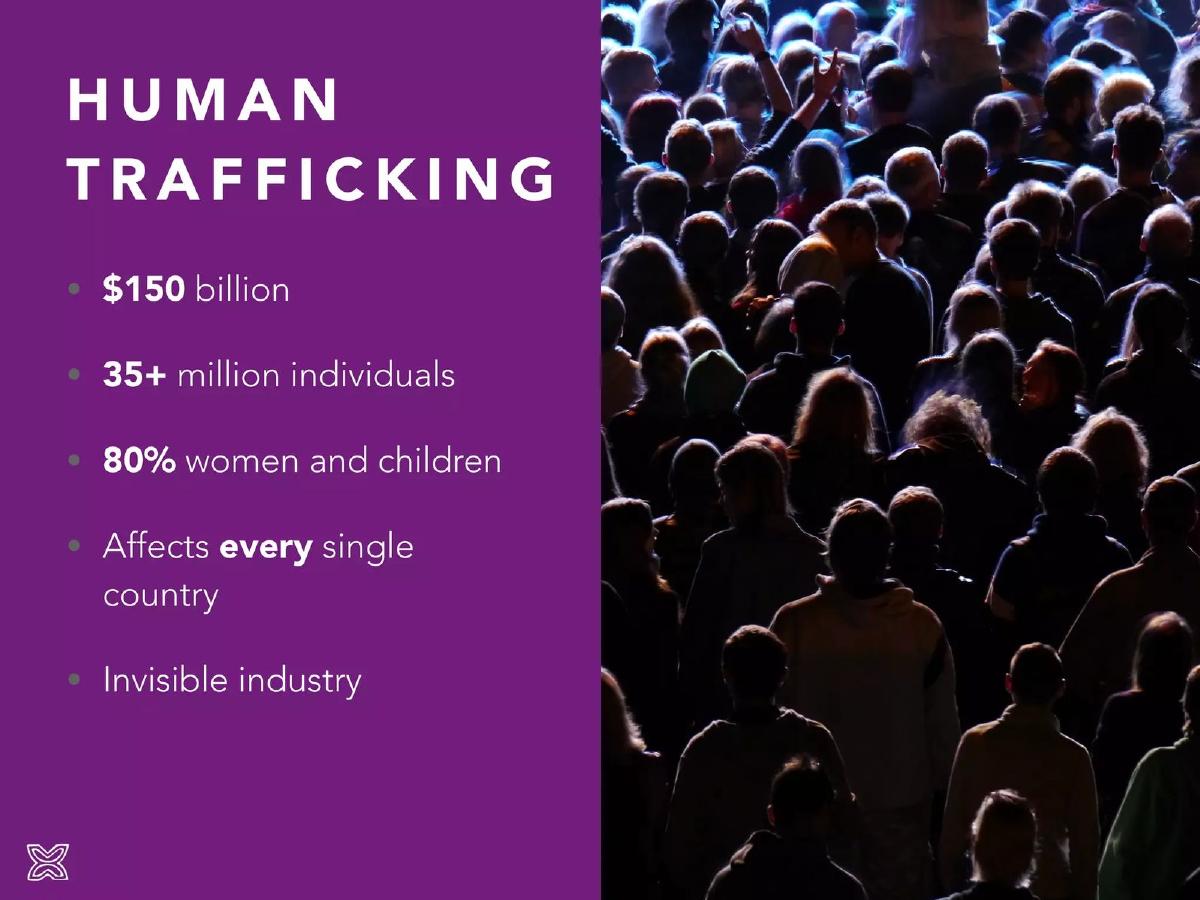
This slide establishes the 'Why' behind the company. It uses a dark, crowded image of people to contrast with the bright title slide, emphasizing the "invisible" nature of the industry. The slide lists several sobering statistics: human trafficking is a $150 billion industry affecting 35+ million individuals . It notes that 80% of victims are women and children and that the issue affects every single country. By labeling it an "Invisible industry," the company justifies its name, Be Visible, as a direct counter-measure to the problem.
The Solution and Narrative
Slide 3: The Call to Action
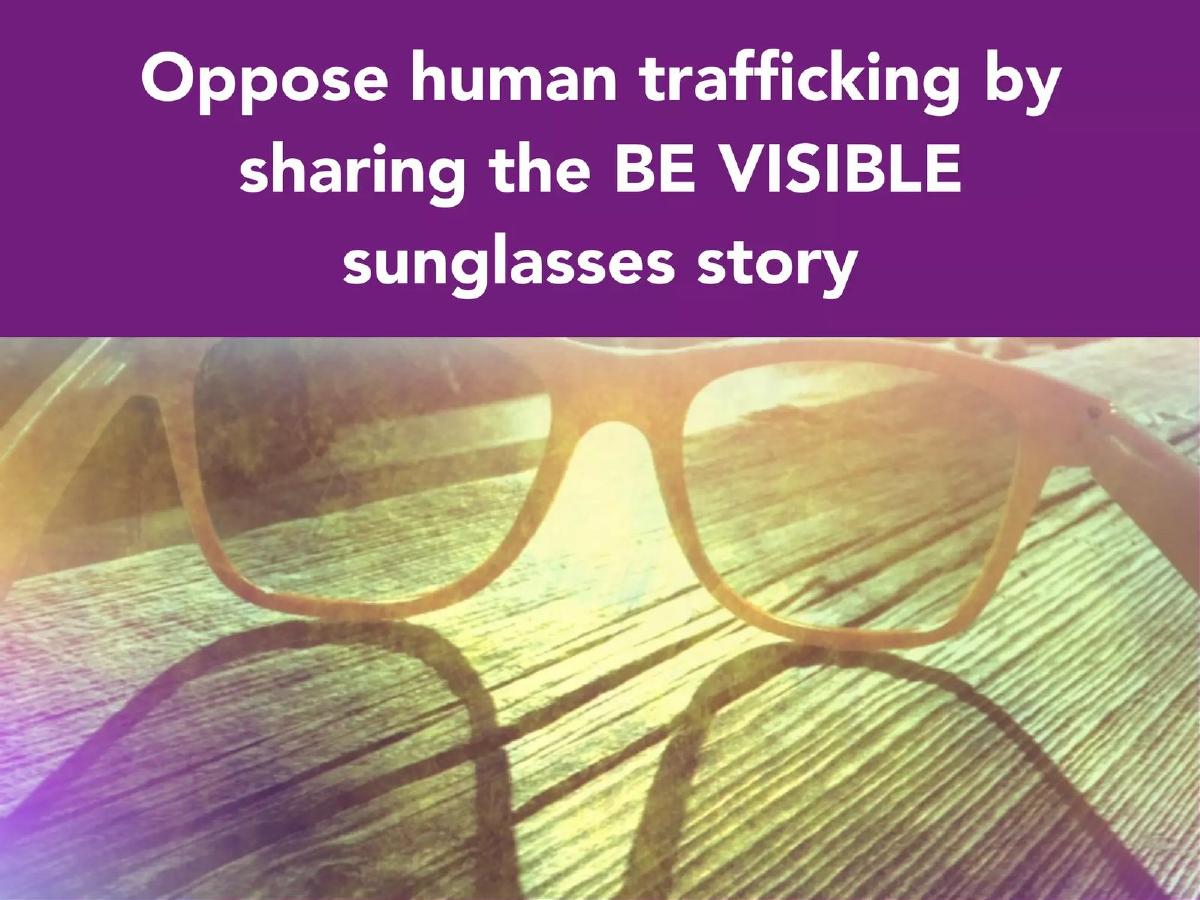
Slide 3 transitions from the problem to the solution. It instructs the viewer to "Oppose human trafficking by sharing the BE VISIBLE sunglasses story." The background image shows a pair of translucent yellow sunglasses on a wooden surface, suggesting a tangible product that carries a social message. This slide positions the product not just as eyewear, but as a storytelling tool.
Slide 4: The Story
This slide outlines the consumer journey in four bullet points: Buy a pair of BE VISIBLE glasses, Wear them proudly, Tell people why you are wearing them, and Encourage others to do the same. This framework relies on the 'social signaling' aspect of fashion. The company is betting that customers want to be ambassadors for a cause, using the physical product as a conversation starter.
Market and Growth Strategy
Slide 5: Early Adopters
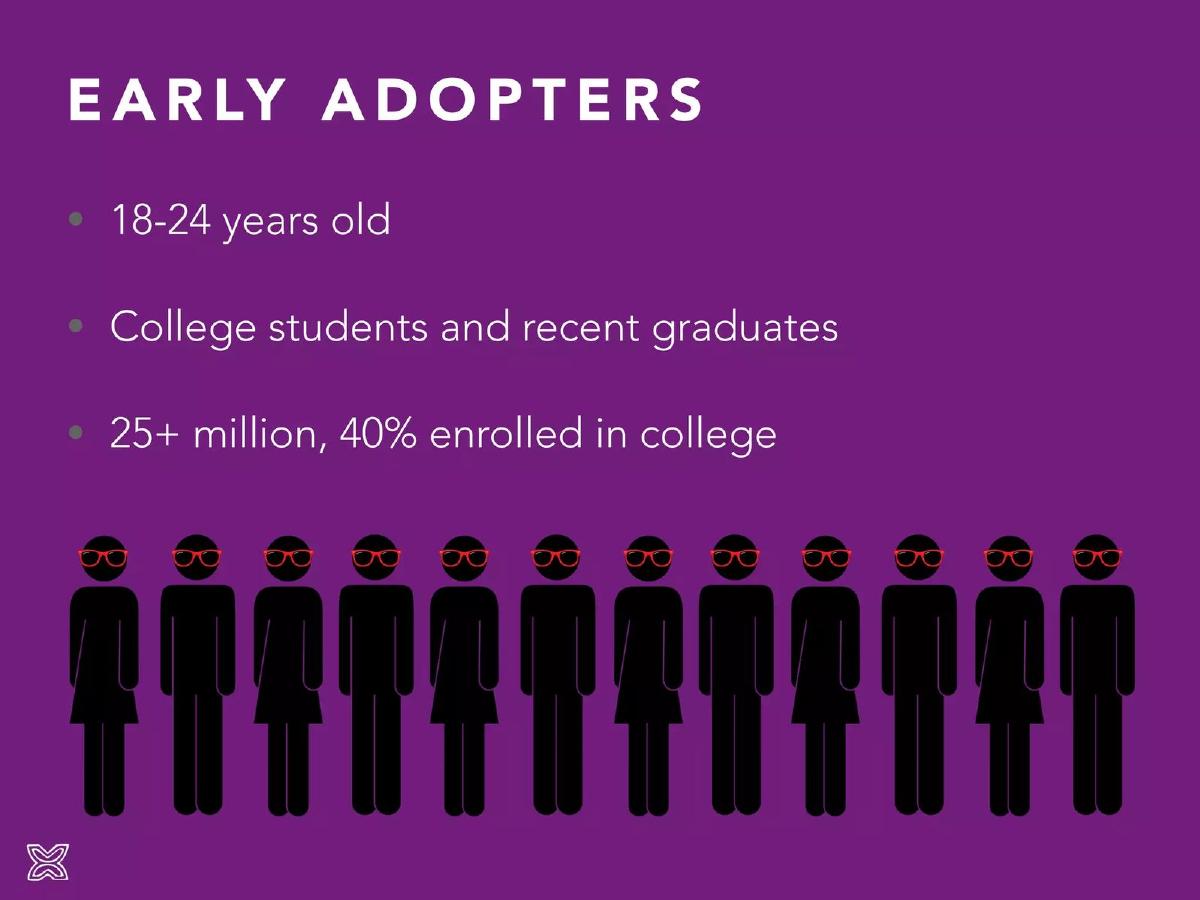
Be Visible defines its initial market segment clearly. The target is the 18-24 year old demographic, specifically college students and recent graduates. The slide cites a market size of 25+ million people, with 40% enrolled in college. This is a standard approach for lifestyle brands, as this demographic is traditionally more receptive to social impact messaging and active on social media platforms.
Slide 6: Customer Acquisition
The acquisition strategy is largely grassroots. The slide lists:
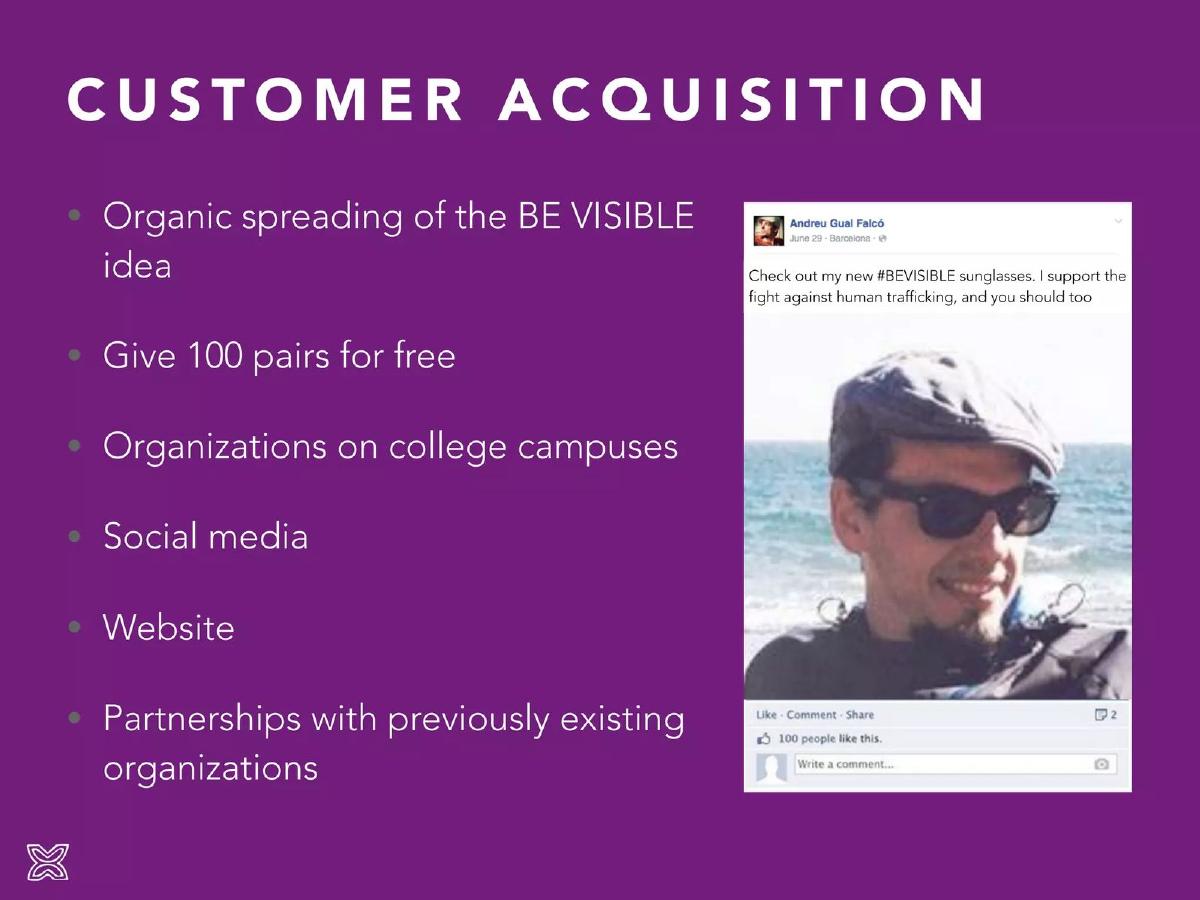
Organic spreading of the BE VISIBLE idea · Give 100 pairs for free (seeding influencers) · Organizations on college campuses · Social media and Website · Partnerships with previously existing organizations
An image of a Facebook post by "Andreu Gual Falcó" is included as a proof-of-concept for how the brand might spread through user-generated content.
Business Model and Financials
Slide 7: Finances
This is the most critical slide for an investor, as it breaks down the unit economics. The product is priced at $40 . The "Landing Cost" (COGS plus shipping) is $20 , leaving a $20 profit margin. The company then splits this margin: $10 is donated to the cause, and $10 is retained as company profit. The slide also explicitly states a Break Even Point of 5,600 glasses . This transparency is helpful, though it does not specify if this break-even covers just the initial inventory or total startup overhead.
Competitive Landscape and Future Vision
Slide 8: Competitors
The deck identifies three competitors: Lokai (known for cause-based bracelets), (RED) (a massive licensing brand for HIV/AIDS), and Warby Parker (the dominant player in direct-to-consumer eyewear with a 'buy one, give one' model). This selection shows that Be Visible views itself as a social impact brand first and an eyewear company second. However, it lacks a matrix or chart explaining how Be Visible differentiates itself from these established giants.
Slide 9: Future
The roadmap for the company includes introducing new styles, expanding to new product categories, and forming more partnerships. The most significant claim on this slide is the intention to "Hire rescued victims to produce glasses." This would transition the company from a 'buy-to-donate' model to a 'social employment' model, which could significantly deepen its impact and brand story.
Conclusion and Contact
Slide 10: Contact Information
The final slide repeats the branding from Slide 1 and provides social media handles for Twitter and Facebook. Notably, the website listed is www.bevisibleglasses.weebly.com . The use of a free Weebly subdomain suggests the company is in a very early, pre-seed stage and has not yet invested in a custom domain or professional e-commerce infrastructure.
What Works in This Deck
The deck is visually consistent and follows a logical narrative flow. The unit economics on Slide 7 are exceptionally clear; many early-stage decks obscure their margins, but Be Visible is upfront about the $10/$10 split between donation and profit. The market segmentation on Slide 5 is also well-defined, focusing on a specific age bracket and environment (college campuses) rather than trying to target everyone at once. The Future slide adds a layer of operational depth by suggesting they want to integrate victims into the supply chain, which moves the mission beyond simple philanthropy.
What Is Missing From This Deck
The most glaring omission is a Team Slide . Investors fund people, especially at the early stage, and there is no information about who is running this company or what their background is in fashion, logistics, or social work. Second, there is no Ask Slide . The deck mentions a break-even point but doesn't state how much money they are looking to raise or how that money will be spent. Third, the Nonprofit Partners are never named. For a mission-driven company, the credibility of the organizations receiving the $10 donation is paramount. Finally, the Competitive Analysis is purely visual; it doesn't explain why a customer would choose Be Visible over a well-funded incumbent like Warby Parker or a viral brand like Lokai.
Founder's Takeaway
Founders should emulate the simplicity of the financial breakdown found here. Being able to explain your margin and your 'give-back' in a single equation is powerful. However, founders must avoid the mistake of omitting the team and the specific funding request. A pitch deck is a tool for a transaction; if you don't tell the investor who you are or what you need, the deck cannot fulfill its purpose. Additionally, using a free subdomain (like Weebly) in a pitch deck can signal a lack of professional commitment or resources; investing in a $15 domain name is a basic requirement for establishing legitimacy before approaching investors.
Frequently asked questions
- What is the core product and mission of Be Visible?
- Be Visible sells branded sunglasses designed to spark conversations about human trafficking. The mission is to use consumer fashion as a tool for advocacy and fundraising. According to Slide 7, for every $40 pair sold, $10 is donated to oppose human trafficking, while the company retains $10 in profit after a $20 landing cost.
- Who is the target audience for this startup?
- The deck identifies 'Early Adopters' as individuals aged 18 to 24, specifically college students and recent graduates. Slide 5 notes that this demographic represents over 25 million people, with 40% currently enrolled in college, suggesting a focus on campus-based marketing and social media influence.
- How does Be Visible plan to acquire customers?
- The strategy relies on organic growth and community engagement. Slide 6 outlines tactics such as giving away 100 free pairs to influencers, partnering with existing college campus organizations, and leveraging social media. The goal is to create an 'organic spreading' of the brand's story through its customers.
- What are the financial projections and break-even requirements?
- Slide 7 provides a clear unit economic breakdown: $40 Sale Price - $20 Landing Cost = $20 Gross Profit. This is split into a $10 donation and $10 company profit. The deck states the company will reach its break-even point once it has sold 5,600 pairs of sunglasses.
- What critical information is missing from the Be Visible deck?
- The deck lacks a 'Team' slide, which is essential for establishing founder credibility. It also fails to name the specific organizations receiving the $10 donations. Furthermore, there is no 'Ask' slide detailing how much capital is being raised or how those funds will be allocated to reach the 5,600-unit break-even goal.