Big Happy’s Series A deck is a high-signal document that prioritizes financial health and technical performance over abstract vision. Founded in 2019, the company reached profitability and a 96.2% 4-year CAGR before raising its first $2.5M in equity capital in 2024. The deck effectively uses third-party validation, specifically MOAT benchmarks, to prove that its mobile ad units outperform the industry in viewability and attention. By showcasing a 270% YoY increase in programmatic revenue and a team with deep roots at Yahoo, Discovery, and News Corp, Big Happy presents a low-risk, high-executi…
Key takeaways
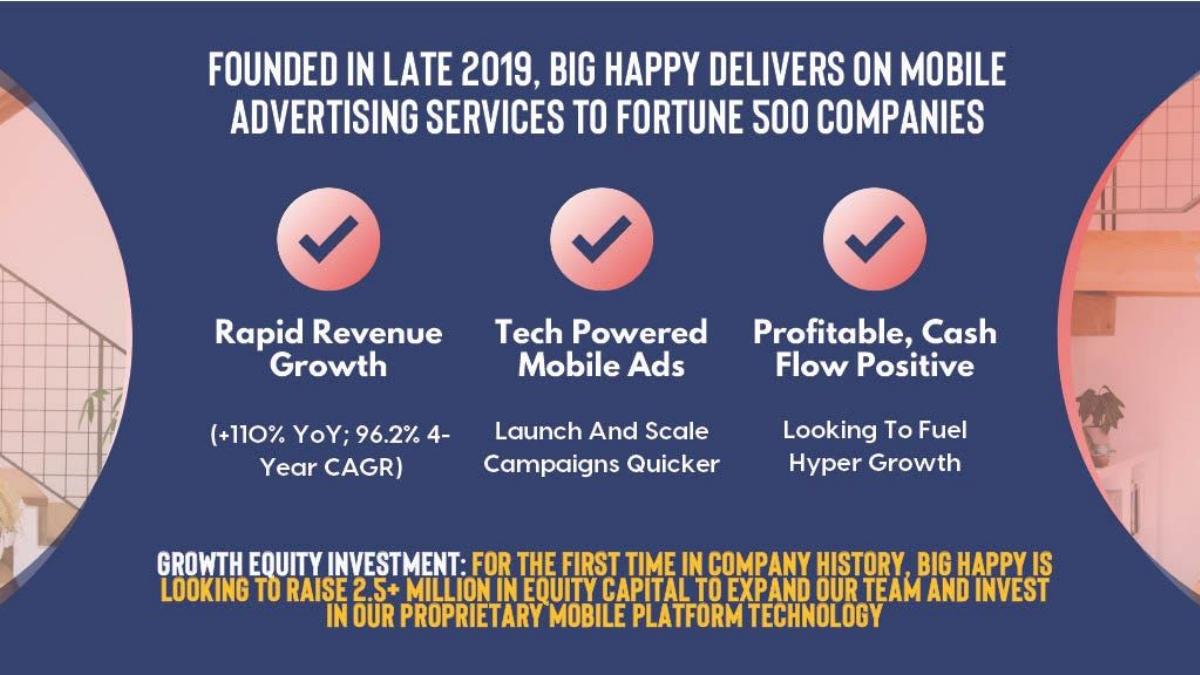
- The company achieved a 96.2% 4-year CAGR and reached profitability before raising its first $2.5M in equity capital (Slide 2).
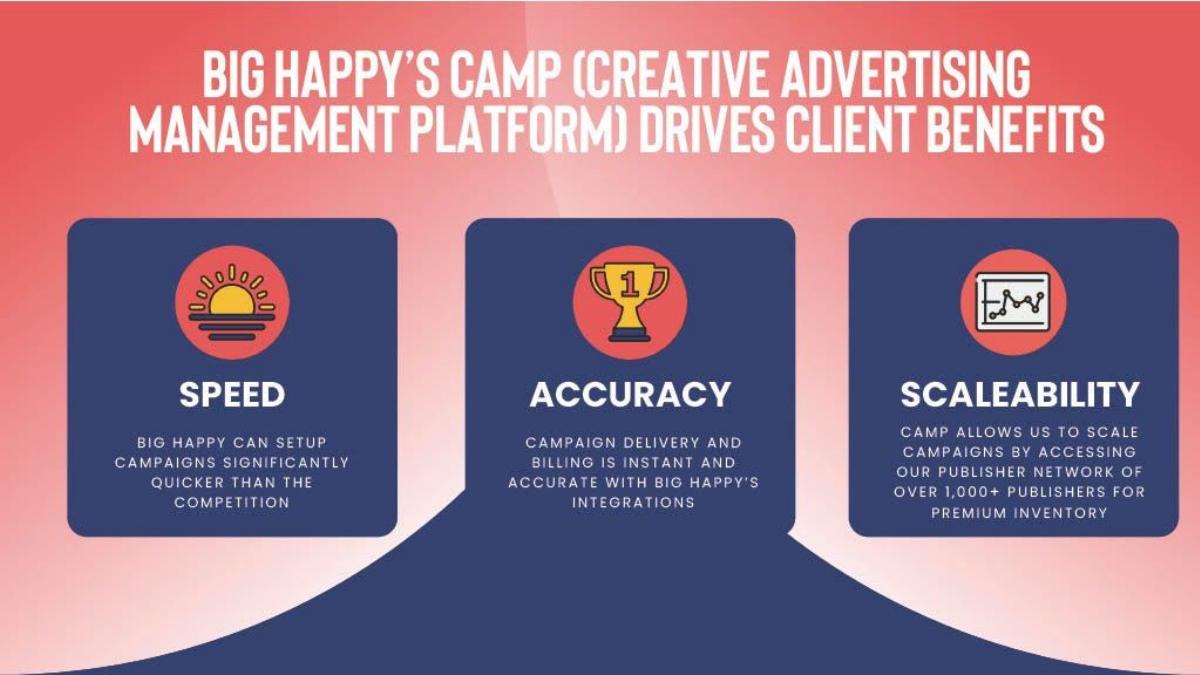
- Big Happy utilizes a proprietary Creative Advertising Management Platform (CAMP) to manage a network of over 1,000 publishers (Slide 3).
- Programmatic revenue is the primary growth engine, showing a 270% YoY increase as of late 2023 (Slide 4).
- The company uses MOAT benchmarks to prove superior performance, claiming a 'MOAT Score' of 822 against an industry range of 300-850 (Slide 5).
- Big Happy’s ad units significantly outperform industry benchmarks in viewability, brand safety, and attention capture (Slide 5).
- The $2.5M raise is strictly allocated: 54.5% for tech investments, 28.4% for working capital, and 17% for national sales expansion (Slide 12).
- The founding team possesses deep domain expertise, with leadership experience at Yahoo, Viacom, Discovery, and News Corp (Slide 13).
- The CTO, Manu Bishnoi, has been with the company since 2019 and built the entire publisher and mobile platform from scratch (Slide 13).
Big Happy: Proving that Beauty and Data Can Coexist in AdTech
Big Happy entered the market in late 2019 with a specific thesis: mobile advertising doesn't have to be intrusive or ugly to be effective. By the time they reached their Fall 2023 investor presentation, they had the data to prove it. This 14-slide deck, which helped secure a $2.5M Series A in 2024 (as reported by Business Insider), is a masterclass in using traction and third-party validation to de-risk a creative-heavy business model.
Slide 1: The Visual Hook
The title slide introduces the brand with a playful, high-quality illustration of an astronaut planting a 'Big Happy' flag on a smartphone. It sets the tone for a company that values 'beautiful ad experiences.' The sub-headline is clear: 'We create beautiful ad experiences that consumers love and remember.' It’s a bold claim in an industry often associated with 'ad fatigue,' but it establishes the company's unique selling proposition (USP) immediately.
Slide 2: The Executive Summary of Strength
Slide 2 is arguably the most important slide for an investor. It bypasses the 'problem' slide—which most investors already understand in the adtech space—and goes straight to the 'why now' and 'why us.' It notes the company was founded in late 2019 and serves Fortune 500 companies. The three checkmarks are high-signal: Rapid Revenue Growth (+110% YoY), Tech-Powered Mobile Ads, and most importantly, 'Profitable, Cash Flow Positive.' By stating they are looking for 'Growth Equity' to 'fuel hyper growth,' they signal that this is not a distressed raise, but a strategic one.
Slide 3: The CAMP Platform
Adtech companies are often dismissed as 'agencies in disguise' unless they can prove they have a scalable platform. Slide 3 introduces 'CAMP' (Creative Advertising Management Platform). It breaks down the benefits into Speed, Accuracy, and Scalability. The mention of a 'publisher network of over 1,000+ publishers' is a critical metric, showing that they have the distribution to match their creative output. This slide transitions the narrative from 'we make nice ads' to 'we have a system that delivers ads at scale.'
Slide 4: The Programmatic Growth Engine
Slide 4 provides the 'hockey stick' chart that Series A investors crave. It focuses specifically on programmatic revenue, which is more scalable and higher-margin than managed services. The chart shows a 270% YoY growth rate, with specific quarterly breakdowns from Q1 22 to an estimated Q4 23. The growth from Q2 23 (+633% YoY) to Q4 23e indicates that the company has found product-market fit in the programmatic space and is ready to pour fuel on the fire.
Slide 5: Third-Party Validation (The MOAT Score)
In advertising, everyone claims their ads are better. Big Happy uses Slide 5 to prove it using MOAT, an industry-standard analytics tool. They showcase a 'MOAT Score' of 822 out of a possible 850. The four bar charts comparing Big Happy to 'MOAT Benchmarks' for In-View Rate, In-View Time, Click-Through Rate, and Invalid Rate (fraud) are devastatingly effective. They don't just say they are better; they show they are significantly above the industry average in every category that matters to a brand's CMO.
Slide 12: Precise Use of Funds
Slide 12 (numbered as such in the deck) provides a transparent breakdown of the $2.5M raise. The pie chart is specific: 54.5% for Tech Investments, 28.4% for General Working Capital, and 17% for National Sales Expansion. This allocation tells investors that the company is prioritizing product and margin improvement ('fuel future tech growth and margins as we scale') over simply hiring a massive sales team to 'brute force' revenue. This is a sophisticated approach that appeals to margin-conscious investors.
Slide 13: The Pedigree Team
The team slide (Slide 13) confirms that the founders aren't just creative enthusiasts; they are industry veterans. CEO Jonathan Frohlinger and COO Jason Sherry bring experience from Yahoo, Viacom, and Discovery. The mention of Jason managing a $2B+ revenue team at Yahoo provides immense credibility. CTO Manu Bishnoi’s background in 3D technologies and Unreal Engine explains how the company is able to deliver the high-end AR and 3D graphics mentioned in the publisher's summary. The team is balanced between high-level sales, operations, and deep technical expertise.
What Big Happy Does Exceptionally Well
The Big Happy deck succeeds because it treats 'creativity' as a measurable variable. In many decks, 'better creative' is a hand-wavy concept. Big Happy anchors it to the MOAT Score (Slide 5) and programmatic revenue growth (Slide 4). They also avoid the common mistake of raising money to 'find' a business model; by the time they hit the market for this $2.5M, they were already profitable and cash-flow positive. This puts the power in the hands of the founders during negotiations.
What is Missing from the Deck
While the deck is strong on traction and team, it omits a detailed 'Competitor Landscape' slide. While they mention they are 'quicker than the competition' on Slide 3, they don't name specific rivals like Unity, AppLovin, or specialized mobile creative shops. Additionally, there is no 'Unit Economics' slide detailing the LTV (Lifetime Value) to CAC (Customer Acquisition Cost) ratio, which is often a requirement for Series A investors to understand the efficiency of the sales engine. Finally, while they mention 1,000+ publishers, a slide showing logos of their top Fortune 500 clients would have added even more social proof.
Founder Takeaways: Copy These Moves
Lead with Profitability: If you are profitable, make it a headline on Slide 2. It changes the entire tone of the investor conversation from 'help us survive' to 'help us win bigger.' · Use Industry Benchmarks: Don't just say your product is better. Use a third-party tool (like MOAT in adtech, or G2 in SaaS) to provide an objective comparison against industry averages. · Segment Your Revenue: Big Happy didn't just show 'Total Revenue.' They showed 'Programmatic Revenue' (Slide 4), which is the specific type of revenue investors value most in the adtech sector. · Be Specific with Funds: A pie chart with percentages to the first decimal point (e.g., 54.5%) shows that you have a rigorous financial plan, not just a round number you pulled out of the air.
Frequently asked questions
- How does Big Happy differentiate its technology from other ad networks?
- Big Happy relies on its proprietary Creative Advertising Management Platform (CAMP). According to Slide 3, this platform focuses on three pillars: Speed (quicker setup than competitors), Accuracy (instant billing and delivery integrations), and Scalability (access to a network of over 1,000 premium publishers). This allows them to deliver high-end 3D and AR graphics at a scale typically reserved for standard display ads.
- What are the specific performance metrics Big Happy uses to prove its value?
- The deck leans heavily on third-party verification. Slide 5 highlights a 'MOAT Score' of 822, which is near the top of the 300-850 industry range. It specifically charts outperformance in In-View Rate, In-View Time, Click-Through Rate, and Invalid Rate (fraud) compared to standard MOAT benchmarks, providing quantitative proof that their 'beautiful ad experiences' actually drive engagement.
- What is the company's financial status according to the deck?
- Big Happy presents itself as an exceptionally stable startup. Slide 2 states the company is already 'Profitable' and 'Cash Flow Positive.' It reports a 96.2% 4-year CAGR and +110% YoY growth. This suggests the $2.5M raise is 'Growth Equity' intended to fuel hyper-growth rather than a survival round, which is a strong position for a Series A.
- Who is leading the company and what is their background?
- The team has significant corporate and startup pedigree. CEO Jonathan Frohlinger has $40M+ in career sales; COO Jason Sherry managed Yahoo’s $2B+ US revenue team; and SVP Paige Grossman drove $14M+ in sales at Big Happy since 2020. The technical side is led by Manu Bishnoi, who has 13+ years of experience in 3D technologies and machine learning (Slide 13).
- How will the $2.5M Series A investment be spent?
- The allocation is highly technical. As shown on Slide 12, the majority (54.5%) is dedicated to 'Tech Investments' to improve creative processes and margins. The remainder is split between 'General Working Capital' (28.4%) and 'National Sales Expansion' (17%), indicating a focus on scaling the product's efficiency before massively expanding the sales force.