Bijana Healthcare Private Limited, through its brand Care N Save, positions itself as a 'one-stop solution' for healthcare in India, specifically targeting Tier 3 and Tier 4 cities. The deck outlines a multi-pronged approach covering e-pharmacy, e-healthcare, and e-labs. While the company sets ambitious growth targets—such as increasing its customer base from 5,000 to 500,000 and achieving profitability by the end of year three—the presentation lacks critical investor data. There is no mention of the current founding team's background, no specific funding amount requested, and no historical f…
Key takeaways
- The company operates under the brand name Care N Save and focuses on three pillars: e-HealthCare, e-Pharmacy, and e-Labs (Slide 1).
- Bijana Healthcare aims to scale its customer base from 5,000 to 500,000 using a marketing budget of 50 lakhs (Slide 8).
- The financial roadmap targets double-digit growth for the first three years and profitability by the end of the third year (Slide 3).
- The marketing strategy includes targeting customers over age 55 through magazine and newsletter campaigns (Slide 6).
- Geographic expansion plans include Tier 3 and 4 cities in India, with future phases targeting Singapore, Malaysia, and Dubai (Slide 8).
- The deck identifies 'Less Competitive Market' and 'Government subsidies' as key opportunities in their SWOT analysis (Slide 7).
- Operational efficiency goals include reducing variable costs per order by 4% annually and maintaining low overhead (Slide 3).
- The deck omits a team slide, specific capital ask, and detailed competitive analysis against major Indian e-pharmacy incumbents (Slides 1-9).
Bijana Healthcare Pitch Deck Analysis
Bijana Healthcare Private Limited presents a vision for a comprehensive digital healthcare platform under the brand "Care N Save." The deck focuses on the logistical and aspirational aspects of building an e-pharmacy and diagnostic network in India. While the deck provides a clear list of objectives and a high-level marketing plan, it functions more as a business plan summary than a venture-grade investment deck, as it lacks specific founder details and a clear capital request.
Slide 1: Title and Brand Identity
The opening slide introduces the brand Care N Save with the tagline "Hope lives here !!" It establishes the three core service areas: e-HealthCare, e-Pharmacy, and e-Labs . The inclusion of the website URL (carensave.com) suggests an active or near-launch digital presence. The branding is clean, utilizing a blue color palette common in the healthcare sector.
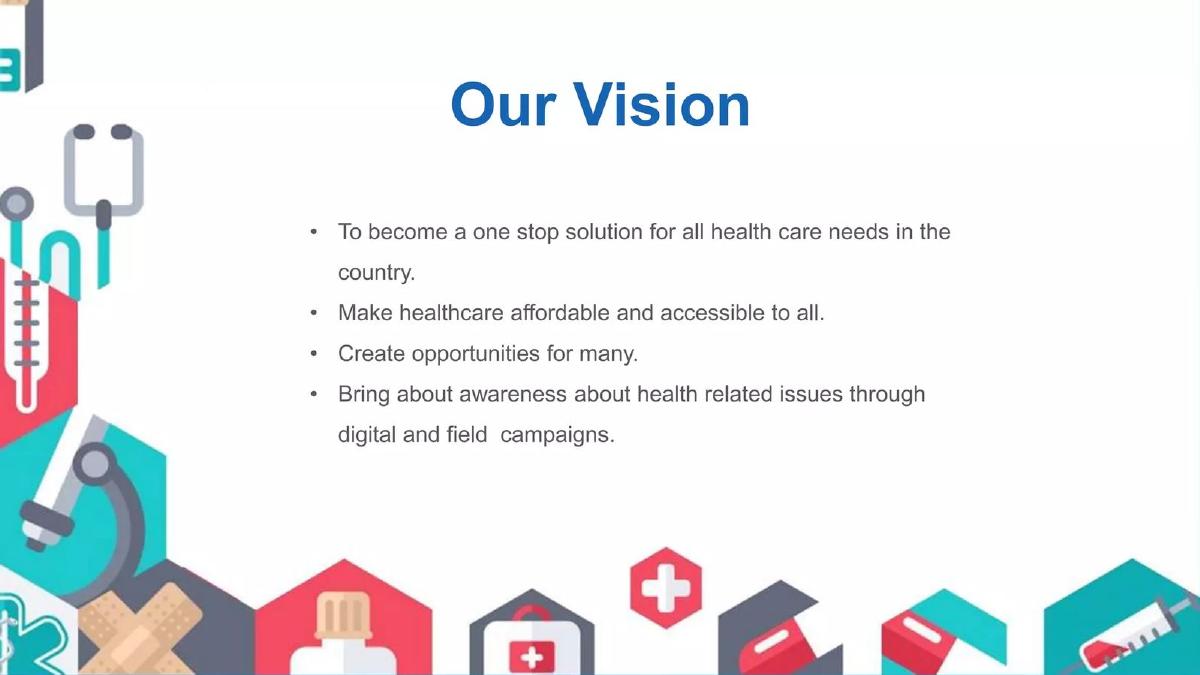
Slide 2: Our Vision
The vision slide outlines four primary goals: becoming a one-stop solution for healthcare in the country, making healthcare affordable and accessible, creating opportunities, and raising health awareness through digital and field campaigns. This slide is high-level and standard for the industry, emphasizing social impact alongside business growth.
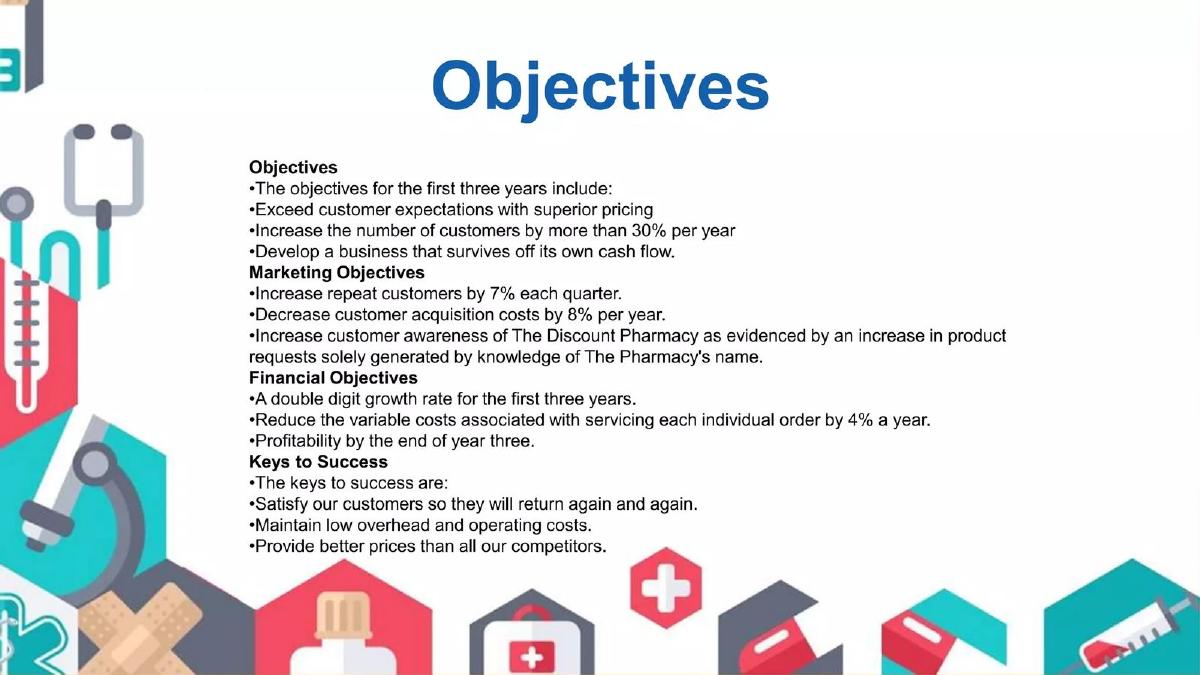
Slide 3: Objectives and Financial Goals
This slide is dense with specific, albeit projected, metrics. The company sets a three-year horizon for several key performance indicators (KPIs):
Increase customer count by more than 30% per year . · Increase repeat customers by 7% each quarter . · Decrease customer acquisition costs (CAC) by 8% per year . · Reduce variable costs of servicing orders by 4% per year . · Achieve profitability by the end of year three.
Analysis: While these targets are specific, the deck does not provide the baseline data (current CAC or current margins) to explain how these improvements will be achieved.
Slide 4: Departments
Slide 4 lists the internal organizational structure, including Pharma, Marketing, Customer Care/Sales, Accounts, Software Development, Operations, Procurement, and Logistics. This indicates the company intends to manage most of the value chain internally rather than outsourcing core functions like software development or logistics.
Slide 5: Business Model
The business model slide features a Business Model Canvas graphic alongside text descriptions of their two primary revenue drivers. E-Pharmacy focuses on home delivery from licensed pharmacies. Diagnostic Services focuses on early diagnosis and monitoring. The canvas graphic mentions "Incentivized reimbursement models" and "Design integrated practice units," suggesting a move toward value-based care, though these terms are not expanded upon in the text.
Slide 6: Marketing Strategy
The strategy presented here is multi-channel. It highlights digital marketing for convenience-seeking users and local paper ads for walk-in customers. A notable detail is the targeting of the over-55 demographic through magazines and newsletters, acknowledging that this group has higher recurring medication needs. The slide also commits to "obsessive customer service" as a core pillar for building the business.
Slide 7: SWOT Analysis
The SWOT analysis identifies "Less Competitive Market" as an opportunity, which is a bold claim given the presence of large, well-funded incumbents in the Indian e-pharmacy space. It also lists "Government subsidies" as an opportunity, though it does not specify which schemes they intend to leverage. The threats are listed as legal/regulatory changes and competition.
Slide 8: Marketing Plan and Expansion
This slide provides the most concrete figures in the deck. The company states a marketing budget requirement of 50 lakhs . With this budget, they aim to scale from 5,000 to 500,000 customers . The plan focuses on Tier 3 and Tier 4 cities through partnerships with hospitals and gram panchayaths. The slide also mentions future international expansion into Singapore, Malaysia, and Dubai.
Slide 9: Conclusion
The final slide is a standard "Thank You" page featuring imagery of pills and data charts. It lacks contact information for the founders, which is a missed opportunity for a pitch deck intended for external circulation.
What Works in This Deck
The deck is successful in identifying a specific niche: Tier 3 and Tier 4 cities . By focusing on these underserved areas and utilizing local partnerships (gram panchayaths), Bijana Healthcare differentiates itself from competitors who often focus on Tier 1 urban centers. The inclusion of specific growth targets (Slide 3) and a clear marketing budget (Slide 8) gives potential partners a sense of the scale the founders are envisioning.
What is Missing
The most significant omission is the Team Slide . Investors back people, especially in early-stage healthcare where regulatory and logistical expertise is mandatory. There is no information on who is running Bijana Healthcare or their relevant experience. Furthermore, the deck lacks a Competitive Landscape slide. Claiming a "Less Competitive Market" in the SWOT analysis without addressing giants like PharmEasy or Apollo 24/7 is a major red flag for sophisticated investors. Finally, the Financials are purely forward-looking; there is no mention of current revenue, burn rate, or the specific amount of equity they are looking to sell for the 50 lakh marketing budget.
Founder Takeaways
Quantify the 'Why': If you plan to reduce CAC by 8%, explain the mechanism (e.g., referral programs, organic SEO, or local partnerships). Projection without methodology is just a wish list. · Address the Giants: Never claim a market is "less competitive" if there are billion-dollar players in the space. Instead, explain why your specific geographic focus (Tier 3/4) allows you to operate where they cannot. · Lead with the Team: In healthcare, trust is the primary currency. A slide detailing the medical, logistical, and technical expertise of the founders should be mandatory. · Be Clear on the Ask: A pitch deck should clearly state how much money is being raised and exactly how those funds will be allocated beyond a single line item like "marketing."
Frequently asked questions
- What is the primary business model of Bijana Healthcare?
- According to slide 5, the business model is built on two main pillars: E-Pharmacy and Diagnostic Services. The E-Pharmacy segment allows customers to order medicines and health products online for home delivery from licensed pharmacies. The Diagnostic Services segment focuses on identifying, monitoring, and screening through diagnostic tests to enable early and timely diagnosis for patients.
- What are the specific growth targets mentioned in the deck?
- Slide 3 and slide 8 outline several quantitative targets. The company aims to increase its customer base by more than 30% per year, eventually scaling from 5,000 to 500,000 customers. They also target a 7% quarterly increase in repeat customers and an 8% annual decrease in customer acquisition costs (CAC). Financially, they seek double-digit growth and profitability within three years.
- How does the company plan to market its services to different demographics?
- Slide 6 details a segmented marketing approach. Walk-in customers are targeted via local paper advertisements to highlight discounted prices. For older demographics (over age 55), the company uses magazines and newsletters. Digital marketing is used for general online medicine purchases, while slide 8 mentions field campaigns through gram panchayaths and medical hospitals to reach Tier 3 and 4 cities.
- What geographic regions is Bijana Healthcare targeting?
- The immediate focus is on Tier 3 and Tier 4 cities within India, utilizing tie-ups with local hospitals and gram panchayaths for upliftment (Slide 8). The deck also states that products will be distributed throughout India (Slide 6). Long-term expansion plans include international markets such as Singapore, Malaysia, and Dubai in a phased manner.
- What critical information is missing from this pitch deck?
- The deck lacks several standard components required for a professional fundraise. Most notably, there is no 'Team' slide showcasing the founders' expertise, no 'Ask' slide detailing how much capital is being raised, and no 'Competition' slide comparing them to established players like Tata 1mg or Netmeds. Additionally, there are no historical financial statements or detailed unit economics.