BioPolynet’s pitch deck is a concise, seven-slide presentation focused on the environmental and economic challenges of industrial tailings. The company introduces BioNanoCoil (BNC), a patented nanotechnology designed to deactivate toxic solids and recover water from waste ponds. The deck highlights a significant $7 billion market opportunity and claims a 77.8% cost reduction compared to conventional methods. While the technical value proposition is clear, the deck is light on detailed financial projections and competitive analysis. It outlines a clear roadmap from 2018 to 2020, including a se…
Key takeaways
- The company identifies a massive public liability exceeding $50,000,000,000 related to oil sands tailings ponds on slide 2.
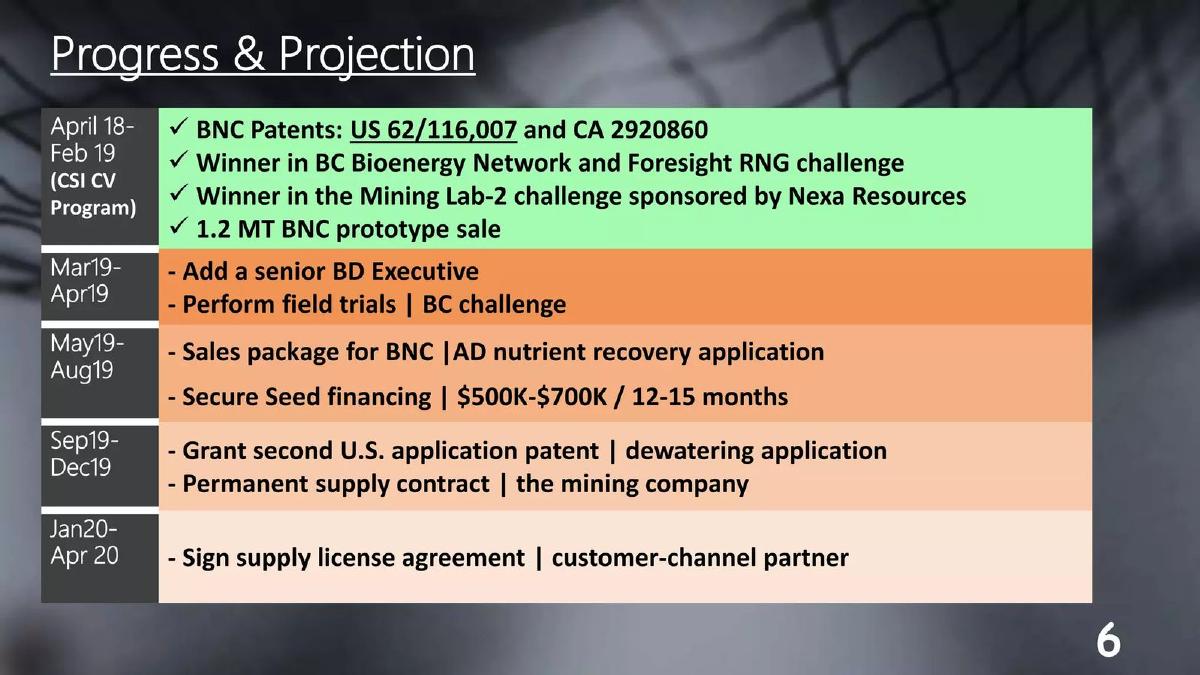
- BioPolynet's core technology, BioNanoCoil (BNC), is protected by US and Canadian patents cited on slide 6.
- The solution claims to reduce treatment costs by 77.8%, bringing costs to approximately $7.2 per cubic meter as shown on slide 3.
- The deck targets a $7 billion total market opportunity across mining, oil, and agriculture on slide 3.
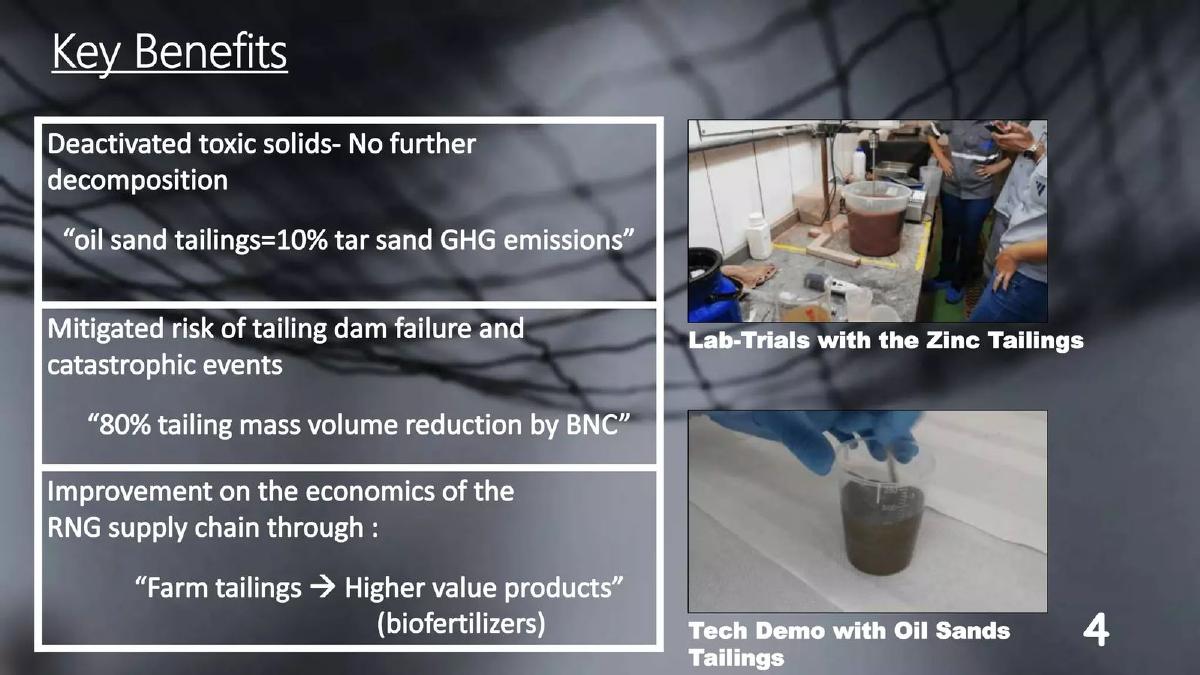
- Technical validation is supported by lab trials with zinc tailings and tech demos with oil sands tailings on slide 4.
- The company seeks a seed round of $500K to $700K for a 12-15 month runway, as detailed in the May-August 2019 roadmap on slide 6.
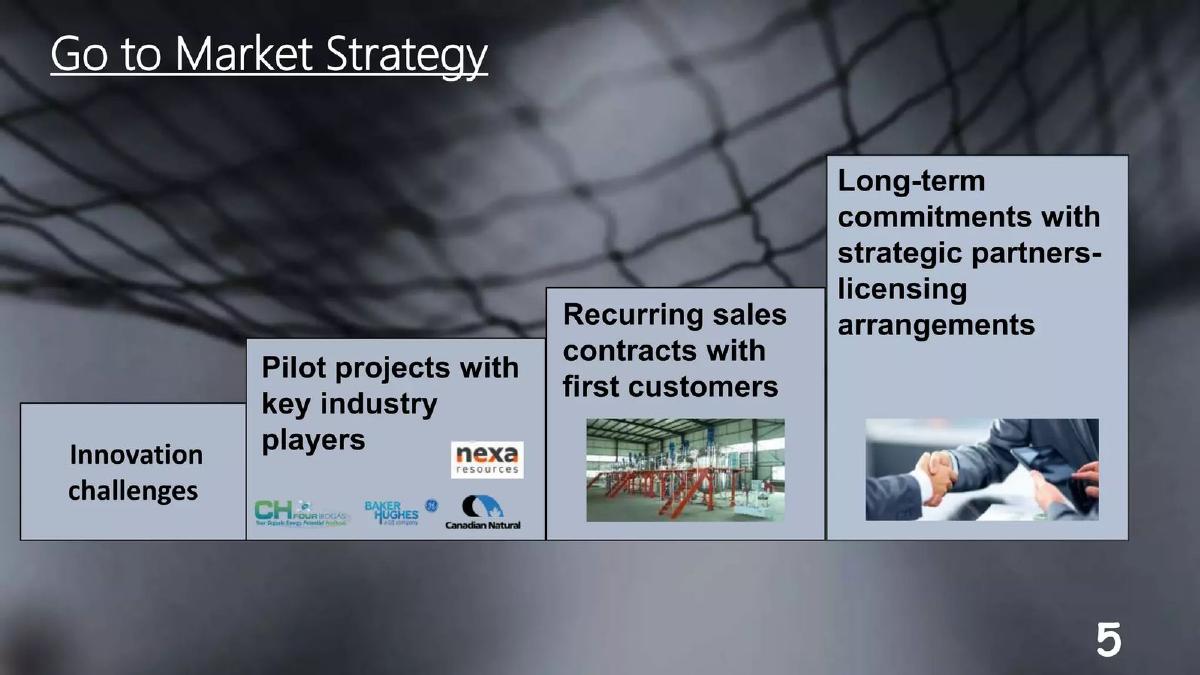
- Strategic partners and pilot projects include industry names like Nexa Resources, Baker Hughes, and Canadian Natural on slide 5.
- The roadmap includes a specific milestone for a 1.2 MT BNC prototype sale achieved between April 2018 and February 2019 on slide 6.
Executive Summary
BioPolynet is a Canadian cleantech company focused on the remediation of toxic industrial tailings. Their pitch deck outlines a specialized chemical engineering solution called BioNanoCoil (BNC), designed to address the massive environmental liabilities in the oil, mining, and agricultural sectors. With a lean 7-slide presentation, the company focuses heavily on technical validation, cost-efficiency, and a clear roadmap toward commercial licensing.
Slide 1: Title Slide
The opening slide introduces the company name, BioPolynet, and its primary mission statement: "We are BioPolynet, and we clean up toxic tailings." The slide features the name of Arian Shahnazari, the Cleantech Operations Manager, along with a contact email. The background image of a net or mesh structure likely alludes to the molecular "network" created by their technology. A small green maple leaf above the logo indicates the company's Canadian origin.
Slide 2: The Problem
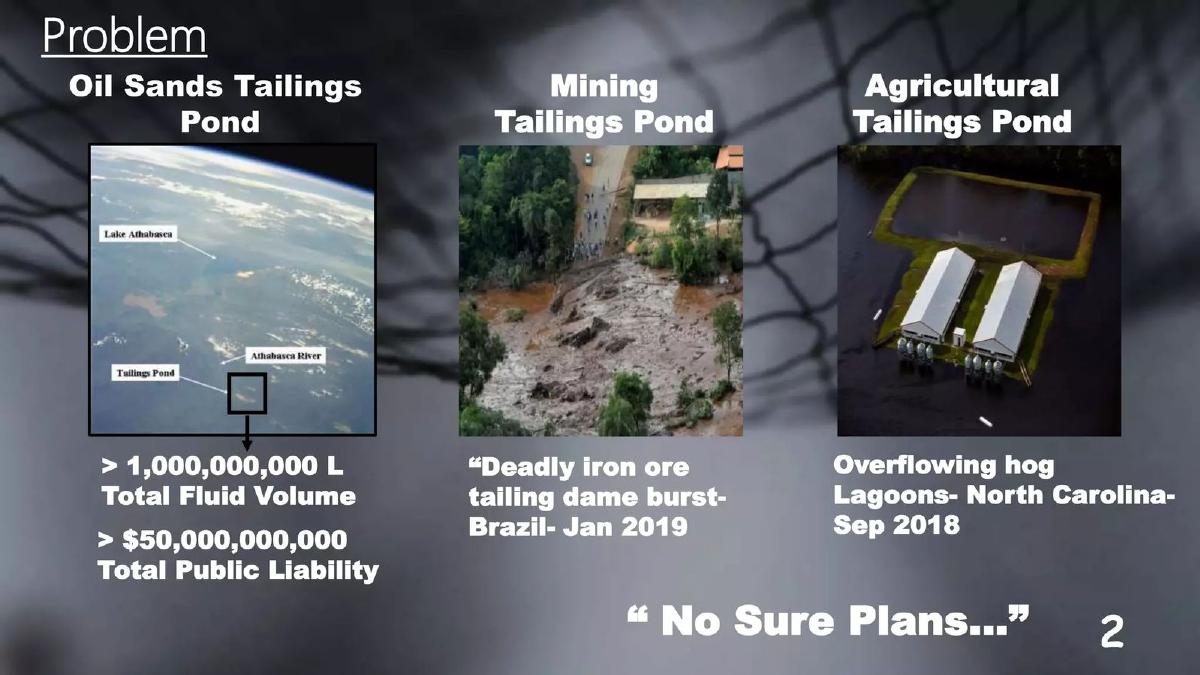
This slide establishes the gravity of the tailings issue across three distinct verticals. For Oil Sands, it cites a fluid volume exceeding 1,000,000,000 liters and a public liability of over $50,000,000,000. For Mining, it references the January 2019 iron ore dam burst in Brazil as a "deadly" event. For Agriculture, it points to the September 2018 overflow of hog lagoons in North Carolina. The slide concludes with the quote "No Sure Plans...", suggesting a lack of effective current solutions in the market.
Slide 3: Value Proposition
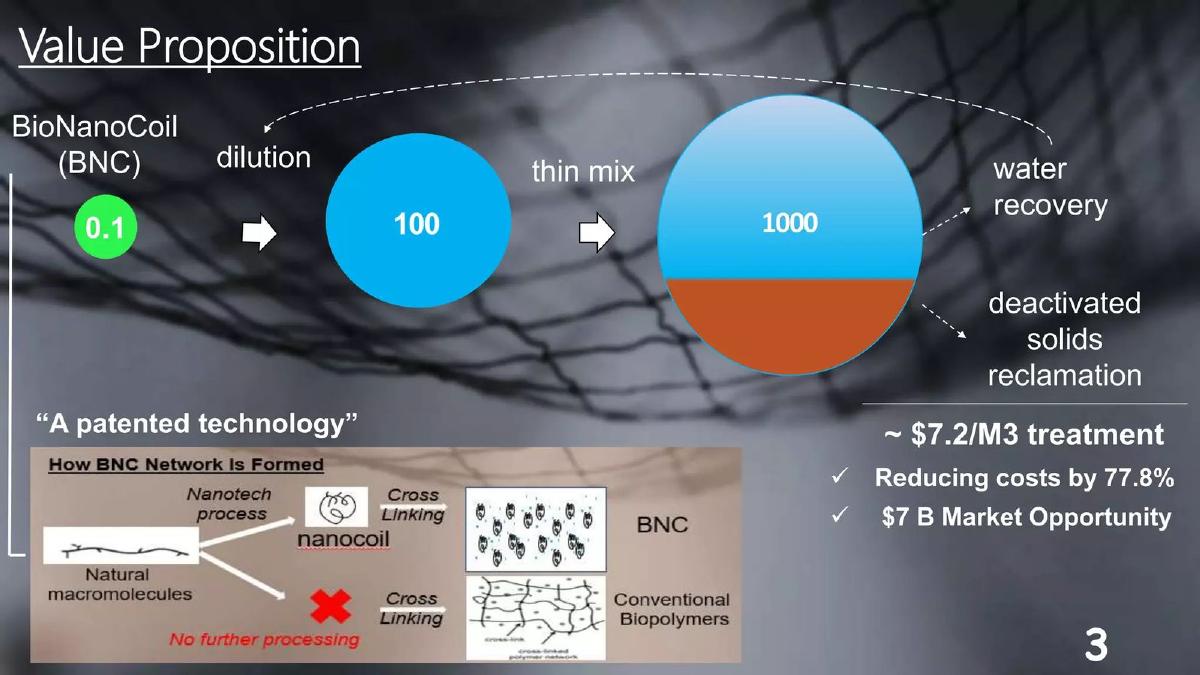
BioPolynet introduces its "BioNanoCoil (BNC)" technology here. A diagram illustrates a dilution process where a small amount of BNC (0.1) is mixed into a larger volume (1000) to achieve water recovery and deactivated solids reclamation. The slide explicitly mentions that this is a "patented technology" and provides a microscopic comparison between the BNC nanocoil network and conventional biopolymers. Financial highlights include a treatment cost of ~$7.2/M3, a 77.8% cost reduction, and a $7 billion market opportunity.
Slide 4: Key Benefits
This slide expands on the technical advantages of BNC. It claims that deactivated toxic solids undergo no further decomposition, which accounts for 10% of tar sand GHG emissions. It also highlights an 80% reduction in tailing mass volume, which mitigates the risk of dam failure. Finally, it notes the potential to turn farm tailings into biofertilizers, improving the economics of the Renewable Natural Gas (RNG) supply chain. Visual evidence is provided through photos of lab trials with zinc tailings and a tech demo with oil sands tailings.
Slide 5: Go to Market Strategy
The strategy is presented as a four-step staircase. Step one involves overcoming "Innovation challenges." Step two focuses on pilot projects with industry leaders, displaying logos for Nexa Resources, CH Four Biogas, Baker Hughes, and Canadian Natural. Step three moves toward recurring sales contracts with first customers, shown with an image of an industrial facility. The final step is securing long-term commitments through strategic partner-licensing arrangements.
Slide 6: Progress & Projection
This slide serves as both a traction report and a forward-looking roadmap. Achievements from April 2018 to February 2019 include two patents (US 62/116,007 and CA 2920860), winning multiple industry challenges, and a 1.2 MT prototype sale. The roadmap for 2019 includes hiring a BD executive, performing field trials, and seeking $500K-$700K in seed financing for a 12-15 month runway. By 2020, the company aims to sign supply license agreements with channel partners.
Slide 7: The Team
The final slide introduces the leadership and advisory board. The core team consists of Mostafa Aghaei (CEO & Co-Founder, scientist), Alma Zangeneh (Co-Founder, manager), Arian Shahnazari (Operations Manager, chemical engineer), and Maryam Dehbashi (Applied Research Specialist, scientist). The advisory section includes Jane Kearns (Business Adviser from MaRS) and Michael Dennis (Investment Manager from Innovacorp), providing the company with significant institutional backing in the Canadian cleantech ecosystem.
What BioPolynet Does Well
The deck is exceptionally focused on the "Why Now" and the technical "How." By citing specific environmental disasters (Brazil 2019, North Carolina 2018) on slide 2, the founders create a sense of urgency that transcends mere financial gain. They successfully frame a massive environmental problem as a quantifiable financial liability ($50B+).
Furthermore, the technical explanation on slide 3 is handled well for a non-expert audience. The use of a simple dilution diagram (0.1 to 1000) effectively communicates the efficiency of the product without getting bogged down in complex chemical equations. The inclusion of patent numbers and specific cost-reduction percentages (77.8%) adds a layer of credibility that is often missing in early-stage cleantech decks.
What is Missing from the BioPolynet Deck
The most significant omission is a detailed competitive landscape. While the deck mentions that conventional biopolymers are inferior, it does not name specific competitors or alternative treatment methods (such as mechanical centrifugation or different chemical flocculants). Investors in the industrial waste space would want to know why BNC is superior to existing incumbents beyond just cost.
Additionally, the deck lacks a clear financial projection or business model breakdown. While it mentions a $7.2/M3 treatment cost and a $7B market, it does not explain how BioPolynet captures that value. Is it a direct sales model, a service model, or purely licensing? Slide 5 suggests licensing is the end goal, but the interim steps involve "recurring sales contracts," leaving the revenue mix unclear. There is also no mention of the manufacturing process or the scalability of producing the BNC material itself.
Founder Takeaways: Lessons to Copy
Quantify the Pain: Don't just say the problem is big; give it a dollar value. BioPolynet's use of the $50 billion public liability figure on slide 2 is a powerful way to frame the market need. · Specific Traction: Listing specific challenge wins and prototype sales (1.2 MT) on slide 6 provides concrete proof of concept that is more convincing than vague "interest from partners." · Clear Ask and Runway: The roadmap on slide 6 explicitly states the amount of money needed ($500K-$700K) and exactly how long it will last (12-15 months). This transparency helps investors quickly assess if the deal fits their mandate. · Leverage Institutional Advisors: Including advisors from recognized hubs like MaRS and Innovacorp (slide 7) provides a "halo effect" of credibility, suggesting the company has already passed some level of professional vetting.
Frequently asked questions
- What is the primary problem BioPolynet is solving?
- BioPolynet addresses the environmental and financial risks associated with industrial tailings ponds. Slide 2 highlights three specific areas: oil sands (with over 1 billion liters of fluid), mining (citing a deadly 2019 dam burst in Brazil), and agriculture (referencing overflowing hog lagoons in North Carolina). The company aims to mitigate the risk of catastrophic dam failures and reduce the $50 billion public liability associated with these waste sites.
- How does the BioNanoCoil (BNC) technology work?
- According to slide 3, BNC is a patented nanotechnology that uses a 'nanotech process' to cross-link natural macromolecules into a 'nanocoil' network. Unlike conventional biopolymers, this network allows for high dilution (from 0.1 to 1000 units) to treat waste. The process results in water recovery and the reclamation of deactivated solids, preventing further decomposition and reducing greenhouse gas emissions.
- What are the economic benefits of using BioPolynet's solution?
- The deck claims two major economic drivers on slide 3 and 4. First, it reduces treatment costs by 77.8%, reaching a price point of ~$7.2 per cubic meter. Second, it improves the economics of the Renewable Natural Gas (RNG) supply chain by converting farm tailings into higher-value products like biofertilizers. Additionally, slide 4 notes an 80% reduction in tailing mass volume.
- What is the company's current commercial traction?
- Slide 6 lists several milestones achieved between 2018 and early 2019, including winning the BC Bioenergy Network and Foresight RNG challenge, as well as the Mining Lab-2 challenge sponsored by Nexa Resources. Most notably, they recorded a 1.2 MT BNC prototype sale. Slide 5 also lists pilot projects with Baker Hughes and Canadian Natural, indicating active engagement with major industrial players.
- What are the funding requirements and planned use of proceeds?
- On slide 6, BioPolynet specifies a seed financing target of $500,000 to $700,000. This capital is intended to cover 12 to 15 months of operations. Key objectives for this period include adding a senior Business Development Executive, performing field trials for the BC challenge, developing a sales package for nutrient recovery applications, and securing a permanent supply contract with a mining company.