Siembra Inc.’s 2014 investor presentation targets a specific demographic niche: the U.S. Hispanic student population. By identifying a massive 800:1 student-to-counselor ratio, the company proposes a scalable social-networking solution to provide guidance and mentoring. The deck relies heavily on demographic trends, citing a $1.5T buying power for Hispanics by 2015 and a population reaching majority status by 2043. While the roadmap is ambitious—spanning five phases from integration to virtual mentoring—the deck is notably silent on financial projections, specific unit economics, and a clear…
Key takeaways
- The company identifies a critical resource gap with a student-to-counselor ratio of 800:1 (Slide 5).
- Siembra targets the U.S. Hispanic market, citing 13M K-12 students and 6M students aged 18-24 (Slide 3).
- The business model relies on highly targeted ad revenue to monetize the platform (Slide 5).
- The product roadmap is divided into five phases, including gamification and virtual mentoring (Slide 7).
- Traction is demonstrated by a live beta with 800 students at a Southern California middle school (Slide 9).
- The team is bifurcated into 'Management' and 'Founders,' supported by a 13-person advisory group (Slides 11 and 13).
- The deck omits a specific funding ask, use of funds, and detailed financial forecasts.
- Market timing is emphasized by the claim that Hispanics adopt technology faster than any other group (Slide 3).
Executive Summary: A Niche Play in EdTech
The Siembra Inc. investor presentation, dated March 11, 2014, is a mission-oriented deck that focuses on the intersection of education technology and the U.S. Hispanic demographic. The company positions itself as a bridge for students who are underserved by traditional counseling resources. By leveraging social-networking technology and mobile adoption trends, Siembra aims to create a scalable mentoring ecosystem. While the deck is strong on demographic data and team credentials, it follows a common early-stage pattern of prioritizing vision over financial mechanics.
Slide 1: Title and Branding
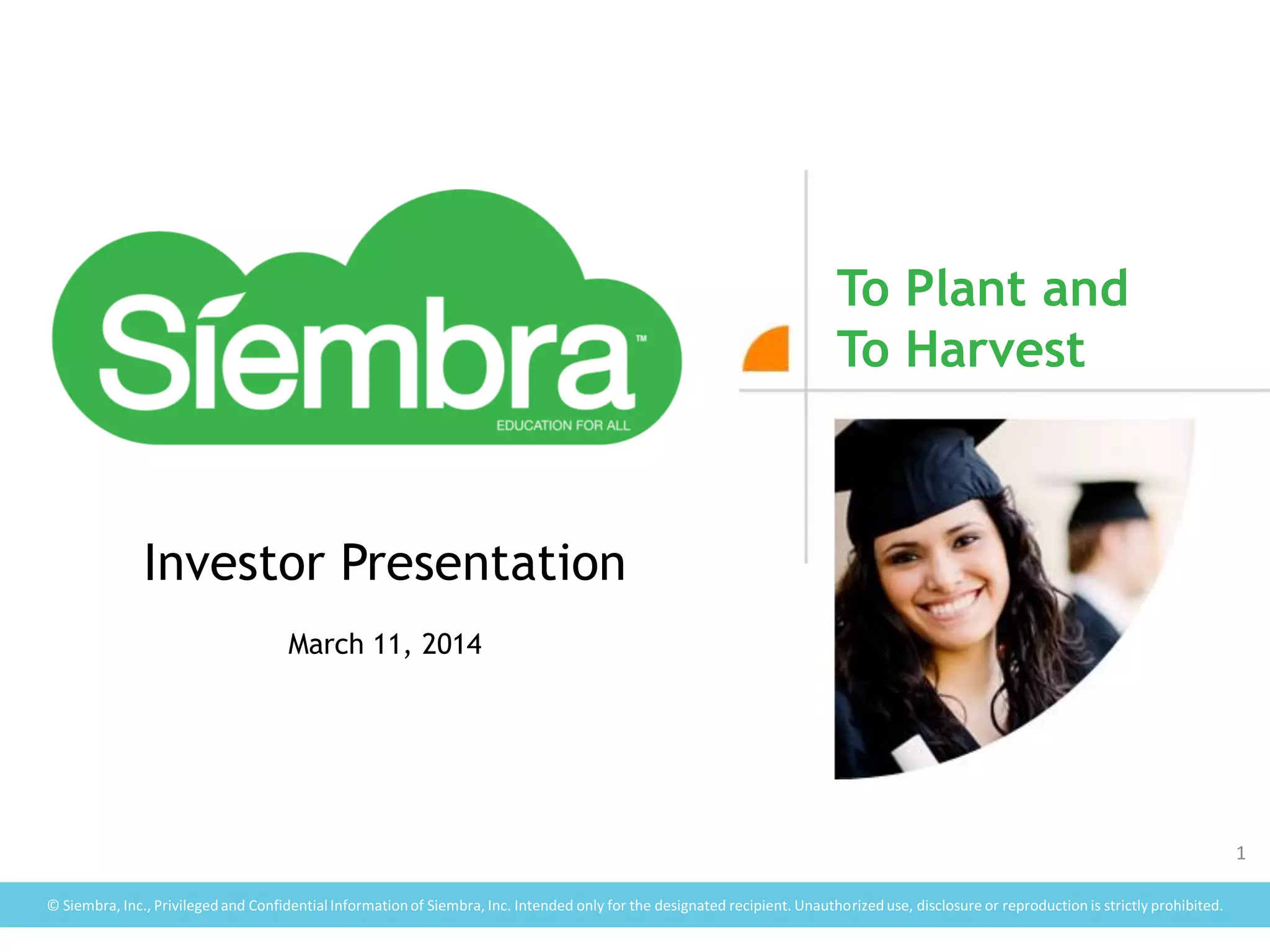
The cover slide introduces the company name, Siembra, which is accompanied by the tagline "Education For All." The logo features a green cloud-like shape, suggesting a cloud-based technology platform. The right side of the slide features the phrase "To Plant and To Harvest," which aligns with the company name (Siembra means 'sowing' or 'planting' in Spanish). A photo of a smiling graduate is included to reinforce the desired outcome of the service. The slide is dated March 11, 2014, providing a clear timestamp for the market data contained within.
Slide 3: The Market Opportunity
Slide 3, titled "What We See," establishes the macro-environment. The company identifies two primary problems: that student problems haven't changed in 50 years and that there is a lack of resources for students to get answers. The slide then pivots to demographic trends, stating that "Hispanics are adopting technology faster than any other group" and that mobile devices are the primary connection point. The core market data points include:
53M U.S. Hispanics today, with majority status projected for 2043. · 6M Hispanics in the 18-24 age bracket. · 13M Hispanics in the K-12 bracket. · A projected buying power of 1.5T in 2015.
The slide concludes that a "Scalable solution to reach students where they live" is the primary need.
Slide 5: The Strategic Focus
This slide defines the target and the solution. The target is students looking for direction, specifically highlighting that the "Counseling office has been left out of technology advances." The most significant metric on this slide is the 800:1 student to counselor ratio , which Siembra calls a "huge leverage point."
Utilizing social-networking technology to connect counselors to students. · Building a "culturally sensitive platform" to track information flow. · Exploiting mobile device adoption. · Monetizing through "highly targeted ad revenue."
This is the first mention of the business model, suggesting a B2C or B2B2C approach where the user does not pay, but the data and access are sold to advertisers.
Slide 7: Product Roadmap
The "Future Products" slide outlines a five-phase development plan. While Phase 1 is not explicitly detailed on this slide, the subsequent phases are:
Phase 2: Extended Integration. · Phase 3: Live Student Mentoring. · Phase 4: Gamification. · Phase 5: Virtual Mentoring.
The text below the graphics explains that Siembra intends to create an "ecosystem of learning and career development" where learning algorithms and metrics are created for stakeholders. This suggests an evolution from a simple communication tool to a data-driven career engine.
Slide 9: Current Traction and Milestones
Slide 9, "Where we’re at," provides a timeline of the company's history. It shows the company was formed in 2012, a prototype was ready in 2013, and the "CC Platform" (presumably Counselor Connect) was ready in 2014. Key achievements listed include:
1 live beta with 800 students at a Southern California middle school.
5 schools ready for Counselor Connect beta sites, totaling 7,500 users. · 5 additional schools identified for beta sites, targeting 15K-20K users.
This slide provides the necessary evidence that the product exists and has been tested in a real-world environment, though it does not provide engagement metrics from the first 800 students.
Slide 11: The Team
The management and founding team are detailed on Slide 11. The leadership consists of:
Timothy Kral (Co-founder & President): Noted as a Private/Public Company CFO and Director with experience in Silicon Valley startups. · Steven Montoya (CTO): Background includes Kintero Ventures, UC Davis College of Engineering, and an MBA from Pepperdine. · Derick Needham (Director IT): Universidad de Guatemala, systems support. · Brenda Trejo (Acting Director, Biz Dev): Gates Millennial Scholar.
The "Founders" section lists Monica Favela Cole (International Relations, San Francisco State) and Felicitas Rubalcava (Bilingual educator, Cal Polytechnic). The mix of financial, technical, and educational backgrounds is a strong point for an EdTech startup.
Slide 13: Advisory Boards
Siembra presents an unusually large advisory board, divided into three categories: Education, Board, and Cultural. The Education Advisors include deans and professors from UC Irvine, Stanford, and UCLA. The Board Advisors include executives from the Cordoba Corporation and Silicon Valley Bank. Notably, they include a "Cultural Advisor," Oscar Hernandez, a Grammy-winning composer. This 13-person advisory group is intended to provide the company with institutional credibility and deep domain expertise in the Hispanic community.
What Siembra Inc. Does Well
The deck excels at identifying a specific, underserved niche. By focusing on the Hispanic market and the specific pain point of the 800:1 counselor ratio, the company avoids the trap of being a generic "education app." The demographic data is compelling and creates a sense of urgency regarding the $1.5T buying power. Furthermore, the inclusion of a live beta with 800 students proves that the team can execute beyond the idea stage. The advisory board is also a significant asset, signaling that the founders have successfully networked with key stakeholders in academia and finance.
What is Missing from the Deck
Despite the strong narrative, the deck leaves several critical questions unanswered for a professional investor: 1. The Ask: There is no slide indicating how much capital the company is seeking or the terms of the investment. 2. Use of Funds: Without an ask, there is also no explanation of how the investment will be allocated (e.g., engineering vs. sales). 3. Financial Projections: The deck mentions ad revenue but provides no estimates of Revenue Per User (ARPU), customer acquisition costs (CAC), or a path to profitability. 4. Competitive Landscape: There is no mention of other EdTech platforms or how Siembra differentiates itself from existing social networks or school management systems. 5. Engagement Data: While they have 800 students in a beta, the deck does not disclose how often those students use the platform or what outcomes (e.g., improved grades, college applications) have been achieved.
Founder's Takeaway: Lessons to Copy
Founders should look to Siembra’s deck as a model for demographic storytelling . If your startup serves a specific community, you must prove that the community is both large enough to matter and technologically ready to adopt your solution. Siembra does this effectively by citing mobile adoption rates and population growth. Additionally, the milestone timeline on Slide 9 is a clean, effective way to show progress from formation to beta. Finally, the segmentation of advisors is a clever way to show that the company has covered its bases in terms of technical, educational, and cultural requirements. However, founders must ensure they include the financial 'meat'—the ask and the projections—that this deck omits.
Frequently asked questions
- What is the primary problem Siembra Inc. is trying to solve?
- Siembra addresses the lack of resources for students seeking academic and career guidance. Specifically, they highlight that counseling offices have been left out of technological advances, resulting in an overwhelming 800:1 student-to-counselor ratio. They aim to use social-networking technology to make these connections scalable and culturally sensitive for the Hispanic community.
- How does Siembra plan to make money?
- According to Slide 5, the primary monetization strategy is to 'Use a highly targeted ad revenue to monetize the platform.' The deck suggests that by capturing students in a virtual learning environment and creating valuable data, they can leverage the $1.5T buying power of the Hispanic market to attract advertisers.
- What stage of development was the company in during this presentation?
- As of the March 11, 2014 presentation date, the company had moved past its 2012 formation and 2013 prototype phase. They had one live beta site with 800 students in a SoCal middle school and stated that their 'CC Platform' was ready, with plans to launch five additional beta sites for 7,500 users (Slide 9).
- Who are the key people behind Siembra Inc.?
- The leadership includes Co-founder/President Timothy Kral and CTO Steven Montoya. The founding team also features Monica Favela Cole and Felicitas Rubalcava, a bilingual educator. They are supported by an extensive advisory board including the Dean of the School of Education at UC Irvine and a Grammy-winning Cultural Advisor (Slides 11 and 13).
- What is missing from this pitch deck that an investor would need?
- The deck is missing several 'hard' components: a specific dollar amount for the investment ask, a breakdown of how funds will be spent, five-year financial projections, and a competitive analysis. While it explains the 'what' and 'why,' it lacks the 'how much' and 'what is the return' details typical of a complete fundraising package.