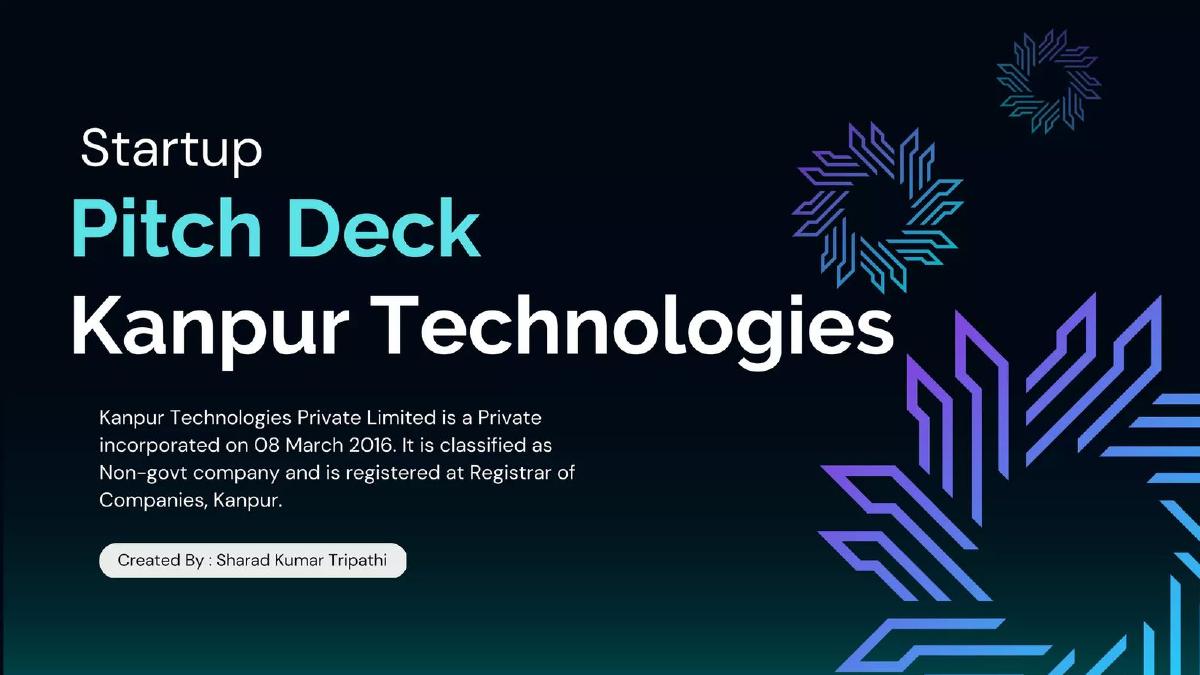
Kanpur Tech is an early-stage vocational training startup established in 2016, aiming to address the lack of skill development in rural India. Their deck highlights a significant market opportunity, noting that 93.7% of rural youth have received no vocational training. The company proposes a hybrid model: mobile-based digital courses and physical training centers utilizing low-cost rural real estate. With a team boasting over 20 years of industry experience, they project reaching 80,000 students within four years. Revenue is planned through a tiered fee structure (Rs. 100-300 for online, Rs.…
Key takeaways
- The company was incorporated on 08 March 2016 as a Private Limited entity in Kanpur (Slide 1).
- The founders, Sharad K Tripathi and Arpan Tripathi, each hold a 50% shareholding in the company (Slide 3).
- A massive market gap is identified: 93.7% of rural youth in India have not received any vocational training (Slide 6).
- The target market includes rural, semi-urban, and hilly areas, specifically focusing on women, youth, dropouts, and illiterates (Slide 7).
- The marketing strategy involves renting cheap rural space and training local people at metro centers to become local trainers (Slide 9).
- Revenue projections estimate a collection of 49 Lakh per annum initially across online, offline, and funded channels (Slide 12).
- The business model sets a long-term goal of reaching 80,000 students within the next four years (Slide 12).
- The deck identifies government programs (NSDC, PMKVY) and NGOs as competitors but claims they lack rural reach and flexibility (Slide 10).
Introduction and Company Overview
Slide 1: Title Slide
The deck opens with the company name, Kanpur Technologies Private Limited . It provides specific registration details: incorporated on 08 March 2016 , classified as a non-government company, and registered at the Registrar of Companies, Kanpur. The deck is attributed to Sharad Kumar Tripathi.
Slide 2: Introduction
This slide defines the mission: offering convenient and flexible skill-based training to students, dropouts, and elderly learners. The goal is to help them acquire skills for entrepreneurship or employment. Crucially, the slide notes the company is in the "pre-seed stage or Ideation stage" and is currently focused on survey, research, and planning.
The Leadership and Advisory Team
Slide 3: Our Team
The core leadership consists of two directors with equal equity. Sharad K Tripathi (Founder Director) holds 50% shareholding and has 20+ years of experience in the industry, specifically in executing skill development projects. Arpan Tripathi (Co-Founder Director) also holds 50% shareholding and has 7+ years of experience.
Slide 4: Team Members
Vinod Vishwakarma: Technical Head with 15+ years of experience in IT and web development. · Surendra Rajput: Academic Researcher with 10+ years of experience, including government survey projects. · Sheetal Gupta: Programmer Cum Researcher with 5+ years in project planning. · Praveen Agarwal: Platform Developer with 22+ years of experience, specifically in skill development projects in Uttar Pradesh.
Slide 5: Our Advisors
The company lists four advisors to provide institutional weight: Sandip Malhotra (Retired Professor, Allahabad University), Raj Kushwaha (Chairman, Axis Group of Institutions), Ashutosh Pandey (ADG, Prosecutions), and Ramkumar Venkateswaran (CEO, Future Skills).
Market Opportunity and Problem Statement
Slide 6: Problem
The deck identifies a significant social and economic gap. It states that 70% of India's population resides in rural areas, yet 93.7% of youth have not received vocational training. The slide critiques existing Government-run Industrial Training Institutes (ITIs) for having limited capacity, outdated courses, and being geographically inaccessible to women due to a lack of transport.
Slide 7: Target Market and Competition
The target segments are rural, semi-urban, and hilly areas, focusing on women, youth, dropouts, and illiterates. Competition is listed as Government skill programs, CSR organizations, and local NGOs. The stated advantage is having "ready-to-use product" and "geographical need-based courses."
The Solution and Strategic Roadmap
Slide 8: Solution
The solution is presented in three parts: guidance for village youth/women to become independent, linking skill development to market income, and designing mobile-based courses for rural entrepreneurs who lack access to traditional training.
Slide 9: Marketing Strategy
Strategy 1: Renting cheap rural space and training local trainers in metro cities to ensure quality at the local level. · Strategy 2: Developing a mobile application for digital course delivery tailored to regional skill requirements. · Strategy 3: A staged approach combining offline and online channels, including "work from home" opportunities for learners to start earning immediately.
Slide 10: Competition Analysis
This slide expands on the competitive landscape, specifically naming NSDC and PMKVY . It argues that while these entities exist, their reach is limited to cities, their training hours (4-8 hours daily) are too rigid for rural workers, and they offer limited placement options.
Slide 11: Our Strategy
Reiterates the flexibility of the model, allowing students to learn offline or online. It emphasizes linking income to the courses, ensuring that students have a method for business setup or job placement immediately after learning.
Financial Model and Projections
Slide 12: Business / Revenue Model
Online Courses: Fees of Rs. 100 – Rs. 300 , 1-3 month duration. · Offline Courses: Fees of Rs. 2000 – Rs. 6000 , 3-6 month duration. · Funded Projects: Targeting at least 4 projects from various agencies.
Financial projections include an initial collection of 49 Lakh per annum (9 Lakh online, 20 Lakh offline, 20 Lakh funded). The long-term goal is to reach 80,000 students in the next 4 years.
Slide 13: Conclusion
A standard thank you slide concluding the presentation for Kanpur Technologies Private Limited.
What Works / What is Missing
What Works
Clear Market Gap: Citing the 93.7% lack of vocational training provides a compelling reason for the business to exist. · Experienced Team: The deck highlights significant industry experience, particularly the 20+ and 22+ year tenures of the founder and platform developer. · Hybrid Delivery: Recognizing that rural areas need both mobile access and physical centers shows a realistic understanding of the infrastructure challenges.
What is Missing
The Ask: There is no slide indicating how much capital the company is seeking or how they intend to use the funds. · Traction Data: Despite being incorporated in 2016, there are no metrics on students trained to date or pilot program results. The deck describes the company as being in the "ideation stage." · Product Visuals: While a mobile app is mentioned as a core strategy, there are no screenshots or UI/UX mockups of the platform. · Unit Economics: The revenue model lists fees but does not detail the cost of acquisition (CAC) or the margin per student after paying local trainers and rent.
Founder's Guide: What to Copy
Equity Transparency: Clearly stating the 50/50 shareholding on the team slide (Slide 3) removes ambiguity for investors regarding cap table structure at the early stage. · Advisor Credibility: Including a mix of academic, government, and industry advisors (Slide 5) helps build trust when entering a sector heavily regulated or influenced by government policy. · Specific Pricing Tiers: Providing clear price points for different delivery methods (Slide 12) makes the business model feel tangible rather than theoretical.
Frequently asked questions
- What is the primary problem Kanpur Tech is trying to solve?
- According to Slide 6, the company is addressing the lack of vocational training in rural India, where 70% of the country's population resides. They cite that 93.7% of youth in these areas have no access to skill development, leading to high dropout rates and a reliance on unskilled migrant labor due to the limited capacity and outdated courses of government-run institutes.
- How does Kanpur Tech plan to generate revenue?
- Slide 12 outlines a three-pronged revenue model: Online Skill Training Courses (Rs. 100 – Rs. 300), Offline Skill Training Courses (Rs. 2000 – Rs. 6000), and Funded Courses from various agencies. They project an initial annual collection of 49 Lakh, assuming 4,000 students per year initially, with a goal of 80,000 students over four years.
- Who are the key members of the leadership team?
- The leadership consists of Founder Director Sharad K Tripathi (20+ years experience) and Co-Founder Director Arpan Tripathi (7+ years experience), both holding 50% equity (Slide 3). They are supported by a Technical Head (Vinod Vishwakarma), an Academic Researcher (Surendra Rajput), and a Platform Developer (Praveen Agarwal) with 22+ years of experience (Slide 4).
- What is the company's competitive advantage?
- As stated on Slide 7 and Slide 10, Kanpur Tech claims an advantage through its 'geographical need-based courses' and ability to reach rural areas where NGOs and government programs are limited by transport facilities or rigid 4-8 hour daily schedules. Their hybrid model allows for both mobile-based learning and local physical centers with flexible timing.
- What stage of development is the company currently in?
- Slide 2 explicitly states that the company is in the 'pre-seed stage or Ideation stage.' They are currently conducting surveys, research, and planning. This is notable because Slide 1 indicates the company was incorporated in March 2016, suggesting a long period of research or a recent pivot to this specific model.