Dixa’s 14-slide Series C deck, used to secure $105M in 2021 led by General Atlantic, is a high-level narrative presentation that prioritizes market positioning over granular financial data. The deck moves quickly through social proof, showcasing a massive logo wall and an executive team with deep SaaS pedigree (Zendesk, Trustpilot, LinkedIn). Its core strength lies in its philosophical argument: that the 'Ticketing Age' is over, replaced by a 'Conversational Age' where customer service is a profit center rather than a cost center. While it lacks a specific 'Ask' slide or detailed unit economi…
Key takeaways
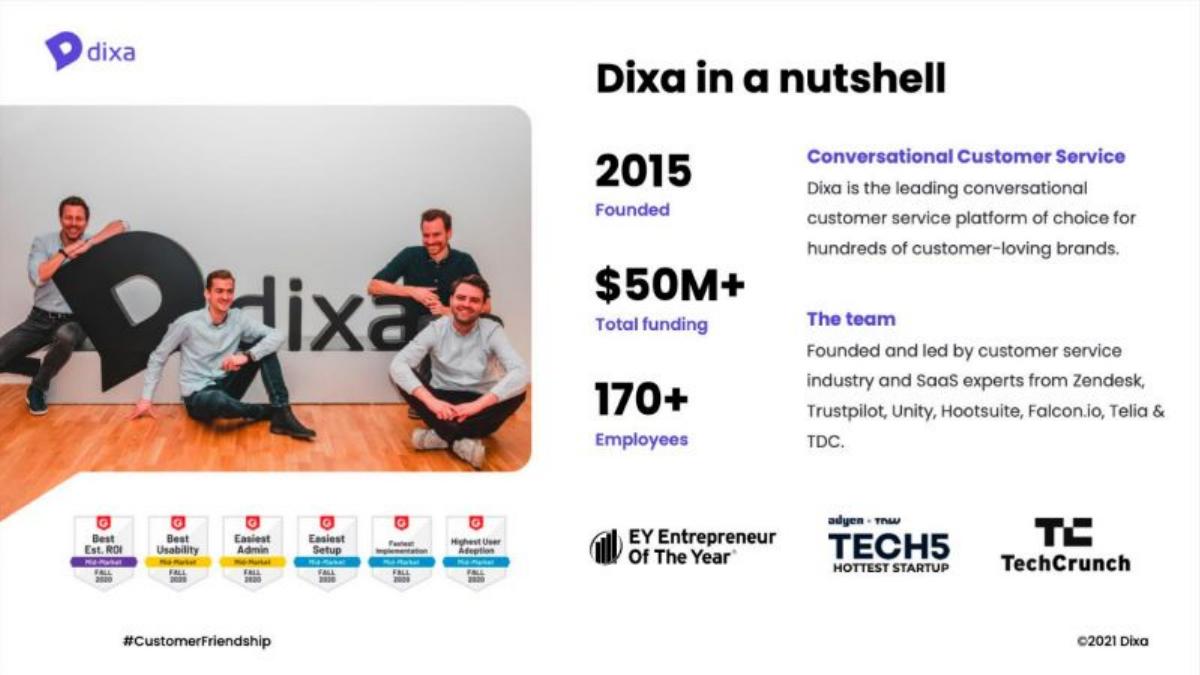
- The deck leads with heavy social proof, featuring six G2 badges from Fall 2020 including 'Best Est. ROI' and 'Highest User Adoption' on slide 2.
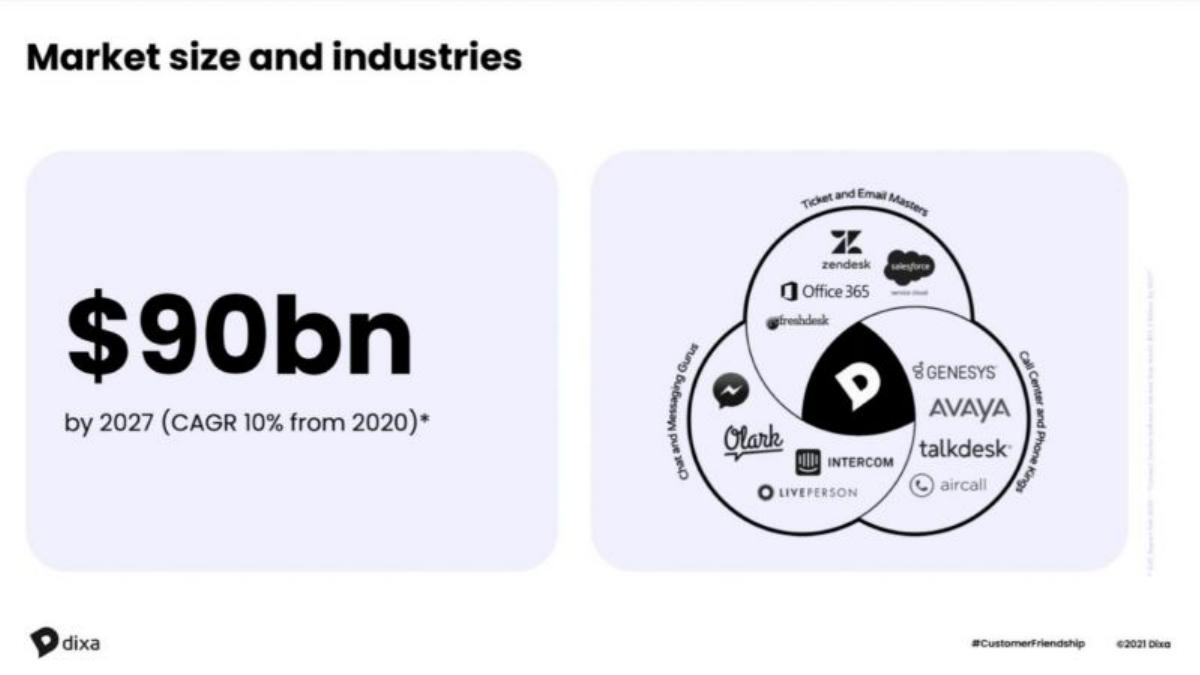
- Dixa positions itself against three distinct competitor clusters: Ticket/Email Masters, Chat/Messaging Gurus, and Call Center/Phone Kings on slide 5.
- The market opportunity is defined as a $90bn industry by 2027 with a 10% CAGR from 2020, as stated on slide 5.
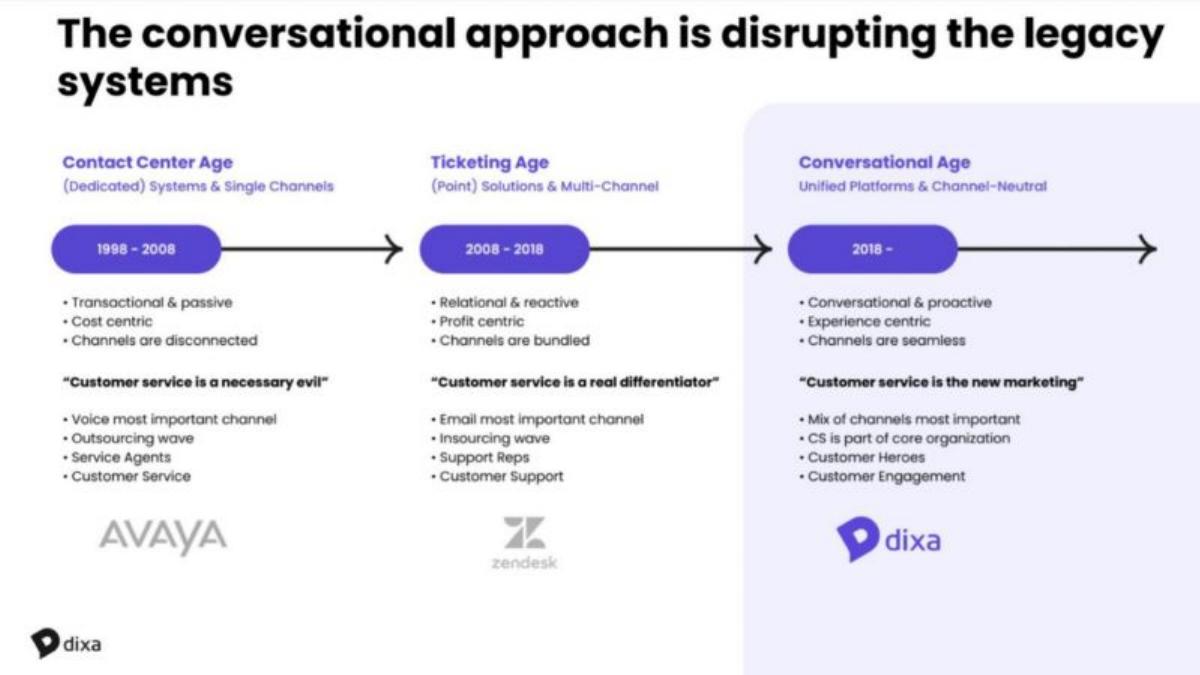
- The narrative centers on a transition from the 'Ticketing Age' (2008-2018) to the 'Conversational Age' (2018-present) on slide 6.
- The company claims to solve 'The Value Gap,' where traditional ticketing approaches fail to meet rising customer expectations on slide 7.
- A single case study for Rapha highlights a 14% customer experience lift and a 22% retention boost after switching from Zendesk on slide 13.
- The deck omits a specific funding request, financial projections, or a detailed breakdown of current ARR/MRR.
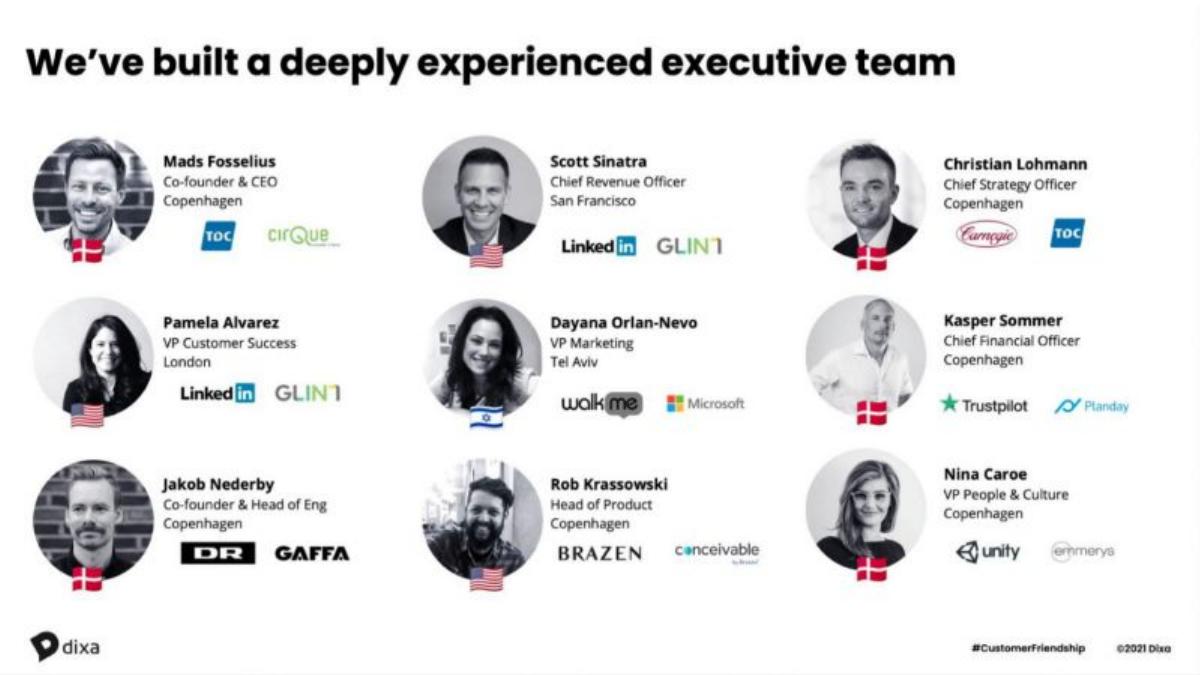
- The executive team is distributed across Copenhagen, San Francisco, London, and Tel Aviv, emphasizing a global operational footprint on slide 4.
The Narrative Shift: Dixa’s $105M Series C Teardown
Dixa’s Series C deck is a masterclass in late-stage storytelling. By the time a company reaches a Series C, the question isn't whether the product works, but whether the company can dominate a category. This deck, prepared for General Atlantic, focuses almost entirely on market evolution and philosophical differentiation. It moves away from the 'how it works' and leans heavily into 'why we win.'
Slides 1-2: The Foundation and Immediate Credibility
The cover slide (Slide 1) establishes the brand identity immediately with the trademarked term "The Customer Friendship™ Platform." It is personalized for General Atlantic, a common but effective tactic for high-stakes management presentations. Slide 2, titled "Dixa in a nutshell," serves as a high-level executive summary. It lists the founding year (2015), total funding to date ($50M+), and headcount (170+ employees). The inclusion of six G2 badges from Fall 2020—ranging from 'Best Est. ROI' to 'Fastest Implementation'—provides immediate third-party validation that the platform is competitive in the mid-market segment.
Slides 3-4: Scale and Human Capital
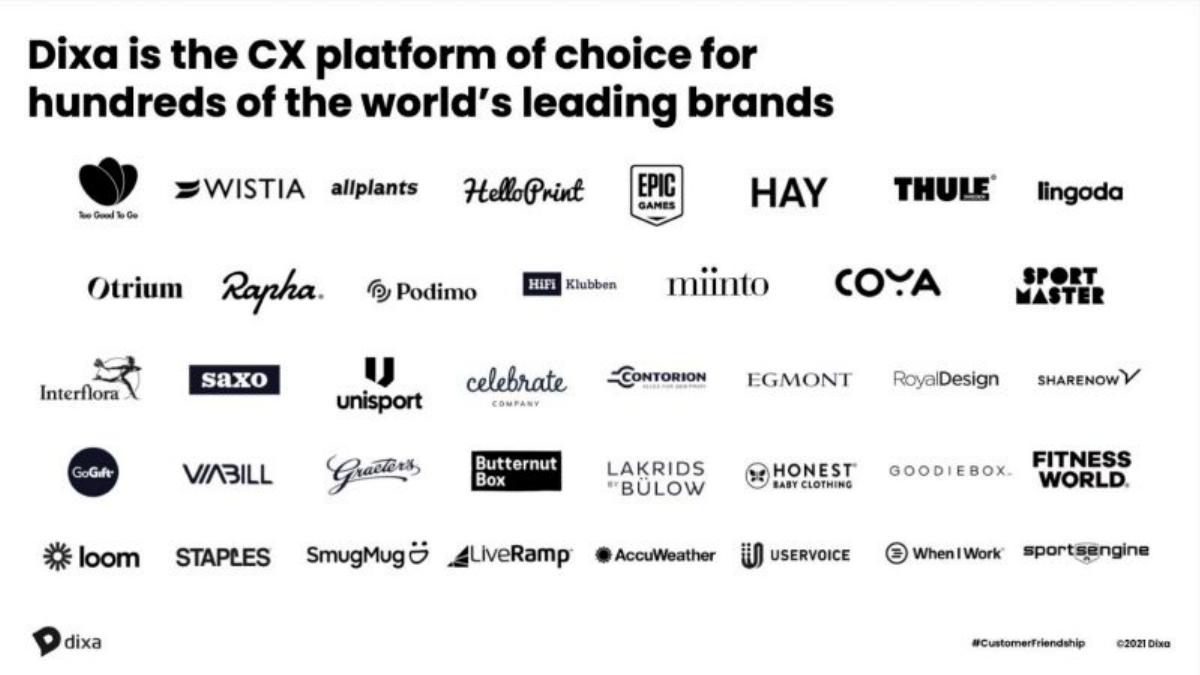
Slide 3 is a dense logo wall featuring "hundreds of the world’s leading brands." Notable names include Wistia, Epic Games, Thule, Loom, and Staples. This slide is intended to overwhelm the viewer with the sheer volume and diversity of Dixa's customer base. Slide 4 introduces the executive team. The pedigree here is significant, with logos from Zendesk, LinkedIn, Trustpilot, and Unity appearing under various team members. The slide also highlights a global footprint, with leaders based in Copenhagen, San Francisco, London, and Tel Aviv, signaling that Dixa is ready for international scale.
Slide 5: The Competitive Landscape
This is one of the most important slides in the deck. Dixa uses a Venn diagram to position itself at the center of three legacy categories: Ticket and Email Masters (Zendesk, Salesforce), Chat and Messaging Gurus (Intercom, Olark), and Call Center and Phone Kings (Avaya, Talkdesk). By placing Dixa in the center, they argue that their platform is the only one that truly unifies these disparate communication silos. They also define the total addressable market as $90bn by 2027 , citing a 10% CAGR.
Slides 6-9: The Problem and The Paradigm Shift
Slide 6 provides a historical timeline, moving from the "Contact Center Age" (1998-2008) to the "Ticketing Age" (2008-2018) and finally the "Conversational Age" (2018-present). Dixa positions itself as the leader of this new age, where customer service is viewed as 'the new marketing.' Slides 7 and 8 diagnose the failure of current systems. Slide 7 introduces "The Value Gap," arguing that a focus on efficiency and productivity (the 'Efficiency Mindset') prevents brands from reaching the 'Value-added Experience' customers expect. Slide 8 critiques the 'Modern' Omni-Channel approach as a 'never-ending tech fix' that creates technical debt. Slide 9 uses a simple quadrant graph to show that Dixa moves the needle from 'Loss/Efficiency' to 'Profit/Value.'
Slides 10-12: The Solution and Product Vision
Slide 10 explicitly states Dixa is the "only customer engagement platform that changes customer service to value." It emphasizes a 'multiexperience' approach over 'omnichannel.' Slide 11 illustrates this with a visual comparison: a unified agent view versus a fragmented customer experience. Slide 12 goes deeper into the technology, mentioning "Intelligent routing and LTV based prioritization" and "AI-optimized knowledge base." It cites an Accenture statistic claiming this approach can result in 3.5x higher financial performance YoY.
Slide 13: The Proof Point
The deck concludes its core content with a case study of Rapha . This slide is data-rich, quoting a 14% customer experience lift, 22% retention boost, and 17% efficiency increase. It specifically mentions that Rapha switched 120 agents from Zendesk Support, Chat, and Talk, which serves as a direct shot at their largest competitor.
What Dixa’s Deck Does Well
Strong Category Creation: By trademarking 'Customer Friendship,' Dixa isn't just selling software; they are selling a new way of doing business. This is essential for a Series C round where you are competing for 'category king' status. · Direct Competitor Targeting: The deck doesn't shy away from naming names. By explicitly showing how they replace Zendesk and bridge the gap between Intercom and Avaya, they make their value proposition concrete. · Visual Narrative: The deck uses a consistent color palette and clean, professional layouts. The transition from the 'Efficiency Mindset' to the 'Value Mindset' is handled through clear, easy-to-digest diagrams.
What is Missing from Dixa’s Deck
Financial Specifics: There is no mention of ARR, NRR (Net Revenue Retention), or CAC (Customer Acquisition Cost). While these were likely in the full management presentation or data room, their absence in the primary deck leaves the 'growth' story purely qualitative. · The Ask: The deck does not state how much money they are looking to raise or how they intend to spend it. In a Series C, this is often understood to be for 'global expansion' and 'product R&D,' but a slide dedicated to the use of proceeds is standard. · Product Roadmap: While the deck mentions AI and intelligent routing, it doesn't show what the future of the product looks like over the next 18-24 months.
Founder Lessons from Dixa
Sell the 'Age,' not the 'Feature': If you are in a crowded market, don't just list features. Do what Dixa did on Slide 6: define the current era, explain why it's ending, and position yourself as the inevitable future. · Use Social Proof Early: Don't wait until the end of the deck to show your logos and awards. Dixa puts their G2 badges and logo wall in the first three slides to build immediate trust. · Focus on Outcomes: The Rapha case study is effective because it focuses on business outcomes (retention and experience lift) rather than just technical improvements. When pitching to late-stage investors like General Atlantic, you must speak the language of ROI.
Frequently asked questions
- How much did Dixa raise with this deck?
- According to the catalogue facts, Dixa raised $105M in a Series C round in 2021. The deck itself notes on slide 2 that they had already raised $50M+ in total funding prior to this specific presentation for General Atlantic.
- Who are Dixa's primary competitors according to the deck?
- Slide 5 categorizes competitors into three groups. 'Ticket and Email Masters' include Zendesk, Salesforce, and Freshdesk. 'Chat and Messaging Gurus' include Intercom, Drift, and LivePerson. 'Call Center and Phone Kings' include Genesys, Avaya, and Talkdesk. Dixa positions itself at the intersection of all three.
- What is the 'Customer Friendship' concept mentioned throughout?
- It is Dixa's trademarked branding for their platform. As described on slide 10, it represents a shift from 'service to value.' The goal is to move away from transactional ticketing toward a 'multiexperience' approach that increases customer lifetime value through more personal, conversational interactions.
- Does the deck include financial metrics like ARR or Churn?
- No. The deck is notably light on internal financial metrics. It mentions 'hundreds of brands' (slide 3) and '170+ employees' (slide 2), but it does not disclose specific revenue figures, growth rates, or churn percentages. This is common in late-stage decks where such data is usually handled in a separate data room.
- What specific results does the deck claim for its customers?
- On slide 13, Dixa uses a case study of the brand Rapha to demonstrate impact. They claim a 14% lift in customer experience, a 22% boost in retention, and a 17% increase in efficiency. Crucially, they note Rapha switched 120 agents from Zendesk to Dixa to achieve this.