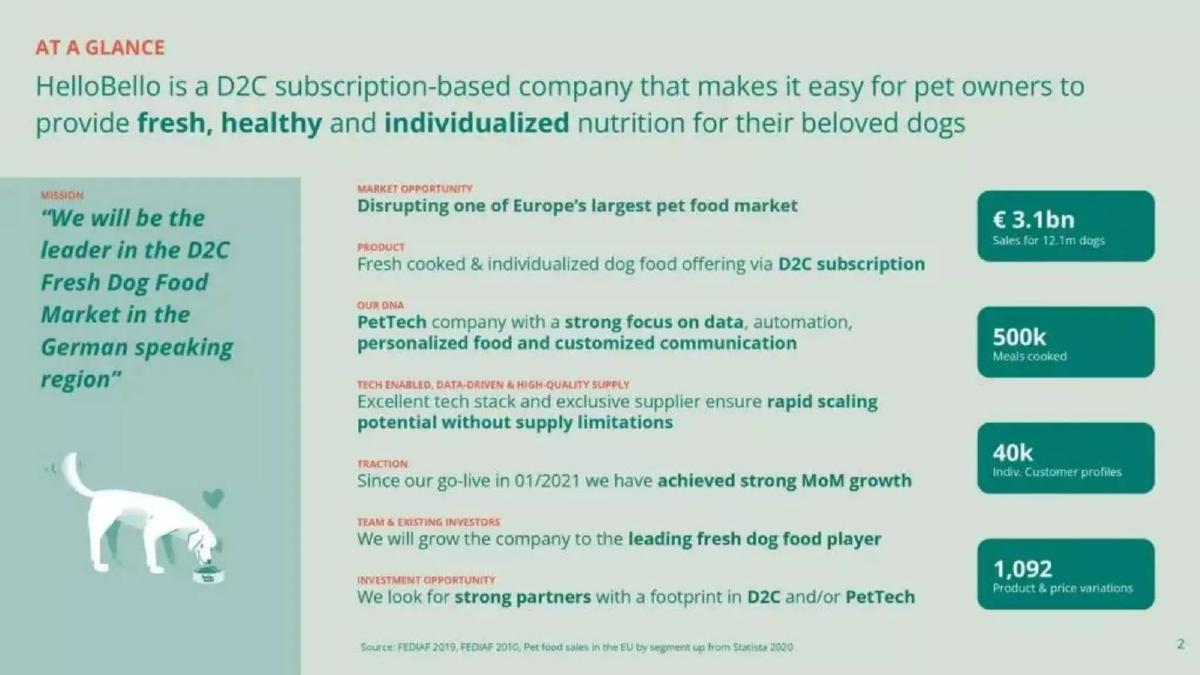
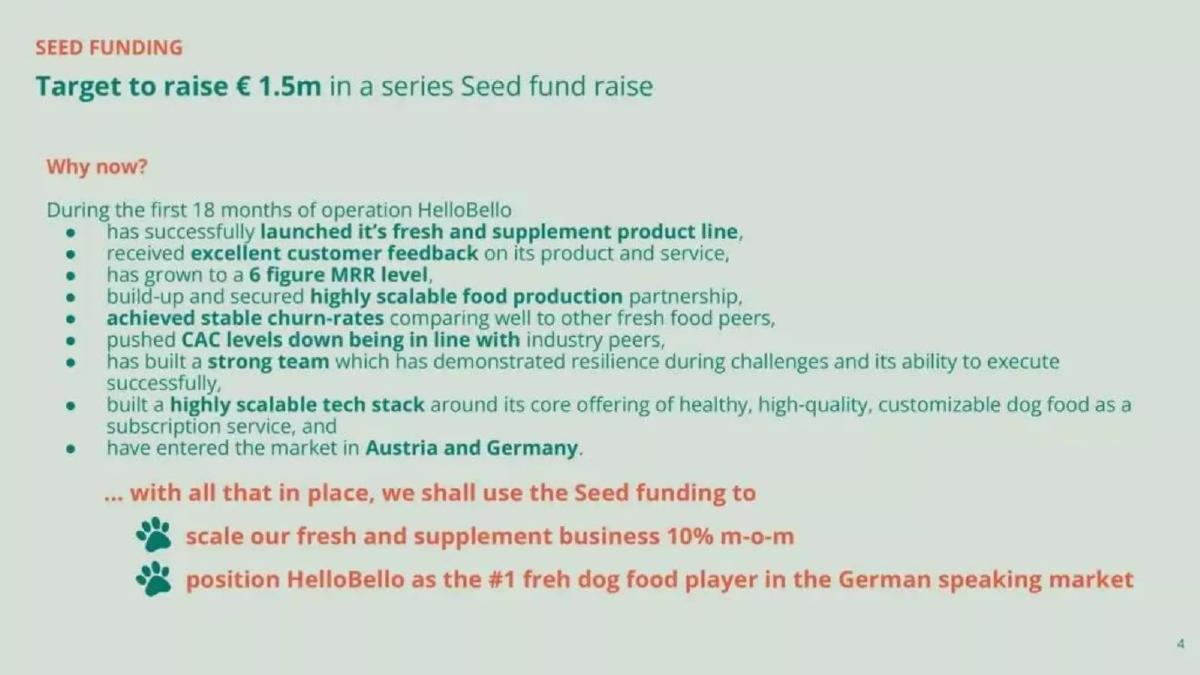
HelloBello’s pitch deck is a textbook example of the 'geographic arbitrage' strategy. By identifying successful fresh pet food models in the US (The Farmer’s Dog) and UK (Butternut Box), the company positioned itself as the first mover for the German-speaking (DACH) market. The deck focuses heavily on the health crisis in pets—citing that 50% of German dogs are obese—and counters this with a tech-enabled, personalized subscription model. While the provided slides lack a specific team breakdown or detailed unit economics, the market sizing slide (Slide 9) is exceptionally detailed, breaking do…
Key takeaways
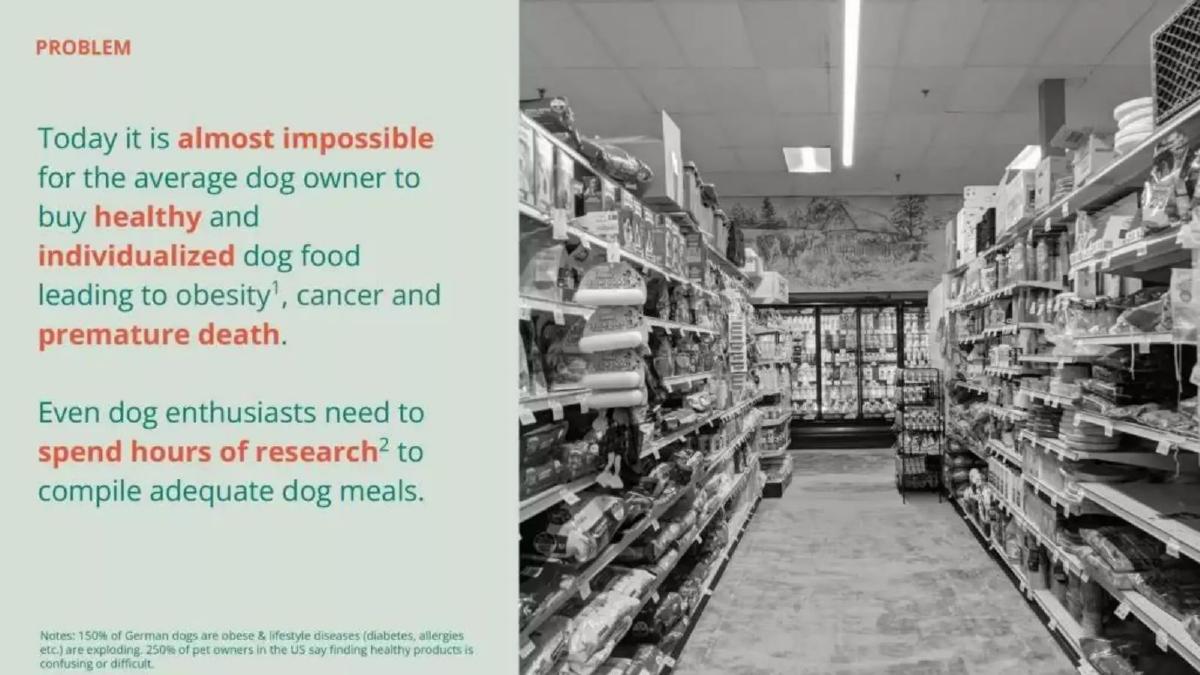
- The company identifies a massive health problem, noting on slide 3 that 50% of German dogs are obese, leading to cancer and premature death.
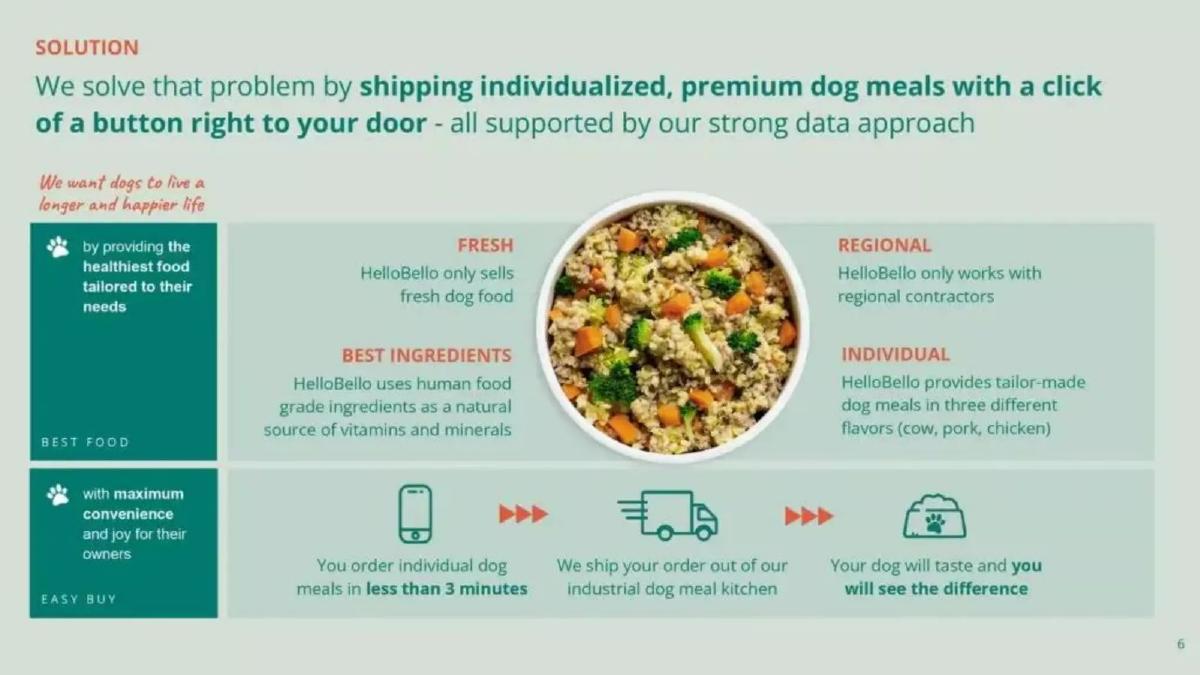
- HelloBello utilizes a three-step product journey: food configurator, delivery within 24-48 hours, and pre-portioned meals (Slide 7).
- The market analysis on slide 9 is highly granular, calculating a SOM of €53m based on a €3.5 daily expenditure per dog for 40.5k dogs.
- Competitive positioning on slide 11 explicitly names US and UK peers like The Farmer's Dog and Butternut Box to validate the business model's success elsewhere.
- The deck highlights a specific 'premium factor' of 4x in spending for the target demographic compared to average dog owners (Slide 9).
- Sustainability is a core pillar, with slide 15 claiming a straw-based packing system uses 50x less energy than expanded polystyrene.
- The product roadmap on slide 13 shows a clear progression from Austria in 2020 to Germany in 2022, aiming for DACH leadership by 2025.
- Operational efficiency is emphasized via a 65% return rate for used packing material, supporting their CO2 neutrality goal (Slide 15).
Introduction and Vision
Slide 1: Title Slide
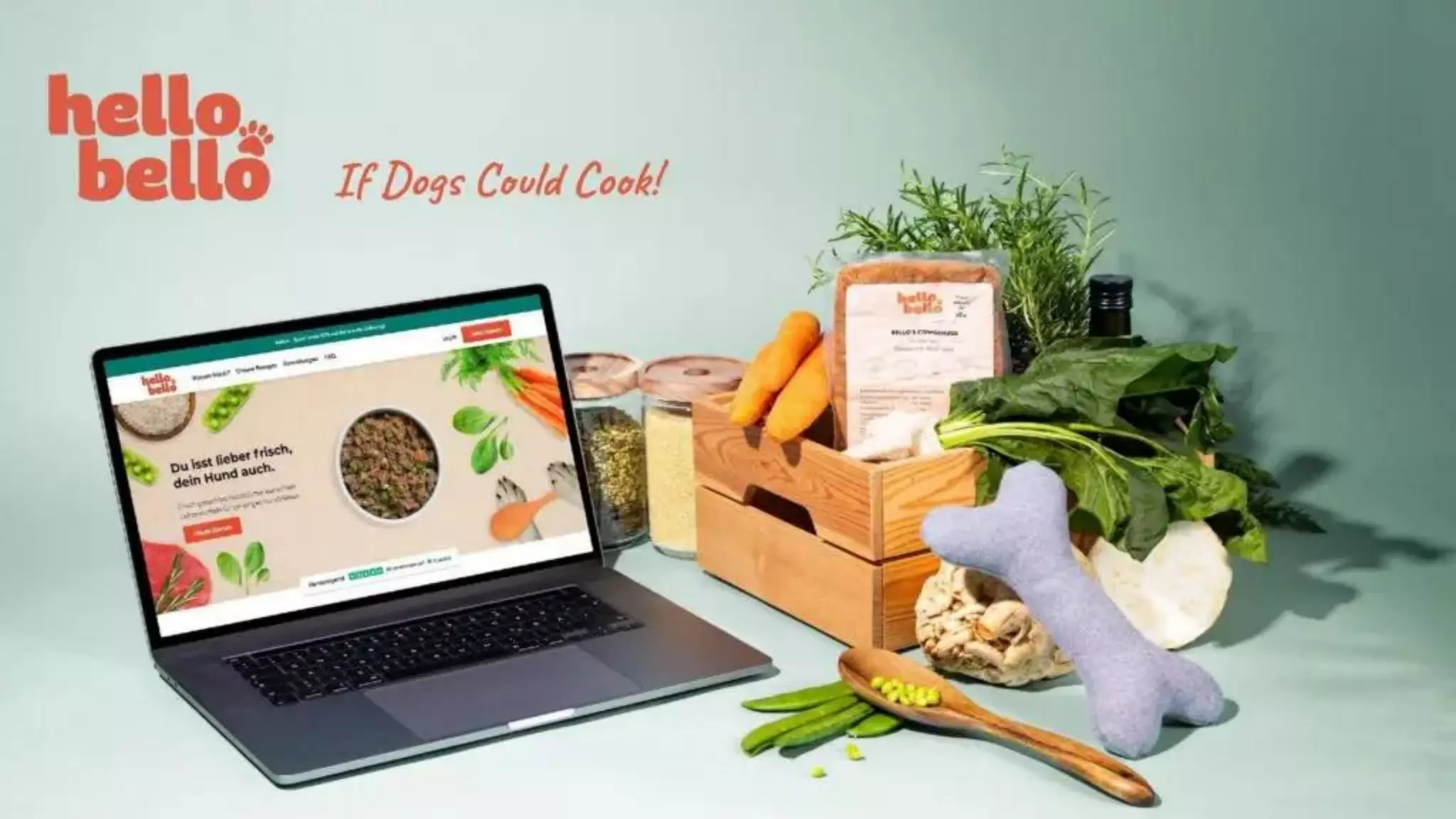
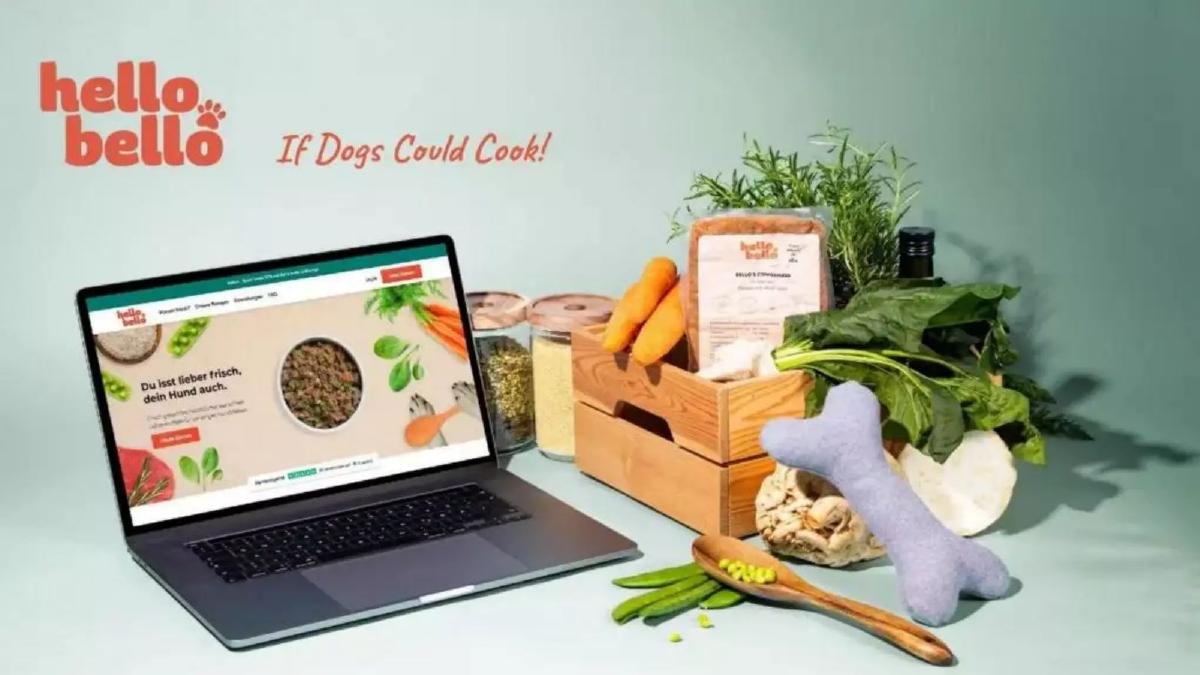
The deck opens with a clean, lifestyle-oriented image featuring the HelloBello logo and the tagline "If Dogs Could Cook!" The visual includes a laptop showing the company's German-language website, fresh ingredients like carrots and spinach, and a vacuum-sealed pack of dog food. This immediately establishes the brand as a D2C (Direct-to-Consumer) fresh food player with a digital-first interface.
Slide 2: Vision
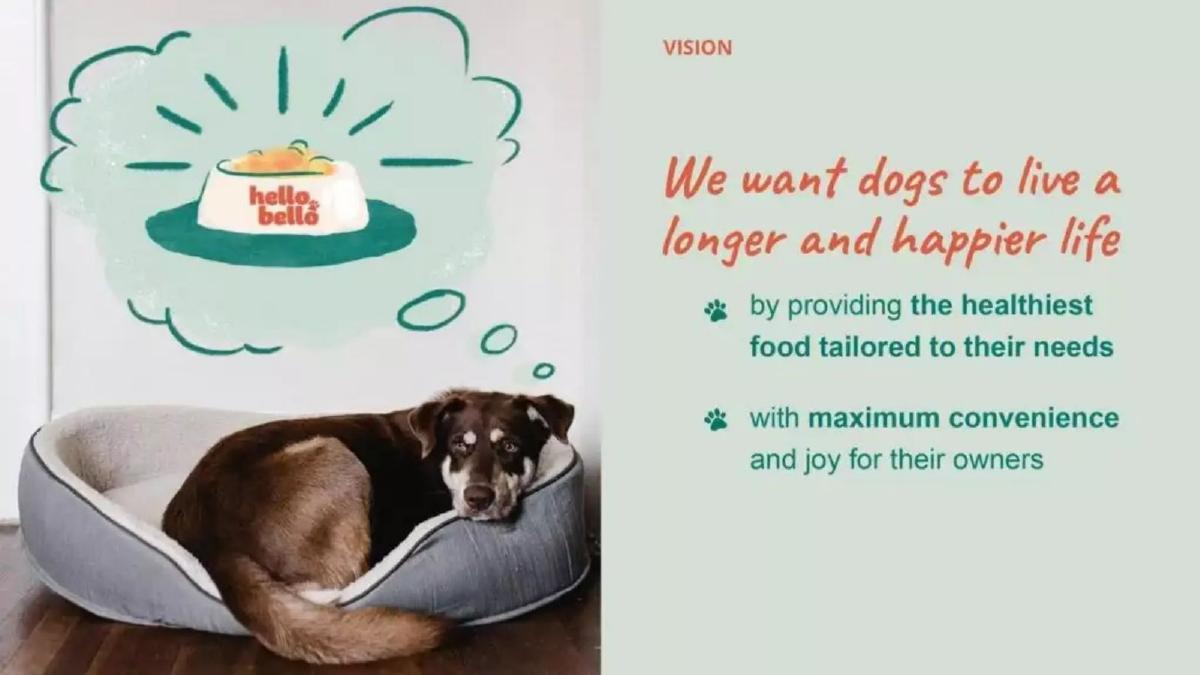
Slide 2 articulates the core mission: "We want dogs to live a longer and happier life." The company plans to achieve this through two pillars: providing the healthiest food tailored to specific needs and ensuring maximum convenience for owners. The use of a thought bubble showing a dog dreaming of HelloBello food adds a playful, emotive element to the pitch.
The Problem and Solution
Slide 3: The Problem
This slide uses a high-contrast strategy, placing a black-and-white photo of a cluttered, uninspiring supermarket pet food aisle next to alarming health statistics. The text states it is "almost impossible" for average owners to buy healthy, individualized food. Crucially, it cites that 50% of German dogs are obese, leading to cancer and premature death. It also notes that even enthusiasts must spend hours researching to compile adequate meals, framing the current market as both dangerous for pets and inconvenient for humans.
Slide 7: Fresh Food - Product Journey
Slide 7 outlines the operational flow of the service in three steps. First, a "food configurator" on a mobile or desktop device allows for personalization. Second, the product is delivered within 24-48 hours. Third, the meals arrive pre-portioned and personalized with the dog's name. This slide effectively demonstrates the "tech-first" approach mentioned later in the deck, showing how software simplifies a complex nutritional task.
Market Opportunity
Slide 9: Market & Trends
This is one of the most data-dense slides in the deck. It breaks down the DACH region market (Germany, Austria, Switzerland) which contains over 12.1 million dogs. The TAM (Total Addressable Market) is cited at €2.23bn, the SAM (Serviceable Addressable Market) at €1.32bn, and the SOM (Serviceable Obtainable Market) at €53m. The math for the SOM is particularly impressive: it assumes a 15% online sales share, a 50% subscription willingness, and a 30% target market share (40.5k dogs) over 4 years. They estimate a €3.5 daily expenditure per dog for HelloBello customers, which is significantly higher than the €0.53 average expenditure for standard dog food in Germany.
Slide 11: Fresh Food Peers
HelloBello uses this slide to validate their business model by pointing to successful international counterparts. They list US companies like The Farmer’s Dog ($103m funding, $1.4bn valuation) and Ollie ($51m funding), and UK-based Butternut Box (£40m last round). By highlighting that these competitors focus on US, UK, or French-speaking markets, HelloBello positions itself as the logical winner for the untapped German-speaking market. This "copycat" strategy (in a positive sense) reduces perceived risk for investors by showing the model works at scale elsewhere.
Roadmap and Sustainability
Slide 13: Product Roadmap
The roadmap shows a clear geographic expansion strategy. Starting in Austria in 2020, moving into Germany in 2022 with an enhanced "Nutri-Mix," and aiming to be the "Leading pet meal supplier in the DACH region" by 2025. The vision for 2025 is to become a "One-Stop-Shop for pet well-being," suggesting future horizontal expansion into other pet services or products beyond just fresh food.
Slide 15: Sustainability
Sustainability is treated as a core business metric rather than an afterthought. The goal is CO2 neutrality by 2023. The slide highlights a straw-based packing system that uses 50x less energy than standard polystyrene. A key traction metric is hidden here: 65% of customers currently send back their used packing material for reuse. This high return rate suggests strong brand loyalty and an environmentally conscious customer base that aligns with the premium positioning of the product.
What Works and What is Missing
What Works
Geographic Focus: The deck makes a compelling case for why the DACH region is a specific, winnable opportunity despite global competition. · Granular Market Math: Slide 9 moves beyond "big numbers" to show exactly how they arrive at their revenue projections based on daily dog spend. · Validation by Proxy: By listing the valuations and funding rounds of US/UK peers, they anchor the potential value of HelloBello in the minds of investors. · Visual Clarity: The deck uses a consistent color palette and clean iconography that reflects a premium consumer brand.
What is Missing
Team Slide: In the provided 9 slides, there is no mention of the founders' backgrounds. In a D2C startup, the ability to execute on marketing and supply chain is paramount. · Unit Economics: While they mention daily spend, there is no data on the cost to acquire a customer (CAC) or the churn rate, which are the two most important metrics for a subscription business. · The Ask: The specific terms of the $1.8M raise and how the funds will be allocated (e.g., % to marketing vs. % to production) are not shown. · Competitive Moat: Beyond being "German-speaking," the deck doesn't explicitly state what stops a well-funded player like Butternut Box from simply translating their site and entering Germany.
Founder Takeaways
Use Geographic Arbitrage: If you are building a business model that is already proven in a different market (like the US), use that data to your advantage. Show the valuations of those companies to prove the "ceiling" is high, then explain why your specific local knowledge makes you the right person to win your region.
Solve a High-Stakes Problem: HelloBello doesn't just sell dog food; they sell a solution to "premature death" and "cancer." By framing the problem in terms of life and death, they move the product from a luxury to a necessity for pet lovers.
Detail Your Sustainability: In the modern investment climate, especially in Europe, having a specific, measurable sustainability plan (like the 65% packaging return rate) can be a significant differentiator for ESG-conscious investors.
Frequently asked questions
- What is HelloBello's primary market focus?
- HelloBello focuses exclusively on the DACH region (Germany, Austria, and Switzerland). Slide 11 notes that while the fresh dog food trend is established in the US and UK, HelloBello is the only firm focusing on the German-speaking market, providing a clear competitive moat based on geography and language.
- How does HelloBello justify its premium pricing?
- Slide 9 explains that premium dog owners spend approximately €2 per day, a 'premium factor' of 4x over the average. HelloBello targets an even higher tier, projecting €3.5 expenditure per dog per day for its subscription service, justified by personalization and health benefits.
- What are the key health metrics mentioned in the deck?
- Slide 3 highlights that 50% of German dogs are obese and lifestyle diseases like diabetes and allergies are 'exploding.' It also mentions that 50% of pet owners in the US find finding healthy products confusing, suggesting a similar pain point in Europe.
- How does the company handle logistics and sustainability?
- According to slide 15, the company uses a straw-based packing system and offers free return shipping for used materials, which 65% of customers utilize. They aim for CO2 neutrality by 2023 by relying on 'Post Next Day Fresh' delivery services.
- What is missing from this pitch deck teardown?
- The provided slides do not include a team slide, a specific breakdown of the $1.8M 'Ask,' or detailed unit economics such as Customer Acquisition Cost (CAC) and Lifetime Value (LTV). These are critical for late-seed or Series A rounds but may have been in the 8 missing slides.