donkidrive, developed by Fetchit4me (Pty) Ltd, is a South African startup proposing a peer-to-peer delivery and ridesharing network. The platform relies on 'circles' of friends to facilitate the transport of goods and people, aiming to solve logistics gaps for items unfit for traditional couriers. The deck specifies a revenue model based on a 10% admin fee or a minimum of R15 per transaction. While the deck provides clear demand forecasting—projecting 1 million active users and R30 million in revenue within a year—it lacks critical information regarding the founding team, current user metrics…
Key takeaways
- The company operates under the registered South African entity Fetchit4me (Pty) Ltd as stated on slide 6.
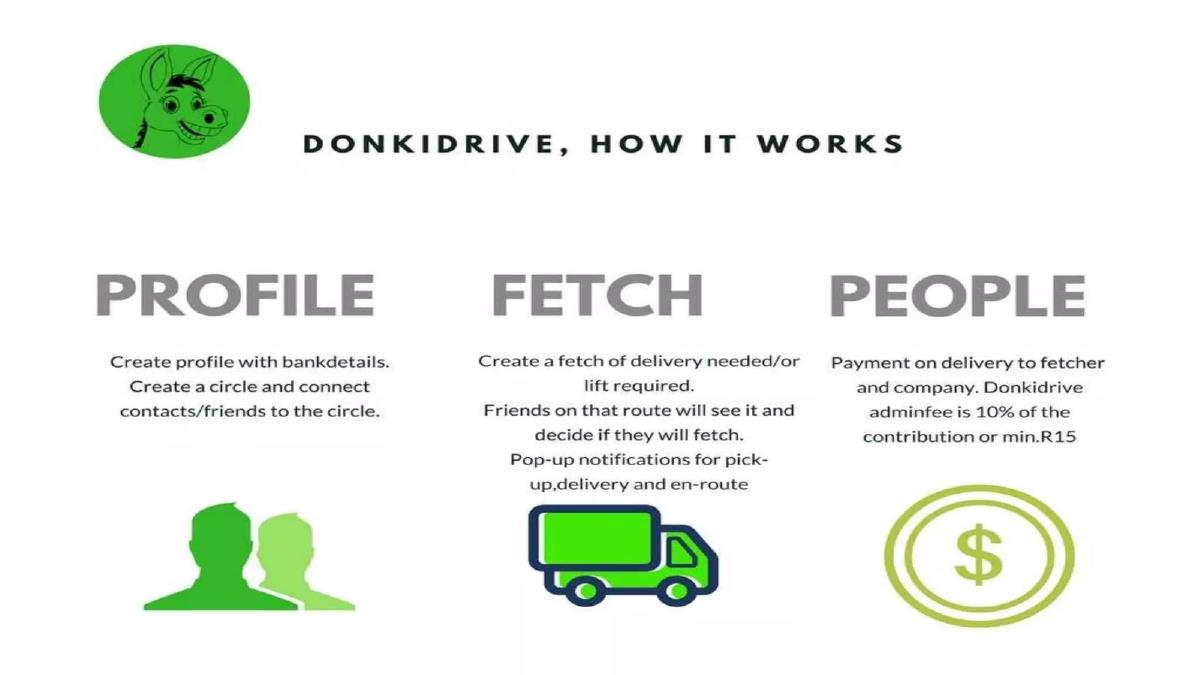
- The revenue model is fixed at a 10% admin fee or a minimum of R15 per transaction according to slide 3.
- The platform utilizes a 'circle' system where users connect with friends to find 'fetchers' for deliveries or lifts on slide 3.
- Demand forecasting projects 3 million downloads and 1 million active users within the first year on slide 5.
- Projected revenue is R30 million for the first year, with a forecasted 100% annual growth rate on slide 5.
- The deck claims the app and website are already created and the company is 'First round of Investment ready' on slide 6.
- A primary differentiator is the 'friends only' model, which the deck claims provides safety without needing live tracking on slide 4.
- The deck omits a team slide, a specific funding amount, and a breakdown of operational costs.
Executive Summary: The Social Logistics Model
donkidrive, presented by the entity Fetchit4me, attempts to bridge the gap between social networking and logistics. The deck focuses on a peer-to-peer (P2P) model where the 'fetcher' is someone within a user's trusted social circle. This teardown examines the 11-slide deck (of which 6 are provided) to understand the business case for a friend-based delivery and ridesharing service in the South African market.
Slide 1: Title and Branding
The cover slide introduces the brand name 'donkidrive' accompanied by the tagline 'CHANGING HOW WE SHARE.' The branding features a cartoon donkey mascot in a green circle. The slide attributes the project to 'fetch-it4me,' which is later identified as the parent company. This slide establishes the identity but does not provide a high-level value proposition beyond the vague concept of 'sharing.'
Slide 2: User Personas and Use Cases
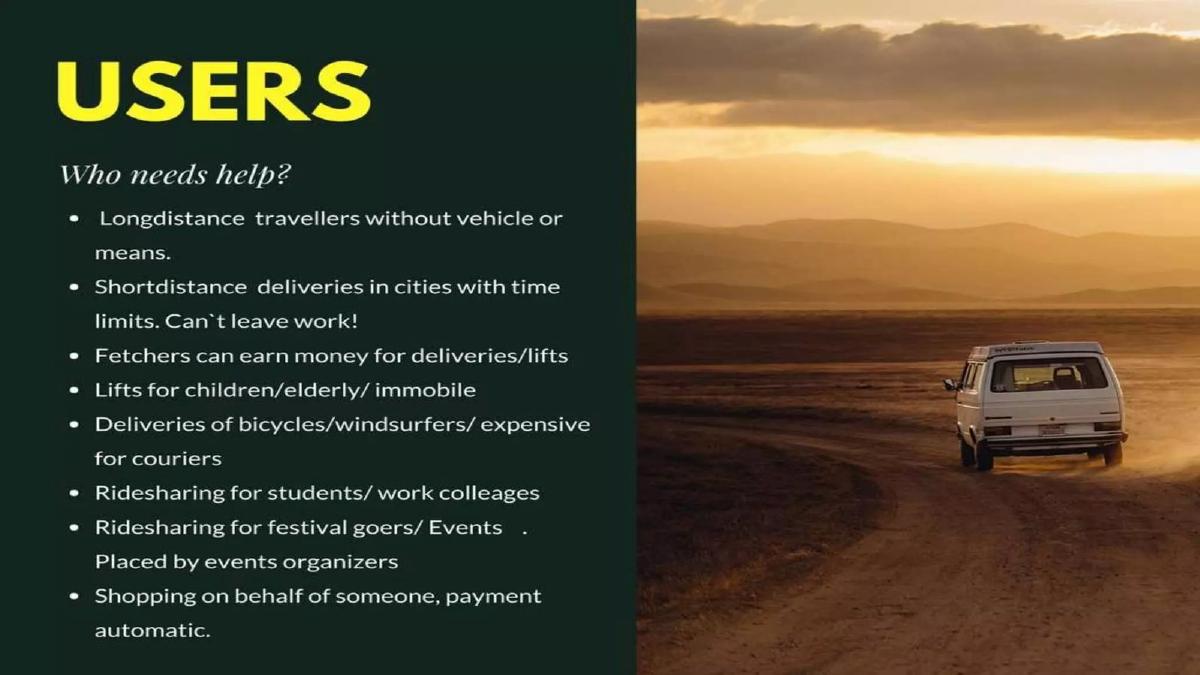
Slide 2, titled 'USERS,' lists eight distinct groups that the platform aims to serve. These include:
Longdistance travellers without vehicle or means. · Shortdistance deliveries in cities with time limits. · Fetchers looking to earn money for deliveries/lifts. · Lifts for children, the elderly, or the immobile. · Deliveries of bicycles, windsurfers, or items 'expensive for couriers.' · Ridesharing for students and work colleagues. · Ridesharing for festival-goers and events, placed by organizers. · Shopping on behalf of someone with automatic payment.
This slide is broad, suggesting donkidrive is a 'super-app' for logistics. By targeting everything from child transport to windsurfer delivery, the company risks lack of focus, though it clearly identifies a gap in traditional courier services for irregular or oversized personal items.
Slide 3: The Operational Workflow
The 'DONKIDRIVE, HOW IT WORKS' slide breaks the process into three pillars: PROFILE, FETCH, and PEOPLE. PROFILE involves creating a profile with bank details and a 'circle' of contacts. FETCH describes the creation of a delivery or lift request, which is then visible to friends on that route. It mentions pop-up notifications for 'pick-up, delivery and en-route.' PEOPLE covers the financial transaction. The deck explicitly states the revenue model: 'Donkidrive adminfee is 10% of the contribution or min.R15.' This is the most concrete business data in the deck, establishing a clear per-transaction monetization strategy.
Slide 4: Competitive Differentiators
Slide 4 lists 'DIFFERENTIATORS' that supposedly set the platform apart. Key points include:
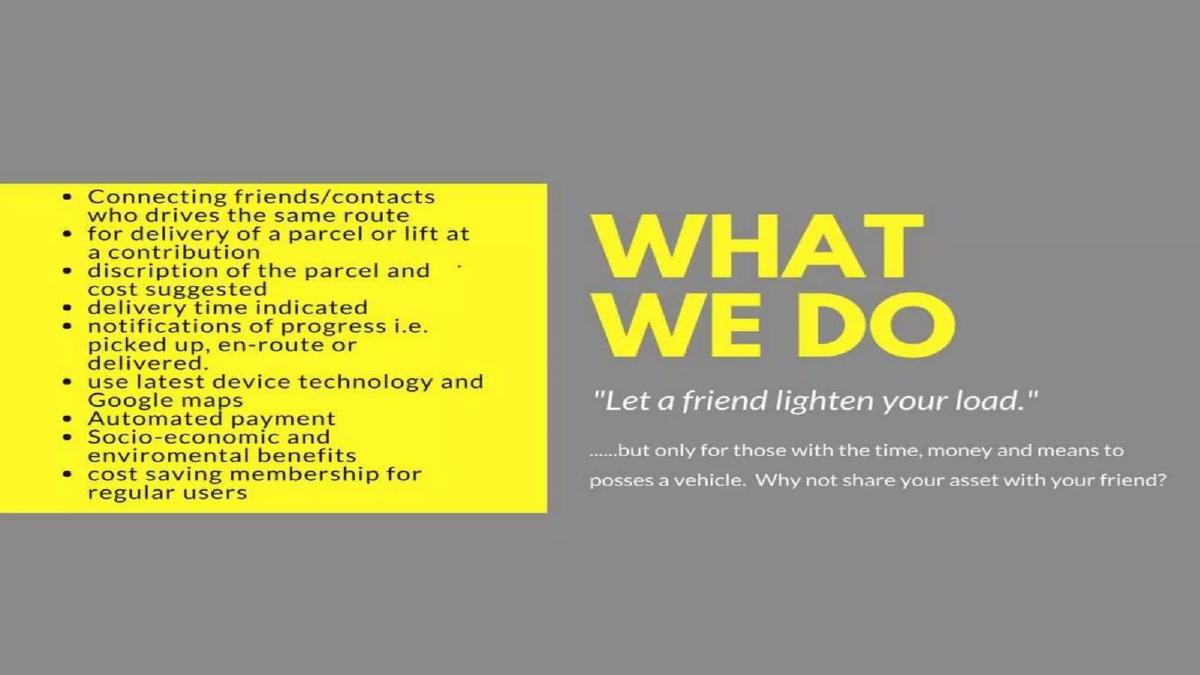
'Friends only, trusted fetcher and driver for lift.' · 'Reduced costs' and 'High-tech convenience.' · 'Packages not fit for courier/ size, personal or delicate.' · 'Geo-awareness addresses for pick-up and delivery.' · 'Safe- no live tracking.' · 'NGOs free use, socio economic contribution.'
The claim that 'no live tracking' is a safety feature is counter-intuitive in the modern gig economy, where tracking is usually synonymous with security. The founder's logic appears to be that because you know the person (they are in your 'circle'), the need for digital surveillance is mitigated. The mention of free use for NGOs suggests a corporate social responsibility angle intended to appeal to the South African regulatory and social environment.
Slide 5: Demand Forecasting and Financial Projections
The 'DEMAND FORCASTING' (sic) slide provides the primary growth thesis. It sets a target of '3million downloads in the next year,' with a subset of '1mil use actively.' The growth rate is projected at '100% p.a.' (per annum). On the revenue side, the deck calculates: 'Used conservatively 2x p.ax R15 x 1 000 000 users - R30 million increasing 100% p.a.' This calculation assumes every active user will perform at least two transactions a year at the minimum fee of R15. While the math is simple, the deck provides no data to support the 3-million-download acquisition strategy or the 100% year-over-year growth rate.
Slide 6: Traction and Current Status
The final provided slide, 'Traction- Progress to date,' lists the company's milestones:
SA company registered- Fetchit4me (Pty)Ltd. · Domains for donkidrive.com, .co.za, fetch-it4me.com, and .co.za reserved. · Website created. · Donkidrive app created. · First round of Investment ready.
This slide indicates the venture is past the ideation phase and has a functional product ('app created'). However, it omits any mention of beta testing, current user numbers, or pilot results. The phrase 'First round of Investment ready' serves as the transition to the (missing) ask slide.
What Works and What is Missing
What Works: The revenue model is unambiguous. By stating the 10% or R15 minimum fee, the founders have answered the 'how do you make money' question early. The focus on 'circles' also addresses the significant trust barrier inherent in peer-to-peer services in South Africa.
What is Missing: The deck suffers from several major omissions. First, there is no Team Slide . In early-stage investing, the founders' background is often more important than the idea. Second, there is no Market Analysis . While they mention 3 million downloads, they don't define the Total Addressable Market (TAM) for P2P logistics in South Africa. Third, there is no Ask Slide . An investor does not know if the company is looking for R1 million or R10 million. Finally, the Competitor Landscape is ignored; the deck does not mention how it will compete with established ride-hailing or delivery giants who could easily implement a 'trusted contacts' feature.
Founder's Guide: Lessons from donkidrive
Founders should look at the 'How it Works' slide as a good example of simplifying a multi-sided marketplace into three digestible steps. However, the 'Demand Forecasting' slide serves as a warning: projecting millions of users and 100% growth without explaining the Customer Acquisition Cost (CAC) or the marketing channels to be used is often viewed as 'spreadsheet theater' by experienced analysts. If you claim an app is 'created,' you should include screenshots to prove the UI/UX quality, which this deck fails to do. Lastly, always include a team slide to establish credibility, especially when the business model relies heavily on 'trust.'
Frequently asked questions
- What is the primary service offered by donkidrive?
- donkidrive is a multi-use peer-to-peer platform. According to slide 2, it facilitates long-distance travel for those without vehicles, short-distance city deliveries, ridesharing for students and festival-goers, and transport for bulky or delicate items like bicycles and windsurfers. It also includes a feature for shopping on behalf of others with automatic payment.
- How does the 'circles' feature work for security?
- Slide 3 and slide 4 explain that users create a 'circle' by connecting with their existing contacts and friends. When a delivery or lift is needed, only friends on that specific route see the request. The deck argues on slide 4 that this 'friends only' approach makes the service safe and removes the necessity for live tracking.
- What are the specific financial projections mentioned in the deck?
- Slide 5 outlines a 'Demand Forcasting' (sic) model. It projects 3 million downloads in the first year, with 1 million active users. Based on a conservative estimate of two uses per person per year at the R15 minimum fee, the company projects R30 million in revenue, increasing by 100% per annum.
- What stage of development is the company currently in?
- According to the 'Traction- Progress to date' slide (slide 6), the company has registered its South African entity, reserved domains for donkidrive and fetch-it4me (.com and .co.za), created a website, and completed the donkidrive app. They state they are now ready for their first round of investment.
- What critical investor information is missing from this pitch?
- The deck is missing several standard components. There is no slide introducing the founders or their expertise. There is no 'Ask' slide detailing how much capital is being raised or how it will be allocated. Additionally, there is no mention of current traction metrics (actual users or revenue to date) or a competitive landscape analysis.