Smartcat’s Series C deck is remarkably concise, utilizing only six slides to justify a $43M raise. The narrative centers on the inefficiency of the $100+ billion multilingual content market, currently dominated by fragmented agencies. Smartcat positions itself as the 'wall-to-wall' Language AI platform, claiming 100x cost savings over traditional methods. The deck relies heavily on social proof, noting that over 20% of the Fortune 500 are customers. While it lacks explicit financial charts or a specific 'Ask' slide, the strength of the leadership team—featuring veterans from ABBYY, Miro, and…
Key takeaways
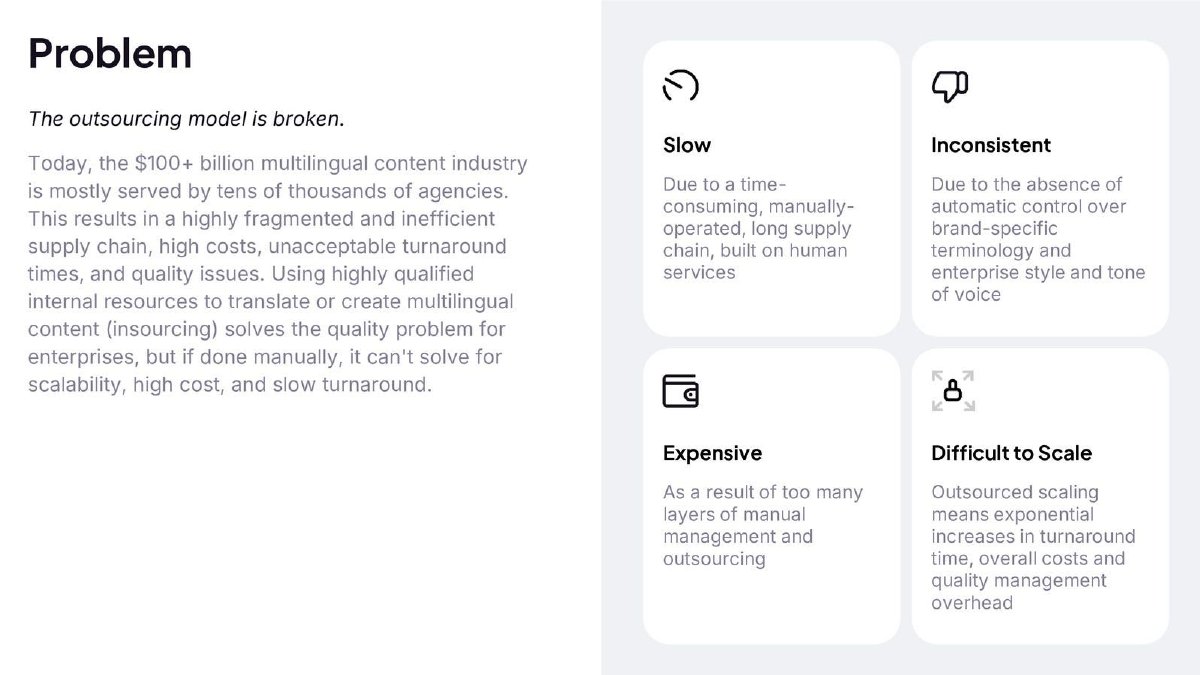
- The deck highlights a massive market opportunity in a $100+ billion industry currently served by inefficient manual agencies (Slide 3).
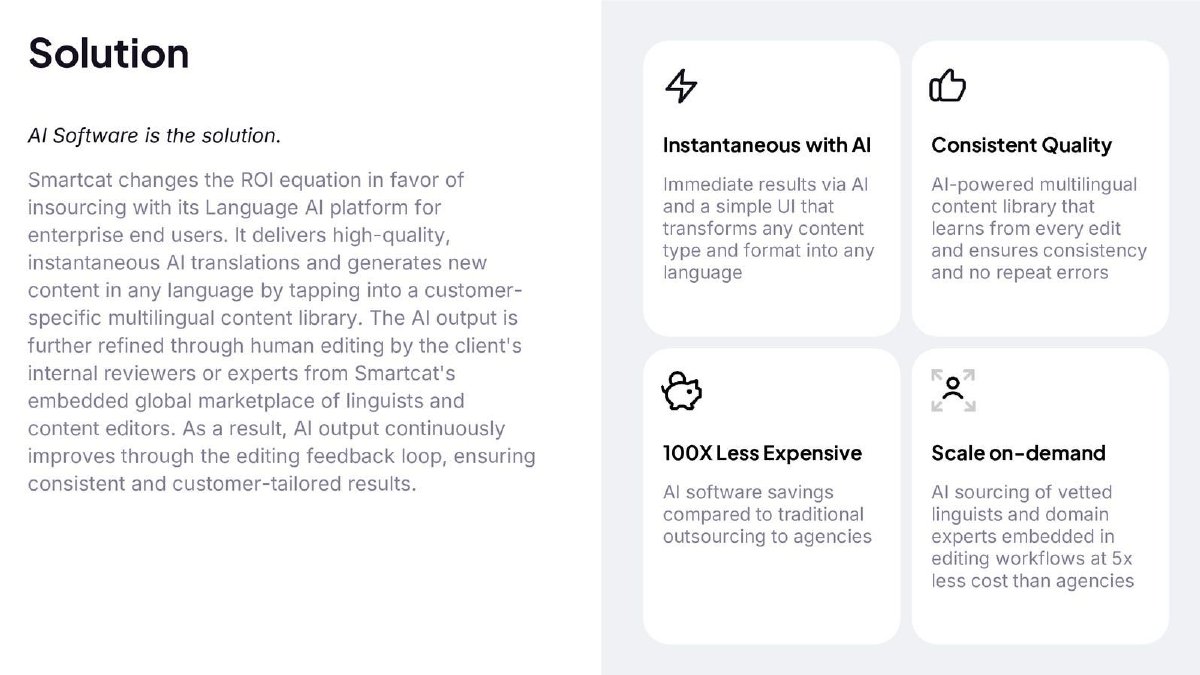
- Smartcat claims a significant competitive advantage by being 100x less expensive than traditional outsourcing to agencies (Slide 4).
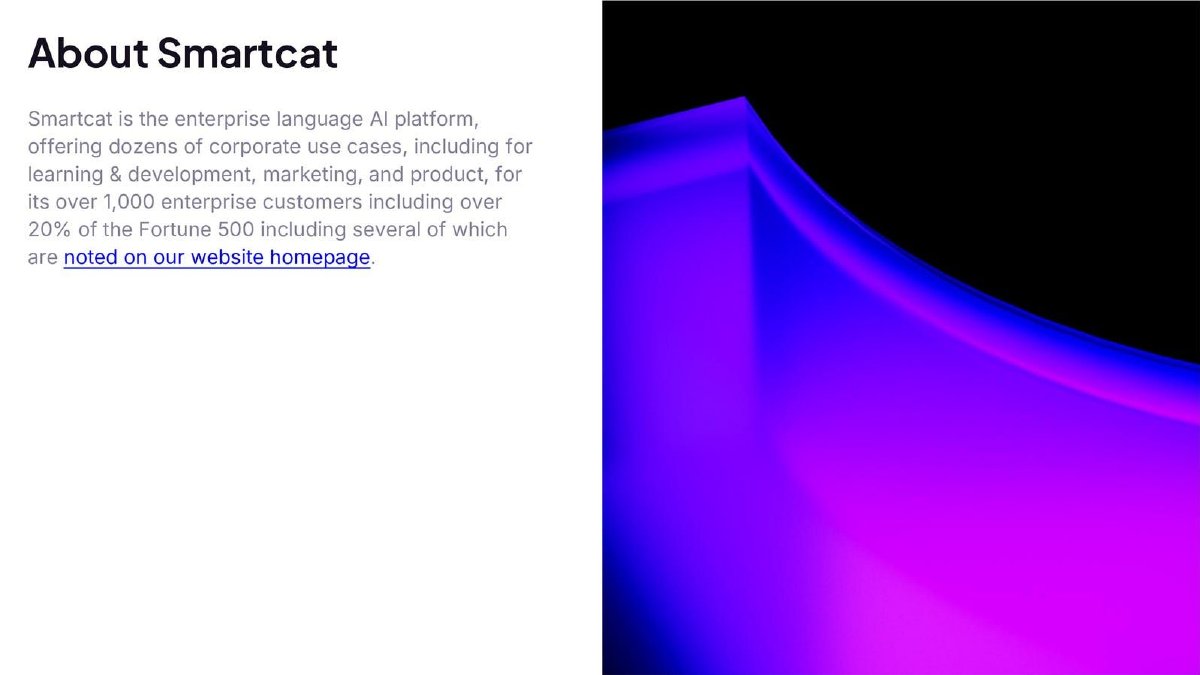
- The company demonstrates deep enterprise penetration, stating that over 20% of the Fortune 500 are already customers (Slide 2).
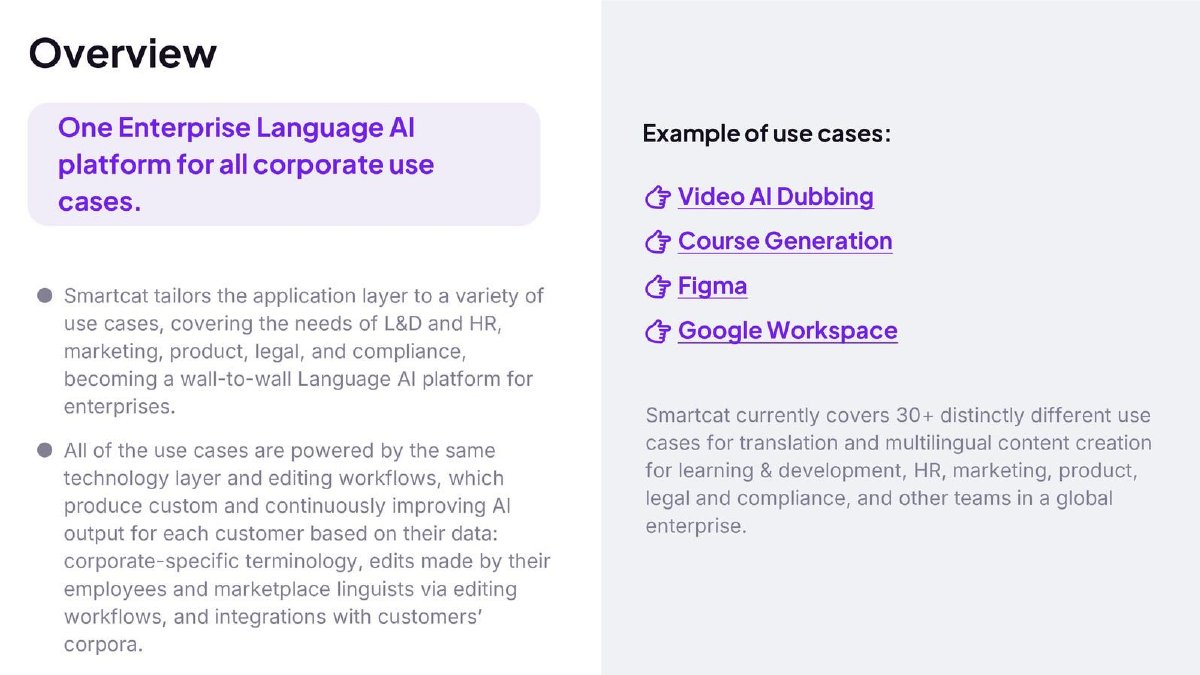
- The solution is presented as a 'wall-to-wall' platform covering 30+ distinct use cases including L&D, HR, marketing, and legal (Slide 5).
- A hybrid approach is emphasized, combining AI translations with an embedded global marketplace of human linguists for refinement (Slide 4).
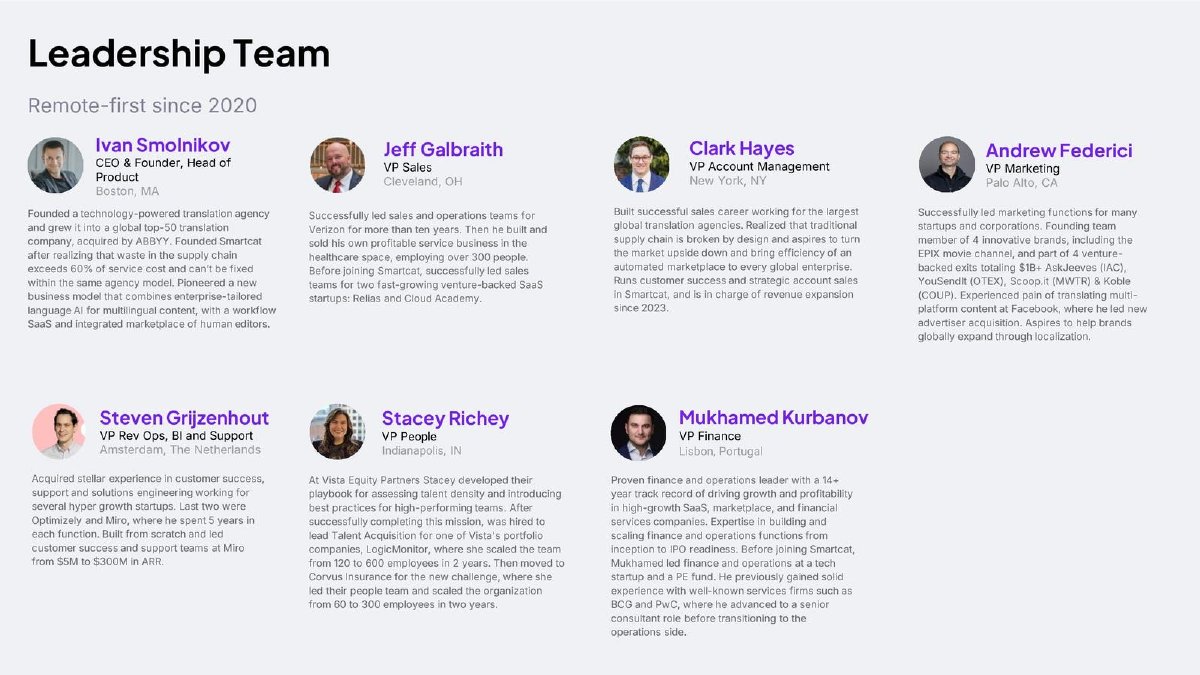
- The leadership team slide is exceptionally detailed, showcasing specific scaling achievements like growing Miro's ARR from $5M to $300M (Slide 6).
- The deck omits traditional financial metrics, projections, and a specific funding ask, focusing instead on the platform's utility and team pedigree.
- Reported data indicates this 6-slide deck supported a $43M Series C round in 2024 (Publisher Fact).
Smartcat Pitch Deck Teardown
Smartcat’s 2024 Series C deck is a masterclass in brevity. In an era where pitch decks often bloat to 20 or 30 slides, Smartcat secured a reported $43M using a lean 6-slide presentation. This teardown examines how the company leveraged its existing enterprise traction and a high-pedigree team to convince investors of its dominance in the Language AI space.
Slide 1: Title Slide
The deck opens with a minimalist title slide featuring the Smartcat.ai branding and a high-fidelity 3D logo. It is functional and sets a professional, enterprise-grade tone immediately. There are no taglines or mission statements here; the focus is entirely on the brand identity.
Slide 2: About Smartcat
Slide 2 serves as the 'Traction' and 'Social Proof' slide. It defines Smartcat as an 'enterprise language AI platform' and immediately drops a significant metric: the company serves over 1,000 enterprise customers. Most importantly, it notes that this customer base includes 'over 20% of the Fortune 500.' By leading with this, Smartcat bypasses the need to prove product-market fit; the market has already validated the tool at the highest level of global business.
Slide 3: The Problem
The problem statement on Slide 3 is framed around the 'broken' outsourcing model. Smartcat identifies a $100+ billion industry that is currently fragmented across tens of thousands of agencies. The slide highlights four specific pain points: Slow (manual supply chains), Inconsistent (lack of brand control), Expensive (too many layers of management), and Difficult to Scale (exponential overhead). This slide effectively sets the stage for a software-led disruption of a service-heavy industry.
Slide 4: The Solution
Slide 4 introduces 'AI Software' as the antidote to the agency model. The core value proposition is 'insourcing'—giving enterprises the tools to handle translation internally with AI. The slide makes a bold claim of being '100X Less Expensive' than traditional agencies. It also explains the 'human-in-the-loop' aspect, where AI output is refined by internal reviewers or Smartcat’s own marketplace of linguists. This hybrid approach addresses the quality concerns typically associated with pure machine translation.
Slide 5: Overview and Use Cases
This slide expands on the platform's versatility. It positions Smartcat as a 'wall-to-wall' platform, meaning it is intended to be used by every department in a company. It lists 30+ use cases, specifically calling out Video AI Dubbing and Course Generation, along with integrations for Figma and Google Workspace. The narrative here is about horizontal expansion within the enterprise—once a company adopts Smartcat for marketing, it can easily roll it out to HR, Legal, and Product teams.
Slide 6: Leadership Team
The final slide is perhaps the most detailed. It features seven executives with deep roots in SaaS and translation. CEO Ivan Smolnikov’s background (founding a company acquired by ABBYY) provides industry-specific credibility. The inclusion of Steven Grijzenhout, who scaled Miro from $5M to $300M ARR, signals to investors that the company has the operational expertise to handle the hyper-growth expected of a Series C firm. The team is geographically distributed (Boston, Amsterdam, Lisbon, etc.), reinforcing the 'remote-first' and global nature of the business.
What Smartcat Does Well
The most striking element of this deck is its efficiency of language . Smartcat does not waste time explaining what AI is; instead, it focuses on the economic impact of AI. By claiming a 100x cost reduction and 5x lower costs for human editing, they speak directly to the bottom-line concerns of CFOs and enterprise buyers.
The social proof is also handled expertly. Mentioning the Fortune 500 penetration on Slide 2 creates an immediate 'fear of missing out' (FOMO) for investors. If 20% of the world's largest companies are already using the platform, the risk of the technology failing to meet enterprise standards is effectively mitigated.
Finally, the Leadership Slide is a standout. It doesn't just list titles; it lists specific, quantifiable achievements (e.g., scaling a team from 60 to 300 employees, or growing ARR by $295M). This level of detail on a team slide is rare and highly effective for late-stage rounds where execution risk is a primary concern for investors.
What is Missing from the Deck
While the deck was clearly successful, it omits several standard components that founders in earlier rounds might need to include:
Financial Metrics: There are no charts showing ARR growth, churn rates, or Net Revenue Retention (NRR). While these were likely shared in a data room, their absence in the pitch deck is notable. · The Ask: The deck does not state how much money is being raised or how the funds will be allocated. This is common in highly competitive Series C rounds where the 'Ask' is often negotiated based on investor interest rather than a fixed target. · Competitive Landscape: There is no 'magic quadrant' or competitive matrix. Smartcat positions itself against 'agencies' generally, rather than naming specific software competitors like DeepL or Phrase. · Unit Economics: While they mention cost savings for the customer, they do not show their own margins or Customer Acquisition Cost (CAC).
What Founders Should Copy
Founders should emulate Smartcat’s problem-solution alignment . Slide 3 and Slide 4 use identical layouts to contrast the 'Broken' world with the 'Smartcat' world. This visual consistency makes the transition from pain to relief very easy for an investor to digest.
Another takeaway is the use case specificity . Instead of saying 'we translate text,' Smartcat lists 'Video AI Dubbing' and 'Figma' integrations. This shows that the product is deeply embedded in modern enterprise workflows, making it 'sticky' and harder to replace.
Lastly, the brevity of the deck is a lesson in confidence. If you have the metrics and the team, you don't need 20 slides of filler. Smartcat proves that a clear value proposition and a stellar team can do the heavy lifting in just six slides.
Final Thoughts
Smartcat’s deck is a high-signal, low-noise document. It assumes a level of investor sophistication regarding the AI market and focuses entirely on the company's unique ability to capture a massive, fragmented industry. For a Series C round, this focus on scale, cost-efficiency, and leadership pedigree is exactly what institutional investors look for.
Frequently asked questions
- How does Smartcat justify its 100x cost-saving claim?
- On Slide 4, Smartcat attributes these savings to the shift from manual agency outsourcing to AI software. By utilizing a customer-specific multilingual content library that learns from every edit, the platform reduces repeat errors and leverages a marketplace of linguists at 5x less cost than traditional agencies for the final human-in-the-loop editing phase.
- What specific enterprise use cases does the platform support?
- Slide 5 lists over 30 distinctly different use cases. Specific examples highlighted include Video AI Dubbing, Course Generation, and integrations with Figma and Google Workspace. The deck emphasizes that the platform serves diverse departments such as L&D, HR, Marketing, Product, Legal, and Compliance.
- Who are the key members of the leadership team?
- Slide 6 introduces a highly experienced team led by CEO Ivan Smolnikov, who previously founded a top-50 translation agency acquired by ABBYY. Other key members include Steven Grijzenhout (VP Rev Ops), who helped scale Miro from $5M to $300M ARR, and Stacey Richey (VP People), who scaled teams at Vista Equity Partners and Corvus Insurance.
- What is the core problem Smartcat aims to solve?
- According to Slide 3, the 'outsourcing model is broken.' The $100+ billion industry is fragmented among tens of thousands of agencies, leading to slow turnaround times, high costs, and inconsistent quality due to a lack of automatic control over brand-specific terminology and tone of voice.
- Is there a specific funding ask or valuation mentioned in the deck?
- No. The 6-slide deck provided does not include a slide dedicated to the funding ask, use of proceeds, or valuation. While publisher facts state the round raised $43M in 2024, the deck itself focuses entirely on the company's value proposition, market position, and team expertise.