Qureight’s 2024 Series A deck is a clinical example of how to pitch a 'TechBio' platform by emphasizing utility over technical jargon. The deck successfully raised $8.5M (as reported by Business Insider) by anchoring its value proposition in the words of its customers, including AstraZeneca and Vicore Pharma. The presentation moves logically from high-level social proof to a granular look at the software interface, followed by a clear breakdown of their three core product pillars: AI image analysis, virtual trial arms, and central read systems. While the deck lacks a specific team slide or de…
Key takeaways
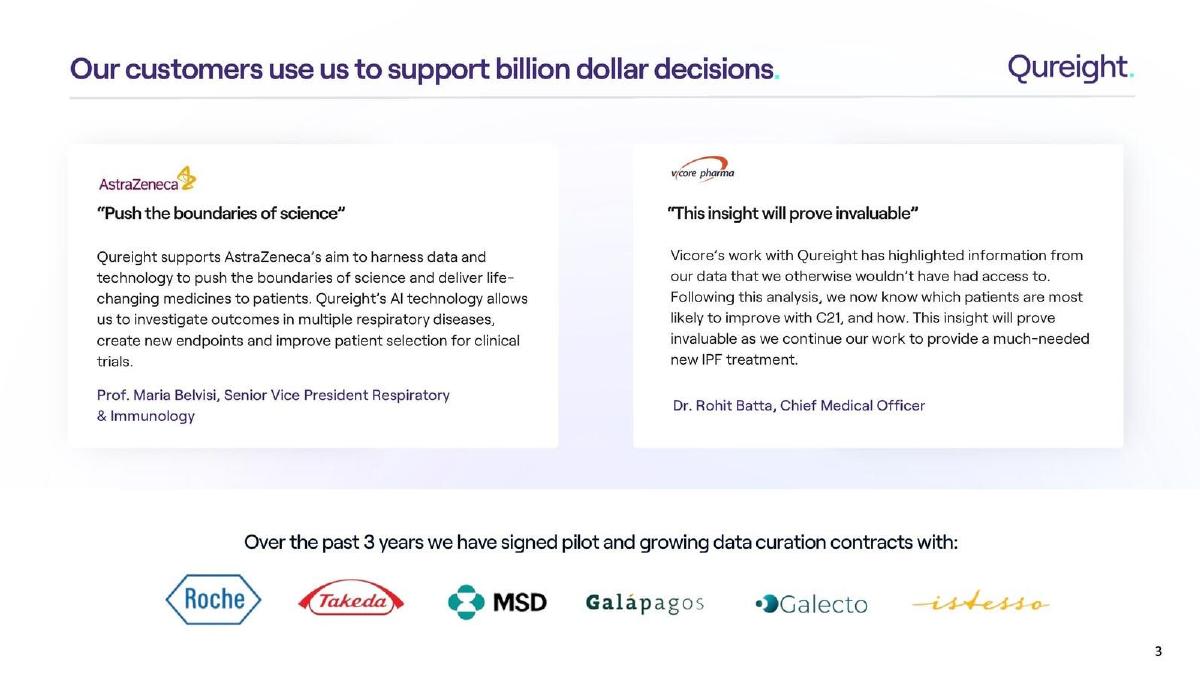
- The deck leads with heavy social proof, featuring direct quotes from AstraZeneca and Vicore Pharma executives to validate the platform's impact on 'billion-dollar decisions' (Slide 3).
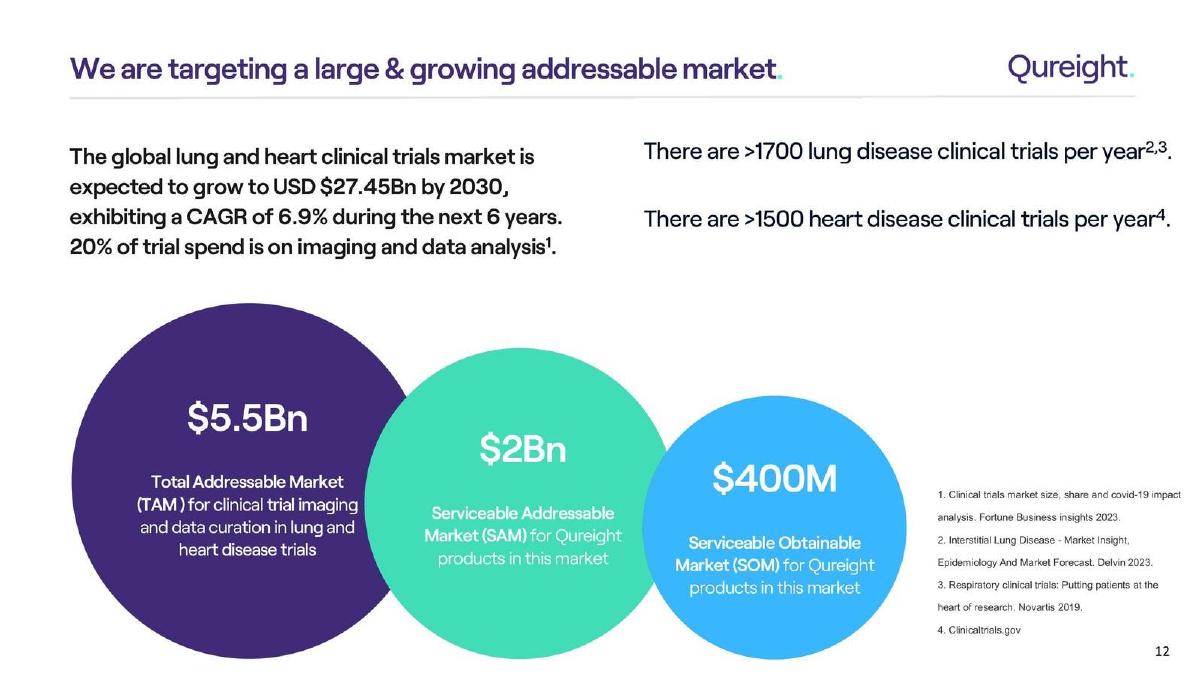
- Qureight defines its market opportunity by isolating the 20% of clinical trial spend dedicated to imaging and data analysis, resulting in a $5.5Bn TAM (Slide 12).
- The product is divided into three distinct revenue-generating pillars: AI image analysis, Virtual trial arms, and Central read (Slide 9).
- A detailed UI screenshot on Slide 6 demonstrates a 'fully functional' platform, moving the narrative from theoretical AI to tangible software.
- The company reports a previous seed investment of $1.9M in December 2021 from investors including Playfair and Cambridge Angels (Slide 22).
- The Series A ask is stated as $7.5M to support 24 months of growth, though the final raised amount was reported as $8.5M (Slide 22).
- The use of funds is highly specific, allocating 50% to imaging/data integration, 40% to data lake expansion, and 10% to clinical trial support (Slide 22).
- The deck identifies a specific volume of opportunity with over 1,700 lung disease and 1,500 heart disease clinical trials occurring annually (Slide 12).
Slide 1: Title Slide
The deck opens with a minimalist title slide featuring the company logo and the tagline: "Data curation to accelerate drug development." The background image is a wireframe rendering of human lungs, immediately signaling the company's primary therapeutic focus. There are no distracting elements, keeping the focus entirely on the core mission statement.
Slide 3: Customer Validation and Social Proof
Slide 3 is arguably the strongest slide in the deck. Titled "Our customers use us to support billion dollar decisions," it features two in-depth testimonials. Prof. Maria Belvisi of AstraZeneca notes that Qureight allows them to "investigate outcomes in multiple respiratory diseases" and "improve patient selection." Dr. Rohit Batta of Vicore Pharma states the platform provides data insights they "otherwise wouldn't have had access to." Below these quotes, the slide displays logos for Roche, Takeda, MSD, Galapagos, Galecto, and Istesso , noting that they have signed pilot and growing contracts over the past three years. This level of Tier-1 validation is rare for a Series A company and serves to de-risk the technology for new investors.
Slide 6: The Solution and Platform Interface
Slide 6 moves from the 'why' to the 'how.' It showcases a screenshot of the Qureight platform, displaying a dashboard with image overviews, quality control (QC) metrics, and a multiplanar viewer for lung scans. The caption describes it as a "single platform to improve clinical trial data flow and maximise data value for drug development decisions." By showing the actual UI, the company proves the product is not just 'vaporware' but a functional tool currently being used by the aforementioned partners. The interface includes sections for clinical data, audits, and central reads, suggesting a comprehensive workflow tool rather than a simple algorithm.
Slide 9: Key Product Pillars
Slide 9 breaks the platform down into three commercial offerings. First is AI image analysis , which utilizes proprietary deep learning biomarkers such as Lung8, Air8, Fibr8, and Vascul8 to identify structural changes in lungs. Second is Virtual trial arms , which leverages healthcare data contracts to build synthetic study arms for comparison against real trial arms. Third is Central read , specifically the Qureight Central Read System (QCRS), which claims to reduce patient evaluation time from weeks to days. This slide is critical because it explains how the company actually generates revenue and the specific technical advantages of their 'TechBio' approach.
Slide 12: Market Sizing (TAM/SAM/SOM)
Slide 12 provides a structured look at the addressable market. The company cites that the global lung and heart clinical trials market will reach $27.45Bn by 2030 with a 6.9% CAGR. Crucially, they note that 20% of trial spend is on imaging and data analysis , which forms the basis of their $5.5Bn TAM . They further refine this to a $2Bn SAM for Qureight products and a $400M SOM . The slide also includes volume metrics: >1700 lung disease trials and >1500 heart disease trials per year, providing a clear picture of the total number of potential contracts available.
Slide 22: Investment History and Use of Funds
The final slide in the provided set details the financial ask and history. It notes a $1.9M Seed investment from December 2021 involving Playfair, Ascension, CMS Ventures, Meltwind, and Cambridge Angels. The current ask is stated as $7.5M to support 24 months of growth (though the publisher reports $8.5M was ultimately raised). The use of funds is split into three buckets: 50% for imaging and clinical data integration , 40% for data lake increase (expanding into pulmonary hypertension and lung cancer), and 10% for increased clinical trials support via new business development hires. This clear roadmap shows investors exactly how their capital will be deployed to scale the business.
What Qureight Does Well
The deck excels at anchoring . By placing the AstraZeneca and Roche logos on Slide 3, the founders effectively end the debate over whether the technology works. In the highly skeptical world of Biotech/AI, third-party validation from industry giants is the ultimate currency. Furthermore, the market sizing on Slide 12 is intellectually honest; rather than claiming the entire $27Bn clinical trial market, they specifically isolate the 20% related to their niche (imaging and data), which makes their $400M SOM feel achievable and grounded in reality.
What is Missing from the Deck
The provided slides omit several standard components of a Series A pitch. There is no team slide , which is a significant gap given that Biotech investments are often bets on the scientific pedigree of the founders. There is also a lack of competitive landscape analysis; while the product seems unique, investors would want to see how Qureight compares to other AI imaging firms or traditional Clinical Research Organizations (CROs). Finally, there are no unit economics or specific revenue figures provided in these slides, leaving the actual financial performance of those 'growing contracts' to the imagination.
Founder Takeaways
Lead with Logos: If you have Tier-1 customers, do not bury them at the end. Qureight puts their biggest wins on Slide 3 to set the tone for the entire pitch. · Quantify the Niche: When calculating TAM, don't just use the biggest number you can find. Qureight’s use of the "20% of spend" rule for imaging shows they understand the budget line items of their customers. · Show the 'Work': Including a high-resolution screenshot of the platform (Slide 6) helps bridge the gap between a complex scientific concept and a tangible software product that a VC can understand. · Specific Use of Funds: Avoid vague categories like 'Marketing' or 'Hiring.' Qureight’s 50/40/10 split tied to specific technical milestones (like expanding the data lake into lung cancer) gives investors confidence in the operational plan.
Frequently asked questions
- What is Qureight's primary value proposition?
- Qureight positions itself as a data curation platform that accelerates drug development by maximizing the value of clinical trial data. According to Slide 6, the platform improves data flow and helps pharmaceutical companies make better development decisions through AI-powered image segmentation and biomarker analysis.
- Who are Qureight's notable customers?
- Slide 3 lists several major pharmaceutical and biotech companies, including Roche, Takeda, MSD, Galapagos, Galecto, and Istesso. The slide also features detailed testimonials from senior leadership at AstraZeneca and Vicore Pharma, highlighting the platform's role in investigating respiratory disease outcomes.
- How does Qureight calculate its market size?
- On Slide 12, the company starts with a global lung and heart clinical trials market expected to reach $27.45Bn by 2030. They narrow this to a $5.5Bn TAM by focusing on the 20% of spend allocated to imaging and data. Their SAM is $2Bn, and their SOM is targeted at $400M.
- What are the specific products Qureight offers?
- Slide 9 outlines three key products: AI image analysis (using proprietary biomarkers like Lung8 and Air8), Virtual trial arms (using real-world and synthetic data), and a Central Read System (QCRS) designed to speed up patient inclusion in trials from weeks to days.
- How does the company plan to use the Series A capital?
- According to Slide 22, the funds are earmarked for three areas: 50% for integrating AI image segmentation with clinical/biomarker data, 40% for increasing their 'data lake' into pulmonary hypertension and lung cancer, and 10% for hiring dedicated trial managers to support their business development pipeline.