Sirona Medical's Series B deck is a masterclass in articulating a 'platform play' within a highly fragmented legacy industry. By framing radiology IT as a broken collection of on-premise silos, Sirona positions its cloud-native 'RadOS' not just as a new tool, but as a fundamental operating layer. The deck successfully balances high-level vision—'Unify, Simplify, Amplify'—with technical credibility, leveraging a team with deep roots in Stanford's Biomedical Informatics Department. While the deck is light on specific revenue figures, it compensates with a clear roadmap for market expansion, mov…
Key takeaways
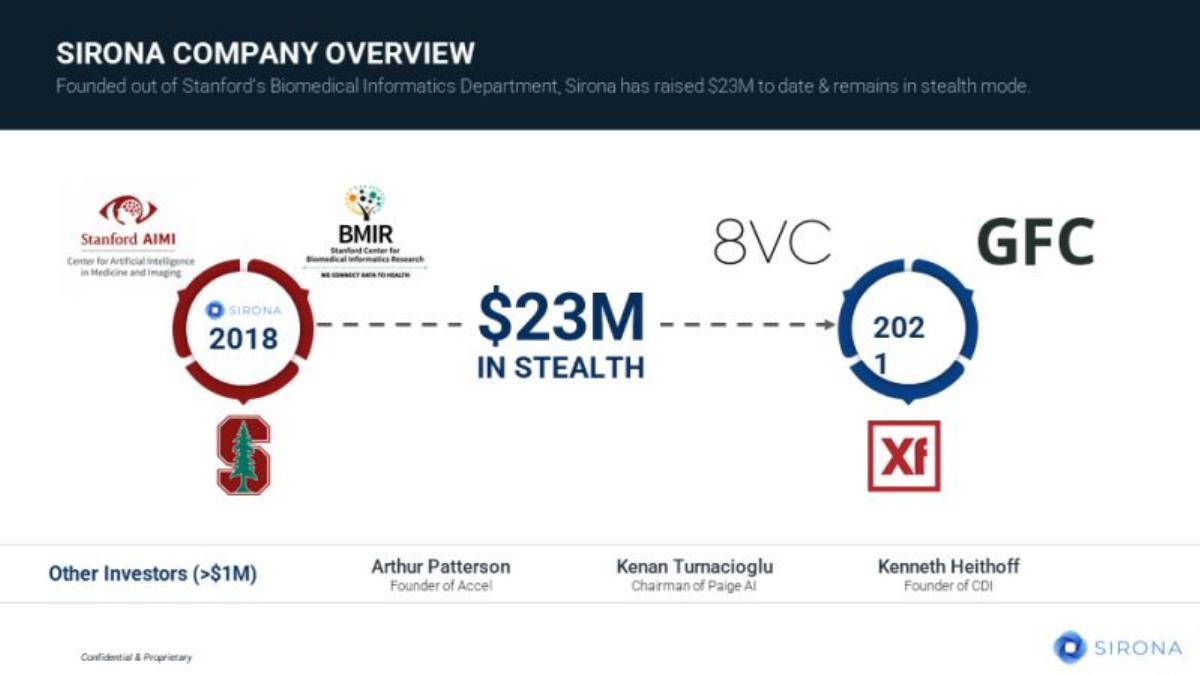
- The company was founded out of Stanford's Biomedical Informatics Department and raised $23M while in stealth mode (Slide 3).
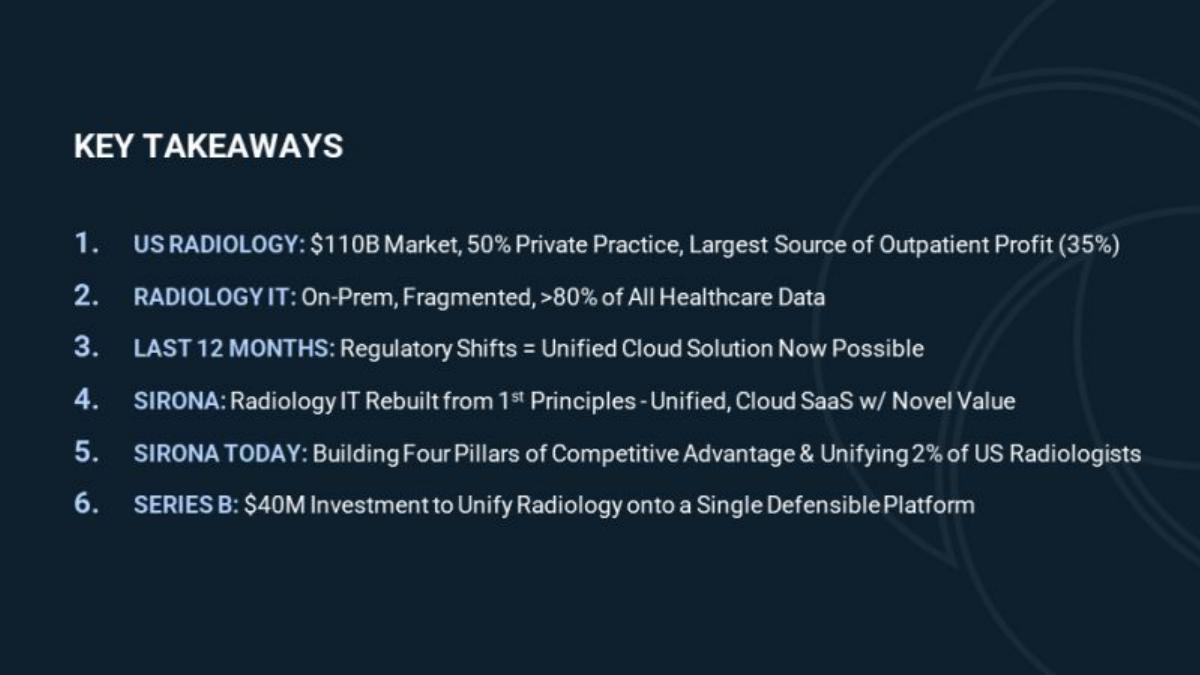
- US Radiology is identified as a $110B market, with private practices making up 50% and serving as the largest source of outpatient profit at 35% (Slide 6).
- Radiology IT is currently characterized by fragmented, on-premise software that handles over 80% of all healthcare data (Slide 6).
- The product strategy is divided into three pillars: Unify (Workspace), Simplify (Workflow), and Amplify (RadOS) (Slide 13).
- Sirona is already live in clinical production, initially targeting the private practice market (Slide 14).
- The 'Simplify' pillar introduces 'Intelligence Amplification' (IA) as a new paradigm for AI, with patents pending (Slide 15).
- The business model is a tiered subscription service charging a per-exam fee on approximately 600M domestic annual exams (Slide 17).
- The Serviceable Obtainable Market (SOM) is valued at $1.5B, with a path to a $50B+ TAM through international expansion and billing (Slide 18).
Executive Summary: The Cloud-Native Overhaul of Radiology
Sirona Medical’s Series B pitch deck, which secured $40M in 2021, is a textbook example of how to pitch a platform play in a legacy-heavy industry. The company targets the $110B US radiology market, specifically focusing on the fragmented IT infrastructure that currently supports it. By framing the problem as a lack of unification—where radiologists are forced to navigate a 'broken' stack of on-premise silos—Sirona positions its 'RadOS' as the inevitable next step in the digital evolution of the field.
Slide-by-Slide Analysis
The Foundation and Team (Slides 1-5)
Slide 1: Title. The deck opens with a clean, professional aesthetic, identifying the round as a Series B and introducing the tagline: 'Unify. Simplify. Amplify.'
Slide 2: Mission. 'To revolutionize the practice of radiology.' This is a standard high-level mission statement that sets the scale of ambition.
Slide 3: Company Overview. This slide establishes immediate credibility. It notes the company was founded out of Stanford’s Biomedical Informatics Department and had already raised $23M while in stealth mode. It lists prominent investors including 8VC, GFC, and Xf, along with individual backers like Arthur Patterson (Founder of Accel).
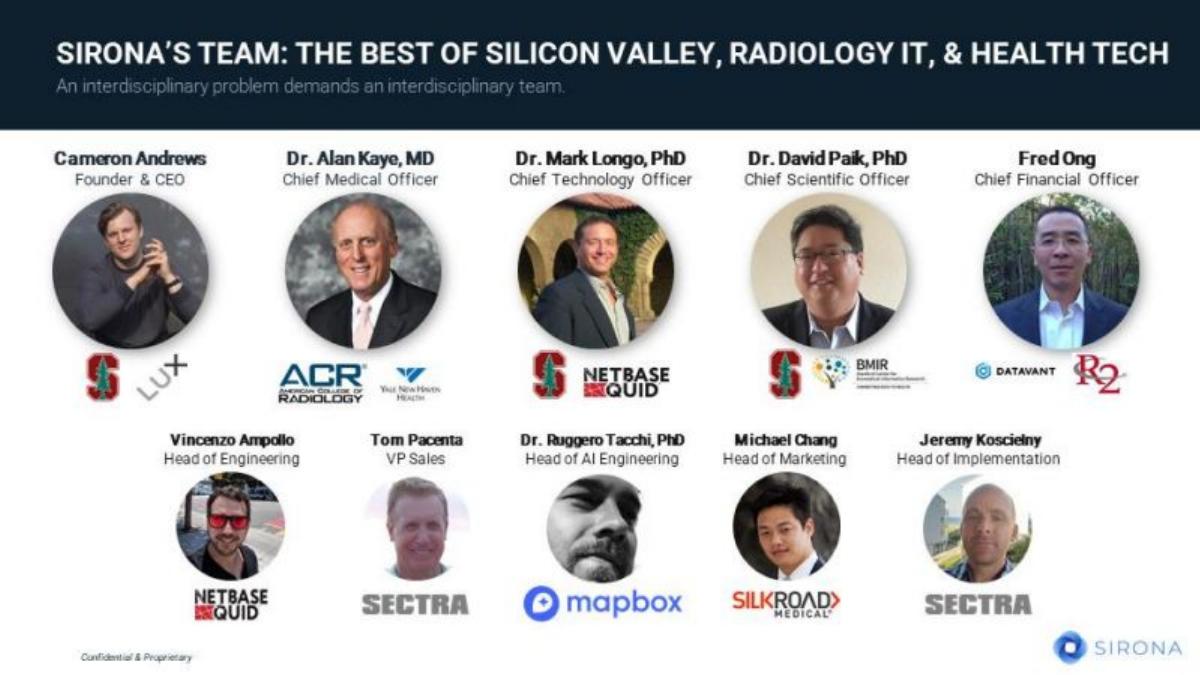
Slide 4: The Team. Sirona highlights an 'interdisciplinary team' combining Silicon Valley tech with radiology expertise. Key figures include CEO Cameron Andrews (Stanford/Lux), CMO Dr. Alan Kaye (ACR/Yale), and CTO Dr. Mark Longo (Stanford/NetBase Quid). The inclusion of logos like Mapbox, Sectra, and Datavant under team members emphasizes a mix of enterprise SaaS and healthcare experience.
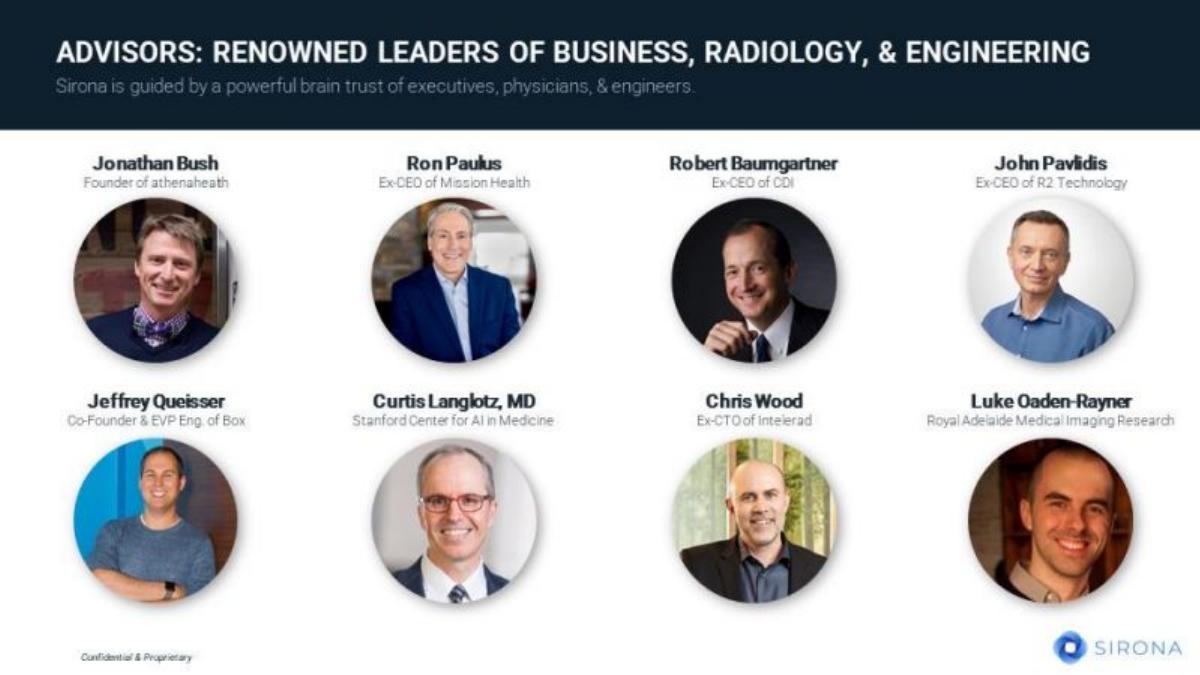
Slide 5: Advisors. The advisory board is exceptionally strong for a Series B, featuring Jonathan Bush (athenahealth), Jeffrey Queisser (Box), and various ex-CEOs from medical imaging companies. This serves to de-risk the execution for investors.
The Market Opportunity (Slides 6-9)
Slide 6: Key Takeaways. Unusually, Sirona places a summary slide early. It defines the $110B US market and notes that radiology IT handles >80% of all healthcare data. It explicitly states the Series B goal: a $40M investment to unify radiology onto a single platform.
Slide 7: Digital Age Timeline. This slide provides historical context, moving from Radiographs (1960) to Cloud/SaaS (2020). It positions the current era as one defined by 'Clinical Productivity' and 'Virtual Clinics,' suggesting that the old 'Digitization 1.0' models are obsolete.
Slide 8: The Problem. A visual representation of a radiologist surrounded by multiple monitors. The text calls this 'one of the last bastions of the knowledge worker using purely fragmented, on-prem-software.' The statistic '>80% medical data by volume' is repeated to emphasize the weight of the data being managed poorly.
Slide 9: The Fragmented Stack. This is a complex architectural diagram showing the 'RadIT' stack. It illustrates the mess of integrations between Modalities, PACS Brokers, RIS, AI Models, and Billing Systems. The headline notes that these components 'can’t be modernized piece-by-piece.'
The Solution: Sirona's RadOS (Slides 10-13)
Slide 10: Reimagine from First Principles. Sirona proposes a unified flow from Patient to Clinician. Below this, it shows the various 'puzzle pieces' (Worklist, Viewer, Reporter, AI Models) being integrated into a single cohesive unit.
Slide 11: Product Reveal. A high-fidelity screenshot of the Sirona interface. It looks modern, dark-themed, and significantly more streamlined than the 'broken' workflow shown on Slide 8.
Slide 12: The Three Pillars. The company defines its value proposition through three verbs: Unify (consolidate the stack), Simplify (improve productivity/wellbeing), and Amplify (increase professional impact). This is the core strategic framework for the rest of the deck.
Slide 13: The Platform Strategy. This slide introduces the 'RadOS' concept, positioning Sirona as a tiered subscription service. It maps out the transition from a 'Workspace' (Unify) to a 'Workflow' (Simplify) to the full 'RadOS' (Amplify).
Product Roadmap and Business Model (Slides 14-17)
Slide 14: Unify (Bronze). Details the 'Workspace' layer. It emphasizes that Sirona is an overlay, avoiding the need to 'rip and replace' existing infrastructure. It notes they are 'Live in Clinical Production' with a focus on private practices.
Slide 15: Simplify (Silver). Focuses on 'Intelligence Amplification' (IA). This is Sirona’s take on AI, focusing on reducing context switching and burnout. It mentions 'Patents Pending' and a rollout over the 'Next 12 Months.'
Slide 16: Amplify (Gold). The 'RadOS' layer. This is the long-term vision for 2023, involving improved customer service, billing, and compliance. It positions the platform as a way for radiology practices to differentiate their own 'work products.'
Slide 17: Distribution of Add-ons. This slide explains the monetization strategy. Sirona charges a per-exam fee on the ~600M domestic annual exams. It shows how they can layer on additional services like 3rd Party AI, Portal Add-ons, and an API layer.
Market Size and Conclusion (Slides 18-20)
Slide 18: TAM/SAM/SOM. Sirona breaks down the market: a $1.5B SOM (existing RadIT spend), a $5.0B SAM (RadOS market + add-ons), and a $50B+ TAM (including billing and international expansion). This provides a clear path for how a $40M investment can lead to a massive exit.
Slide 19: Conclusion. A simple restatement of the mission: 'Sirona will replace Radiology IT. And revolutionize the practice of radiology.'
What Works in This Deck
Strategic Framing: By categorizing their product into 'Unify, Simplify, Amplify,' Sirona makes a complex technical transition easy for an investor to follow. · Credibility by Association: The heavy emphasis on Stanford and the high-profile advisory board (Slide 5) creates a 'winner's aura' that is crucial for a Series B. · Addressing Friction: Slide 14 explicitly addresses the biggest hurdle in enterprise healthcare sales: the 'rip and replace' problem. By positioning themselves as an overlay, they lower the perceived barrier to adoption. · Clear Monetization: The 'per-exam fee' model (Slide 17) is easy to understand and scales directly with the volume of the market ($600M exams).
What Is Missing
Unit Economics: While the business model is clear, the deck does not provide specific data on Customer Acquisition Cost (CAC) or Lifetime Value (LTV). · Revenue Traction: Although they mention being 'Live in Clinical Production,' there are no hard numbers regarding current Annual Recurring Revenue (ARR) or growth rates. · Competitive Landscape: The deck focuses entirely on Sirona. It does not mention other cloud-native competitors or how they plan to win against established legacy giants beyond just having 'better software.' · Case Studies: For a Series B, one would expect to see a slide detailing a specific pilot or customer success story with measurable ROI (e.g., 'Practice X saw a 20% increase in throughput').
Founder Takeaways
Use a 'Key Takeaways' slide early: If you have a strong market story and a clear ask, don't bury it at the end. Sirona’s Slide 6 acts as an executive summary that anchors the rest of the presentation. · Define your own terminology: Sirona’s use of 'Intelligence Amplification' (IA) instead of just 'AI' allows them to own a specific niche and avoid being compared to the hundreds of other 'AI for Radiology' startups. · Visualizing the 'Mess': Slide 9 is a great example of using a complex diagram to prove a point. It doesn't need to be fully understood; it just needs to look like a problem that requires a 'First Principles' solution. · Tiered Roadmap: Showing a progression from 'Bronze' to 'Gold' (Slides 14-16) helps investors see both the immediate path to revenue and the long-term 'moonshot' potential.
Frequently asked questions
- What is the core problem Sirona Medical is solving?
- Sirona addresses the fragmentation of radiology IT. As shown on Slide 9, the current 'RadIT' stack consists of independent components like PACS, RIS, and AI models linked by weak integrations. This forces radiologists to work across multiple siloed systems, which Sirona claims increases task complexity, reduces productivity, and negatively impacts patient care.
- How does Sirona's 'RadOS' differ from existing radiology software?
- Unlike legacy on-premise software, Sirona is a cloud-native platform built from first principles. According to Slide 14, it is deployed as an overlay to existing infrastructure, meaning practices don't have to 'rip and replace' their current systems. It unifies the worklist, viewer, and reporter into a single interface.
- What is the significance of the 'Intelligence Amplification' (IA) mentioned in the deck?
- Sirona uses 'Intelligence Amplification' (Slide 15) to describe their approach to AI. Rather than just providing automated diagnosis, they focus on consolidating workflows and shipping novel features built on proprietary data to reduce cognitive burden and burnout. This is positioned as a 'new paradigm for AI' in clinical settings.
- What is the company's go-to-market strategy?
- Sirona's initial target is private practices, which represent 50% of the US radiology market (Slide 6). They use a tiered subscription model based on a per-exam fee (Slide 17). The roadmap suggests moving from basic workspace unification to workflow simplification in 2022, and full practice differentiation (RadOS) by 2023.
- Who are the key people behind Sirona Medical?
- The team has deep ties to Stanford and major tech/healthcare firms. CEO Cameron Andrews and several C-suite members (CTO Mark Longo, CSO David Paik) are Stanford-affiliated. The advisory board includes heavyweights like Jonathan Bush (Founder of athenahealth) and Jeffrey Queisser (Co-founder of Box), as shown on Slides 4 and 5.