Sincera’s 10-slide Seed deck is a highly technical, industry-specific presentation that successfully raised $4.2M in 2024. The company positions itself as a 'metadata company' providing telemetry for adtech transactions, moving away from traditional cookie-based tracking toward a 'cookieless, tagless, and privacy-first' approach. The deck relies heavily on the founders' pedigree—specifically their history at industry giants like LiveRamp and Index Exchange—to establish credibility. By reframing potential competitors as 'ideal customers,' Sincera demonstrates a sophisticated understanding of t…
Key takeaways
- The founders lead with their specific inventions in the adtech space, such as the Authenticated Traffic System (ATS.js) and Real Time Identity Framework (Slide 2).
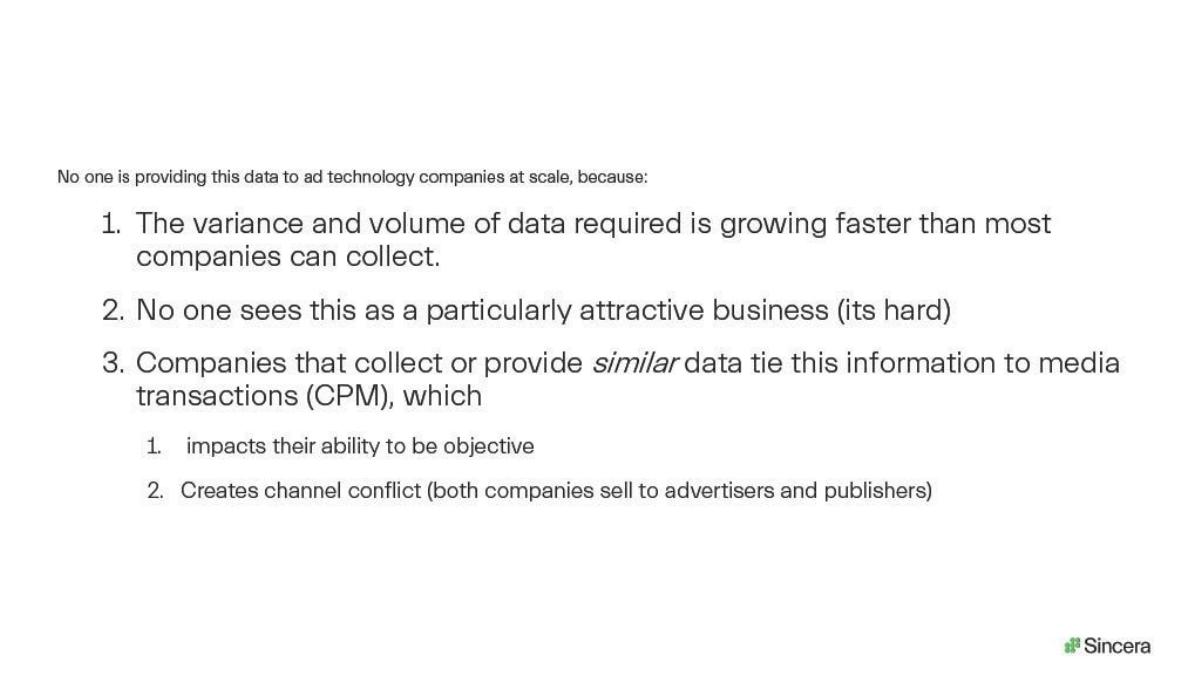
- Sincera identifies a specific market gap: the volume of required metadata is growing faster than companies can collect it (Slide 4).
- The deck lists nine specific 'Unaddressed Scenarios' involving major players like Microsoft, Lego, and The Trade Desk to prove market demand (Slide 3).
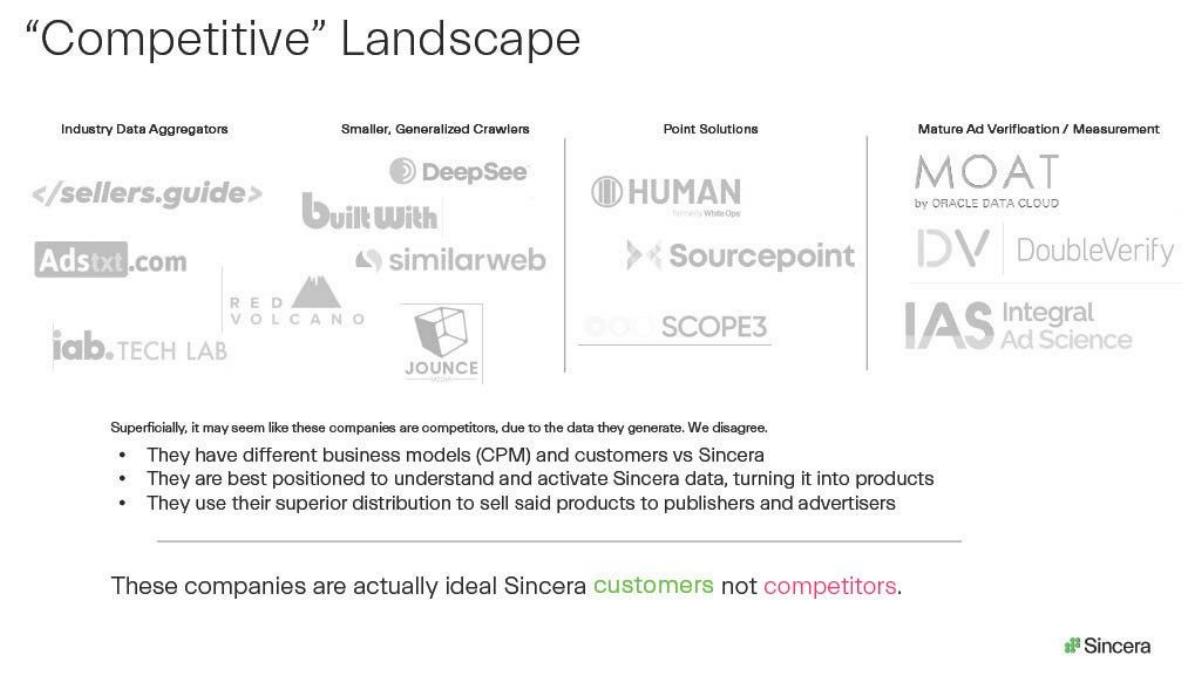
- Competitors like Moat and DoubleVerify are strategically reframed as 'ideal Sincera customers' rather than threats (Slide 5).
- The product generates metadata using a 'Synthetic User Engine' that simulates full browser sessions with smooth scrolling and clicks to bypass detection (Slide 7).
- Sincera maps over 670 known AdTech companies within their 'Ecosystem Graph' to decode crawl data (Slide 7).
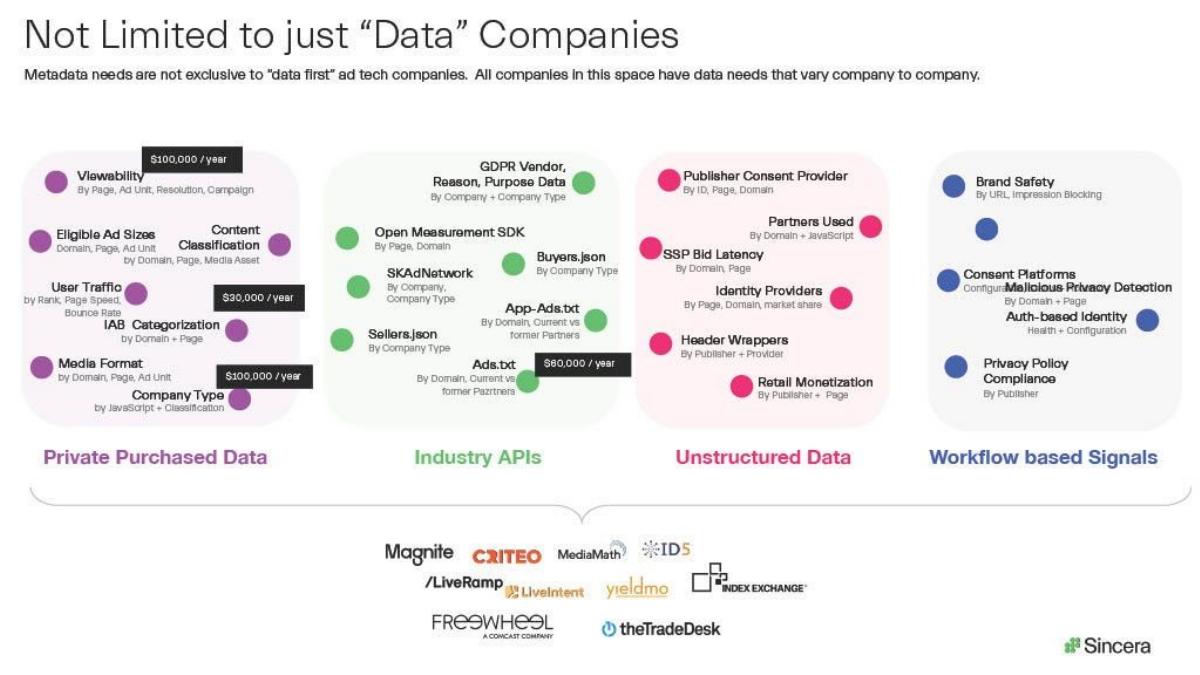
- The deck highlights high costs of private data, citing figures like $100,000/year for viewability or company type data (Slide 6).
- Post-funding strategy is explicitly tied to headcount, planning for +3 GTM heads and +2 founding engineers (Slide 10).
Sincera Pitch Deck Analysis
Sincera’s Seed deck is a prime example of a 'founder-led' technical pitch. In the complex world of AdTech, where privacy regulations and the death of the third-party cookie are upending business models, Sincera positions itself not as a disruptor, but as the essential plumbing. The deck, which helped secure $4.2M in 2024, is notable for its density and lack of 'fluff.' It assumes the reader understands the nuances of the advertising ecosystem, which is a calculated risk that clearly paid off with sophisticated investors.
Slide 1: Title Slide
The title slide is minimalist, establishing the brand identity immediately. The tagline 'a metadata company' is modified by a handwritten-style annotation: 'Cookieless, Tagless, and Privacy-first.' This is a direct nod to the current headwinds in the advertising industry. By positioning themselves as 'metadata' rather than 'tracking' or 'identity,' they avoid the negative connotations associated with modern privacy concerns. The inclusion of founder emails (mike@sincera.io and ian@sincera.io) on the front page signals a direct, no-nonsense approach to the fundraise.
Slide 2: Team
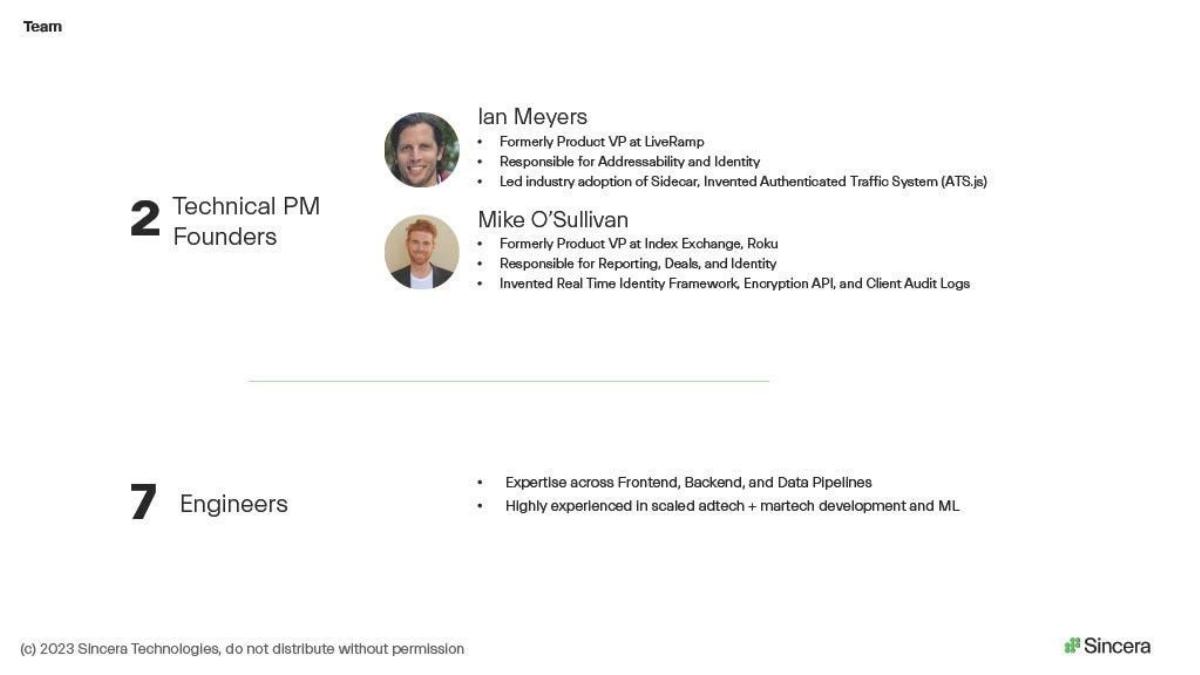
Placing the team slide second is a strategic move for a Seed round. In AdTech, domain expertise is everything. The slide highlights two 'Technical PM Founders' and 7 engineers. The pedigree here is the 'hook': Ian Meyers (formerly VP at LiveRamp) and Mike O’Sullivan (formerly VP at Index Exchange and Roku). Crucially, they don't just list titles; they list specific inventions like 'ATS.js' and 'Real Time Identity Framework.' This proves they haven't just worked in the industry—they have built the standards the industry currently uses. The mention of 7 engineers with expertise in 'scaled adtech + martech development and ML' suggests the product is already well under construction.
Slide 3: Unaddressed Scenarios from the Advertising Industry
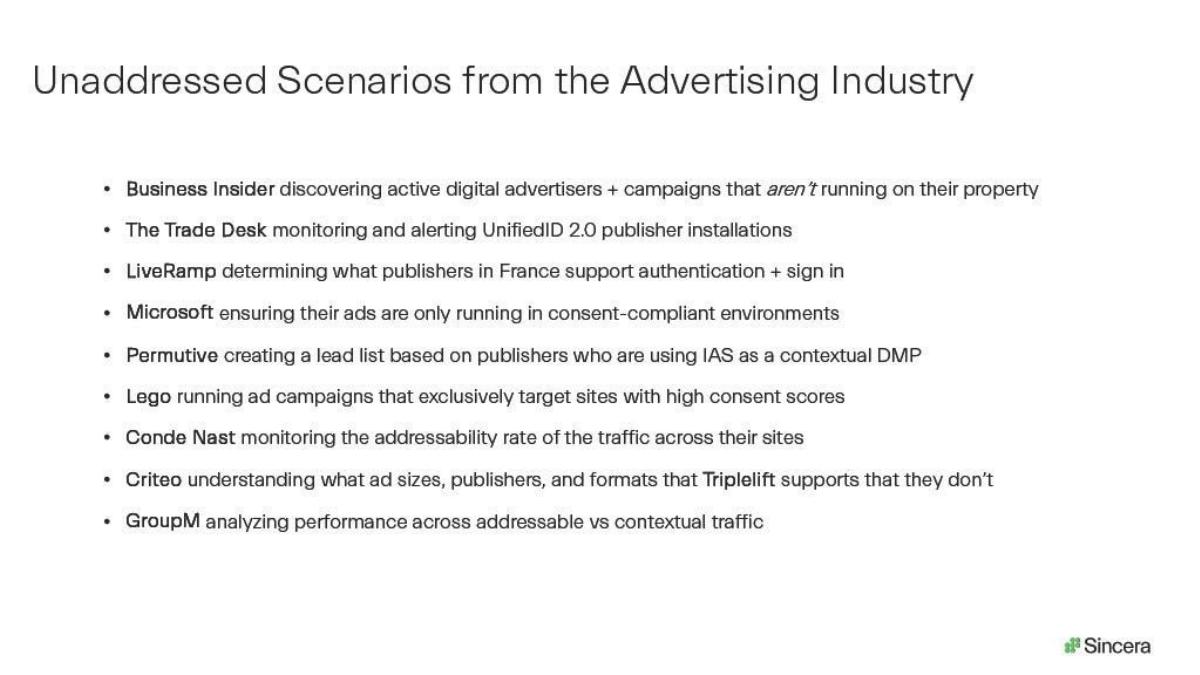
Instead of a generic 'Problem' slide, Sincera uses a 'Scenarios' slide. This is a sophisticated way to demonstrate market pull. They name-drop major entities like Business Insider, The Trade Desk, LiveRamp, Microsoft, Lego, and Conde Nast. By describing specific tasks—such as 'Microsoft ensuring their ads are only running in consent-compliant environments'—they prove that their metadata has immediate utility for the largest spenders in the market. This slide serves as a proxy for a 'Customer' slide, even if these companies are not yet paying clients, by showing exactly where Sincera fits into their workflows.
Slide 4: The Market Gap
This slide explains why the problem exists. Sincera identifies three reasons: the volume of data is outstripping collection capabilities, the business is 'hard' and thus unattractive to newcomers, and existing data providers are biased because their revenue is tied to media transactions (CPM). This third point is a subtle jab at the status quo, suggesting that Sincera’s 'objectivity' is a competitive advantage. It frames the company as a neutral third party in an industry often plagued by conflicts of interest.
Slide 5: "Competitive" Landscape
The use of quotation marks around 'Competitive' is intentional. Sincera categorizes the market into Industry Data Aggregators, Generalized Crawlers, Point Solutions, and Mature Ad Verification. They then explicitly state: 'These companies are actually ideal Sincera customers not competitors.' This is a bold claim that expands their Total Addressable Market (TAM). Instead of fighting for a slice of the ad verification pie, they are positioning themselves as the ingredient brand that makes those verification companies better. This reduces the perceived risk of being crushed by incumbents like Oracle (Moat) or DoubleVerify.
Slide 6: Not Limited to just "Data" Companies
This slide visualizes the 'Metadata needs' across the industry. It breaks data down into four categories: Private Purchased Data, Industry APIs, Unstructured Data, and Workflow based Signals. Most importantly, it attaches price tags to these needs, citing costs like '$100,000 / year' for Viewability data and '$60,000 / year' for Ads.txt data. By showing the logos of companies like Criteo, The Trade Desk, and Magnite at the bottom, they reinforce that these multi-billion dollar companies are already spending heavily on the types of data Sincera provides.
Slide 7: How does we generate the Metadata?
This is the 'How it Works' slide, and it is highly technical. It introduces the 'Synthetic User Engine' (SUE). The key takeaways here are 'Always Full Browser' (no simple curl calls) and 'Progressive Impersonation.' This explains their technical moat: they have built a crawler that can act like a human—scrolling, clicking, and accepting consent prompts—to gather data that simple bots cannot reach. They also mention an 'Ecosystem Graph' mapping 670+ AdTech companies, which represents a significant data asset already in existence.
Slide 8: Working With Sincera Today
This slide outlines three specific engagement models: the Global Crawler (for market understanding), the SDK (for augmenting product offerings), and Private SUEs (for offloading expensive crawling work). This shows product flexibility. Whether a customer wants to buy a finished dataset or use Sincera’s infrastructure to run their own private crawls, the company has a solution. This 'offload' messaging is particularly effective for enterprise sales, as it promises to reduce the customer's internal engineering costs.
Slide 9: The Product
Slide 9 provides a high-level architectural view. It shows 'global metadata ingestion' and 'Private SUEs' feeding into three product outputs: Platform APIs and Datasets, a User Interface (dashboard), and Private Jobs. This slide ties the technical engine from Slide 7 to the business scenarios from Slide 3. It clarifies that Sincera is a SaaS API company first, but offers a UI for sales leads and alerting, making it useful for both engineers and business development teams.
Slide 10: Post Funding Strategy
The final slide serves as the roadmap. It is divided into five clear goals. The most prominent is the hiring plan: +3 heads for GTM (Sales Lead, GTM, Customer Analyst) and +2 Founding Engineers to join the 7 existing developers. They also mention specific technical goals, like 'Key feature for CTV and in app' and '100% server side activity ad transactions.' This gives investors a clear picture of how the $4.2M will be deployed to reach the next milestone. Interestingly, there is no 'Ask' slide stating the specific dollar amount or valuation, which is common in decks that are leaked or shared after the round is already closed.
What Sincera Does Well
Sincera excels at establishing authority . In a crowded Seed market, many founders struggle to prove they are the right people to solve a problem. Sincera solves this by listing their specific industry-standard inventions on Slide 2. They don't just say they know AdTech; they show they built the foundations of it.
The deck also does an excellent job of market positioning . By reframing competitors as customers on Slide 5, they turn a threat into an opportunity. This is a classic strategy for infrastructure startups: don't compete with the gold miners; sell them the shovels. Sincera is selling the metadata 'shovels' to the verification 'miners.'
Finally, the granularity of the problem is impressive. Slide 3 and Slide 6 provide specific, dollar-denominated examples of what the industry is struggling with. This moves the conversation from abstract 'data needs' to concrete 'cost savings and compliance.' It makes the ROI of the product feel tangible even at the Seed stage.
What is Missing from the Sincera Deck
The most glaring omission is traction metrics . While the deck mentions 'Working With Sincera Today' (Slide 8), it does not list current revenue, number of active pilots, or growth rates. For a $4.2M Seed round, investors usually want to see some evidence of commercial momentum, even if it is just early design partners.
There is also no Financial Projections or TAM calculation . While the deck implies a large market by listing major industry players, it never explicitly states the size of the opportunity in dollars. This suggests the round may have been raised primarily on the strength of the team and the technical moat rather than a traditional financial model.
Lastly, the 'Ask' slide is missing. A standard pitch deck usually concludes with a slide stating 'We are raising $X to achieve Y.' While Slide 10 describes the strategy, the specific terms of the fundraise are absent. This may have been removed for the version of the deck shared publicly, but its absence makes the narrative feel slightly unfinished.
Lessons for Founders
Founders building in highly technical or 'boring' B2B sectors can learn a lot from Sincera. First, don't be afraid of density . If your target investors are industry specialists, using technical terms like 'CPM,' 'ATS.js,' and 'server-side activity' builds credibility. It shows you speak the language of the market.
Second, leverage your past wins . If you have built something significant in a previous role, name it. Sincera’s founders didn't just list their former employers; they listed their specific contributions to the industry's technical standards. This is the ultimate 'social proof' for a technical founder.
Third, address competition head-on . The 'Competitive Landscape' slide is often the weakest part of a deck. Sincera turned it into a strength by explaining exactly why those companies would want to buy their product. If you can convincingly argue that your competitors are actually your future distribution partners, you significantly de-risk the investment in the eyes of a VC.
Frequently asked questions
- What is Sincera's core technology?
- Sincera uses a 'Synthetic User Engine' (SUE) to generate metadata. According to Slide 7, this engine uses a full browser and 'Progressive Impersonation' to appear as a genuine user. It simulates entire sessions, including mouse movements and clicks, to collect data across different regions and connection types without being blocked as a bot.
- How does Sincera differentiate itself from ad verification companies?
- On Slide 5, Sincera argues that mature ad verification companies like Moat and IAS have different business models tied to CPM (Cost Per Mille). Sincera claims these companies are actually 'ideal customers' because they can use Sincera’s objective data to power their own measurement products for publishers and advertisers.
- What specific problems does Sincera solve for the advertising industry?
- Slide 3 lists several scenarios, including helping Microsoft ensure ads run in consent-compliant environments, assisting The Trade Desk in monitoring UnifiedID 2.0 installations, and allowing Lego to target sites with high consent scores. Essentially, they provide the underlying telemetry needed for compliance and performance auditing.
- Who are the founders and what is their background?
- The founders are Ian Meyers and Mike O’Sullivan. As detailed on Slide 2, Meyers was a Product VP at LiveRamp and invented the Authenticated Traffic System (ATS.js). O’Sullivan was a Product VP at Index Exchange and Roku, where he invented the Real Time Identity Framework and Client Audit Logs.
- What is Sincera's plan for the $4.2M Seed funding?
- Slide 10 outlines a five-part strategy: developing a GTM function (hiring a Sales Lead and GTM head), growing customer revenue, increasing shipping velocity by hiring two founding engineers, scaling machine learning functions, and developing log analysis for server-side activity transactions.