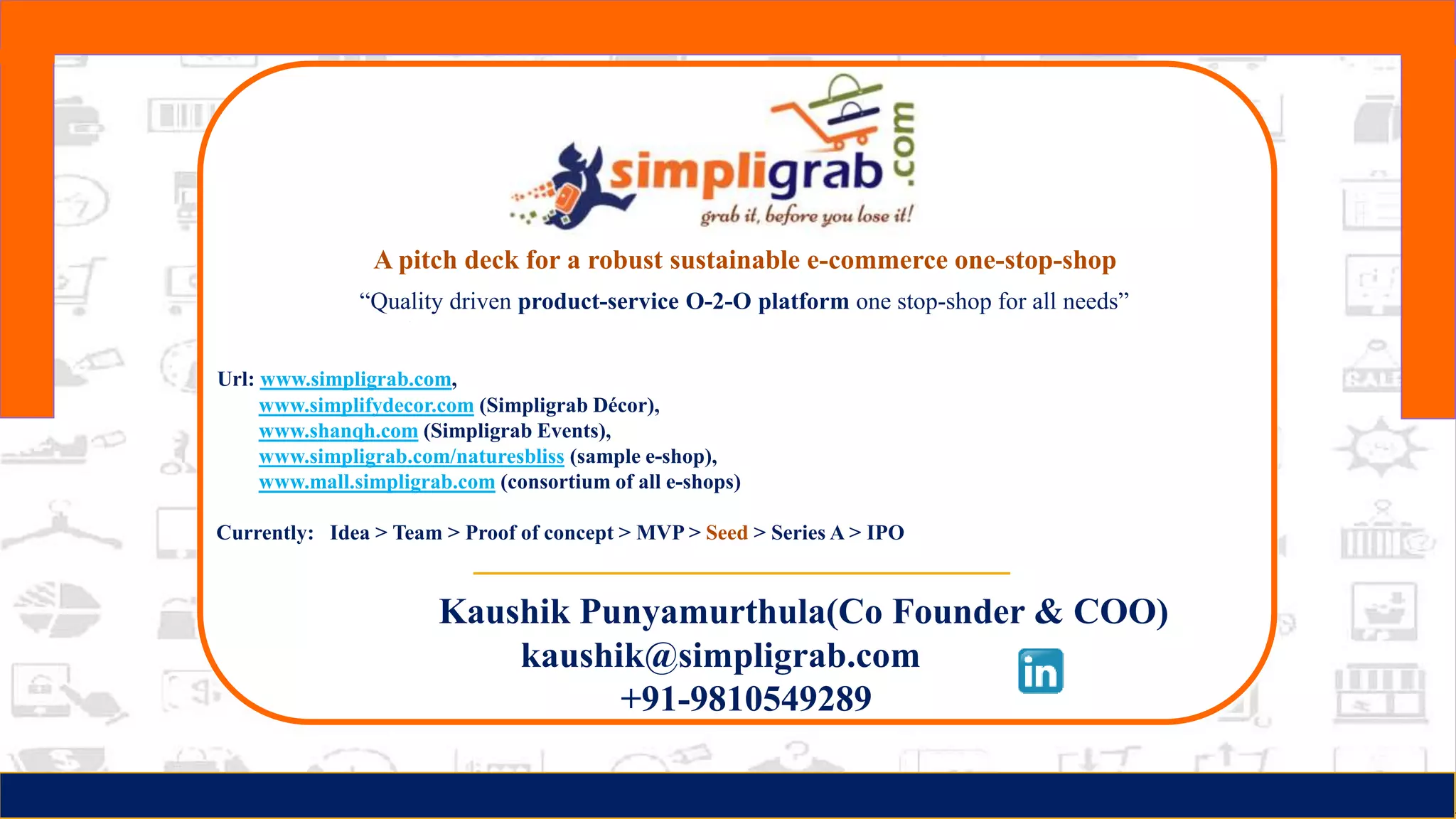
Simpligrab positions itself as a 'quality driven product-service O-2-O platform' designed to serve as a one-stop-shop for diverse consumer needs. The deck outlines a highly ambitious scope, ranging from retail electronics and groceries to high-touch services like interior design and event planning. While the company claims to offer the 'World’s 1st Virtual Grand Mall Shopping' experience, the deck lacks critical financial data, market sizing, and a specific funding ask. The operational model relies on a mix of online portals and physical 'Simpligrab Goldman' locations, aiming to bridge the ga…
Key takeaways
- The company identifies its current stage as 'Seed' on a progression scale from Idea to IPO (Slide 1).
- The business model is built on an 'O-2-O' (Online-to-Offline) framework, aiming to provide a 'feel & buy' concept for customers (Slide 6).
- Simpligrab operates multiple distinct web domains for different business lines, including simplifydecor.com and shanqh.com (Slide 1).
- The service vertical includes a freemium model for health and nutrition consulting, with personal training fees ranging from Rs 500 to Rs 1500 (Slide 5).
- The deck highlights a 'Virtual Grand Mall' concept where vendors can meet customers in a digital environment (Slide 6).
- The team includes dedicated CEOs for specific verticals like Event Planning and Interior/Exterior design (Slide 2).
- The deck lists OYO Rooms and Alibaba.com as inspirations for their business model (Slide 4).
- There is a total absence of financial projections, historical revenue, or a specific capital requirement (Slides 1-7).
Simpligrab Pitch Deck Analysis
Slide 1: Title and Introduction
The cover slide introduces Simpligrab as a "robust sustainable e-commerce one-stop-shop." It defines the business as a "Quality driven product-service O-2-O platform." A notable feature of this slide is the listing of five different URLs, suggesting a fragmented digital presence where different services (Decor, Events, E-shops) live on separate domains. The slide also includes a linear growth chart indicating the company is currently at the "Seed" stage, positioned between MVP and Series A. Contact information for Kaushik Punyamurthula (Co-Founder & COO) is prominently displayed.
Slide 2: Core Team – Simpligrab Family
This slide introduces six key figures. Manvir Singh (Founder & Group CEO) brings experience from CSC and Mobile Mart. Maninder Singh (Founder & Mentor) is credited with leadership roles at Sonalika Group and Amtek Group. The technical side is led by Ishaan Gupta (CTO), formerly of Cognizant. Interestingly, the company has appointed specific CEOs for its service verticals: Siddhant Paul for Event Planning and Vibhanshu Jain for Interior/Exterior design. Each member is accompanied by a motivational quote, though specific years of experience or key achievements are not detailed.
Slide 3: Working Model – Online & Offline
Slide 3 uses a collage of screenshots to demonstrate the user interface of their various platforms. It showcases the "Simpligrab portal," "Simplifydecor," "Shanqh," "Nature’s Bliss," and the "Simpligrab Mall." The slide emphasizes the ability to view themes in 3D for the decor and event planning segments. The "Simpligrab Mall" is labeled as the "World’s 1st Virtual Mall," showing a directory-style interface where users can select shops by location, such as "Vijay Sales, Lajpat, Delhi."
Slide 4: Physical Presence and Inspiration
This slide focuses on the "Offline" component of the O2O model. It features photos of physical storefronts branded with "Simpligrab E-SHOP" signage in various market settings and malls (citing locations near Aldo and Forever 21). It also shows "Simpligrab Goldman" offices for interior design and event management. At the bottom right, the deck explicitly states the business is "Inspired By" OYO Rooms and Alibaba.com, suggesting a desire to replicate the scale and aggregator model of those giants.
Slide 5: Products & Services
This is a text-heavy slide detailing the company's three main pillars: Product Based, Service Based, and IT Based. The product list is exhaustive, covering electronics, apparel, groceries, and automotive accessories. The service section details high-touch offerings like 3D interior design and corporate event planning. Notably, it mentions a freemium model for health consulting, with paid personal training tiers at Rs 500, Rs 1000, and Rs 1500. The IT segment describes a B2B offering where Simpligrab builds e-shops for brick-and-mortar vendors to help them save on digital maintenance costs.
Slide 6: Unique Selling Points
The USP slide reiterates the "One Stop-One Shop" value proposition. Key points include the "Virtual Grand Mall," the "feel & buy" concept, and the use of 3D/4D viewing for design services. It also introduces a social impact angle, mentioning the involvement of NGOs for "farm fresh and organic food products" to promote bio-diversity. The slide claims that "Subject Matter Expertise" is available across all vertical service deliveries, though it does not explain how this expertise is scaled.
Slide 7: Conclusion
The final slide is a simple thank you page. It repeats the COO's contact information and includes a small graphic of flying dollar bills next to the text "the opportunity to invest in us, your future." There is no specific "Ask" slide detailing the amount of capital sought or the intended use of proceeds.
What Simpligrab Does Well
Simpligrab effectively communicates the breadth of its vision. By showing actual physical storefronts and multiple functioning websites, they demonstrate that they are beyond the "idea stage" and have moved into execution. The inclusion of specific pricing for health consultations (Slide 5) shows at least one concrete revenue stream. The O2O (Online-to-Offline) strategy is a clear theme throughout the deck, providing a consistent narrative about bridging the gap between digital discovery and physical fulfillment.
What is Missing from the Deck
The deck suffers from several critical omissions that would be required for a professional seed-stage fundraise. First, there is no Market Size (TAM/SAM/SOM) analysis; investors need to know the scale of the Indian e-commerce and home services market to justify the investment. Second, there are no Financials . There is no mention of current GMV (Gross Merchandise Volume), revenue, burn rate, or customer acquisition cost (CAC). Third, the Competitive Landscape is ignored. Simpligrab is entering highly crowded markets (e-commerce, food delivery, home services) where giants like Amazon, Flipkart, and Urban Company operate, yet it does not explain how it will compete. Finally, there is no Funding Ask . A pitch deck is a tool to raise money, but this deck fails to state how much is needed or what milestones that money will achieve.
Founder Takeaways: What to Copy and What to Avoid
Copy the multi-channel visualization: Simpligrab does a good job of showing that their business exists in the real world. Using photos of physical locations and screenshots of the app/web interface helps investors visualize the "Working Model."
Avoid the 'Everything Store' trap: One of the biggest red flags in this deck is the lack of focus. Trying to be a leader in electronics, groceries, wedding planning, and interior design simultaneously is nearly impossible for a seed-stage startup. Founders should focus their deck on one "wedge" market where they have a clear advantage, rather than listing every possible product category. The fragmentation of their web domains (Slide 1) further highlights this lack of focus, which can signal high operational overhead and brand confusion to an investor.
Avoid missing the 'Ask': Never end a deck without a clear call to action. If you are raising $500k for a 12-month runway to reach 10,000 orders per month, say so. The vague "opportunity to invest" on Slide 7 is not sufficient for a serious fundraising effort.
Frequently asked questions
- What is Simpligrab's core product?
- Simpligrab does not have a single core product; instead, it is a multi-vertical platform. According to Slide 5, it offers product-based categories (Mobiles, Electronics, Women/Men/Kids apparel, Grocery, Sports, Home & Furniture, and Automotive) and service-based categories (Interior/Exterior Designing, Event & Planning, and Health & Nutrition). It also provides IT-based services for brick-and-mortar vendors to build 'e-shops'.
- How does the 'Online-to-Offline' (O2O) model work here?
- Slide 6 describes a 'feel & buy' concept where customers can see and wear items at a physical store and then buy online, or vice versa. Slide 4 shows physical 'Simpligrab E-Shops' located in markets and malls, as well as 'Simpligrab Goldman' offices for service-based verticals like interior design and event management.
- Who are the key members of the leadership team?
- Slide 2 identifies Manvir Singh as Founder & Group CEO, Maninder Singh as Founder & Mentor, Kaushik Punyamurthula as COO, and Ishaan Gupta as CTO. The team also features specialized CEOs for sub-brands: Siddhant Paul for Event Planning and Vibhanshu Jain for Interior/Exterior design.
- What is the 'Virtual Grand Mall' mentioned in the deck?
- Slide 3 and Slide 6 refer to the 'Simpligrab Mall' as a collection of e-shops and the 'World’s 1st Virtual Grand Mall.' It is presented as a digital interface where users can shop by category, region, or shop name, intended to provide a 'thrilling experience' for vendors to interact with customers.
- Is there a clear investment opportunity presented?
- No. While Slide 7 invites the viewer to 'invest in us,' the deck fails to specify how much money is being raised, the valuation, or how the funds will be allocated. Furthermore, there are no slides dedicated to market size (TAM/SAM/SOM) or competitive analysis beyond mentioning 'inspired by' logos.