Data Moat Slide: How AI Startups Show a Data Advantage
How AI and data startups show investors a data advantage in a pitch deck: where the data comes from, why rivals can't get it.
Data Moat Slide: How AI Startups Show a Data Advantage
Seven real slides, shown in full, compare how AI and data companies claim a data advantage, from sized, sourced datasets to a single bullet that says "proprietary data".
TL;DR
Almost every AI deck now says "proprietary data". Investors believe it when the slide answers three questions: where the data comes from, why a competitor cannot get the same data, and what the data measurably does for the product. The strongest slides below size the dataset and name its source (Vic.ai: cloud accounting data for 40,000 companies, 200M+ financial documents, acquired through "an unusual partnership"), or explain why the data can only come from deployments (Chef Robotics: food robots "cannot download the internet for training data"). The weakest list "proprietary data" as one bullet with no size, source or result (Doctronic). Name the source, size it, say why it's hard to copy, and show one result it produces.
Data advantage slides from real pitch decks
Each example shows the exact stored slide above its analysis and links to the full teardown. Figures and claims are as shown on the slides; we have not verified them.
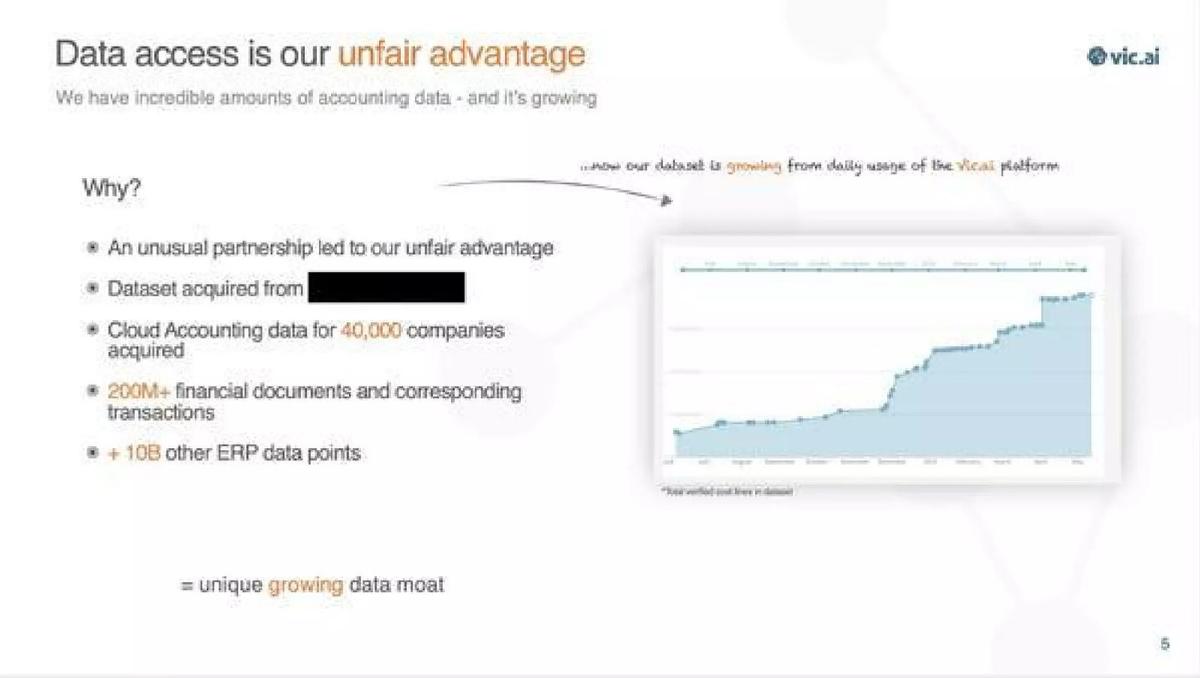
Vic.ai data moat slide — slide 6
AI for accounts payable and accounting firms. This is the deck's dedicated data slide.
Vic.ai deck, slide 6. Exact stored slide matched to this analysis.
Our analysis: The slide covers source and exclusivity well. It does not show what the data does for accuracy or automation rates.
Evidence and limitation: Sized figures (40,000 companies, 200M+ documents, 10B data points) and a named acquisition route, plus a growth chart.
What a founder can adapt: Split your data into what you started with and what usage adds, and size both.
Supporting analysis
What the deck claims: "Data access is our unfair advantage — We have incredible amounts of accounting data - and it's growing." Why? "An unusual partnership led to our unfair advantage"; "Dataset acquired from" (the partner's name is redacted in the stored deck); "Cloud Accounting data for 40,000 companies acquired"; "200M+ financial documents and corresponding transactions"; "+ 10B other ERP data points". A rising chart is labelled "now our dataset is growing from daily usage of the Vic.ai platform". Bottom line: "= unique growing data moat".
Presentation choice: It answers where the data came from and why it's rare in one place, with numbers on each line.
When it does not fit: The chart has no readable axis values. Label it, and add one accuracy or automation result.
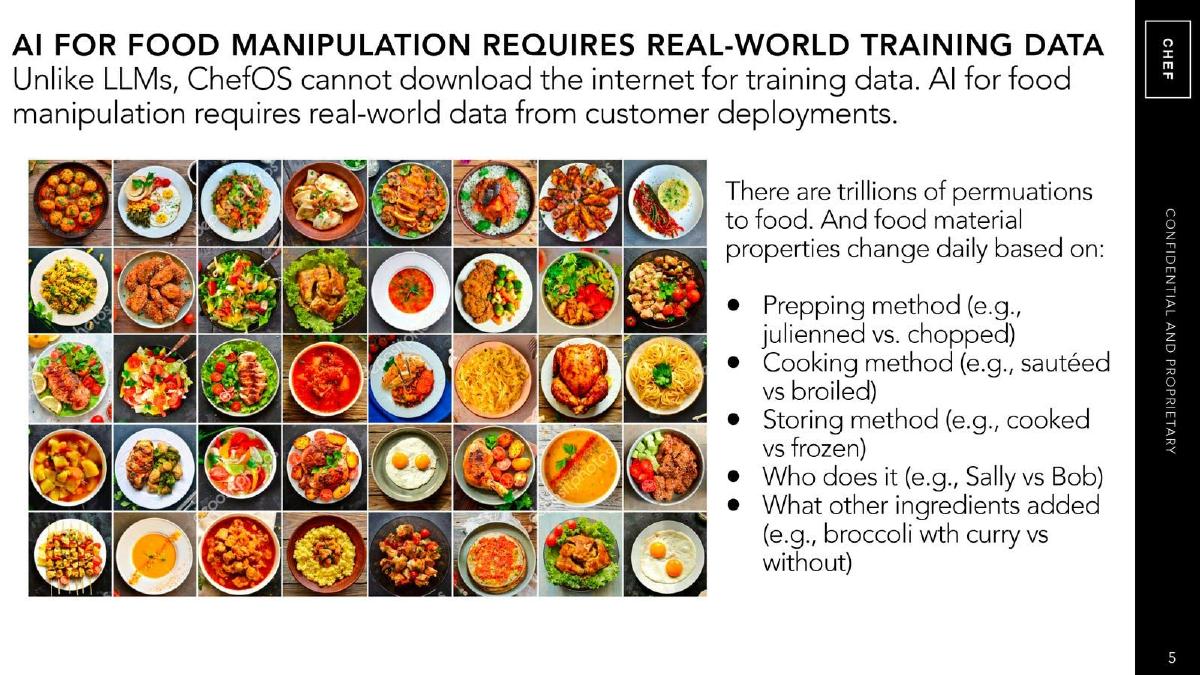
AI-powered food-assembly robots for food manufacturers.
Chef Robotics deck, slide 5. Exact stored slide matched to this analysis.
Our analysis: This is the clearest exclusivity argument in the set. A competitor must deploy robots before it can collect comparable data.
Evidence and limitation: An argument, not a number: the data can only be gathered through physical deployments, and the variety is very large.
What a founder can adapt: If your data only exists after deployment, say so plainly and list what varies.
Supporting analysis
What the deck claims: "AI for food manipulation requires real-world training data. Unlike LLMs, ChefOS cannot download the internet for training data. AI for food manipulation requires real-world data from customer deployments." A grid of dishes sits beside: "There are trillions of permutations to food. And food material properties change daily based on": prepping method (julienned vs. chopped), cooking method (sautéed vs. broiled), storing method (cooked vs. frozen), who does it (Sally vs Bob), and what other ingredients are added.
Presentation choice: It explains why the data is hard to get, using concrete examples anyone can picture.
When it does not fit: No figures on data collected so far. Add deployment hours, items handled or number of customer sites.
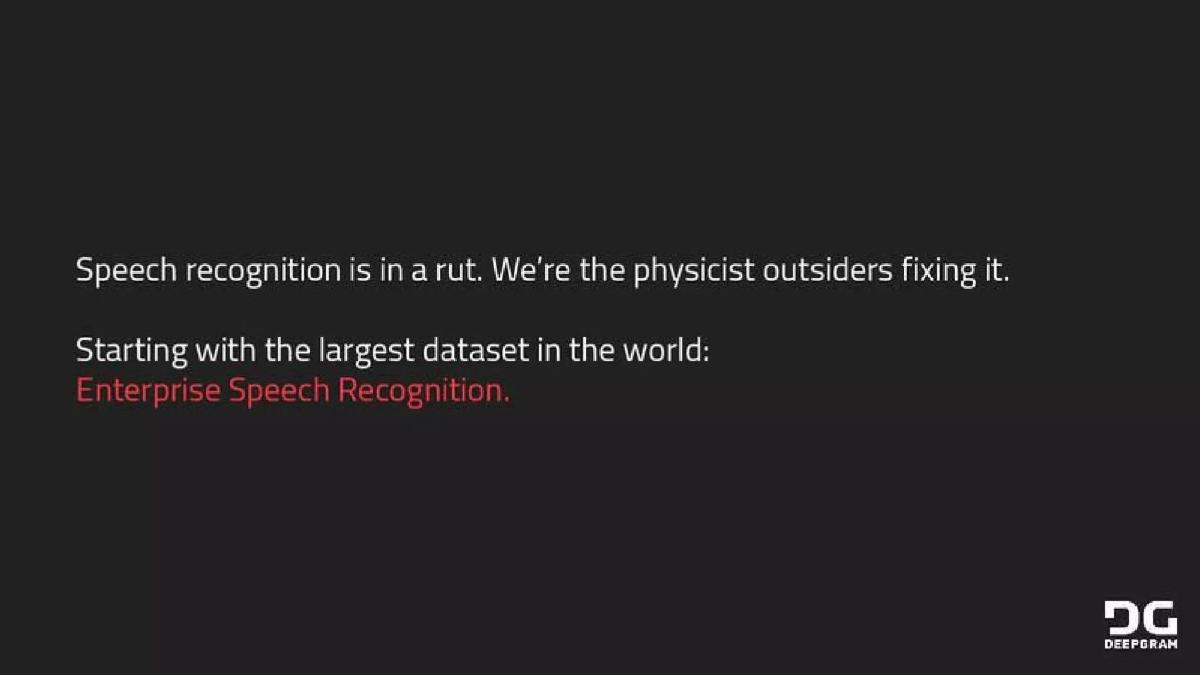
Speech recognition API. This is the deck's opening statement; the later solution slide is covered in our flywheel guide.
Deepgram deck, slide 2. Exact stored slide matched to this analysis.
Our analysis: Putting data in the opening line signals it's central to the story. On its own, the superlative can't be checked.
Evidence and limitation: A superlative claim ("largest dataset in the world") with no size, source or comparison on the slide.
What a founder can adapt: If data is your thesis, say it early, but put a number next to the claim.
Supporting analysis
What the deck claims: "Speech recognition is in a rut. We're the physicist outsiders fixing it. Starting with the largest dataset in the world: Enterprise Speech Recognition."
Presentation choice: It sets up data as the company's core advantage from the first content slide.
When it does not fit: "Largest in the world" invites the question "measured how?" Give hours of audio or number of customers instead.
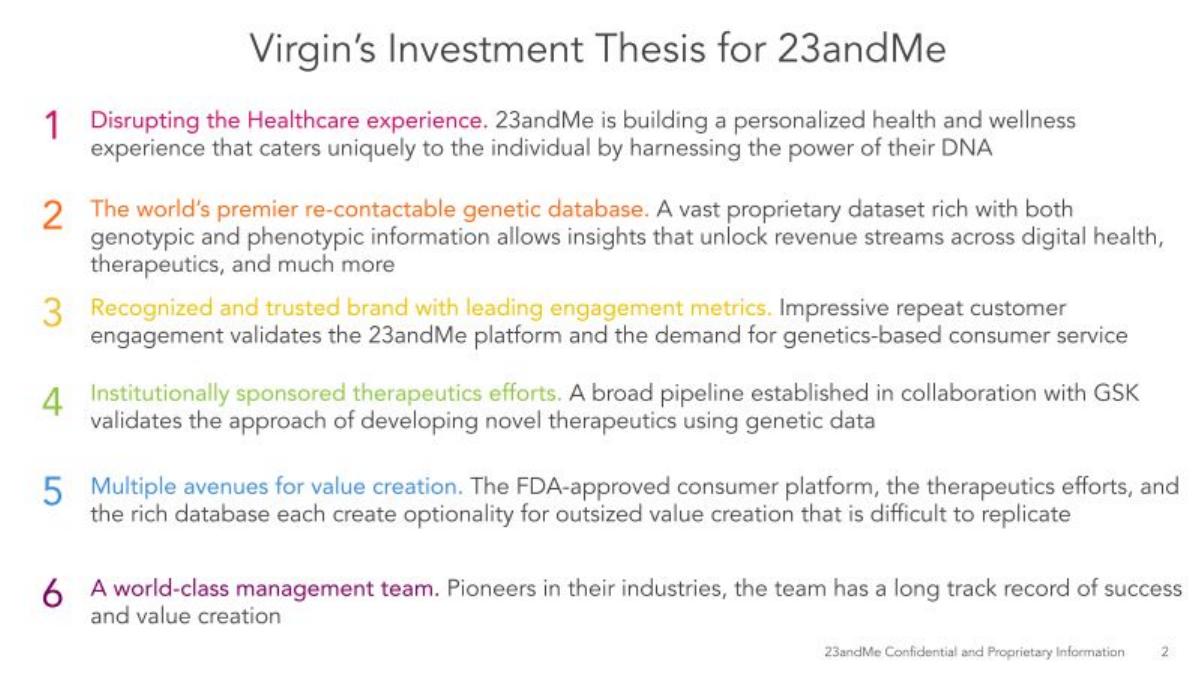
Consumer genetics. This slide is Virgin's investment thesis in the SPAC merger deck, so the data point is one of six reasons.
23andMe deck, slide 4. Exact stored slide matched to this analysis.
Our analysis: "Re-contactable" is the key word: customers have agreed to be asked again, which a competitor cannot buy. The GSK collaboration is the evidence that the data has value.
Evidence and limitation: A qualitative description plus a named partner (GSK) that uses the data.
What a founder can adapt: Name the property that makes your data rare, and one partner or product that already depends on it.
Supporting analysis
What the deck claims: "Virgin's Investment Thesis for 23andMe", point 2: "The world's premier re-contactable genetic database. A vast proprietary dataset rich with both genotypic and phenotypic information allows insights that unlock revenue streams across digital health, therapeutics, and much more." Point 4 links the data to "a broad pipeline established in collaboration with GSK"; point 5 names "the rich database" as one of the assets "difficult to replicate".
Presentation choice: It names what makes the data unusual (consent to re-contact, genotype plus phenotype) and links it to revenue.
When it does not fit: "Vast" has no number. Add the count of consented customers.
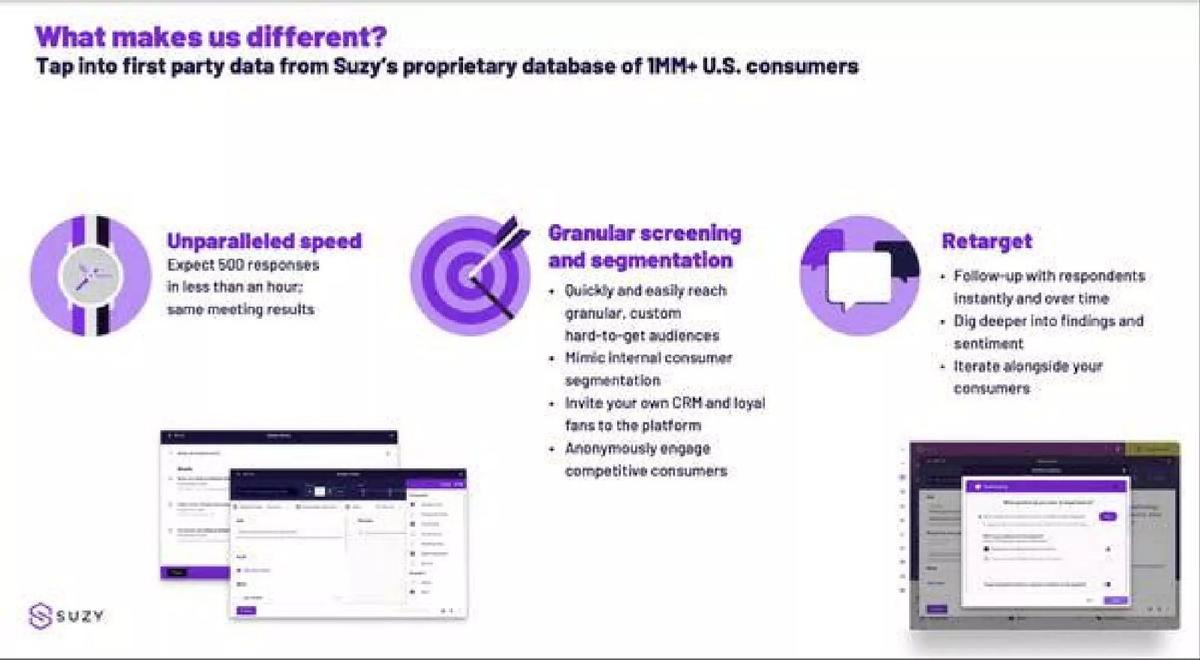
Consumer research platform. The data asset is a panel of consumers who answer questions.
Suzy deck, slide 3. Exact stored slide matched to this analysis.
Our analysis: The slide ties the dataset directly to a customer outcome, speed, which is what a buyer pays for.
Evidence and limitation: A sized panel (1MM+ U.S. consumers) and a speed result (500 responses in under an hour).
What a founder can adapt: Translate your dataset into the customer result it enables, and quantify both.
Supporting analysis
What the deck claims: "What makes us different? Tap into first party data from Suzy's proprietary database of 1MM+ U.S. consumers." Three benefits follow: "Unparalleled speed — Expect 500 responses in less than an hour; same meeting results"; "Granular screening and segmentation" (reach hard-to-get audiences, mimic internal consumer segmentation, invite your own CRM, anonymously engage competitive consumers); "Retarget" (follow up with respondents instantly and over time).
Presentation choice: It turns the data asset into a benefit a customer can feel, with a number on both.
When it does not fit: It doesn't say why a rival panel couldn't match it. Add retention, profile depth or cost to recruit.
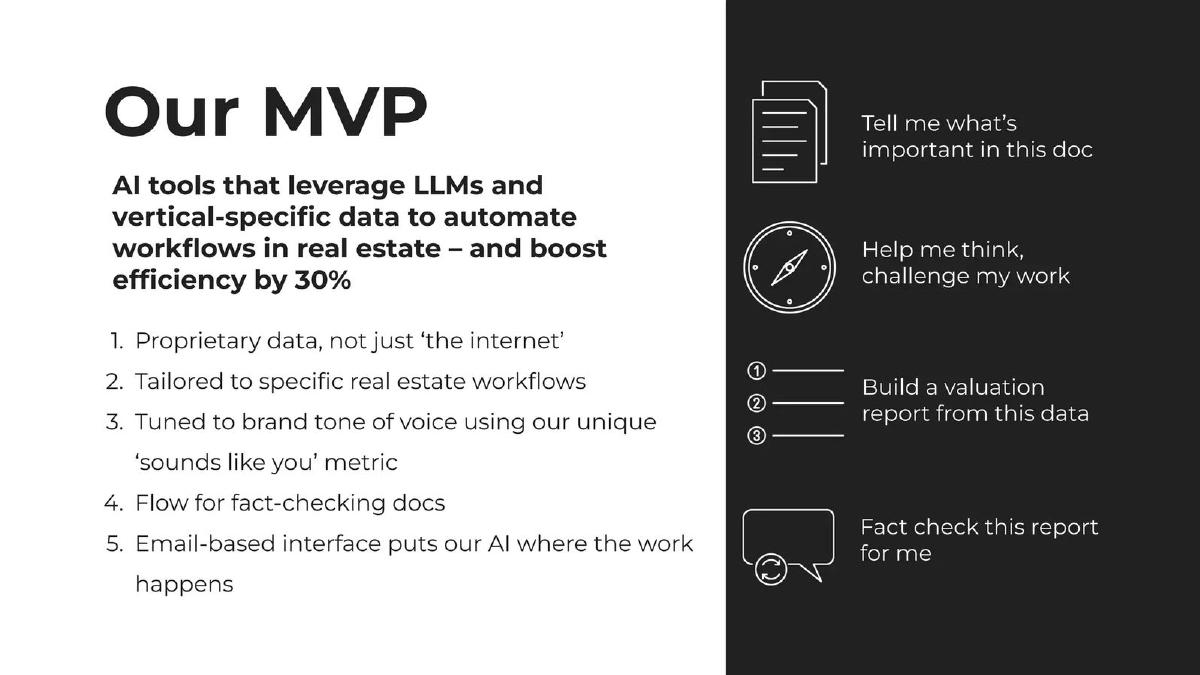
AI tools for commercial real estate workflows. Data appears as point one on the MVP slide.
Fifth Dimension AI deck, slide 5. Exact stored slide matched to this analysis.
Our analysis: "Not just the internet" is the right contrast for an LLM product, but the slide doesn't say what the data is.
Evidence and limitation: A 30% efficiency claim for the product; the data point itself has no source or size.
What a founder can adapt: Say what the vertical data is (documents, transactions, valuations) and how you get it.
Supporting analysis
What the deck claims: "Our MVP — AI tools that leverage LLMs and vertical-specific data to automate workflows in real estate – and boost efficiency by 30%." List: "1. Proprietary data, not just 'the internet'; 2. Tailored to specific real estate workflows; 3. Tuned to brand tone of voice using our unique 'sounds like you' metric; 4. Flow for fact-checking docs; 5. Email-based interface puts our AI where the work happens." Right panel shows tasks such as "Build a valuation report from this data" and "Fact check this report for me".
Presentation choice: It positions vertical data against general-purpose models, which is the question investors ask of LLM products.
When it does not fit: A single list item. Name the source and the volume, or move it to a slide of its own.
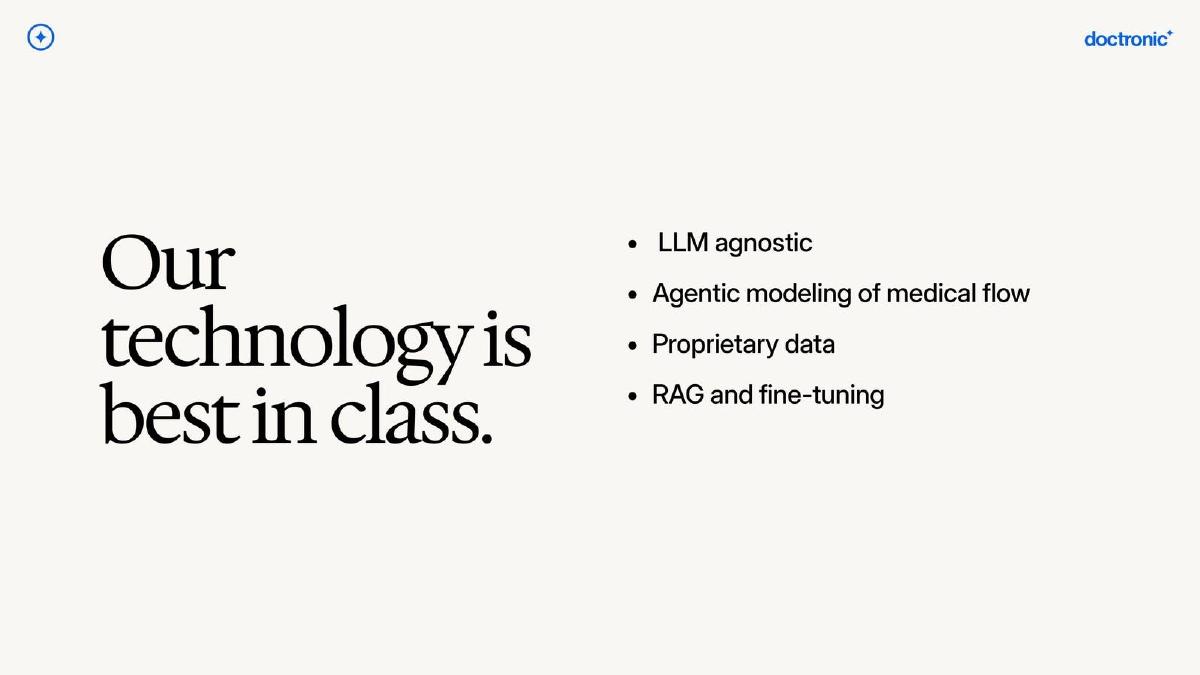
AI medical assistant. Data appears as one of four bullets on the technology slide.
Doctronic deck, slide 6. Exact stored slide matched to this analysis.
Our analysis: The pattern to avoid. "Proprietary data" appears as a label that any AI startup could write.
Evidence and limitation: None on the slide: no source, size or result.
What a founder can adapt: Replace the bullet with one line: what data, from where, how much, and what it improves.
Supporting analysis
What the deck claims: "Our technology is best in class." Bullets: "LLM agnostic"; "Agentic modeling of medical flow"; "Proprietary data"; "RAG and fine-tuning".
Presentation choice: Included as a contrast: it shows how little a bare "proprietary data" bullet tells an investor.
When it does not fit: "Best in class" with no comparison. Show a benchmark or a customer result.
Source and size are common; a measured effect is rare.
Example
Source named
Sized
Why rivals can't copy
Effect shown
Vic.ai
Yes (partnership, usage)
Yes (40,000 companies, 200M+ docs)
Unusual partnership
No
Chef Robotics
Yes (deployments)
No
Needs physical deployments
No
Deepgram
No
Superlative only
Not stated
No (on this slide)
23andMe
Yes (consented customers)
No
Re-contactable consent
GSK collaboration
Suzy
Yes (consumer panel)
Yes (1MM+)
Not stated
500 responses < 1 hour
Fifth Dimension AI
No
No
"Not just the internet"
30% efficiency (product)
Doctronic
No
No
Not stated
No
Key Takeaways
Name the source of the data. Vic.ai credits a partnership; Chef Robotics credits customer deployments.
Size it with a unit investors can check: companies, documents, consumers, records.
Say why a competitor can't get it. "Cannot download the internet" is a reason; "proprietary" is only a label.
Show one result the data produces, like accuracy against named alternatives, not just its size.
One bullet is not a moat. If data is your advantage, it deserves its own slide.
Write your data advantage in four lines
If you can't fill in a line, that's the question investors will ask.
Source. Where exactly does the data come from? Deployments, partners, users, a panel, purchased?
Size. How much, in a unit investors can check? Records, customers, hours, documents. How fast is it growing?
Exclusivity. Why couldn't a funded competitor get the same data in 18 months? Contract, consent, deployments, time?
Effect. What measurable result does the data produce? Accuracy, automation rate, speed, versus which alternative?
Copyable framework: We learn from [data type] collected through [source]. We hold [size], growing [rate]. Competitors can't match it because [reason]. On customer data, this gives [result] versus [alternative].
Illustrative example 1 — written by us
Before: Proprietary data. Best-in-class AI.
After: Trained on 4M anonymised freight invoices from 60 shipper customers, adding 300K a month. Each new customer's invoices only exist inside their systems. Extraction accuracy on customer data: 97% vs 88% for a general-purpose model.
What improved: Our illustrative rewrite; all figures are invented. It names the source, sizes it, gives the exclusivity reason and shows a comparative result.
What this guide adds
The why us guide covers unfair advantages of every kind: founders, audiences, distribution, licences. The flywheel guide covers growth loops in which usage feeds growth. The technology guide covers what a product's technology proves. This guide covers one specific claim that now appears in most AI and data decks: that the company has data others do not. It shows what makes that claim believable and what makes it sound like every other deck.
It's written for founders of AI, machine learning and data-product companies who are deciding whether to give data its own slide, and how to word it.
The three questions a data slide must answer
Source: where does the data come from? Customer deployments, a partnership, a consumer panel, public sources you have cleaned, or usage of your own product. Each has different defensibility. Public data that anyone can collect is not an advantage, however well you clean it.
Exclusivity: why can't a funded competitor get the same data within a year or two? Good answers include an exclusive or unusual agreement, data that only exists after physical deployments, a consumer base that has opted in to be re-contacted, or years of accumulated usage. "We built it first" is weaker unless the gap is hard to close.
Effect: what does the data do? The most persuasive answer is a measured result, such as accuracy on customer data against named alternatives. A dataset's size alone does not prove that more data keeps improving the product; investors increasingly ask where the returns stop.
Where the claim sits in the deck
In our examples the data claim appears in four places: a dedicated slide (Vic.ai, Chef Robotics), inside the solution slide (Deepgram in a later slide, Fifth Dimension AI), as one point in an investment thesis (23andMe), or as one bullet on a technology slide (Doctronic). A dedicated slide works when data is the main reason the company wins. If data is one advantage among several, a clear line on the solution or why us slide is enough, but it still needs a source and a number.
Common mistakes
"Proprietary data" as a label. Every AI deck says it. Name the source and size.
Size without effect. A large dataset isn't a moat unless it makes the product measurably better.
Public data presented as an advantage. If anyone can collect it, cleaning it is a head start, not a moat.
Unverifiable superlatives. "Largest in the world" needs a measure and a source.
No reason competitors can't copy it. State the contract, consent, deployment or time barrier.
Diagnostic checklist
The source of the data is named.
The dataset is sized in a checkable unit.
It says why a competitor can't get the same data.
One measured result the data produces is shown.
Customer data use is consistent with your privacy and contract terms.
Frequently asked questions
How we chose these examples
Corpus: published pitch deck teardowns on StartupFundraising.com. Founder-uploaded private decks are excluded.
Selection (2026-09-24): we searched extracted text of slides 2–6 for data-advantage terms (proprietary data, data moat, unique data, training data, largest dataset, more data) and inspected about twenty candidates. We excluded slides already used in other guides (Crunchbase slide 6 and Deepgram slide 6 in the flywheel guide), slides whose stored images are not available (several later-slide candidates), slides describing a data problem rather than the company's own data (Datagen, Kili Technology, Nereus), and a generic platform description (7bridges).
Overlap check: the why us guide covers unfair advantages generally, the flywheel guide covers growth loops, and the technology guide covers technical proof. This guide covers the specific claim that a company has data others don't.
Two examples (Fifth Dimension AI, Doctronic) are included to show weaker patterns; the 23andMe slide is an investor's thesis in a SPAC merger deck, not a startup fundraising slide.
Review: all seven stored slide images were inspected on 2026-09-24 and matched to company, deck and slide number (editorial model review). No person has yet completed an editorial review of this page.
Claims are as shown on the slides. We make no claim that any slide caused a fundraising outcome.