Chef Robotics secured $20.6M in Series A funding in 2024 to scale its AI-powered food production systems. The 12-slide deck avoids traditional financial projections in favor of a technical and operational narrative. It frames the food industry's labor shortage as a structural crisis that cannot be solved by offshoring, positioning its 'ChefOS' as the only viable solution for 'high-mix' production. The deck’s core strength lies in its 'flywheel' argument: because food properties are too complex for simulation, the company that gathers the most real-world deployment data wins. By showcasing 44…
Key takeaways
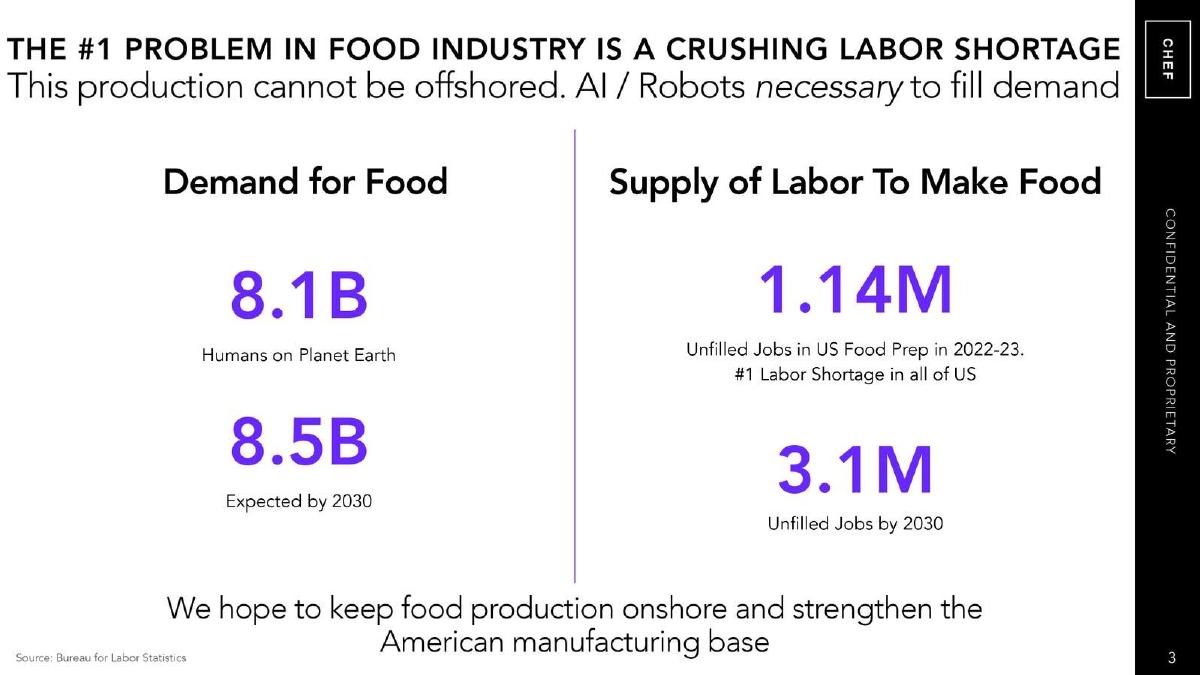
- The deck identifies a massive labor gap, citing 1.14M unfilled US food prep jobs in 2022-23 on Slide 3.
- Chef Robotics positions its AI as a data moat, arguing on Slide 5 that food manipulation requires real-world data because it cannot be 'downloaded from the internet' like LLMs.
- The company claims its 'starter pack' of 6 robots can handle approximately 80% of ingredients immediately upon deployment, as stated on Slide 7.
- A critical technical claim on Slide 7 notes that AI training must happen in the physical world because physics models for 'deformable, wet food' do not exist in simulation.
- The deck highlights a significant efficiency gap, stating the industry currently operates at less than 70% capacity due to being 30% understaffed on Slide 9.
- Traction is quantified by volume rather than revenue, with Slide 11 reporting over 44,000,000 servings made by ChefOS-enabled robots.
- The deck lacks a traditional team slide, financial forecast, or specific breakdown of the $20.6M Series A ask.
- The presentation emphasizes 'high-mix' production, distinguishing its flexible AI from 'traditional automation' that fails when ingredients change (Slide 9).
The Macro Problem: A Labor Crisis That Can't Be Offshored
Slides 1-3: Setting the Stakes
The deck opens with a minimalist title slide (Slide 1) and moves immediately into a high-stakes problem statement on Slide 3. Chef Robotics frames the opportunity not just as a business venture, but as a necessity for national food security. By citing the Bureau of Labor Statistics, they highlight a 'crushing labor shortage' with 1.14M unfilled jobs in US food prep as of 2022-23. The slide projects this gap will grow to 3.1M unfilled jobs by 2030.
Key Insight: The deck makes a strategic distinction that food production 'cannot be offshored.' This creates a sense of urgency for domestic automation. By framing the solution as a way to 'strengthen the American manufacturing base,' the company aligns itself with broader economic and political trends, which can be a powerful motivator for institutional investors.
The Technical Moat: Why Food is Hard for AI
Slides 4-5: The Data Problem
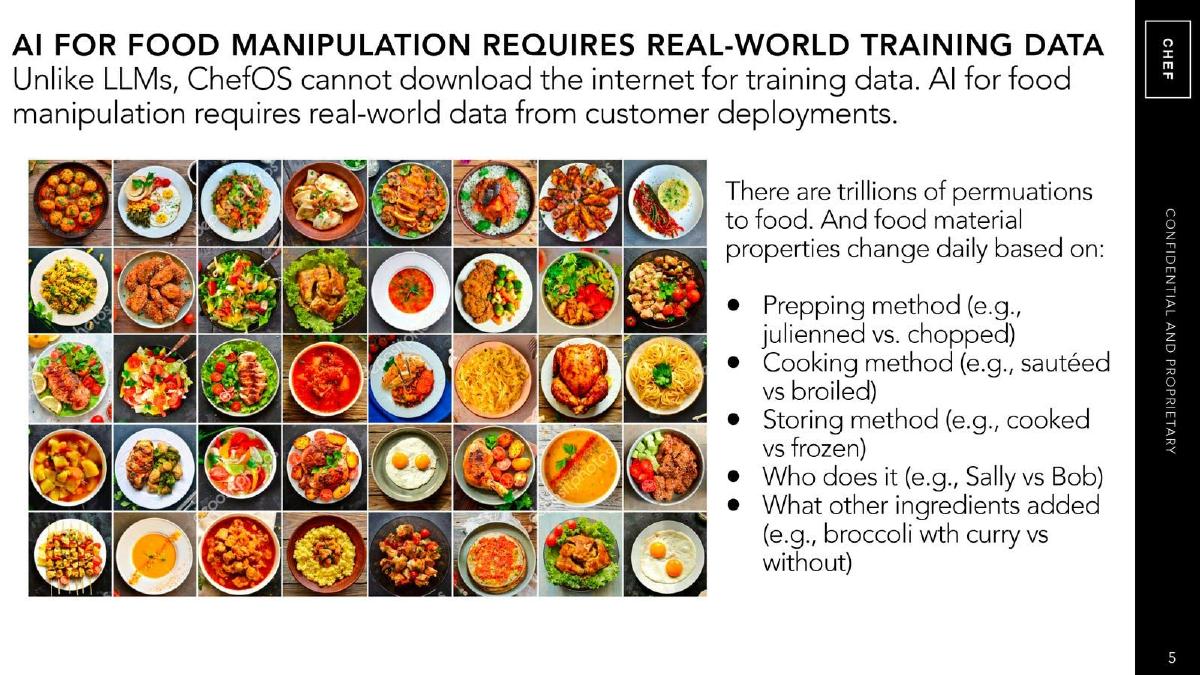
Slide 5 is perhaps the most important slide for a technical investor. It addresses the 'Why Now?' and 'Why You?' questions by explaining the unique difficulty of food manipulation. The deck argues that unlike Large Language Models (LLMs), which can scrape the internet for training data, food AI requires 'real-world data from customer deployments.'
The slide lists the variables that make food difficult: prepping methods (julienned vs. chopped), cooking methods (sautéed vs. broiled), and even the specific individual performing the task. By stating there are 'trillions of permutations,' Chef Robotics justifies why a hardware-software integrated approach is the only way to build a functional 'ChefOS.'
The Flywheel: Scaling Through Deployment
Slides 6-7: The Feedback Loop
Slide 7 introduces the 'food manipulation flywheel.' This is a classic venture capital narrative: more deployments lead to more data, which leads to better AI, which leads to higher utilization and more customers. The company claims that for a '6-robot starter pack,' they can manipulate approximately 80% of ingredients immediately.
A critical footnote on Slide 7 explains that they 'cannot learn in sim' (simulation) because there are no accurate physics models for 'deformable, wet food.' This is a bold technical claim that positions their physical deployments as an insurmountable lead. If simulation is impossible, the first company to get 100 robots in the field wins the data race.
The Reality of the Factory Floor
Slides 8-9: High-Mix Production
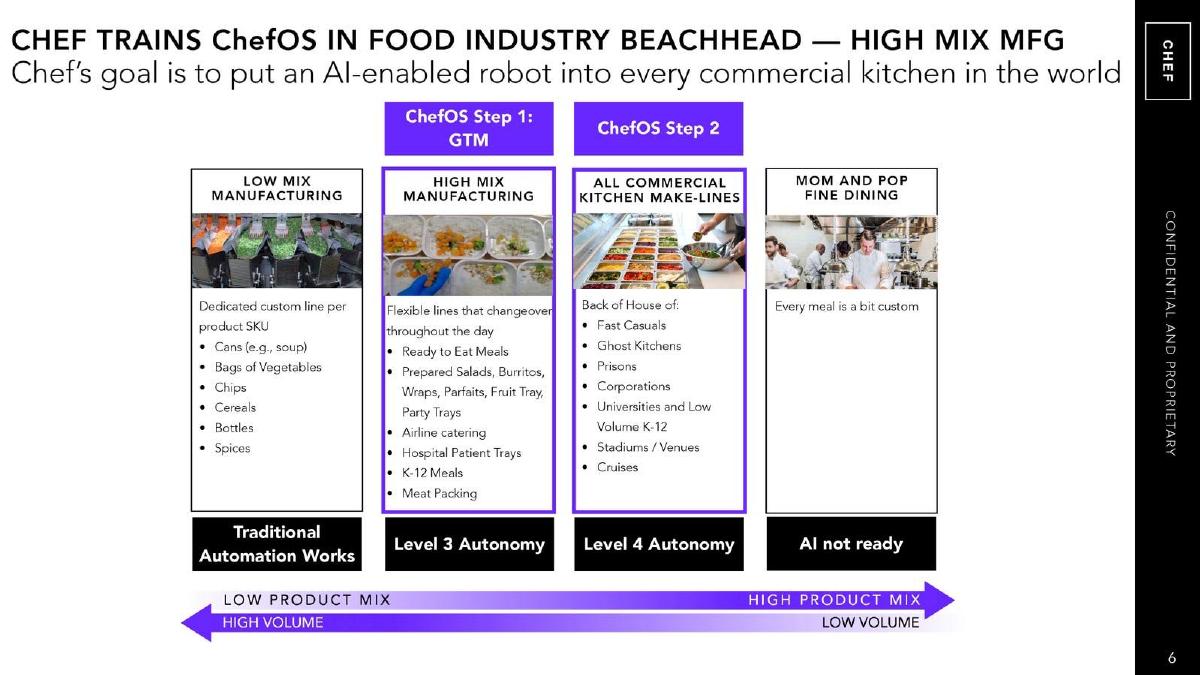
Slide 9 contrasts 'Reality' with 'Traditional Automation.' Most industrial robots are designed for 'low-mix' environments—doing the same thing a million times. Chef Robotics targets 'high-mix' production, where the menu changes daily. They note that the industry currently operates at 'less than 70% capacity' because they simply cannot find enough people to man the lines. This slide bridges the gap between the high-level labor stats on Slide 3 and the day-to-day operational pain of a food plant manager.
Proof of Scale: 44 Million Servings
Slides 10-12: Traction and Execution
The deck concludes its narrative arc on Slide 11 with a massive traction metric: '44,000,000+ servings' made by ChefOS-enabled robots. The images show robots integrated into standard stainless-steel commercial kitchen environments, working alongside or in place of human staff. The emphasis here is on 'unsupervised, high uptime performance.'
What’s Missing: The deck ends without a traditional 'Ask' slide, a 'Team' slide, or a 'Financials' slide. While Business Insider reported this deck helped raise a $20.6M Series A in 2024, those specific details are absent from the slides provided. This suggests the deck was used as a 'teaser' or a technical deep-dive rather than a standalone full-pitch presentation.
What Works in the Chef Robotics Deck
The Data Moat Argument: By explaining why food is uniquely difficult for AI (the lack of simulation models), the founders create a very strong 'moat' story. Investors love businesses where the product gets better and harder to compete with as it scales.
Focus on 'High-Mix': Identifying the specific niche where traditional automation fails (flexibility) allows Chef Robotics to avoid competing with established industrial giants like Fanuc or ABB on their home turf. They aren't just building a robot; they are building a robot that can handle a sautéed broccoli one minute and a curry the next.
Concrete Traction: The figure of 44 million servings is an excellent 'anchor' metric. It moves the conversation from 'Can this work?' to 'How fast can this scale?' It proves the hardware is durable enough for the harsh, wet, and variable environment of a food plant.
What is Missing from the Chef Robotics Deck
The Human Element: There is no Team slide in this 12-slide set. For a Series A, the pedigree of the engineering and AI team is usually a top-three concern for investors, especially when making claims about the impossibility of simulation-based learning.
Unit Economics: While the deck mentions a '6-robot starter pack,' it provides no information on the business model. Is it Robotics-as-a-Service (RaaS)? A capital purchase with a software license? Without knowing the cost to deploy versus the labor savings generated, the '70% capacity' problem remains a theoretical one for the investor.
Competitive Landscape: The deck briefly mentions 'competitors' in a footnote on Slide 7, claiming their robots only work 20% of the day. However, a dedicated slide showing where Chef Robotics sits compared to other food-tech startups (like Miso Robotics or Picnic) would have helped clarify their market positioning.
Founder Takeaways: Lessons to Copy
Use 'Flywheel' Diagrams: If your business benefits from a network effect or a data feedback loop, visualize it. Slide 7 is a textbook example of how to show investors that your lead will widen over time. · Address Technical Skepticism Early: By admitting that 'food is high dimensional and has a long tail,' the founders show they understand the complexity of their task. This builds more trust than a deck that claims automation is easy. · Quantify the 'Unsolvable' Problem: Don't just say there is a labor shortage. Use specific numbers (1.14M unfilled jobs) and explain why current solutions (offshoring) aren't an option. · Show, Don't Just Tell: The photos on Slide 11 of robots in actual, messy, real-world kitchens are worth more than a dozen slides of CAD renderings. Investors in hardware want to see 'dirty' robots—it means they are actually working.
Frequently asked questions
- How does Chef Robotics differentiate itself from traditional industrial automation?
- Traditional automation is designed for high-volume, low-variety tasks. Chef Robotics targets 'high-mix' production where ingredients and methods change frequently. On Slide 9, they argue that traditional systems cannot serve this need, leaving the industry 30% understaffed. Their solution uses AI to adapt to different food textures and prep methods that would jam or confuse a standard robotic arm.
- Why does the deck focus so heavily on data collection?
- Slide 5 explains that food material properties change based on prepping, cooking, and storing methods. Unlike text-based AI, food AI cannot be trained on web data. By deploying robots in real kitchens, Chef Robotics builds a proprietary dataset of 'deformable, wet food' interactions, creating a technical moat that competitors cannot easily replicate through simulation.
- What is the 'starter pack' mentioned in the deck?
- On Slide 7, the company references a '6-robot starter pack.' They claim this configuration can manipulate approximately 80% of ingredients 'off-the-bat' for a new customer. This suggests a modular sales model designed to integrate quickly into existing production lines rather than requiring a total facility overhaul.
- What metrics does Chef Robotics use to prove market fit?
- Instead of focusing on MRR or ARR in these slides, the company uses production volume as its primary proof of utility. Slide 11 highlights that their robots have produced over 44,000,000 servings in 'real-world, commercial settings.' This demonstrates high uptime and the ability to handle industrial-scale workloads without constant human supervision.
- What essential pitch deck elements are missing from this presentation?
- The 12-slide deck is notably missing a Team slide, a Competition slide, and a detailed Financials/Projections slide. It also does not explicitly state the terms of the $20.6M Series A round or how the funds will be allocated. This suggests the deck was likely a technical supplement to a broader due diligence process.