Chibwe presents Osmium, a business intelligence and text analytics platform specifically tailored for small and medium-sized enterprises (SMEs) that find enterprise tools like IBM too expensive or technical. The deck, likely produced in early 2014, highlights features such as sentiment analysis, cluster analysis, and part-of-speech tagging. It positions the product as a bridge for businesses unable to leverage big data due to cost barriers. With a structured four-tier subscription model ranging from £50 to £500 per month, the company seeks £130k in funding, utilizing the UK's SEIS tax incenti…
Key takeaways
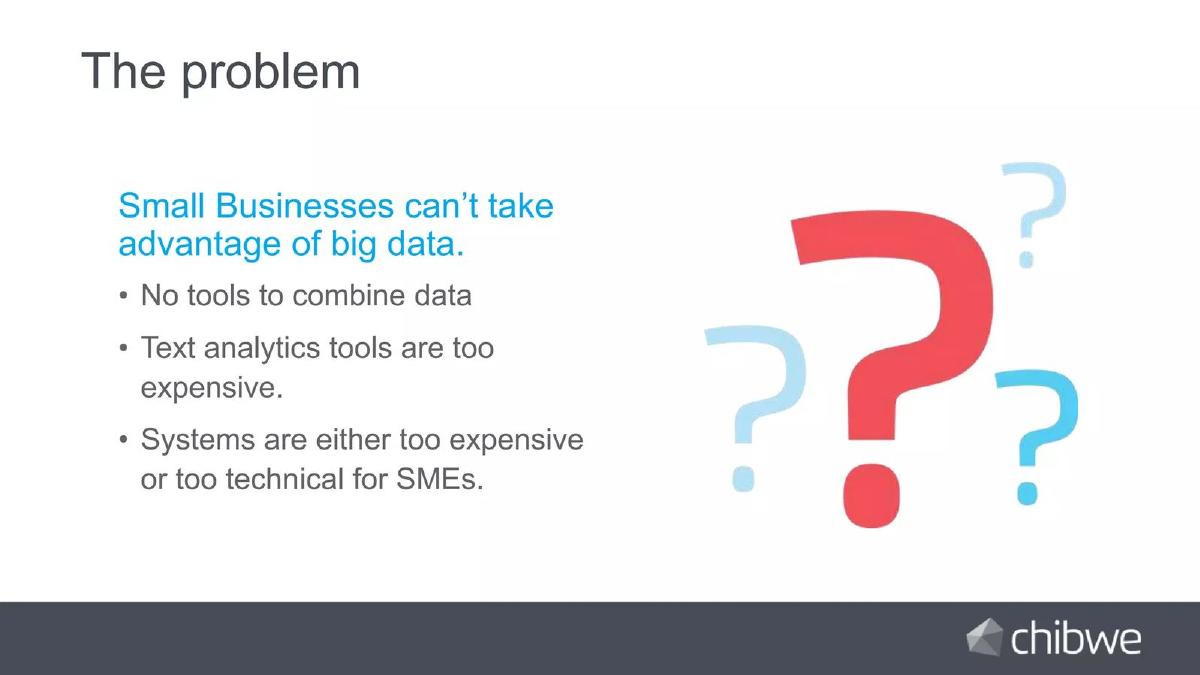
- The core problem identified is that big data tools are currently too expensive or technical for SMEs to utilize effectively (Slide 2).
- The product, named Osmium, includes features like sentiment analysis, cross tabs, and part-of-speech tagging (Slide 3).
- Target audiences are explicitly defined as small/medium businesses, small research agencies, and digital marketing agencies (Slide 4).
- A clear four-tier pricing strategy is presented, with monthly costs of £50, £175, £300, and £500 (Slide 5).
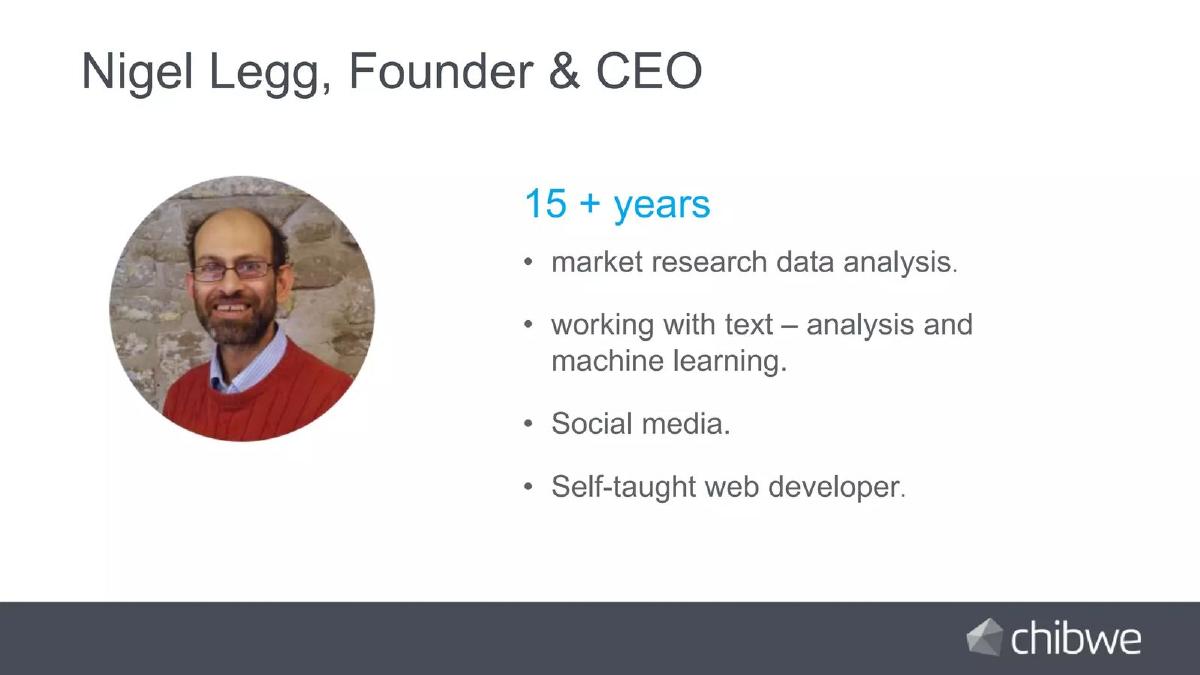
- The founder cites personal experience in market research (MR) and social media as a key driver for success (Slide 6).
- The company mentions existing case studies with a coffee chain and a games studio, though specific outcomes are not detailed (Slide 6).
- The deck targets a late summer or autumn 2014 launch date (Slide 6).
- The funding ask is exactly £130k, positioned to take advantage of the SEIS (Seed Enterprise Investment Scheme) in the UK (Slide 7).
Company Overview
Chibwe is a technology startup focused on democratizing big data analytics for the SME market. Their flagship product, Osmium, is positioned as an affordable alternative to enterprise-grade business intelligence tools. The deck focuses on the gap between complex, expensive data tools and the needs of smaller agencies and businesses that require sophisticated text and sentiment analysis without the high price tag or technical overhead.
Slide 1: Title Slide
The opening slide is minimalist, featuring the Chibwe logo—a stylized, faceted grey geometric shape—and the company name in a clean, sans-serif typeface. The URL www.chibwe.com is provided at the bottom. There is no tagline or mission statement present on this slide, leaving the initial context to be established by the following slides.
Slide 2: The Problem
Slide 2 identifies the core pain points for the target market. It states that "Small Businesses can’t take advantage of big data." The slide lists three specific barriers: a lack of tools to combine data, the high cost of text analytics tools, and the fact that existing systems are either too expensive or too technical for SMEs. This slide uses large question mark graphics to emphasize the confusion and difficulty faced by small business owners in the current data landscape.
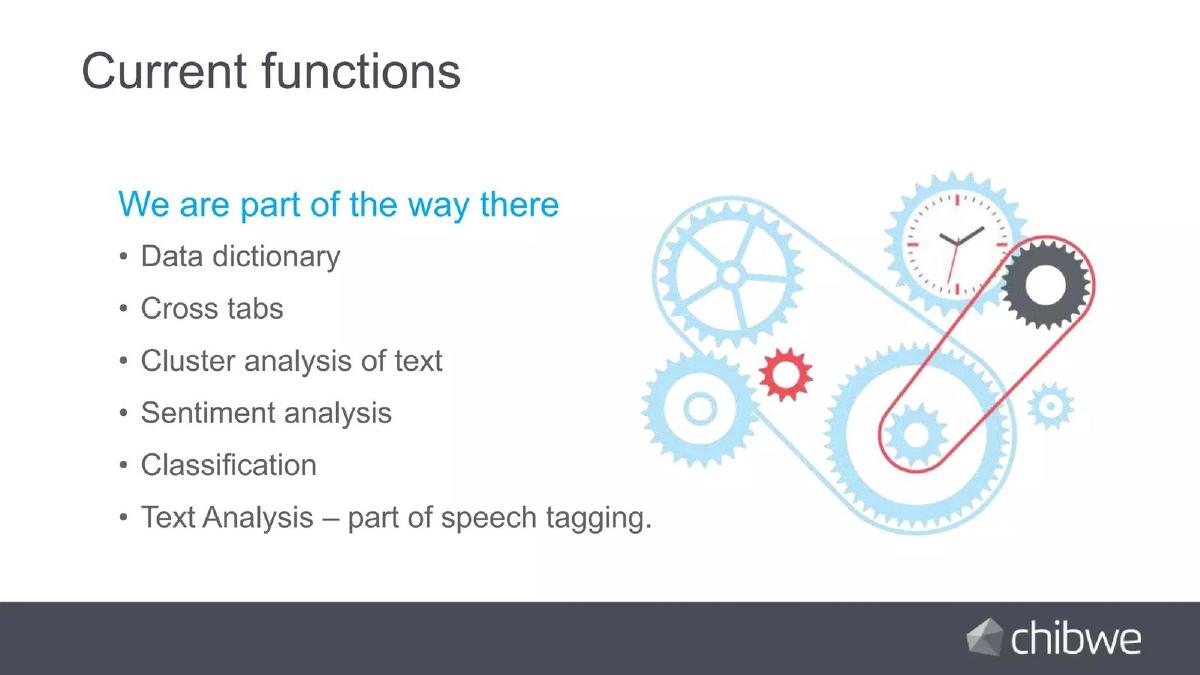
Slide 3: Current Functions
This slide provides a technical overview of what the Osmium platform can currently do. It uses the phrase "We are part of the way there" to indicate that the product is in development or beta. The listed functions include:
Data dictionary · Cross tabs · Cluster analysis of text · Sentiment analysis · Classification · Text Analysis – part of speech tagging
The inclusion of specific NLP (Natural Language Processing) terms like "part of speech tagging" suggests a focus on unstructured text data, which is often a significant hurdle for small businesses to analyze manually.
Slide 4: Target Audience
Slide 4 answers the question "Who is Osmium for?" It identifies three primary segments: Small/medium sized businesses, Small research agencies, and Digital marketing agencies. A summary statement at the bottom clarifies the competitive positioning: "Small businesses that cannot afford the enterprise-scale Business Intelligence offerings from eg IBM." This explicitly defines Chibwe as a "value" or "accessible" alternative to major industry players.
Slide 5: Monthly Subscription Structure
This slide presents a detailed pricing grid, which is rare for a pre-launch pitch deck but provides concrete evidence of the business model. The four tiers are:
Starter (£50): 2 users, 2 projects, 2 searches, 5,000 posts, 2 files/week, 1 data source, no prediction. · Bronze (£175): 4 users, 4 projects, 5 searches, 7,500 posts, 5 files/week, 3 data sources, no prediction. · Silver (£300): 6 users, 6 projects, 8 searches, 12,000 posts, 8 files/week, 5 data sources, includes prediction. · Gold (£500): 8 users, 8 projects, 12 searches, 15,000 posts, 12 files/week, all data sources, includes prediction.
The pricing is structured to scale with the volume of data and the complexity of the analysis (specifically the "prediction" feature).
Slide 6: Why Osmium Will Succeed
This slide serves as a combination of a "Why Us" and "Traction" slide. It lists the ability to transform and combine data and the wide range of analyses as product strengths. Crucially, it mentions the founder's experience in market research (MR) and social media. It also references "Case studies – working with a coffee chain and a games studio," which suggests early validation, though no data from these studies is shared. The slide concludes with a launch timeline of "late summer / autumn 2014."
Slide 7: The Ask
The final slide in this set is a direct funding request. It features a large blue circle with "£130k" inside it. In the bottom left corner, the "SEIS" logo is displayed. SEIS (Seed Enterprise Investment Scheme) is a UK government initiative that provides tax relief to investors, which is a significant selling point for early-stage UK startups. The slide is extremely direct, focusing entirely on the number and the tax incentive.
What Works Well in This Deck
The deck is highly focused on a specific market gap. By naming IBM as the "enterprise-scale" alternative they are avoiding, Chibwe clearly defines its territory as the affordable, user-friendly option. The pricing slide is exceptionally detailed for an early-stage deck, showing that the founders have thought through the unit economics and how to segment their customer base. The mention of specific technical features like "part of speech tagging" and "cluster analysis" gives the product more credibility than a generic "analytics" pitch.
What Is Missing
The most notable omission in this 7-slide sequence is a dedicated Team Slide. While the founder's experience is mentioned on Slide 6, there are no names, photos, or specific career histories for the leadership or engineering team. There is also no "Market Size" (TAM/SAM/SOM) slide to show the scale of the opportunity, nor is there a "Competition" slide to show how they stack up against other SME-focused tools like Hootsuite or basic survey tools. Finally, the "Case Studies" mentioned on Slide 6 are vague; showing a single chart or a quote from the coffee chain or games studio would have significantly boosted the "social proof" of the deck.
Founder Takeaways
Be specific about your pricing: Even if you are pre-launch, having a well-reasoned pricing table shows investors that you understand your customer's willingness to pay and how your costs will scale. Leverage local tax incentives: If you are in a jurisdiction like the UK, prominently featuring SEIS or EIS eligibility can be a major draw for angel investors. Define your 'Anti-Competitor': By stating who you are not for (in this case, those who can afford IBM), you make it much easier for an investor to understand your exact market positioning.
Frequently asked questions
- What is the primary product being pitched by Chibwe?
- The primary product is called Osmium. It is described as a data analytics and business intelligence tool designed to help small businesses combine and analyze data, specifically focusing on text analytics, sentiment analysis, and predictive modeling for those who cannot afford enterprise-scale solutions.
- How does Chibwe plan to generate revenue?
- Chibwe outlines a monthly subscription model with four tiers: Starter (£50), Bronze (£175), Silver (£300), and Gold (£500). These tiers are differentiated by the number of users, projects, searches, posts analyzed, and access to predictive features.
- What specific technical capabilities does the Osmium platform offer?
- According to Slide 3, the platform currently offers a data dictionary, cross tabs, cluster analysis of text, sentiment analysis, classification, and part-of-speech tagging. Higher-tier plans also include 'Prediction' capabilities.
- Who are the intended customers for this platform?
- The deck targets three specific segments: small and medium-sized businesses (SMEs), small research agencies, and digital marketing agencies. The unifying characteristic is that these entities cannot afford enterprise offerings from companies like IBM.
- What is the investment ask and the associated tax incentive?
- The company is seeking £130,000 in investment. The deck prominently features the 'SEIS' logo, referring to the UK's Seed Enterprise Investment Scheme, which offers significant tax breaks to investors in early-stage startups.