The 2013 Chewse seed deck is a study in restraint. With only 12 slides and almost no body text, the presentation relies entirely on high-impact numbers and social proof. The deck opens with a massive traction figure—20,000 meals—and quickly validates the business model by showing that a single client can generate $30,000 to $500,000 in annual revenue. Instead of explaining the 'how' of their logistics, they show a screenshot of a simple interface and a hockey-stick growth chart showing revenue jumping from $4.4k to $22.1k in just 90 days. The deck concludes with a $33B market opportunity and…
Key takeaways
- The deck leads with a massive traction milestone of 20,000 meals on slide 2 to immediately establish credibility.
- Slide 3 uses blue-chip logos like PwC and Wells Fargo to provide instant social proof without needing a client list slide.
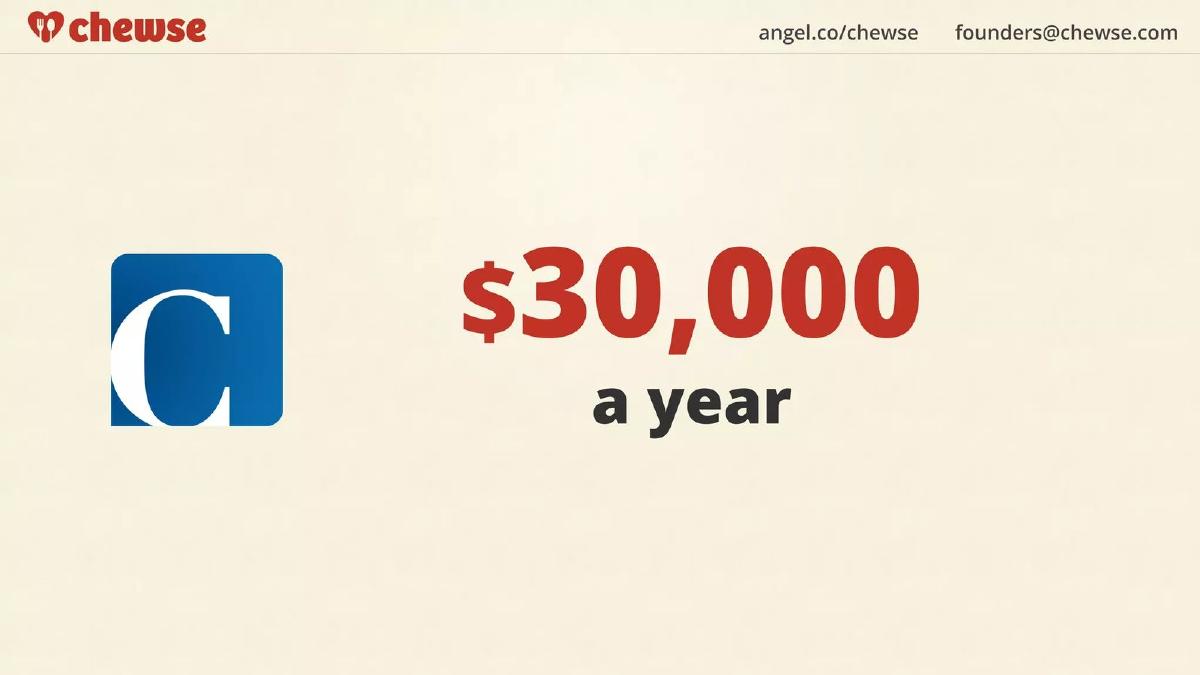
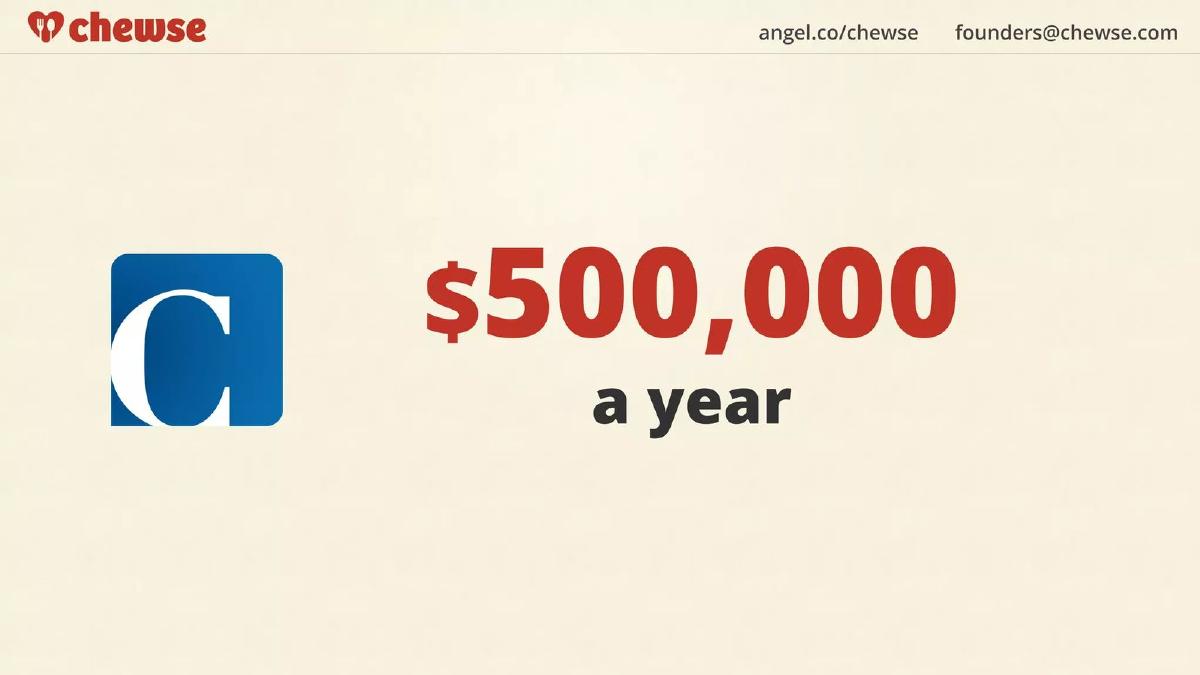
- The business model is explained through a single client's potential, showing a jump from $30,000 to $500,000 a year on slides 4 and 5.
- Revenue growth is the focal point, with slide 7 showing a leap from $4.4k in November 2012 to $22.1k in January 2013.
- The market size is built bottom-up, starting with a $265,000 figure for a specific LA segment on slide 8 and scaling to $33B on slide 11.
- The deck completely omits a traditional team slide, mentioning only Tracy Lawrence on the final slide.
- The 'Ask' slide (12) creates urgency by stating that 60% of the $500,000 seed round is already committed.
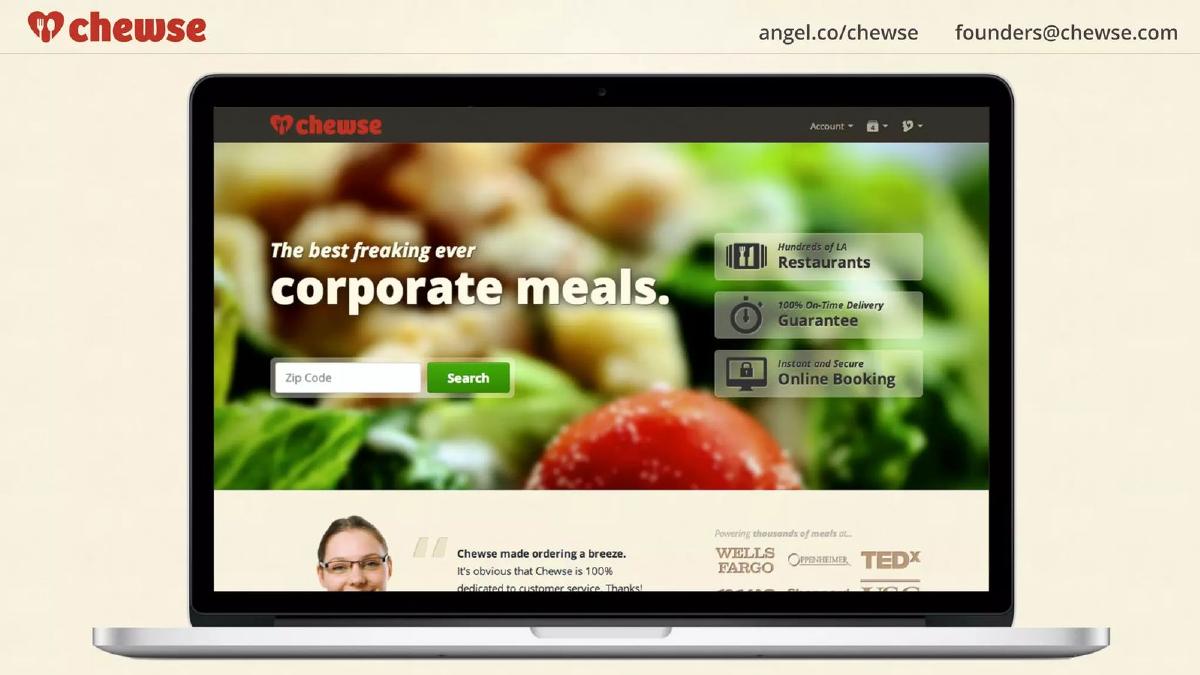
- Product functionality is condensed into a single laptop mockup on slide 6, emphasizing 'Instant and Secure Online Booking.'
The Power of Minimalism: Chewse's $500k Seed Deck
The 2013 Chewse pitch deck is a fascinating artifact from the early days of the food-tech boom. While many founders feel the need to pack 50 slides with data, Chewse used just 12 slides, most of which contain fewer than ten words. This teardown examines how a company that eventually raised over $33 million started with a high-impact, low-word-count presentation that focused almost exclusively on momentum and market scale.
Slides 1-3: The Hook and Social Proof
Slide 1: Title The deck opens with the Chewse logo and the tagline: "Big groups. Big meals. Thousands fed." It is a simple value proposition that identifies the target audience (groups) and the scale (thousands). The background image of a meal is blurred, keeping the focus on the text.
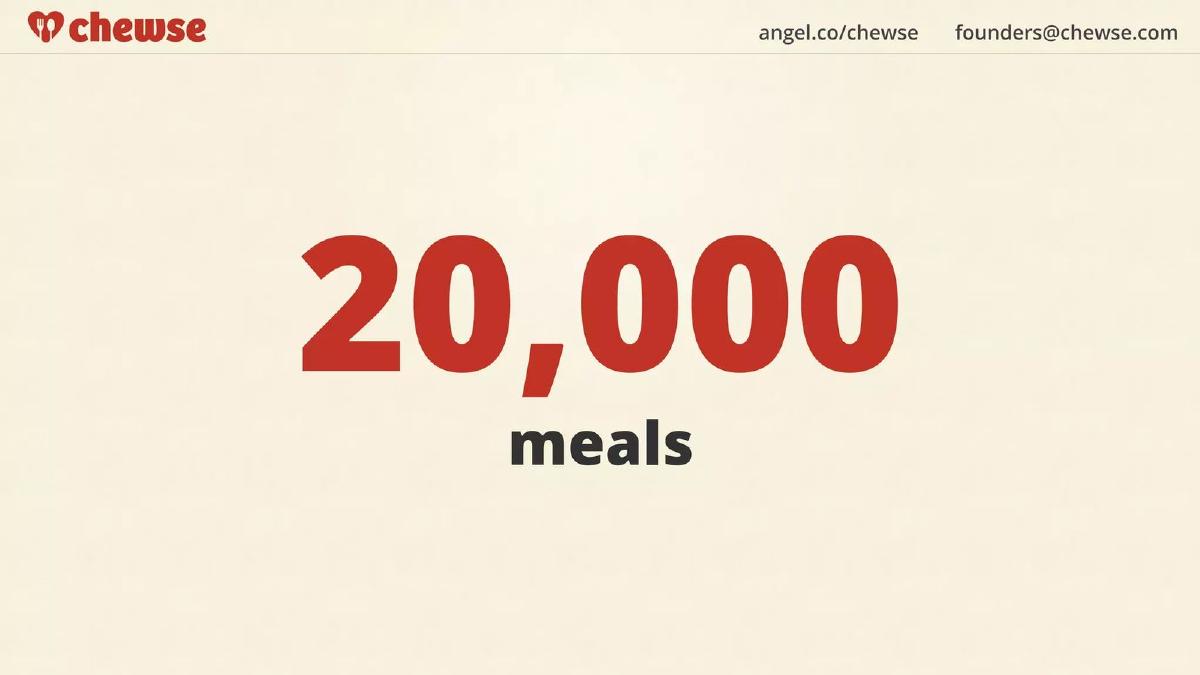
Slide 2: The Traction Anchor Immediately following the title, slide 2 presents a single number: "20,000 meals." There is no context provided on the slide other than the company logo and contact info in the header. This is a bold move designed to stop an investor from skimming. It establishes that this is not a theoretical concept; it is a functioning business with significant volume.
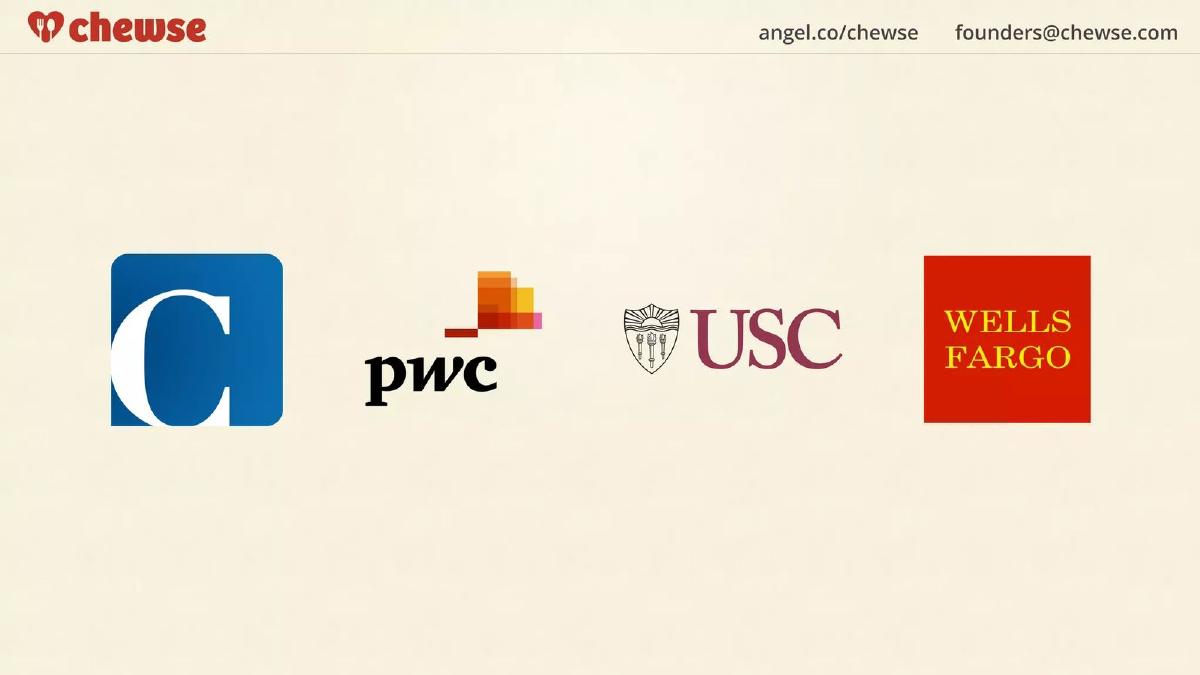
Slide 3: Logo Soup Slide 3 displays four major logos: Citadel, PwC, USC, and Wells Fargo. By placing these immediately after the '20,000 meals' slide, Chewse is telling the investor who those meals were for. This provides instant institutional credibility. If PwC and Wells Fargo trust Chewse with their corporate catering, the service is enterprise-ready.
Slides 4-5: The Unit Economics of Growth
Slide 4: The Starting Point Slide 4 shows the Citadel logo next to the figure "$30,000 a year." This sets a baseline for what a single corporate account is worth at the entry level.
Slide 5: The Upside Slide 5 keeps the Citadel logo but changes the figure to "$500,000 a year." This is one of the most important sequences in the deck. It demonstrates 'Land and Expand.' It shows that once Chewse gets into a large organization, they have the ability to grow that account by more than 16x. For an investor, this suggests that the Cost of Customer Acquisition (CAC) is offset by a massive Lifetime Value (LTV).
Slides 6-7: Product and The Hockey Stick
Slide 6: The Interface This is the only slide that shows the actual product. It features a laptop mockup of the Chewse website. The text highlights three key pillars: "Hundreds of LA Restaurants," "100% On-Time Delivery Guarantee," and "Instant and Secure Online Booking." It also includes a customer testimonial and more logos (Oppenheimer, TEDx). This slide answers the 'how'—it is a tech-enabled marketplace for corporate food.
Slide 7: The Revenue Growth If an investor wasn't convinced by the 20,000 meals, slide 7 provides the growth rate. It is a simple bar chart showing monthly revenue:
The jump from December to January represents a nearly 300% month-over-month increase. This is the 'hockey stick' that seed investors look for. It proves that the company has found a lever to pull for rapid growth.
Slides 8-11: Building the $33B Market Case
Slide 8: The Local Niche Slide 8 shows a red silhouette of a small portion of the Los Angeles skyline with the figure "$265,000." This likely represents their current captured market or a specific sub-segment.
Slide 9: The Local Opportunity Slide 9 expands the red silhouette to the full LA skyline and the figure "$1,400,000,000." This defines the TAM (Total Addressable Market) for just one city.
Slide 10: Multi-City Expansion Slide 10 shows skylines for Los Angeles ($1.4B), New York ($2.3B), San Francisco ($500M), and Chicago ($1.1B). This demonstrates that the business model is geographic-agnostic and can be replicated in any major metro area.
Slide 11: The Global TAM Slide 11 shows a grid of 12 city skylines and a massive "$33B market" headline. By building the market size slide-by-slide, Chewse makes the $33 billion figure feel earned rather than just a number pulled from a generic industry report.
Slide 12: The Ask and The Team
Slide 12: The Closing The final slide states the goal: "seed round $500,000." Below it, a progress bar shows "60% committed." This is a tactical fundraising move to create scarcity. It also lists the name "Tracy Lawrence" and the logos for Twitter, Quora, and Google. Interestingly, the deck does not explain these logos—they are likely the former employers or investors of the team members, serving as a shorthand for 'high-quality talent.'
What Works in This Deck
Extreme Clarity: There is no jargon. There are no complex diagrams of logistics flows. The deck focuses entirely on the outputs of the business: meals served, revenue grown, and market size.
Momentum as a Narrative: The deck is structured to build excitement. It starts with a big number (20k meals), shows how one client can become huge ($500k), shows the revenue exploding (4x in 3 months), and then shows the massive market ($33B). It is a logical progression that leads to the inevitable conclusion that the investor should participate in the round.
Social Proof: By using logos of world-class companies (PwC, Wells Fargo) and high-tier tech companies (Google, Twitter) early and often, the deck overcomes the 'risk' factor associated with a seed-stage startup.
What is Missing
The Team Slide: Most modern decks dedicate at least one full slide to the founders' backgrounds. Chewse relegates this to a few logos on the final slide. While the traction was clearly enough to overcome this, most founders should provide more detail on why they are the right people to build the company.
Competition: There is no mention of other catering services or food delivery platforms. In 2013, the space was becoming crowded, and addressing how Chewse differed from traditional caterers or emerging tech competitors would have been standard.
Unit Economics: While we see the top-line revenue for a client, we don't see the margins. Investors usually want to know the take-rate (the percentage Chewse keeps from each order) and the cost to fulfill those orders.
What a Founder Should Copy
The 'Land and Expand' Visualization: Slides 4 and 5 are brilliant. If your business has a high expansion rate within accounts, show it by highlighting a single recognizable client. It is much more impactful than a bullet point saying "high net retention."
The Bottom-Up Market Build: Don't just put a giant TAM number on a slide. Show how you get there. By starting with one city and expanding to four, then twelve, Chewse made their $33B market claim feel grounded in reality.
Leading with Traction: If you have numbers as strong as a 300% monthly revenue jump, put them at the front. Don't make an investor wait until slide 10 to see that your business is actually working. Traction is the best antidote to investor skepticism.
Conclusion The Chewse deck is a reminder that at the seed stage, investors are buying into two things: a massive market and evidence of execution. By stripping away everything else, Chewse forced the focus onto their impressive early growth and the sheer scale of the corporate catering opportunity. It is a masterclass in 'showing, not telling.'
Frequently asked questions
- Why does the deck lead with '20,000 meals' instead of a problem statement?
- Chewse opted for a 'Traction-First' approach. In a crowded food-tech market, proving that people are already using the service is more valuable than explaining why office catering is difficult. By starting with a large number, they bypass the need to convince investors that a problem exists; the 20,000 meals are the evidence that the problem is being solved.
- How does the deck handle the business model without a pricing slide?
- Instead of a complex table of fees or margins, slides 4 and 5 use a single logo (Citadel) to show account growth. It demonstrates that a single customer can scale from $30k to $500k in annual spend. This implies high retention and significant 'land and expand' potential, which is often more attractive to seed investors than a list of per-meal margins.
- Is the lack of a team slide a mistake?
- In 2024, omitting a team slide is generally considered a mistake. However, in this 2013 deck, the traction was so strong (4x growth in 3 months) that the founders likely felt the numbers spoke for themselves. The final slide mentions Tracy Lawrence and logos for Twitter, Quora, and Google, hinting at a high-pedigree background without a dedicated slide.
- What is the purpose of the city skyline slides (8-11)?
- These slides visualize the Total Addressable Market (TAM). By starting with a small red sliver of Los Angeles and gradually filling in the skyline, they show how they plan to capture a $1.4B local market before expanding to a $33B national market. It makes a massive, abstract number feel grounded in specific, repeatable geography.
- How does the deck create investor FOMO?
- Slide 12 is a classic 'closing' slide. By stating that the round is for $500,000 and that 60% is already committed, the founders tell investors that the 'train is leaving the station.' This forces a quicker decision and suggests that other sophisticated investors have already done the due diligence and said yes.