Chekkit’s bridge deck seeks $1M to expand its 'Consumer Intelligence Ledger,' a blockchain-based solution for tracking consumables and preventing counterfeiting. The company reports having previously raised $600,000 in equity and grants and is currently operating with a team of 21 staff. The deck is notable for its transparency regarding business setbacks, specifically the loss of an $8M deal in Afghanistan due to internal national crisis. Revenue is generated through a multi-tiered SaaS model, ranging from $12,000 to $120,000 annual licenses plus per-unit tracking fees. While the deck provid…
Key takeaways
- The company is seeking a $1M bridge round as stated on the cover slide.
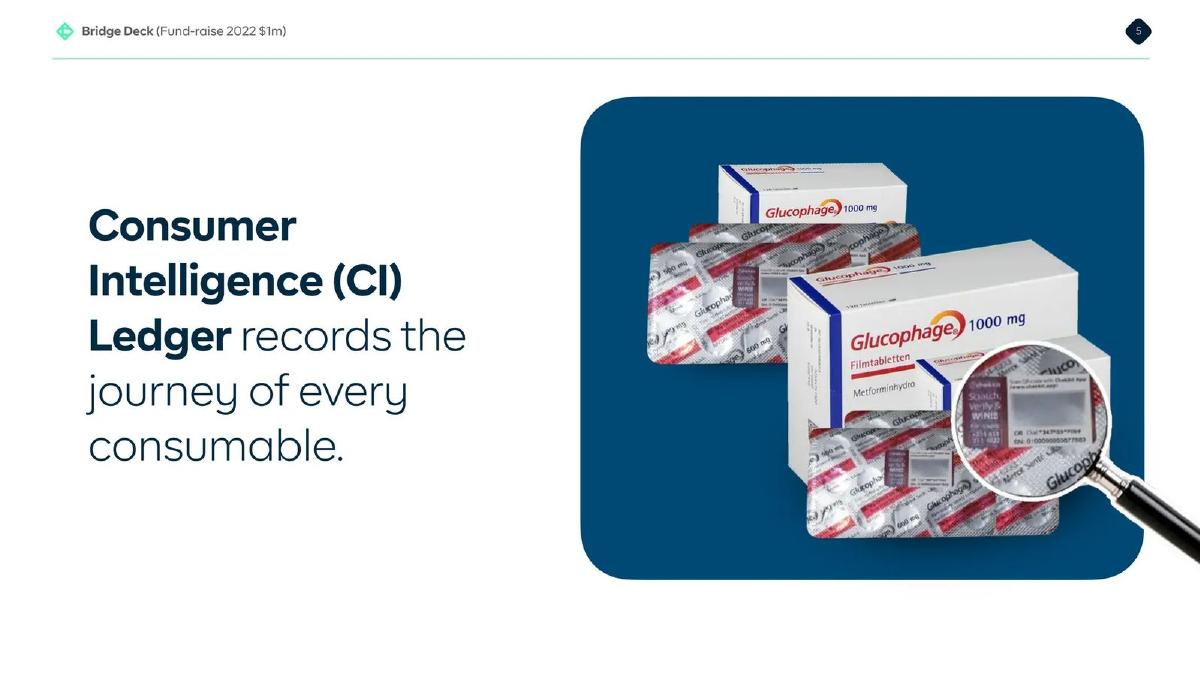
- Chekkit uses a Consumer Intelligence (CI) Ledger to record the journey of every consumable, illustrated with pharmaceutical packaging on slide 5.
- The platform includes a rewards system where 1000 tokens are valued at ₦100, according to slide 13.
- Total capital previously raised amounts to $600,000 in equity and grants, as shown on slide 17.
- Revenue is diversified across three SaaS products with annual licenses starting at $12,000 and reaching $120,000, per slide 21.
- The business faced a significant $8M loss in 2021 due to the collapse of a deal in Afghanistan following a national crisis, detailed on slide 25.
- The team has grown to 21 staff members and has a pipeline of over 15 businesses, according to slide 25.
- Fundraising terms are based on a standard Y Combinator SAFE note, as specified on slide 29.
Chekkit Bridge Deck: A Deep Dive into Supply Chain Verification
Chekkit’s bridge deck is a functional, data-heavy presentation designed to secure $1M in follow-on funding. The deck focuses heavily on the mechanics of their 'Consumer Intelligence Ledger' and the specific unit economics of their SaaS offerings. It is a transitionary deck, moving from the proof-of-concept phase—where they achieved break-even—to a growth phase characterized by intentional short-term losses and international expansion efforts.
Slide 1: Cover and The Ask
The cover slide is direct, featuring the title Bridge Deck and a clear fundraising target of $1M . It includes the company URL, chekikitapp.com, and stylized illustrations of individuals contributing to a 'money jar.' This slide establishes the primary objective of the presentation immediately: securing capital for a bridge round.
Slide 5: The Consumer Intelligence (CI) Ledger
Slide 5 introduces the core technology. The headline states, Consumer Intelligence (CI) Ledger records the journey of every consumable. The visual aid shows pharmaceutical boxes (Glucophage 1000 mg) with a magnifying glass hovering over a 'Scratch, Verify & WIN!!!' label. This slide identifies the pharmaceutical industry as a primary vertical and explains the mechanism of consumer-facing verification as the entry point for data collection.
Slide 9: Insights & Rewards Platform
This slide details the software interface for manufacturers. Titled Chekkit Insights & Rewards , it lists five key capabilities: generating QR codes, generating custom USSD codes, creating reward types, attaching surveys to products, and accessing insights. A laptop mockup shows a dashboard with metrics like '1387' and '2400,' presumably representing user engagements or rewards distributed. This slide positions Chekkit as a marketing and data tool, not just a security solution.
Slide 13: Tokenization and 3rd Party Integration
Slide 13 explains the economic layer of the platform. It defines the token value: 1000 tokens = ₦100 . The slide is divided into three pillars: Chekkit gifts for survey participation, POS Payment API integration for mainstream purchases and P2P transfers (mentioning a 'Tap & Pay' solution used in Lagos public transport), and the ability to convert tokens to instant cash via POS agents across Nigeria. This demonstrates a sophisticated approach to consumer retention in the Nigerian market.
Slide 17: Funding History
A simple, high-impact slide showing $600,000 Raised in equity and grants . This provides social proof and indicates that the company has already undergone due diligence from previous investors and grant-giving bodies. It sets the stage for why a $1M bridge is the logical next step in their capital structure.
Slide 21: Revenue Model and SaaS Tiers
This is one of the most critical slides for an analyst. It breaks down three distinct revenue streams:
Consumer Intelligence SaaS: $12,000 annual license plus $0.01 - $0.05 per tracked product. · Asset tracking SaaS: $24,000 annual license plus $0.30 - $3.00 per tag. · Hashcode (Retail Promotions Insights) SaaS: $40,000 - $120,000 annual license for ranges of 100 - 500 users.
The inclusion of both fixed license fees and variable per-unit fees suggests a scalable model that benefits from increased manufacturer volume.
Slide 25: Status of the Business in 2021
This slide provides a candid look at the company's recent history. It admits to making some losses this year after breaking even in the last , attributing this to a focus on growth. Most notably, it discloses the loss of an $8m deal in Afghanistan due to the country's internal crisis. The deal would have involved 200 million scratch-off labels. The slide also notes a pivot to Pakistan, a partnership with Fantom (blockchain), a team size of 21 staff , and a pipeline of 15+ businesses with 3 expected to close by Q1 2022.
Slide 29: Terms & Conditions
The final slide in the provided set outlines the investment vehicle. It specifies a SAFE note (Ycombinator standard) and provides a link for the draft. By using a standardized document, the company signals a desire for a streamlined closing process and alignment with international venture capital norms.
What Works and What Is Missing
What Works: The deck is exceptionally transparent about its failures. Disclosing the loss of an $8M deal due to geopolitical instability is a bold move that builds trust with sophisticated investors. The pricing slide (Slide 21) is also a highlight, providing exact figures that allow an analyst to model potential revenue based on market share. The integration of USSD codes and POS agents shows a deep understanding of the local Nigerian infrastructure where smartphone penetration may not be universal.
What Is Missing: The provided slides do not include a dedicated Team slide, which is a significant omission for a $1M raise. While Slide 25 mentions '21 staff strength,' it does not highlight the founders' backgrounds or technical expertise. There is also no explicit Competitor slide in this selection, leaving investors to wonder how Chekkit differentiates itself from global giants like Sproxil or local incumbents. Finally, while the 'journey of every consumable' is mentioned, the technical architecture of the blockchain ledger (beyond a brief mention of Fantom on slide 25) is not detailed.
Founder's Guide: What to Copy
Founders should emulate the granular pricing breakdown found on Slide 21. Many decks remain vague about 'custom pricing,' but Chekkit provides clear brackets that demonstrate they know their worth and their costs. Additionally, the Status of the Business slide (Slide 25) is a masterclass in framing bad news; it acknowledges the loss of a major deal but immediately pivots to how that experience is being applied to a new, similar market (Pakistan), thereby turning a failure into a narrative of resilience and market-readiness.
Frequently asked questions
- What is the primary problem Chekkit is solving?
- Chekkit addresses supply chain transparency and anti-counterfeiting, primarily in the pharmaceutical sector. By using a 'Consumer Intelligence Ledger' and scratch-off labels, they allow consumers to verify product authenticity while providing manufacturers with data on the product's journey and consumer behavior.
- How does Chekkit generate revenue?
- The company employs a tiered SaaS model. This includes a Consumer Intelligence SaaS ($12k/year + $0.01-$0.05 per product), an Asset Tracking SaaS ($24k/year + $0.30-$3.00 per tag), and a Hashcode Retail Promotions SaaS ($40k-$120k/year for 100-500 users).
- What happened to the $8M deal mentioned in the deck?
- Slide 25 explains that an $8M deal to supply 200 million scratch-off labels for a nationwide pharmaceutical distribution pilot in Afghanistan was lost. This was attributed to the internal crisis within that country, leading the company to pivot its focus toward similar opportunities in Pakistan.
- What is the role of tokens in the Chekkit ecosystem?
- Tokens are used to incentivize consumer participation in surveys and loyalty programs. 1000 tokens are valued at ₦100. These can be used for P2P transfers, store purchases via POS integrations, or converted to instant cash through bank transfers or POS agents in Nigeria.
- What are the investment terms for this bridge round?
- Chekkit is raising $1M using a standard Y Combinator SAFE (Simple Agreement for Future Equity) note. This is a common instrument for early-stage startups to defer valuation until a subsequent priced round while providing investors with future equity rights.