Check-Eat is a Mexican hospitality technology startup that aims to consolidate the fragmented restaurant app market into a single platform for ordering, payment, and loyalty. The deck highlights a dual-brand strategy with 'Check-Eat' and 'Taim,' covering dine-in, takeaway, and delivery. While the presentation excels at demonstrating local traction—citing participation in Shark Tank Mexico, the FbStart program, and a $25,000 crowdfunding round—it lacks specific financial projections and a defined capital ask. The competitive analysis is robust, positioning the company against global giants lik…
Key takeaways
- The platform aims to eliminate the need for consumers to download individual apps for every restaurant (Slide 4).
- Check-Eat positions itself as a cost-saving alternative for businesses, removing the need for custom app development and high third-party fees (Slide 4).
- Market data indicates 80% of restaurant owners are willing to implement technology, yet cost remains the primary barrier for 63% of them (Slide 5).
- The company claims a competitive advantage over UberEats and OpenTable by offering tax invoicing and virtual waiter features (Slide 6).
- Traction is anchored by a $25,000 crowdfunding round in 2016 and a subsequent Angel investment in 2018 (Slide 7).
- The startup was recognized as one of the top-50 most promising startups to invest in Mexico (Slide 7).
- The product roadmap indicates an MVP launch in 2017 with a full version scheduled for November 2018 (Slide 7).
- The expansion strategy targets the entire American continent, moving from Mexico into North and South America (Slide 8).
Executive Summary: The Unified Restaurant Interface
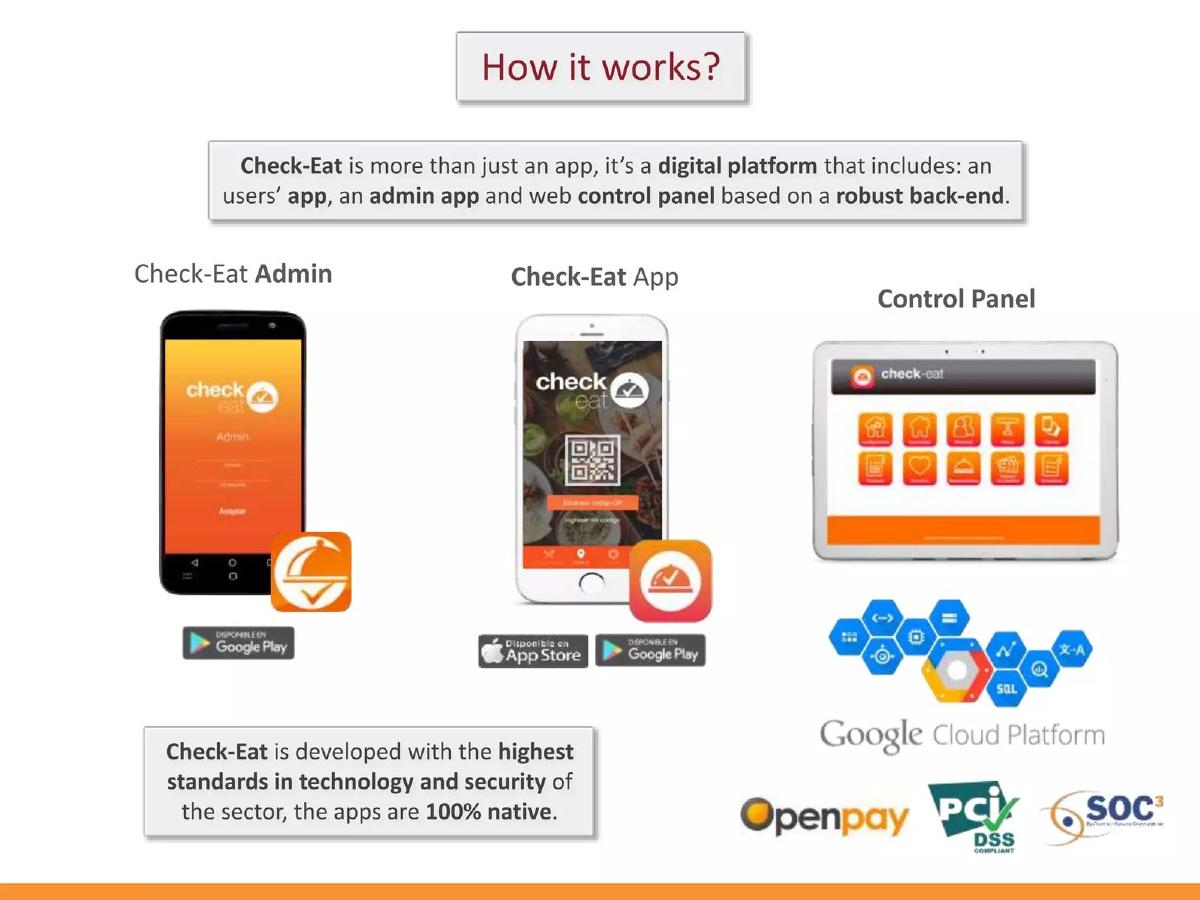
Check-Eat presents a vision for a consolidated restaurant ecosystem. The deck, published around 2018, seeks to capitalize on the digital transformation of the Mexican hospitality sector. By positioning itself as a 'super-app' for dining, the company attempts to solve the friction points of both the merchant and the diner. The following teardown analyzes the 9 slides provided from the original 18-slide deck.
Slide 1: Title and Branding
The cover slide introduces two distinct logos: Check-Eat and Taim by Check-Eat . The tagline 'Dining made easy' is paired with a high-quality lifestyle image of a smartphone next to a cup of coffee. This immediately establishes the company as a mobile-first, consumer-facing technology brand. The presence of two logos suggests a multi-product strategy, though the distinction between them is not immediately explained.
Slide 2: The Value Proposition
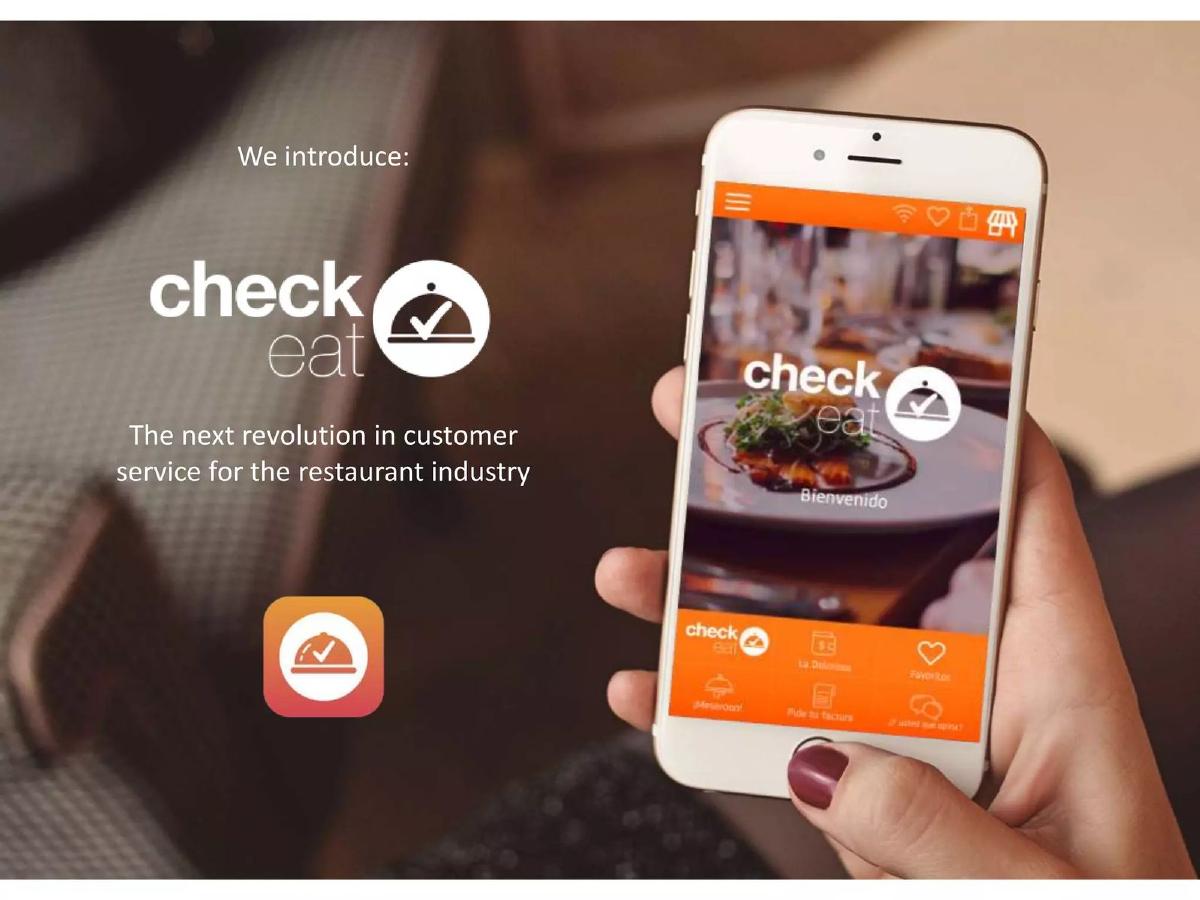
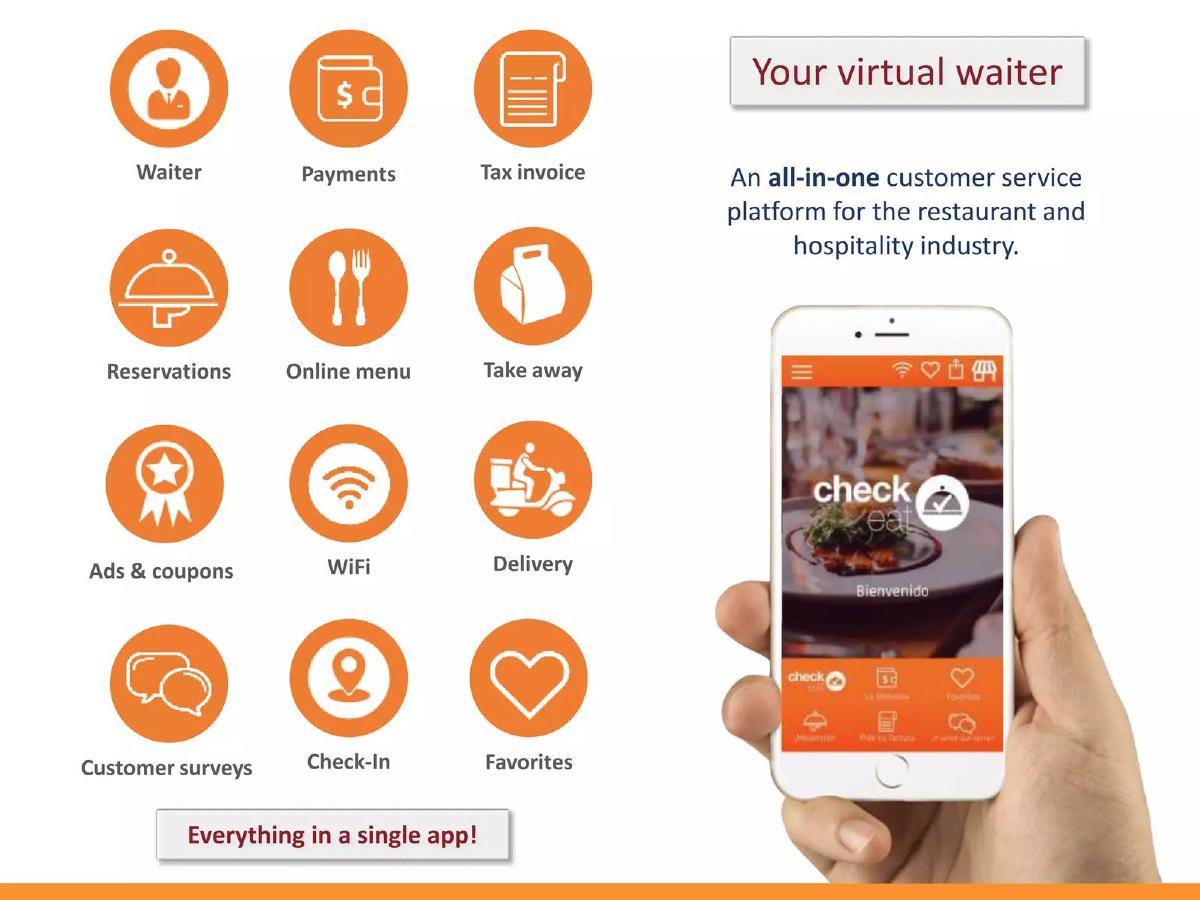
Slide 2 reinforces the brand identity, describing the product as 'The next revolution in customer service for the restaurant industry.' The visual focus remains on the mobile interface, showing a 'Bienvenido' (Welcome) screen. This slide functions as a transition, moving from the brand name to the specific industry vertical: restaurant customer service.
Slide 3: How It Works - Dine-in vs. Take-away
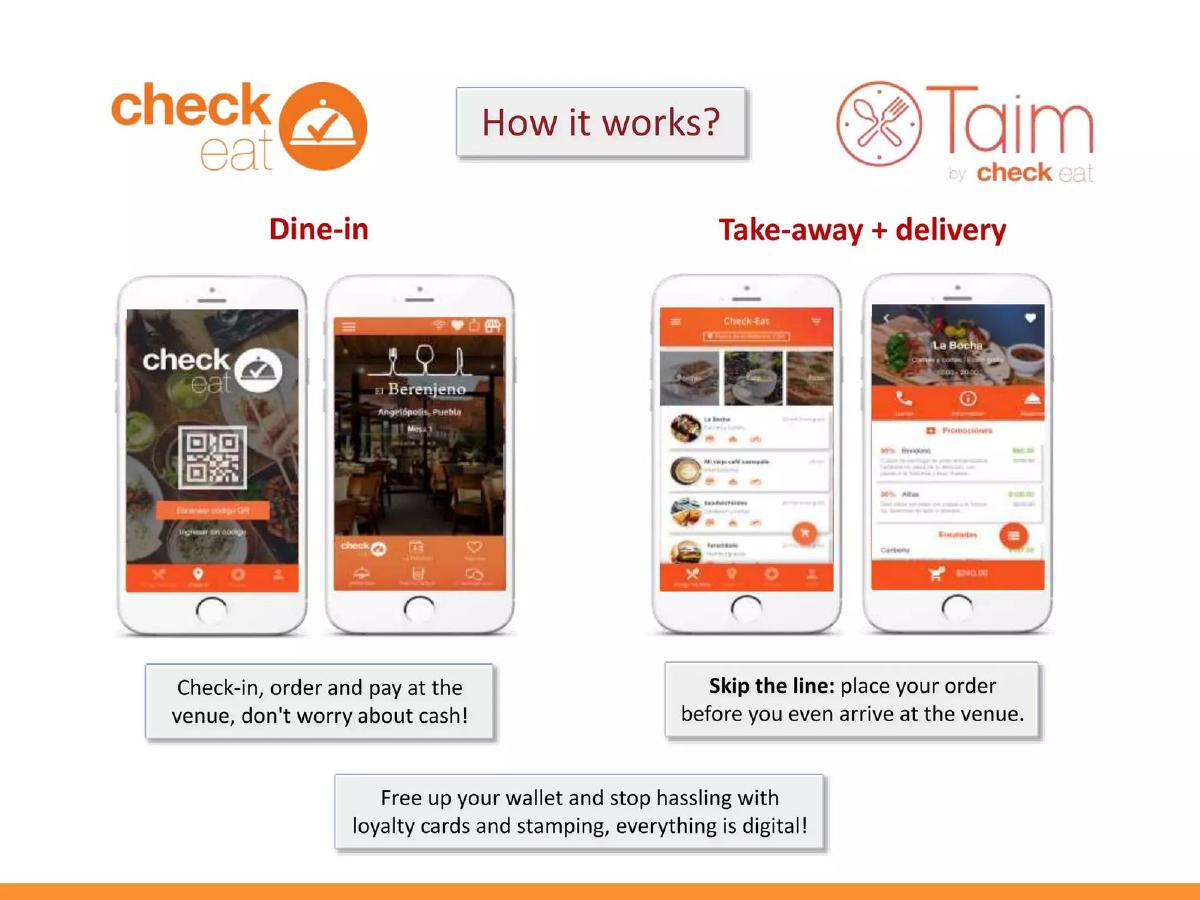
This slide provides the first look at the product's functional split. It divides the service into two categories: Dine-in and Take-away + delivery . For dine-in, the app uses QR codes for check-in, ordering, and payments, emphasizing a 'cashless' experience. For take-away, the 'Taim' brand is highlighted with a 'Skip the line' value proposition. A footer note mentions that the app also digitizes loyalty cards and stamping, removing physical clutter from the user's wallet.
Slide 4: Standardizing the Ecosystem
Slide 4 addresses the B2B and B2C benefits of standardization. For Users , the benefit is not having to download a different app for every restaurant. For Businesses , the deck claims they 'do not need to invest' in their own applications or pay 'expensive fees' to third-party services. This slide identifies the 'middleman' problem in the food-tech space, positioning Check-Eat as the efficient aggregator that reduces overhead for all parties.
Slide 5: The Market Opportunity
Check-Eat uses data from the National Restaurant Association to validate the market. It claims 80% of restaurant owners want to implement technology, yet 63% cite 'Cost' as the top concern. Other barriers listed include 'Poor Existing Processes' (50%), 'Maintenance' (49%), and 'Fees' (49%). By highlighting these specific pain points, Check-Eat sets the stage for its solution to be viewed as a cost-effective alternative to the status quo of pagers and expensive tablets.
Slide 6: Competitive Landscape
The competitive matrix is one of the most detailed slides in the deck. It compares Check-Eat against Open Table, UberEats/SinDelantal, PUSH!/Cuponerapp, Yelp/Foursquare, Pigui Wallet, and Velleux . Check-Eat claims to be the only provider offering a full suite of 12 features, including tax invoicing, virtual waiters, and WiFi connection. Notably, it positions itself as more comprehensive than UberEats by including dine-in features like reservations and online menus that are integrated with the in-restaurant experience.
Slide 7: Traction and Social Proof
This slide is dense with 'trust signals.' It mentions being selected by SUM (Startup México) and FbStart from Facebook . It highlights a $25,000 crowdfunding round from 2016 and an Angel investment in 2018. The slide also features their appearance on Shark Tank Mexico and a ranking as one of the 'top-50 most promising startups to invest in Mexico.' The mention of 4,864 Google Play reviews with a 4.8-star rating provides quantitative evidence of user satisfaction. Finally, it sets a timeline: MVP launched in 2017, with a full version due in November 2018.
Slide 8: The Ask and Expansion Strategy
Slide 8 outlines the geographic ambition. Using a map of the Americas, it shows arrows pointing from Mexico toward North and South America. The text states, 'We want to take Check-Eat to the next level!' Underneath, it lists the requirements: Investors and Strategic partners . However, the slide fails to mention a specific funding amount, valuation, or use of proceeds, which is a significant omission for a pitch deck.
Slide 9: Closing and Vision
The final slide reiterates the profitability of the restaurant tech industry. It uses the phrase 'The time to be a reference is now!' and ends with a 'Join us!' call to action. It features lifestyle imagery of young professionals using the app in a social setting, reinforcing the consumer-facing side of the brand alongside the Taim logo.
What Works in This Deck
Strong Social Proof: The inclusion of Shark Tank Mexico, Facebook's incubator, and specific review counts (4,864) builds immediate credibility. · Clear Feature Differentiation: The competitive matrix clearly shows where the company believes it wins, particularly in the 'all-in-one' nature of the platform compared to niche players. · Dual-Market Focus: By addressing both dine-in and delivery, the deck shows an understanding of the total restaurant revenue stream, not just one segment.
What Is Missing
The Team: There is no slide introducing the founders or key leadership. Investors invest in people, and the absence of a team slide is a major red flag. · Financials and Unit Economics: The deck mentions 'expensive fees' of competitors but does not disclose Check-Eat's own take rate, CAC, or LTV. There are no revenue projections. · A Specific Ask: 'Seeking investors' is too vague. A professional deck should specify the amount being raised and what milestones that capital will achieve. · Business Model Details: While it mentions avoiding 'expensive fees,' it doesn't explicitly state how Check-Eat makes money (SaaS fees, transaction commissions, or advertising).
Founder's Lessons
Leverage Local Wins: Check-Eat does an excellent job of taking local Mexican success (Shark Tank, SUM) and presenting it as a foundation for international expansion. Founders should always highlight regional accolades to prove they can win their home market before asking for expansion capital.
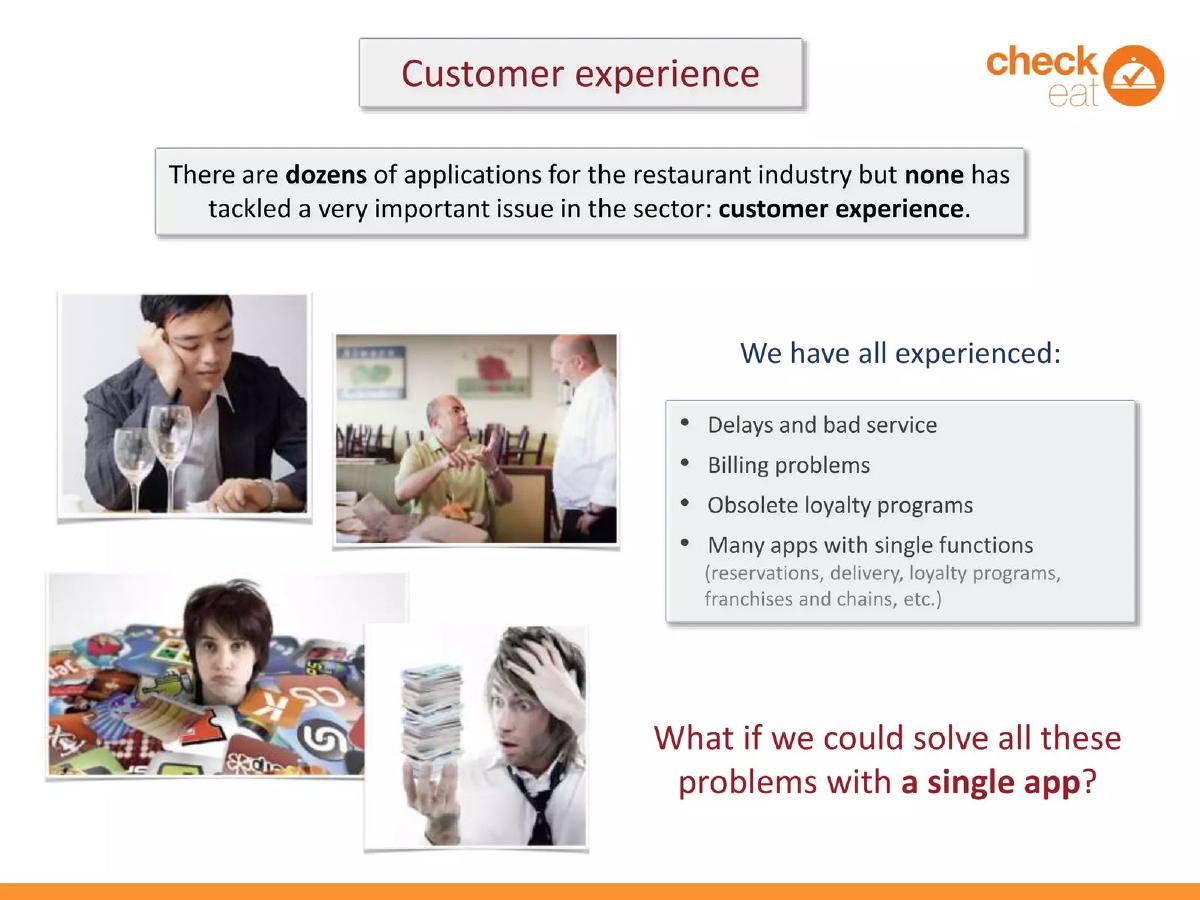
Address the 'App Fatigue' Head-on: The argument on Slide 4—that users don't want 50 different restaurant apps—is a powerful psychological hook. If your startup is an aggregator, make the 'consolidation' benefit central to your pitch.
Don't Hide the Ask: While this deck is great for a general presentation, it fails as a fundraising tool without a specific dollar amount. Founders should always include a 'Use of Funds' slide that breaks down how new capital will be allocated (e.g., 40% Engineering, 30% Marketing, 30% Operations).
Frequently asked questions
- What is the primary problem Check-Eat is trying to solve?
- Check-Eat addresses the fragmentation and high cost of restaurant technology. For consumers, it solves 'app fatigue' by providing one platform for all restaurants. For businesses, it eliminates the high capital expenditure required to build proprietary apps and the high commission fees charged by existing third-party delivery and reservation services.
- How does Check-Eat differentiate itself from UberEats or OpenTable?
- According to their competitive matrix on slide 6, Check-Eat offers a more comprehensive suite of tools. Unlike its competitors, it includes tax invoicing, customer surveys, loyalty programs, and 'virtual waiter' functionality all in one interface, whereas competitors like UberEats focus primarily on delivery and payments.
- What evidence of market validation does the deck provide?
- The deck provides significant social proof and early-stage funding data. It cites selection by Startup México (SUM), participation in Facebook's FbStart program, an appearance on Shark Tank Mexico, and a 4.8-star rating from 4,864 Google Play reviews. It also notes a $25k crowdfunding round and an angel round.
- What are the biggest omissions in the Check-Eat pitch deck?
- The deck is missing three critical components: a team slide, unit economics, and a specific financial ask. There is no information on the founders' backgrounds, the cost to acquire a customer (CAC), the lifetime value (LTV), or exactly how much capital they are looking to raise in the current round.
- What is the significance of the 'Taim' brand mentioned in the deck?
- Taim appears to be a sub-brand or a specific product line within the Check-Eat ecosystem. While Check-Eat is the primary platform, Taim is specifically associated with the 'Take-away + delivery' and 'Skip the line' features, suggesting a consumer-facing brand focused on speed and convenience.